


I’ve turned into a right softie in the last three months since my daughter was born. If you ask my mother, I’ve been a right softie for 40 years but she isn’t reading this right now so I can say what I like.
On Saturday evening around twenty-five minutes past seven, I was jumping around my living room with my girlfriend silently shouting COME ON MUNSTER into my fists because we’d just put the baby to sleep. Five minutes later, I stood before the TV choking back tears when Craig Casey booted the ball into the stands.
Why was I so emotional? Why did I need the entirety of Sunday to recover?
Because when Munster have played Leinster in high-stakes rugby games – never mind just in general – we have lost. Every. Single. Time. Without fail. In the six PRO14/URC seasons since we lost the 2016/17 final against the Scarlets, our campaigns have ended in Dublin at the hands of the guys in blue jerseys four separate times, on top of regular home and away league defeats.
To win this semi-final in the manner that we did is the kind of catharsis that this club has spent years chasing. The last time we beat Leinster in a quarter-final or semi-final was 2006. Seventeen years later, we finally managed it. Since 2011, when we beat a freshly crowned European Champion Leinster side to win our last trophy of significance in an emotionally charged Thomond Park, Munster have taken part in three league finals and lost all of them, each for different reasons and with largely different teams. Peter O’Mahony and Keith Earls have been constants in all of them and, when it comes to the last few seasons in O’Mahony’s case, the man who is often the man in the unenviable position of chatting shit to the media after the game.
Leo Cullen got a flavour of it this weekend when he was reduced to talking about “lads taking learnings” as we so often have in the past. The only true learning to be taken from losing a semi-final or final like this is that it is infinitely better to win them instead.
I feel a fair bit of joy for O’Mahony that, for once, he didn’t have to find a way not to say “yeah, look, we lost and it fucking hurts“. That’s the thing with sport. So often it bounces its fans between two states – inexplicable hurt and indescribable joy. Of those two states, inexplicable hurt is by far the most readily available but you endure that hurt, year after year if needs be, to get those true moments of joy. Joy makes the whole thing worth doing.
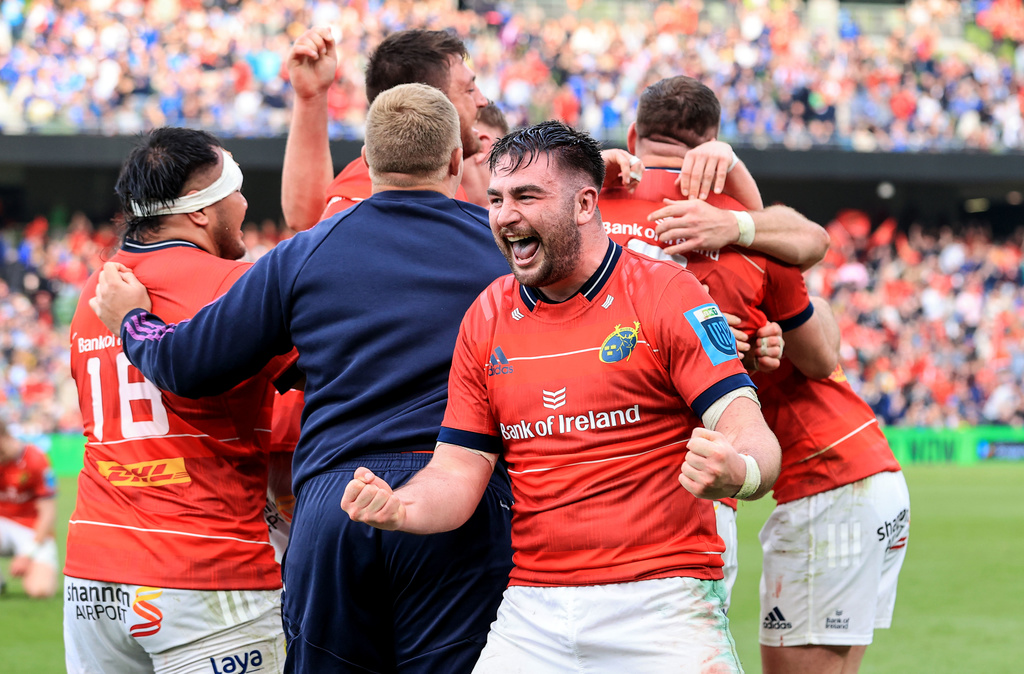
On Saturday evening, I felt that sporting joy coursing through me as I flung myself silently around the living room. The next morning, I would sit down with my daughter at 5:30 in the morning and rewatch the whole game, just to relieve those moments of joy again with her sitting on my lap.
I want to think she felt the same joy welling up in my throat that I did when Jack Crowley landed The Drop Goal but she didn’t appear to. Not yet, anyway, but there’s plenty of time for that. She’ll see it enough times.
While I write all of this I’m aware that we have another game to play – a URC final against the Stormers in Cape Town, where it’ll be played on a literal sandpit spray-painted green for appearance’s sake. We won the last time down there but this will be a different story. There’ll be time enough for that, though.
For now, we can (and should) enjoy this win for what it is; the most significant win by a non-Leinster Irish province since Leinster ascended to their current status in 2017/18.
This win, and Crowley’s drop goal, are already iconic moments in the history of this club but both the win and the drop goal can become legendary if we can go and win the thing.
The players and staff’s focus is on that game with an unwavering gaze. But make no mistake – they were celebrating too and will do until it’s time to focus on the next job. I’ve seen some people in my mentions talk about how “irresponsible” it is for Munster fans to enjoy a win over our geographic rivals who’ve slapped us up almost relentlessly since 2014 because there’s still a final to come.
This kind of dour pastiche of Roy Keane is the sole preserve of bores, chodes and spoofers. That schtick works for Roy Keane because… he’s Roy Keane. I can’t handle Derek from accounts who hasn’t touched grass post-pandemic talking about what a cereal winnah does or doesn’t do because these people wouldn’t win a week in jail.
Don’t let them police you. Enjoy the feeling of Saturday for what it is – the entire point of throwing a ball around a field for people to watch. The final will look after itself. Soon I’ll be prepping my video work on the Stormers and building to that game and all that comes with it.
No one expected us to be here. I didn’t expect us to be here, at least not back in January or even March. We’re in beyond bonus territory here with the Leinster monkey off our back. That doesn’t mean we quit, though. That doesn’t mean we have to stop here.
On Saturday evening, the Stormers players and coaches were celebrating that they didn’t have to play Leinster. Joseph Dweba screamed, “we’re going to fuck them up”. The man has a short memory, but OK. When we played them with our teeth chattering over European qualification, we won. That was less than a month ago.
We will need to remind them who the Bad Guys are, just as we’ve reminded the rest of Europe in the last 25 days.
***
The scoreboard flattered Leinster to the tune of around 15/20 points in my opinion.
That might seem like potholing but watch the game back and tell me that we didn’t have the better opportunities, played the better rugby overall and had higher quality 22 entries. You can’t. This was Munster’s answer to Leinster’s counter-transition rugby and, with a bit more accuracy and a little lower quality defending, we’d have scored the points that would have rightfully mirrored our dominance of this contest.
Look at Mike Haley’s on-ball numbers for this game and you’ll get a flavour of what we were doing;
Munster knew that Leinster would kick the ball to us as a starter play for most of their non-set piece action so we knew that when they did that, we would have to resist both their transition defence – which they use to force errors and penalty concessions – and refuse to kick on any terms but our own.
Mike Haley is down for 20 carries in this game for a reason – he was the man guarding the space in the backfield that Leinster almost always kick to and his job was simple – run it back down their throats, get us a solid ruck point to work with and then we’ll do the rest.
If that sounds familiar, it was the exact framework used by La Rochelle in last season’s European Champions Cup final.
Off the resulting lineouts – which Leinster often contested in the air vigorously – La Rochelle did a really good job of securing possession first & foremost but then did a better job of hanging onto the ball and then rolling across the face of the defence. They scored their first try off the back of that very sequence.
At numerous points in those sequences, La Rochelle passed up obvious “smart kick” opportunities to keep the phase pressure up on Leinster. When Leinster kicked long to La Rochelle, the likes of Dulin and West either exited directly to touch – where La Rochelle focused on stuffing Leinster’s strike plays rather than attacking them in the air – or they ran back Leinster’s reset kicks with a heavy, low-risk game that maximised heavy contact. La Rochelle’s Pass Per Carry ratio was 1.04 on 61% possession. What La Rochelle did was reduce the effective ball in play time by controlling the sequence of the game and making sure they used a low PPC game prioritised forward on forward carrying.
La Rochelle made Leinster’s possession incredibly expensive by reducing the ball in play time and then reducing Leinster’s share of that possession. Leinster had a PPC ratio of 1.7, which put a big focus on pass accuracy and, even with good ruck ball, that exposed elements of inefficiency in Leinster’s attack. The same thing was visible in Leinster’s win over Leicester. Leicester had 56% possession and kept the Ball In Play time down to just 27 minutes. Leinster flew out of the blocks in that game but lost the second half 14-3.
Munster don’t have the size that La Rochelle does, however, so we couldn’t play a low-risk rolling off #9 game because Leinster would lap that up eventually. We’ve essentially done that before in Thomond Park where we trucked off #9 for what seemed like the entire game before going onto lose.
What we actually did in this game was far more interesting.
Essentially, we said to Leinster that they can kick to us all they want – we will keep the ball in play as long as you do. It was going to redline our fitness but we bet that it would do the same to them. As a result, we had 44 minutes of ball in play time – another colossal number after last week’s marathon in Glasgow – but we pulled Leinster’s usage of that BIPT right down.
In doing so, we stressed Leinster’s efficiency. Just how efficient could they be with a reduced amount of possession? How well could they navigate around our defensive press?
Leamy’s read of Leinster’s offensive structures was one of the best I’ve seen so far this season. A lot has been made of Leinster’s variety off their pods this season but their primary action is either a direct carry off the middle runner, a tip-on pass to the outside runner for the middle runner to clean the ruck on or a pass into the screen from the same player.
Leinster uses this to bounce around the outside of press defences who over-focus on double stops on the likes of Ryan, Porter, Furlong or Doris by leaving a lane for the screen runner to pass into or surge into, with the scrumhalf supporting inside and the likes of Henshaw/Ringrose/Keenan surging on the outside.
All of these offensive actions take up the same space – the gap between the middle runner and the outside runner.
You’ve seen them make that linebreak a hundred times this season alone. What Munster did was pretty simple; cut off the lane outside the middle runner.

In this instance, Coombes ensures that Kelleher has to make contact with Kleyn while also slowing the recycle to McGrath. Leinster’s variety off this pod evaporated because Coombes took the space where the variety happens.
When Leinster played flat to the line on a hit sequence – usually with Ngatai or Henshaw riding in the screen – we were able to shut it down more effectively but when they put Byrne in the screen, we had to adapt just as Leinster’s spacing does. Leinster’s system isn’t perfect when it comes to their offensive capacity. When they are running into the wider channels, they will often flatten out their attack to increase the linebreak opportunities for Henshaw/Ringrose/Keenan but when they want to run schemes on wider rucks, they will step back from the gainline to create a “pocket” for Ross Byrne, Johnny Sexton or Harry Byrne, in this instance, to use. Leinster’s #10s are all quite similar in that they aren’t typically required to move too much from the receiver position, even if they use guys like Lowe to step in there every now and then after a play where the #10 is involved.
They have experimented with a dual-playmaker system this season but with two centrally contracted midfielders of the build of Ringrose and Henshaw, there is limited scope for what they can actually do there on a consistent basis.
You’ve seen this play a hundred times from Leinster and Ireland too, right? Leinster screen to Byrne, he pops into Kelleher with Milne on the cleanout and McGrath scooting into gaps.
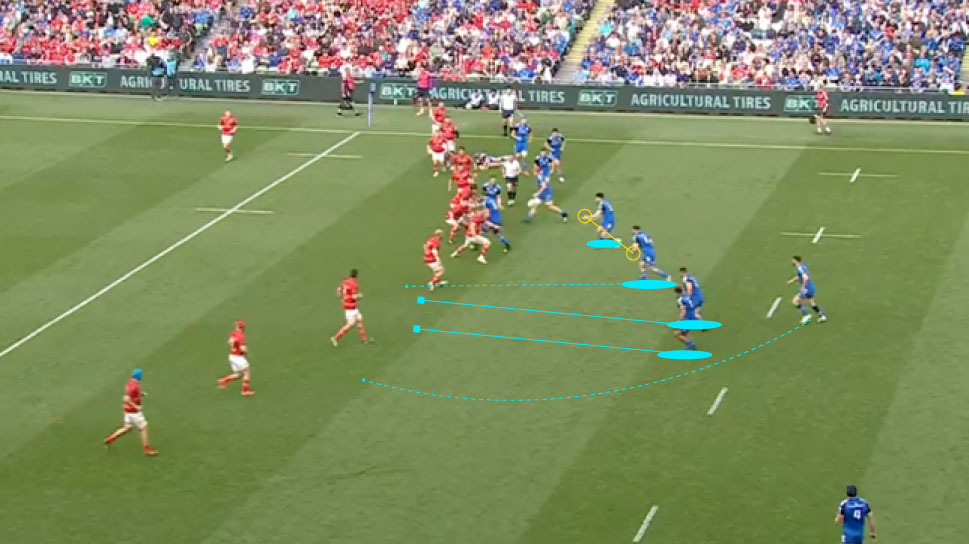
Or you’ve got Henshaw to release with one or both of the O’Brien’s shooting on the inside.
How do you pressure this?
Cut off the one option that opens up all of it – shooting into the space Harry Byrne will try to use to open up all of it and taking him man and ball.

Munster don’t have to commit any numbers to slowing Leinster at the breakdown with a poach because Coombes’ tackle is enough of a slowdown, given how Leinster’s cleanout crew have to readjust. We didn’t give them any clean opportunities to use the core starting mechanic of most of their best plays.
All of that means that Leinster have a slow recycle and are reduced to pinning Coombes on the ground to try and find space somewhere to exploit, which on this phase is back to the blindside.
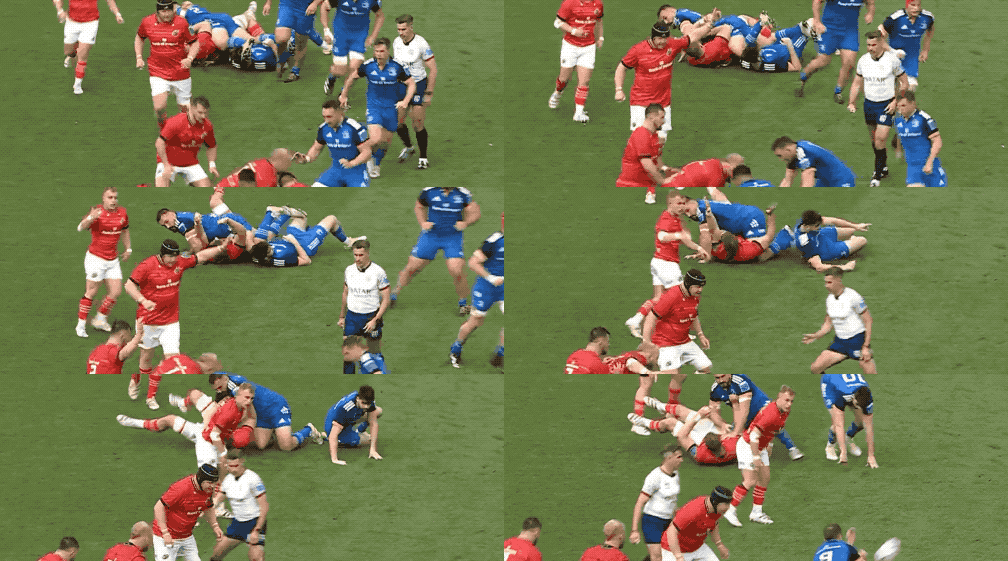
When we snuff that out with a scramble, Leinster come back to a few familiar schemes that we’ll have videoed to death all week.
A poor pass from McGrath – a constant issue for him is his pass consistency – means Jenkins can’t approach this collision with a dominant shape. Leinster recycle but it’s the old Van Der Flier inside line snipe which would have been the first thing we’d have looked at for our second-half prep on Friday.

Watch how Hodnett slows the ball down in the tackle as opposed to making a vulnerable target at the ruck – this slows Leinster again and pressurises their attacking layers. They are already into “inefficient” use of the ball here by their own standards.
They go again to their pod structure; this time with a tip on pass from the middle runner but Coombes just switches from one target to the other and, with Kleyn again, absolutely stuffs the contact.

Leinster run a hurried pinch line with Baird taking an inside loop line from the previous ruck to make a wide pod of two with Jenkins but the pass isn’t what it needs to be and Munster can clear.
In the wider channels, we used the same principle to cut off their usual play options. Watch Earls step up to be level with the ball handler – to act as a pass obstacle for the float to the touchline – but to also give him a driving angle on any pass that happens inside him.

We have so many active defenders in this sequence that Leinster have to over-commit on the ruck to keep Hodnett and O’Mahony from winning a turnover.
Earls does the same a few minutes later; step up level with the handler, reads the options inside, and smashes whoever gets the ball.

He “misses” the tackle technically but he prevents the ball from getting to Kearney – even with Haley covering that option – and forces O’Brien back into Hodnett and Beirne, two huge jackal threats that Leinster have to cluster around. That’s a big defensive win.
That kind of defensive pressure allowed us to force Leinster into an unusual amount of inefficiency by their standards.
That brought a lot of kicking out of Leinster as they tried to gas us out on transition defence – only issue was that we were putting together excellent transition and post-transition phases that started to bring errors out in Leinster’s defence.
Healy ran this back off a long Leinster exit, Coombes nailed down the first transition ruck and from there, we hit Leinster off the pod. Conan doesn’t seem to back Jenkins to stop this and leaves McGrath to cover the inside runner, and he duly gets run over. That’s the kind of contact I don’t want my #9 making.

From there we generate quick ruck ball, run a split screen – look at the 3-2-X shape on transition – and use Shane Daly as a loop runner to open up a tonne of options for Frisch, who hits Hodnett with the perfect pass, at pace and right in his gait so he can push right into the Leinster 22.
We should have scored from this sequence!
The last pass from Haley to Crowley was just a little too shallow. If this is the right depth? Earls or Frisch score in the corner.

We consistently punished Leinster on kick transition, which was especially impressive given that Van Der Flier and Henshaw – two of their three best transition defenders – were on the field for most of them.
The build-up to our crucial try from Tadhg Beirne came from just such a transition. Leinster exited deep to Mike Haley, who kept the ball infield. He earned us a wide ruck position with another excellent runback and, after we retained possession in the face of some big Leinster counter-rucking, we were able to hit them with a brilliant screen pass loop combination with the excellent Rory Scannell linking up twice with Shane Daly.

That is a perfect use of a transition structure to generate a 22-entry. When we got constricted on the first two rucks, we got length by stacking our screen pod off #10, rather than off #9 with Daly acting as the key component in generating the linebreak.
That brings us to… the Drop Goal.
How was it generated? Well, through zero fear rugby under our posts. Daly’s switch step, Hodnett’s step to take out Conan, his handling, Scannell’s step inside, the offload and the second Hodnett touch – this is balls to the wall zero fear rugby when the stakes are as high as they can be.

This is outstanding rugby. Casey would boot the ball downfield into an empty backfield, McCarthy would do what Leinster always do in these circumstances – return the kick. Crowley took it in the backfield, promptly ran the fuck over Harry Byrne like he was prime CJ Stander and from there, our transition phases kicked into gear again.

That pullback pass from O’Donoghue is perfect. Exactly what it needed to be. Scannell runs a great option/blocker line – completely legally, for me, as he’s always a legit pass option. When the ball gets to the edge, we cut back inside and start to run the unstructured offloading that we’ve been building all season. We use this skillset on the edge more often than anywhere else because that’s where the chaos is most likely to be. It buys us time to restructure and it pulls defenders into the space where we want them.
When we get our structure in place, we pull the trigger with Scannell stepping in at first receiver and picking the perfect option to bring Kendellen into the play on a dangerous line.

Does Wycherley fly off his feet? Yes. But that is what you need to do against Leinster if the referee has allowed a free for all. All too often we’ve been too shy to pull these entries but not here – zero fear. Crowley runs into space, hits Hodnett on the edge and we have another 22 entry in the exact range we’d need to pull off the dagger of all daggers right at the death.

It’s not quite Sexton screaming in O’Gara’s face, but it sends a message. You know who this is, we know who this is. And we know what it means.
You won’t beat this Leinster team – as well coached and as well drilled as they are from the top of the depth chart all the way through onto the academy – without understanding how they beat you. In this game, we produced our best breakdown performance of the season but lacked the finishing touch when we got to close range, especially in the first half to the point we underscored our ORW output quarter by quarter by nearly 20 points.
That tells me that this side has another few levels in them, which is incredibly exciting with the final around the corner. In the last month, Munster have crossed the equator twice, taken the Stormers’ home record, avenged ourselves against the Sharks in Durban, broke Glasgow’s long streak of home wins and then beat Leinster at the Aviva for the first time since they lost to Saracens there in 2020.
All in successive games. As schedules go, I’ve never seen anything like it.
The Kings of the Hard Way have returned to take their crown and what better way to top it off than by crossing the equator once more to bring back the first trophy in 12 years?
They can do it.
Because that is what Bad Guys do.
| Names | Rating |
|---|---|
| Jeremy Loughman | ★★★★ |
| Diarmuid Barron | ★★★★ |
| Stephen Archer | ★★★★ |
| Jean Kleyn | ★★★★★ |
| Tadhg Beirne | ★★★★★ |
| Peter O'Mahony | ★★★★ |
| John Hodnett | ★★★★★ |
| Gavin Coombes | ★★★★★ |
| Craig Casey | ★★★★★ |
| Ben Healy | ★★★ |
| Shane Daly | ★★★★★ |
| Jack Crowley | ★★★★★ |
| Antoine Frisch | ★★★★★ |
| Keith Earls | ★★★★ |
| Mike Haley | ★★★★★ |
| Niall Scannell | ★★★ |
| Josh Wycherley | ★★★★ |
| Roman Salanoa | ★★★ |
| Fineen Wycherley | ★★★★★ |
| Jack O'Donoghue | ★★★★ |
| Neil Cronin | DNP |
| Rory Scannell | ★★★★★ |
| Alex Kendellen | ★★★★ |
