


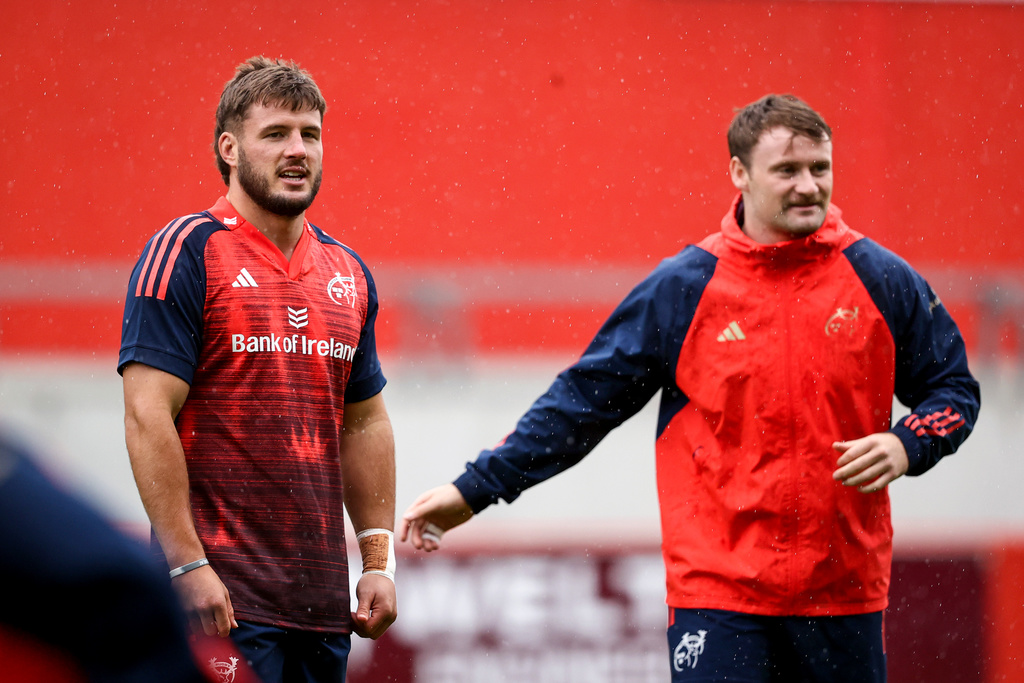
Alex Nankivell’s run with the Tasman Makos is over and that means only one thing; trading the north end of the south island of New Zealand for the southwest corner of Ireland – the Limerick HPC in particular.
Since the start of this preseason, I’ve been asked repeatedly why we chose to sign two midfielders instead of spending big on a hooker or a prop – arguably an area of greater need. My answer always comes in two parts;
- We’ll know if we need to sign a prop early enough this season and spending huge money on a hooker is a risky contract.
- We lost Goggin, Farrell and Fekitoa in the last six months, so we needed to restock that position with established system-fit players who can enhance the style of rugby we want to play.
In the grand scheme of things, adding midfield options was a better use of resources and, in Sean O’Brien and Alex Nankivell we have two really good options who can seamlessly fit into the role we want from the #12 and even #13 jersey going forward.
As Munster continues to build our on-ball, high-volume possession game – at least on the evidence of the preseason friendlies – then our midfield is massively important. There really isn’t a place for going into the main teeth of this campaign with makeshift options.
During preseason, Rory Scannell was perfectly serviceable alongside Antoine Frisch. I don’t mean that as a backhanded compliment – Scannell was decent – but we signed two other senior midfielders for a reason and that reason is mostly “system-fit”.
In the Munster system that we saw last season, we need our #12 to be a direct hitter off the shoulder of the #10, a viable carrying option in the same spot off the set piece, an occasional handler that’s comfortable switching with our secondary hander Antoine Frisch but – and this is crucial – they also have to be a power winger.
What does this mean? In practice, it means that the Munster #12 will spend more time than you’d expect in the zones you would normally expect a winger to operate. We saw that multiple times last year with Fekitoa and Scannell during games where they would unhinge from the usual “second receiver” slot and loop to the wing to force an overload or replace a winger who had looped to the other wing on a previous phase.
In our system, Antoine Frisch is a strike playmaker – he averaged 1.39 passes per carry last season – while Malakai Fekitoa averaged 0.72 when he played at #12 alongside Frisch, especially in the run-in to winning the URC title. For reference, when it comes to the back three we mostly used for the same run-in, Mike Haley had a PPC of 0.40 across the season, Calvin Nash had a PPC of 0.34 and Shane Daly had a PPC of 0.64.
What does this tell us? Our #12 had more or less the same PPC metrics as our Inside Winger which gives you a really good illustration of their usage and the roles expected of them.
Why would we look to move away from Fekitoa – outside issues aside – who I’d describe as a Slashing Edge Runner and move to a player like Nankivell? I’m absolutely certain that the intent is to play Frisch at #13 in the Strike Playmaker role he was so impressive in last season and to play Alex Nankivell at #12 alongside him as a Lockdown Centre/Wing Hybrid.
When I watched Alex Nankivell for the Chiefs a few months ago I was super impressed with his high breakdown output from midfield – something we lacked last year, despite our high-volume possession game – and that will immediately improve what we do offensively.
However, watching him play NPC rugby showed me a different side of his game in the freedom of a slightly lower-level competition.
Here are some of the things I spotted;
Now, the kicking surprised me and, while it’s not super high-level, it did show a side to his game that wasn’t very visible at the Chiefs. It adds an interesting wrinkle to his possible usage.
The big standouts in the games I saw were his power in contact, his ability to ride tackles and how willing an offloader he was. He’s deceptively quick too and that shows up everywhere from his work in the tramlines to how quickly he can loop around screens and move between attacking layers.
In Munster’s 3-3-1 shape in settled phase play, expect Nankivell to be capable of popping up on multiple phases in multiple different slots; first receiver, behind a screen as second receiver and into the edge spaces all while adding real punch, physicality and attacking variety at the set piece.
