


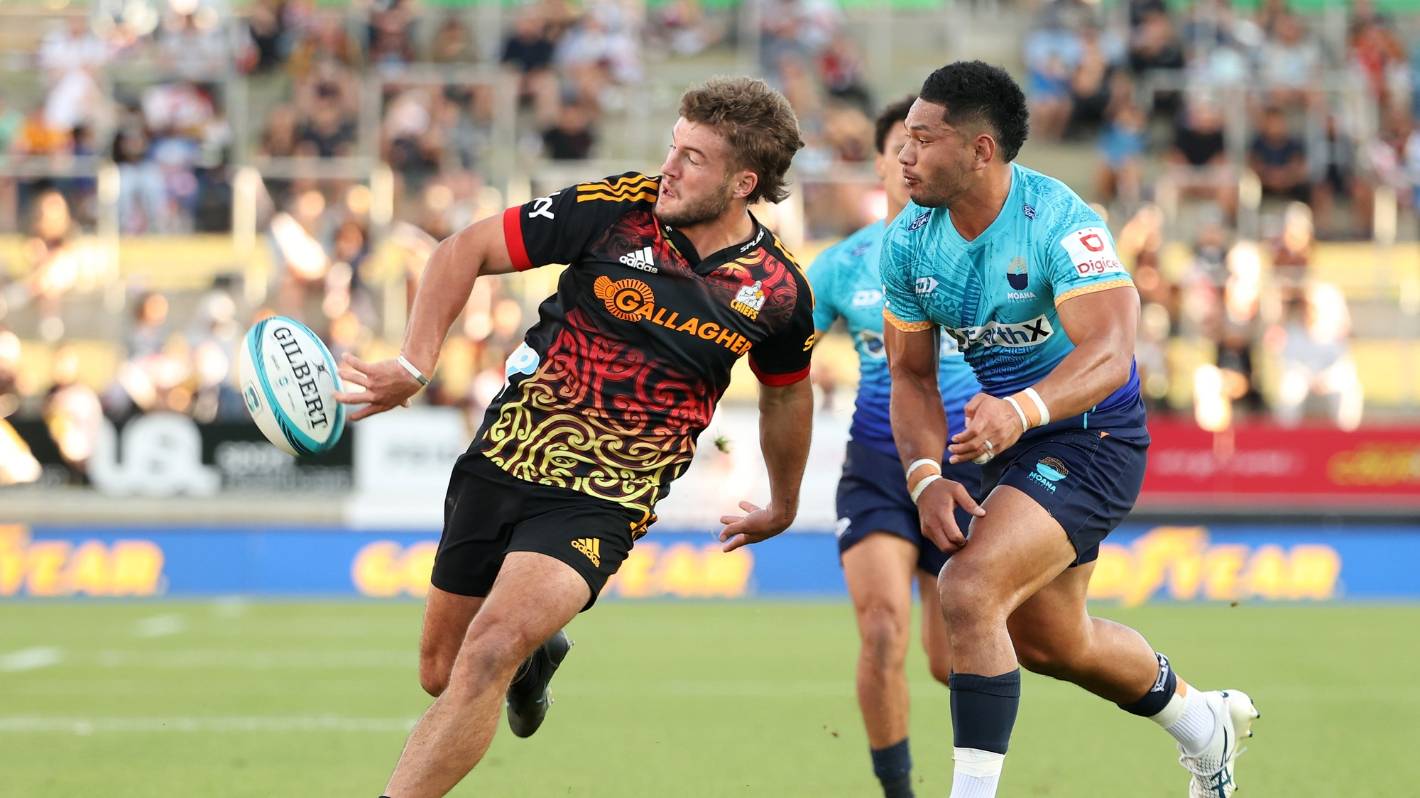
What seemed like a pretty simple job back when the signing of Alex Nankivell was announced – namely, replacing Malakai Fekitoa – has become a much bigger job in the last few months.
Let’s say the first half of Fekitoa’s season was… mixed. There were some good performances when he was selected in the first half of the season but they were mixed in with some way below-par averages for a player of Fekitoa’s reputation and quality. It was pretty telling that, when Munster got our season back on track post-October, it was mostly done with Jack Crowley at #12 with Malakai Fekitoa popping off the bench.
That was not how Munster visualised the position in pre-season but other issues at play with Fekitioa complicated his first few months here. Right when it was announced that he would leave at the end of the season, it seemed as if the weight of off-field issues that had been plaguing him were lifted and we could finally get a good look at the player we signed and, almost more importantly, we could see our system working at peak performance with the right balance of handlers and strike running options.
With Carbery/Crowley and Frisch as the spine of our backline, we didn’t get the full value out of Nash, Daly and Haley or our back row from an offensive perspective or, at the very least, nothing near what we saw for the run in where we rebalanced that spine with the right rolesets.
With three playmakers in that spine, our natural tendency was to elongate our playing structure or force key players like Frisch slightly off role.
What was a consistent sign of Munster’s system running well this past season? Antoine Frisch passing the ball with a relatively high volume.
For most of the middle block of the season after recovering from injury, Frisch played with Crowley at #12 and, when we look at the season overall, he averaged 9.2 passes per game.
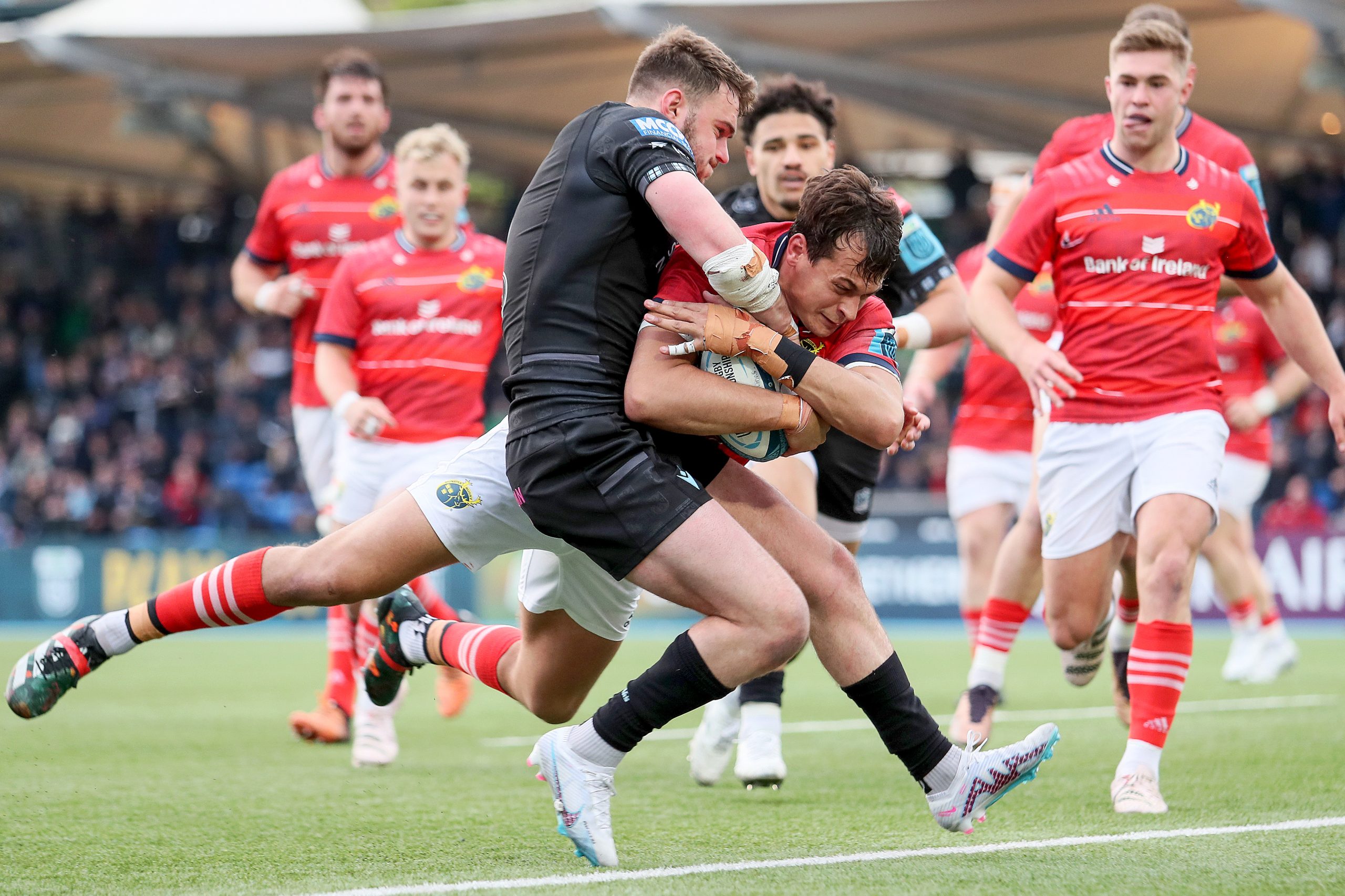
When we look at Frisch’s passing volume with Malakai Fekitoa at #12 his average bumps up to 10 passes per game. So what does this tell us? That, when Frisch plays with a non-playmaking midfield partner, he passes the ball more freely which, in this system, leads to more phases which leads to more tries because Munster have the highest number of tries scored in the URC when the phase count is above 10.
Fekitoa’s role when paired with Frisch – and the same is true for Rory Scannell when he partnered Frisch off the bench against Leinster in the semi-final – is really interesting because, positionally, you’re as likely to find him in the 5m tramline as you are running behind a screen or hitting a short line off #10.

Earlier in the year, I hypothesised on how Munster might use Fekitoa, Farrell and Frisch in the same team. This was before Chris Farrell’s legal issues in France took him out for the season and then out of the club entirely, which rendered the article pointless.
In the article, I wrote this;
With Fekitoa deployed as a Power Winger/Layered Power Handler in the back three, Munster can easily slot together all three players without playing anyone wildly off-role. Fekitoa is nominally an outside centre but using him as a Power Winger/Layered Power Handler hybrid will utilise all of his strengths in a system that prioritises longer sequences of possession and multiple attacking threats.
He can be a devasting inside ball option for Carbery, a player well capable of handling the ball as first receiver with a carrying/offloading threat that has to be respected and when you factor in his ability to, essentially, become a defacto outside centre in the same mould as a Virimi Vakatawa when the ball progresses back across the field with Carbery and Frisch alternating as handlers, you realise the possibilities this has. Farrell would be retained as a big-hitting outside centre that can set platforms in the wider channels and impact at the set-piece while Fekitoa essentially plays as another outside centre in that Power Winger/Layered Power Handler hybrid role.
This ended up being very close to Fekitoa’s actual role, albeit from the #12 jersey. Shane Daly played a similar enough role in the #11 jersey for much of the season and our best rugby was played at the end of the season with both players taking up similar and mirrored positions with Crowley and Frisch taking up the bulk of the passing volume.
In this regard, what #12 and #13 mean in Munster’s system is actually pretty fluid, especially when Crowley is such a mobile and dynamic presence at #10.
This is a really good example of the principle;

So, knowing what we know about Fekitoa over the last few months we can make a pretty good read as to his role chart and the archetype he’d fit under.
For me, Fekitoa is a Slashing Edge Runner. What does this mean? It applies to the type of midfielder that has covered both #12 and #13 while also covering the wing. They are usually between 6’0″ and 6’2″, with a good burst of pace, a reliable short passing/offload range and a strong burst in the carry when called upon.
Munster used Fekitoa as a “#12” but his primary offensive usage fell down around these lines.
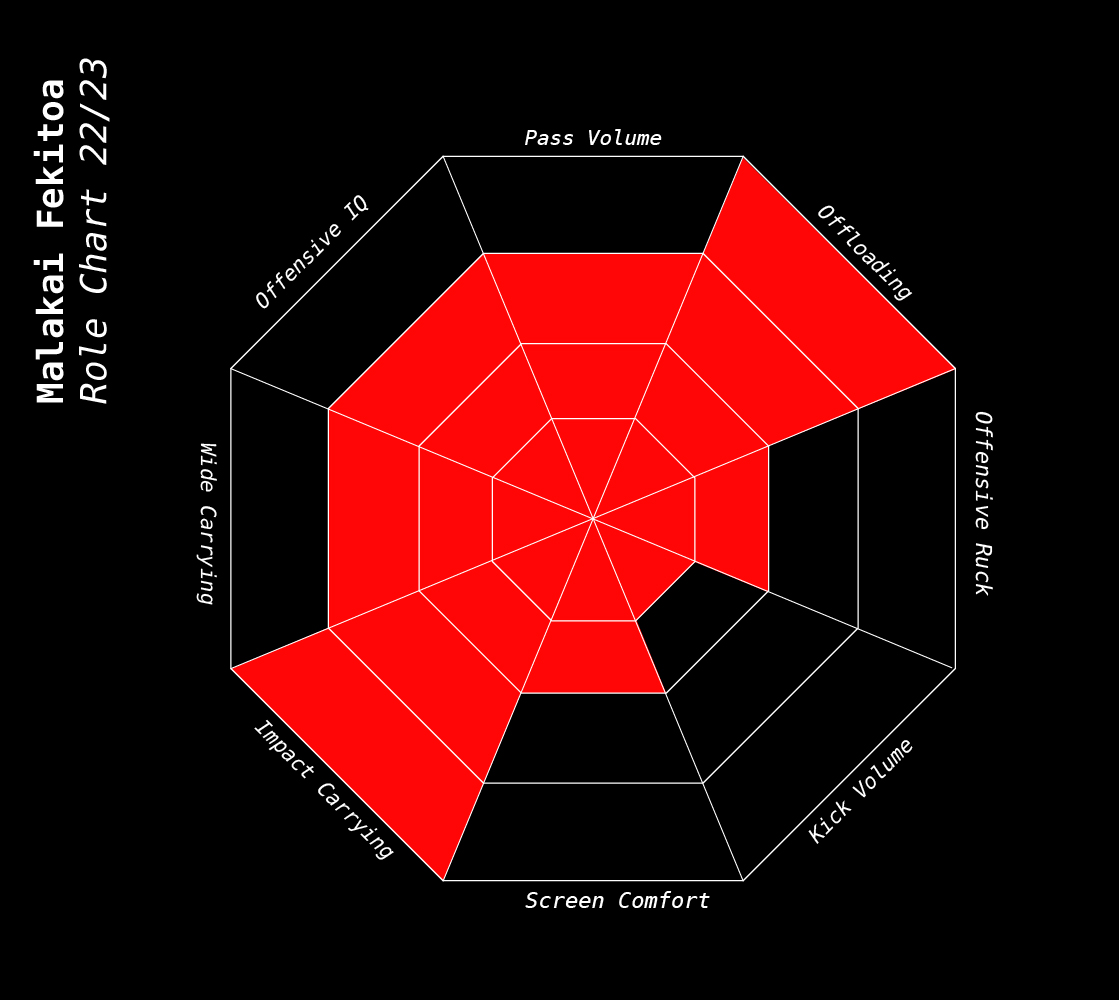
So we were able to use Fekitoa as a #12 on defence while playing him mostly as a traditional outside centre and power winger when it came to the offensive side of the ball.
That doesn’t mean he wasn’t capable of running behind a 3-3 block as a handler either, we just didn’t see it all that often this season.
 Check out the pod blocks from Coombes and Archer.
You can see how Nash’s inside loop lines interacted really well in these progressions, as a quick little tangent. That gives the handler short and midrange options regardless of the play. When Frisch takes the ball he’s looking for an inside and then an outside offload, something he and Fekitoa constantly interacted on as a pair, especially on plays like this where they could run loops in each other’s orbit.
Fekitoa’s focus in the latter half of the season meant we got a decent screen passer, a great offloader and a punchy carry option off the set piece.
So, how do you replace that? With Alex Nankivell, a Lockdown Centre/Wing Hybrid.
After watching Nankivell extensively over the last few months, I can make the following Role Chart for him on the offensive side of the ball.
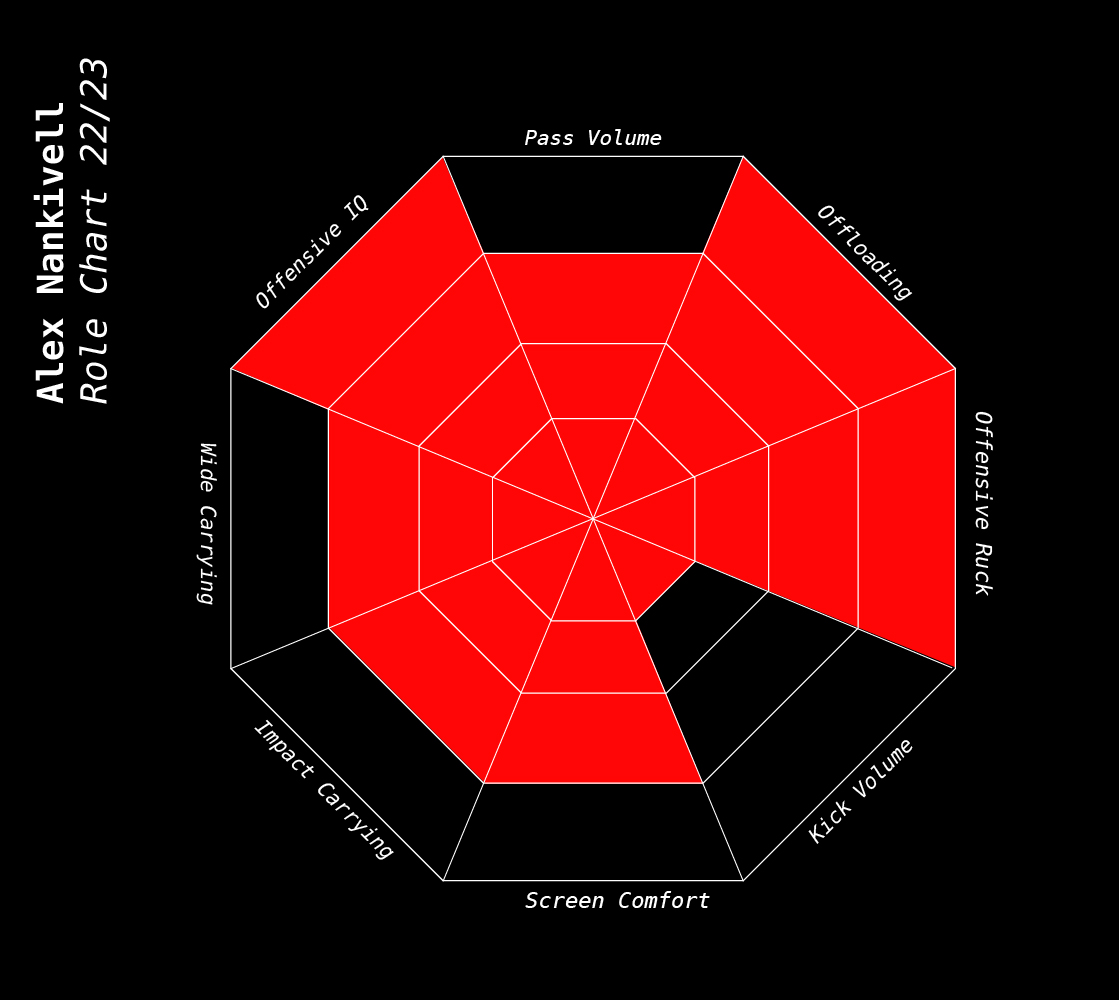
Nankivell doesn’t have the same punch at the set piece that Fekitoa does but he more than makes up for that with a huge breakdown output, balanced pass volume and outstanding offensive IQ.
Fekitoa is a great attacking player who knows exactly when and where to run lines and make plays. Alex Nankivell has that same instinctual play in his arsenal but he’s also an offensive organiser who drives forwards and backs around the field. His passing and comfort as a screen runner are really good too, as is his work rate as a loop runner – a lot like a winger in that regard.
He’s also comfortable sliding into those edge spaces and has the strength and handles to create killer linebreaks there, as well as a deceptive turn of pace.
His biggest strength, by far, is his offensive breakdown output. This is what I mean by a “lockdown” centre/wing hybrid – he consistently locks down and wins ruck possession with dominant cleans, guard actions and very few passive entries.
If you have a high possession, high variety gameplan Alex Nankivell is almost the perfect #12 for it because of his ability to keep that high phase count going in all kinds of positions.
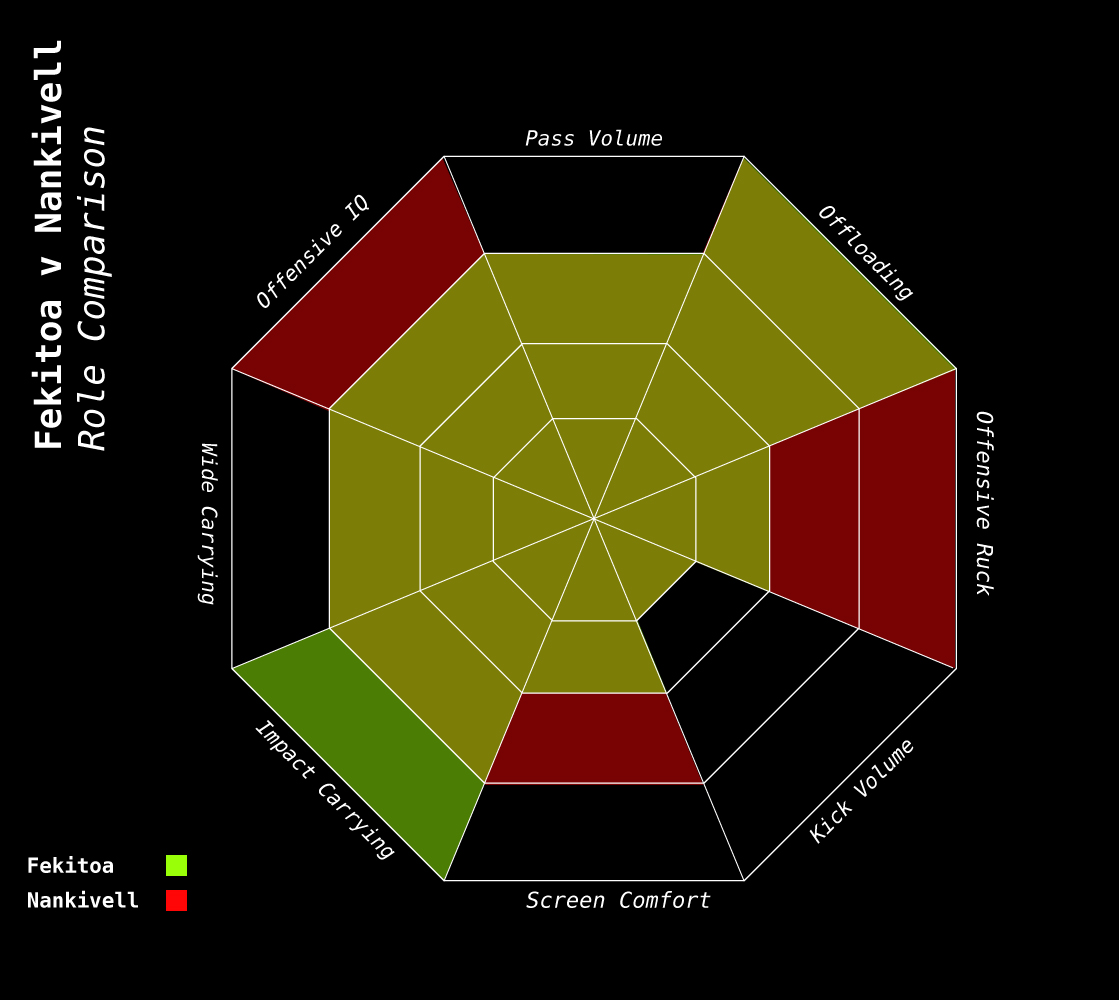
When we compare him with Fekitoa, we can see where the points of difference lie.
He’s got an injury to recover from but I think he’s got the perfect role set to compliment Crowley and Frisch as part of our new 10-12-13 combination.
