


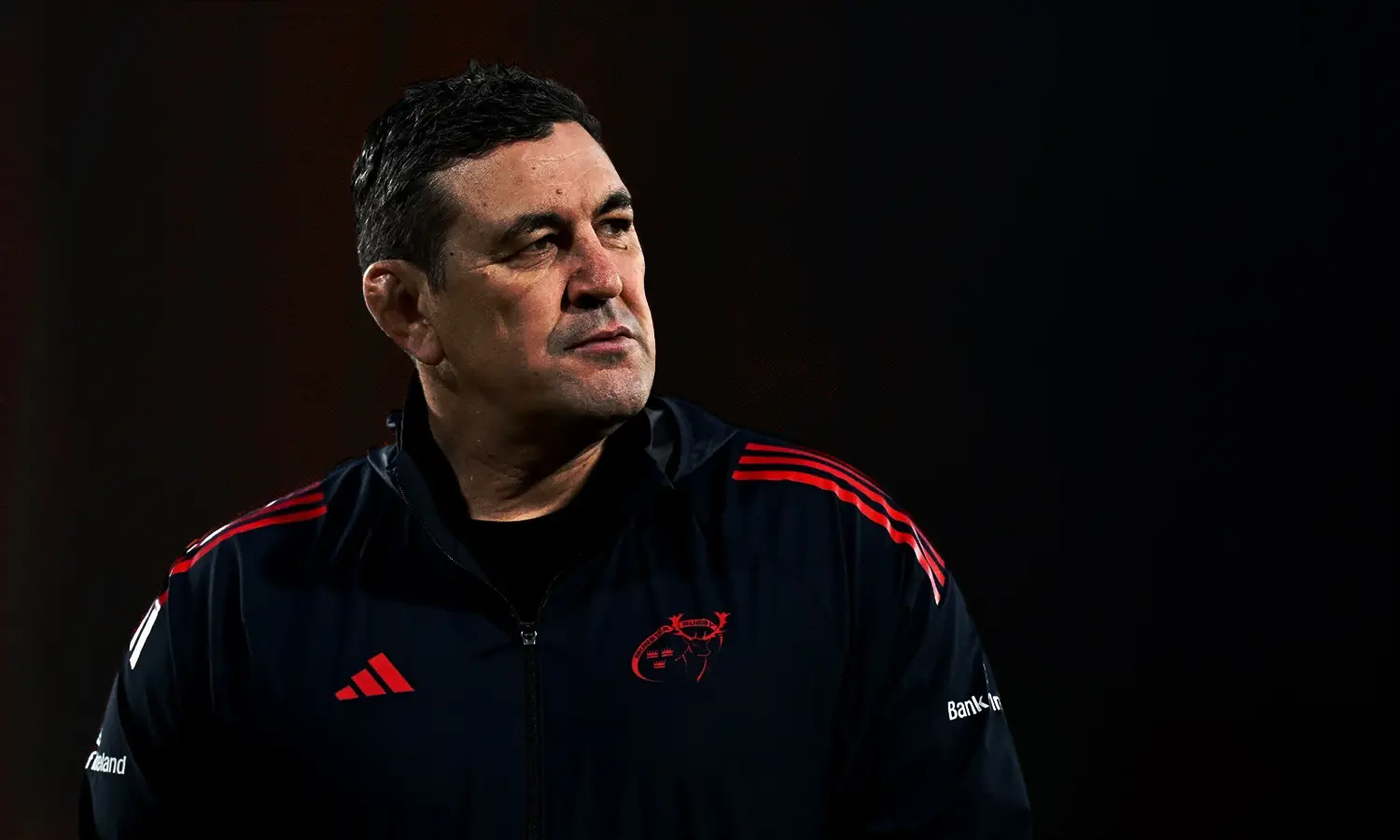
In the last few weeks, I’ve spent a lot of time writing about pretty detailed data analysis of where things went wrong for Munster last season.
That’s been fine — illuminating in some ways — but that’s the past. It’s gone. Munster learned, both during last season and in their post-season review, what the issues were and have taken big steps to address the issues head-on.
I think it’s fair to say that Munster know, or at least believe, where last season spun out of control and how best to avoid that this season.
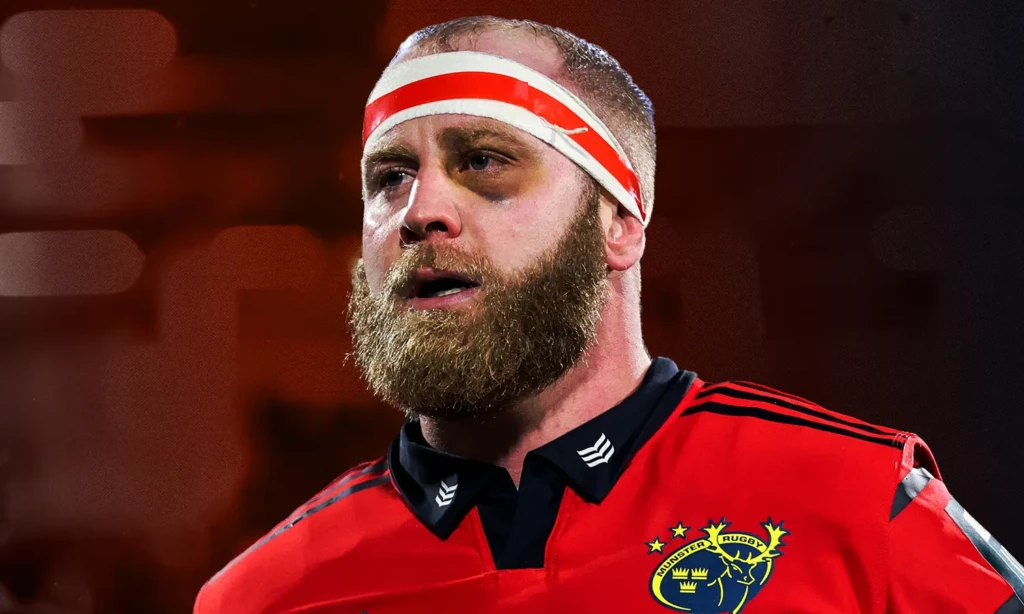
It’s easier planned than executed, of course, but after the first two weeks of preseason, there’s a lot of confidence internally that they are starting on the right foot.
Of course, that is rooted in the idea of “the new”. Last season had an element of change with the arrival of Clayton McMillan, Martyn Vercoe and Brad Mayo. Yet the rest of the coaching unit was the same and utilised the same framework as the previous seasons. There were a few tweaks on preparation, theming and other bits and pieces, but when I spoke to people mid-season, almost everything was the same — systems, general strategy with the possession, and the roles within it.
This is not unusual in and of itself, but it led to a lot of consternation about what Clayton McMillan was doing, especially when compared to Stuart Lancaster at Connacht.
Lancaster is a teacher; McMillan is a builder.
At Connacht, Lancaster was the primary driving force behind their “system” and the implementation of it in a very direct way. He was, essentially, their attack and defence coach — much as he was at Leinster — and that goes some way to explaining why their attack coach Rob Seib departed the club after just one season, to be replaced by a more sub-unit-specific backs coach in Gerard Mullen from Quins. Lancaster’s system is very specific to him as a coach, and that’s arguably why he didn’t really work out in Racing 92, which is probably the biggest coaching surprise of the last five or six years.
One of the best on-field coaches in the game, at a club with as close to an unlimited budget as possible and multiple highly experienced test players, including all the power players he would have wanted in Leinster, but it never clicked. Right coach, wrong playing group. His more prescriptive approach never quite landed as he’d have liked in Paris, but he showed in Connacht last season that, with a more coachable and pliable group, his methods can work once they have the time to bed in, although the challenge of managing a Champions Cup campaign this coming season rather than the Challenge Cup — glorified A-games with off-green branding — will be a much more difficult proposition.
At Munster, the Lancaster equivalent wasn’t McMillan — it was Mike Prendergast.
Like Lancaster, Prendergast has a very specific approach to how he feels the game should be played. At Bath, his methods will take time to bed in but, once they do, they will tear teams up. At Munster, I think it’s fair to say — as I’ve said over and over again — that elements of his game had grown stale as the squad had aged without significant reinforcements in the associated areas needed to refresh it.
A lot of what we saw last season was an illustration of that staleness, both in the execution of the system as it was, and the opposition’s reaction to it.
By the end of January, a change was definitely required, but there is no real scope to reinvent something as fundamental as your attacking framework with four or five months of the season left, even with the downtime of the Six Nations included. No systemic changes can be implemented while your best players are away with Ireland, for a start, but even then the grind of back-to-back games and the recovery required from them means that anything that is radically new soon gives way to the practicalities of the upcoming game, and the points required from them.
It takes intense learning and training field application to make that kind of change — and preseason is the only time it can be done.
I’ve gone back and forth on what could or should have been done last July, but the sensible decision with the same coaches was to run broadly the same system, especially with Mike Prendergast in situ as Senior Coach. The way he coaches the game is fundamental to his identity as a coach. You don’t walk into a meeting with Mike Prendergast and tell him, yeah, nice work so far Mike, and I know you’ve been bumped up to Senior Coach here, but I’d like you to coach a very different system this season for these players I don’t know yet, and with zero games played. It’s like asking Pat Lam to coach a kick and grind off-ball team, or getting Stuart Lancaster to be a figurehead for a team more used to playing more individualistic, expressive, looser rugby.
The stronger the teacher coach, the more clearly identifiable their on-field identity is. You see it in everything their teams do.

That identity didn’t work for Munster last season — or, really, the season before — but it will work for Bath. A change of scenery was needed for both Prendergast and Munster, and hopefully next season illustrates that clearly.
McMillan is a “builder” coach. He doesn’t arrive with a fixed playbook — a PDF of set plays, systems and roles. Instead, he brings an understanding of what could and should work with the players available to him, along with a sharp read on what’s working and what isn’t. Combine that with a clear recruitment plan — who to bring in, and why, both players and coaches — and you get a coach who builds a squad led by strong unit coaches, one that executes what’s required collectively. Unlike the “teacher” coach, who imposes their own system wherever they go, the builder coach constructs the team he believes will succeed piece by piece, contract cycle by contract cycle.
That’s generally why builder coaches — effectively Directors of Rugby, even if the title doesn’t say so — tend to last longer at clubs than teachers do. When things grow stale for a teacher coach, they are very rarely able to adapt the core fundamentals of how they implement their vision of the game.
In essence, a builder head coach has to decide what kind of teacher the club needs, and then live or die by that decision — and every decision that flows from it.
This is why, whatever happened with the coaches post-Prendergast, McMillan wanted Mossy Lawlor to be heavily involved in what came next.
Our initial choice for a new Senior Coach was Jason Holland. McMillan, Munster and the IRFU felt that he was the perfect teacher-coach to move the team forward, with Lawler to be heavily involved as the backs coach within that structure. When Holland ultimately decided not to make the move — bad timing on the family side of the decision — Munster wanted to bump Lawlor up to be the main voice in phase play possession, with Randle (however ill-fated) as the man to lead the strike plays.
When that blew up, the pivot wasn’t to someone to lead Munster’s phase play, as Lawler was already in place; it was for someone to lead the strike plays, and that will be Jared Payne’s role in a general sense, although he will be leading the kicking strategy, exits and a few other bits around transition.
Lawler’s vision is the one that Munster are leaning into for next season, as McMillan feels what he will bring is different enough in scope and exactly what this group needs to progress.
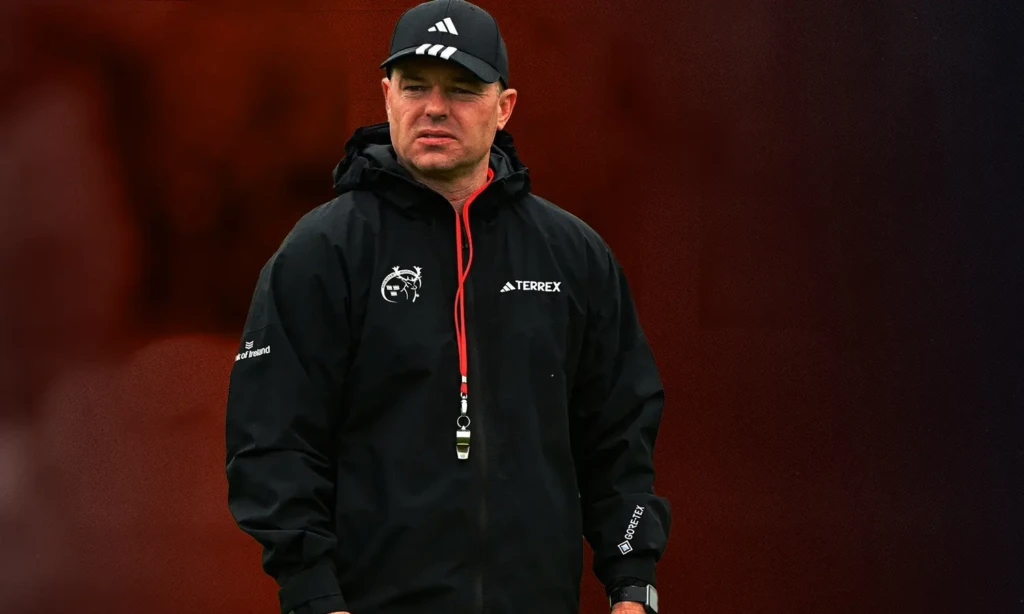
The general assumption I’ve seen of Lawler since he arrived is that he’s an extension of Mike Prendergast in one form or another, and that what Munster are looking to pivot to won’t be a pivot at all. That couldn’t be further from the truth. Maybe it’s related to Lawler’s role here since he joined ahead of 2023/24 as a skills coach, before moving to a backs-coaching role last season.
That has to be understood in the context of the role. Lawler will be a very different phase possession lead than Mike Prendergast. He’s not reinventing the wheel, of course; no coach does, but he sees Munster as being a team that will do a lot better playing deeper and wider, and less wedded to structure than the last few seasons.
Lawler, who had a front row seat to the issues of the last few seasons, recognises that we have good ball carriers — better than the numbers suggest — but they need to be viewed in a different context. That means a change in shape. More isolations, a clearer path to width that requires fewer passing sequences, less integrated forward and back structures, and a more direct approach to ball carrying, empowered by a deeper alignment.
Last season, players who we know are good ball carriers, because we’ve seen them do just that for either Munster or at another club, produced some of the worst carrying data in the club game worldwide. Have they all turned into bad ball carriers over the course of two seasons? No. I don’t think so.
This is where forward shape and structure come into play, but I wouldn’t get too bogged down in that either. Whatever shape we use — mostly 3-2 in the middle, or blended 3-3 with one or two edge forwards — it has to empower what actually works in the modern game. Does our structure empower our players to win collisions and create space? Is it flexible enough that it can be trained broadly without too much of a focus on alignment during heavy back-to-back blocks? Can it be run at a high level while also allowing extra focus and time on the set piece (an issue last season)?
An in-possession system isn’t just about Xs and Os; it’s about how many training minutes per week it takes to get to a point where you’re comfortable, because every minute is budgeted.
If Munster are to be successful next season, it has to be rooted in the collision and set piece upgrading to an acceptable level, because it’s the biggest force amplifier we have available to us.
In a general sense, I think we’re going to the end of an era of rugby we’ve lived in since 2015 — I’m going to call it the Intellectual Era.
This era, driven by Irish Rugby, if not fully exploited by winning World Cups or even enough Grand Slams or Six Nations titles to justify our prominence, was defined by using the ruck primarily as the launch point for more systemic, predictable rugby. Predictable in this context shouldn’t be taken as “robotic”, although it can look that way when the opposition has a firm handle on it, or it’s executed poorly.
I think the game, through a variety of law tweaks, is turning into a simpler (although no less complex) form of the sport. One that is less prone to “hacking” or taking shortcuts to avoid the truth of the game as it is. You either have the horses to impact physically at the top end of whatever tournament you’re trying to win, or you don’t. How smart you think you are will determine where you exit the tournament, if your smartness is your defining feature.
If you’re not that smart, you exit early. If you’re very smart, you exit in the semi-final or lose the final.
That means winning scrums, winning mauls, winning collisions and then having the ability to play through the spaces they leave behind. Without physical dominance somewhere, you’re going to struggle to impact at the level you need to win trophies, although you’ll pick up plenty of kudos about what a clever boy you were to get however far you managed.
Do you want kudos, or trophies? In the old, intellectual era, you could generate pace on the ball without necessarily loading up with big, impactful ball carriers. Everyone is the same size on the ground, after all, and Ireland — first through Schmidt, and then continued through Farrell — did really well by building around that truth. You hit ruck position, the offside line resets, you play through “one more ruck”, and blitz any team that tries in earnest to “slow down your ruck ball”.
These days, the slowdown is done in contact, not post-contact, so the value of bigger ball carriers has increased relative to the value of hard-working all-rounders going down. You still need hard-working all-rounders — every team does, somewhere — but they need to support impact ball carriers, rather than being the dominant profile in your pack, and even your backline.
For Munster, the key to playing through this era change is by maximising our ability to play isolation rugby.
What do I mean by isolation rugby?
At its simplest, it’s the deliberate engineering of one-on-one and one-on-two collisions in space, rather than the massed, multi-man contacts that defined the intellectual era. Instead of a carrier hitting a set defensive front with two latchers and a shortened picture, you’re looking to give your best carriers an isolated defender — ideally a mismatched one — with room to work before and through contact.
That’s where the deeper alignment comes in. Depth is pace, and pace is the great equaliser in contact. A carrier taking the ball flat and static is fighting the collision on the defender’s terms; a carrier arriving from depth, with a one-or-two-way option either side of him, is fighting it on his own. The trade-off is risk — deeper alignment means the defence has more time to read you — but that’s exactly why the shape matters. A 3-2 in the middle, or a blended 3-3 with an edge forward, isn’t there to grind through the middle phase after phase like it’s 2018. It’s there to occupy defenders, hold the fold, and create the isolations elsewhere.
This is why I wouldn’t get too hung up on the specific numbering of the pods, because in practice it oscillates anyway. Commit a carrier and two cleaners to the breakdown, and you’re playing the next phase with five forwards in the line, not eight. What looks like a 1-3-2 on one phase becomes a 3-2 on the next, and something else again once the recycled forwards fold back in. The numbers are a snapshot, not something you can scheme. Lose too many guys in a ruck? Your shape is gone on the next phase, maybe the one after. If that’s true, your framework has to be flexible, rather than set blocks of three.
What matters is the principle underneath: does the shape consistently manufacture the collisions we want, with the carriers we want, in the spaces we want?
That’s a much easier question to train than “can everyone hit their mark on phase four of a five-phase pattern?” — and that’s the value of what Lawler is building. A system built on principles rather than sequences is cheaper, in training-minute terms, than one built on choreography. Fewer integrated forward-and-back structures means fewer moving parts to rehearse, which means more time on the training pitch for the scrum, the maul and the collision work that actually decides where we’ll finish this season. The staleness of the last two years wasn’t just tactical or personnel issues; there was time economics at play. Too many minutes spent maintaining a complex possession machine, not enough spent sharpening the force amplifiers.
And the personnel fits. We have carriers who are at their best with a head of steam and a defender to beat, not tip-toeing onto a flat ball in traffic. The data from last season says they were among the worst carrying groups in the club game; the eye test, and everything they’ve done before, says otherwise. Change the context, and you change the output. Give those same players depth, width and an isolated defender, and the numbers will follow.
None of this is revolutionary. Munster won’t be the only team moving this way as the law tweaks continue to reward teams who win the contact in the carry, rather than at the ruck, and punish teams who try to think their way around it. But that’s the point. The intellectual era rewarded the clever; this one rewards the physical and the creative.
Look at Munster’s preseason training if you get a chance in the next few weeks. You’ll see the tweaks immediately. More directness through the forwards — who have all come back to preseason bigger and heavier.
Will Harrison is already being used as a second playmaker — a second #10 — who can help us split the playmaking load into two zones.
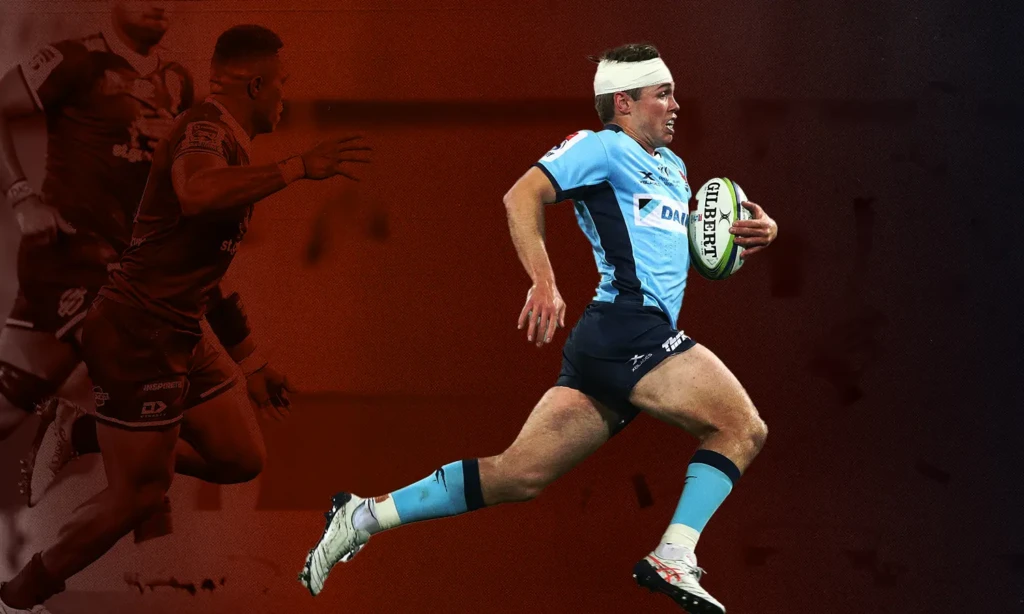
French rugby is leading the way in this through players like Ramos or Jailbert, with New Zealand (McKenzie) and South Africa (Willemse) on the same track.
All of these sides play with simplicity through the forwards and set piece, impact and pace in the backs, and almost always with a second playmaker somewhere. The more true playmakers you have in your backline, the less rooted in structure you become. The Intellectual Era, for me, was rooted in the idea that everything has to flow through one brain. In Ireland, that was Sexton, and we’ve been trying to duplicate that ever since he retired.
The #10 drives us around the field, and everything rotates around giving him as many options to control the game as possible. There’s no need for a second playmaker when one player “runs the week”. Backline selection follows from this — strike runners everywhere to give him options, set edge forwards and work-rate wingers to allow the #10 to float. I think, at a fundamental level, this style of play is dead in the water, unless you have generational talents.
The teams who will succeed in the new era will be the kings of simplicity.
