


If there was a nexus point to this season on and off the field, it was our home loss to Castres Olympique in Thomond Park.
Almost everything negative that we experienced in the second half of the season flowed from that game, that result, and the fallout that came afterwards. It was after that Castres loss that we realised what we were doing wasn’t working and, not only that, that what we had been doing was exposing our weaknesses as opposed to highlighting our strengths.
I don’t intend to relitigate this game or turn it into a catch-all, but I will look at it because I think it highlights a lot of our issues last season.
I’m going to be speaking a lot about our attack work in this article, but I first wanted to show you something on the defensive side of the ball — and it’s something we were doing all season long. I noticed it at points during the season, first statistically and then live. We tackle incredibly high. Not high shots — we didn’t give that penalty away a lot — but high on the body.
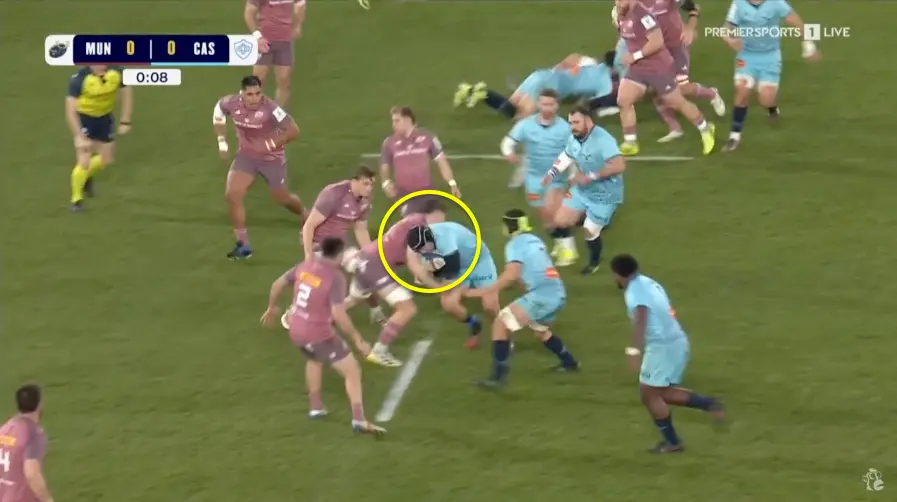
In Europe last season, we were in the top ten for tackles made above the line of the hips, and you can see it in action, plain as day, against Castres from the first whistle.
As with everything, we tackle this way in general for a reason; we’re trying to slow the recycle of the ball in the tackle, draw in cleaners, and give ourselves turnover opportunities on the deck, while making sure we have a good fold by adding time to the contact point. You also deny the opponent space to offload, which is another core reason why we defend this way.
You can see O’Donoghue and Farrell going high on their tackles here.
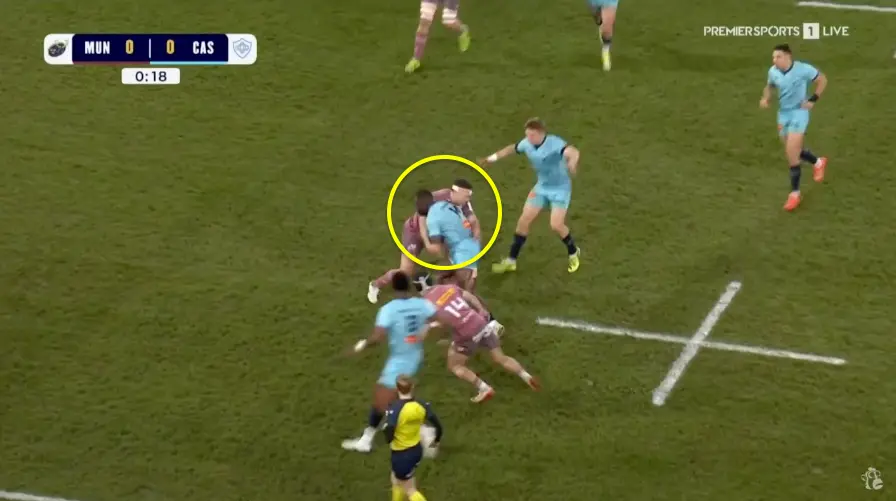
You use your arms and upper body to jolt the ball carrier upwards and back, shifting your weight forward and giving your secondary defender a shot at making a play on the ball.
Here’s a good example of how it works. Loughman makes a higher profile tackle on the ball carrier, giving Beirne enough time to get into position and win a jackal turnover.
But you might notice that we end up giving away a lot of ground in contact on these, and you’d be right — we did. We never really stopped teams dead, and we quite often put ourselves under pressure against teams who played deeper to the gainline. When we got our angles wrong on those high entries and gave up linebreaks that we really couldn’t afford to give up.
We tried to slow the contact point, deny the offload and then use that time in the tackle to fold across to cover the next phase, but it was higher risk than it sounded, especially against bigger packs or teams with a lot of evasion in the 3/4 space.
If we’re going to talk about what went wrong against Castres offensively, I think it’s only fair that we look at the defensive issues too, because it wasn’t just against Castres that this showed up.
But the biggest thing that came out of this loss to Castres was our clarity, or lack thereof, on what we were trying to do with the ball.
When we talk about clarity, it almost always applies to what you do with possession. You can choose where and how you want to defend with your use of the ball. You can choose where to press the opposition with the ball in hand by how you use the ball elsewhere. Clarity is most often defined here as “where do we play?” and “how do we play when we’re there?”
Munster seemed to struggle with a clear answer to those questions all season long, and that was no clearer example than this game.
Pragmatism vs Expansity
Is it as simple as a team grappling with the grey area between two different general states? Pragmatism vs expansivity? To get to the bottom of that, you need to start with exits — where you exit, and how you exit.
In general, most teams have cut-and-dried exit strategies. When you’re in the 22 or inside your own 10m line, there are specific zones where you have instructions on what comes next in specific scenarios. It makes sense if you think about it. Not everything can or should be called by the halfbacks. To cut down on lag, you’ll try to have everyone clued into what you’re doing when you have the ball inside your 10m line, whether it’s post-set piece, after a turnover, or after a kick.
For example, when you take a kick in the backfield outside your 22 but inside your 10m line, what do we want to do?
- Did we take the kick? Yes/No
- Was the kick contestable? i.e. is there space between the chase line and the kick receipt, or not?
- Where on the pitch laterally did we take the kick? Is it central? Or closer to the tramlines?
- If we took the kick, what comes next?
- Will you have a cut on transition? Yes, if the space is there, everyone should be cued up to support that read, but that really does depend on what your combined read on what “space” actually means as a collective, and is context dependent on where you took possession in the first place and where the defence is. If the kick was an aimless one dropping in the middle of the field, that’s different to a contestable kick on the touchline with three defenders following the drop, and a possible contest in the air.
- If you’re not attacking directly from the kick, the forwards dropping back (or other backs) have to secure the first ruck after the drop. Depending on where that ruck is, players will get into shape for the next phase. Wingers and midfielders get into position behind either the scrumhalf or whoever is at first receiver to be onside for any kick that might follow immediately or get into shape behind the first receiver for a possible pass option.
- How many phases do we take post-transition? Is it one or two, and prep for a box kick or a longer kick from #10? Are the phases we take purely for position to make the kick easier, and buy time for the chasers to get set? Or do we expend energy trying to run post-transition phase play based on a halfback read? Can we support that play with the forward resources dropping back after the kick? How important is this to the decision-making?
- Execute the play based on your read in the moment.
A more pragmatic way to approach this — and pragmatic doesn’t mean better, in this context, it just means playing with less risk — is to pretty much always have your forwards set up to secure the ruck, for your remaining backs to set up for a kick chase with the outside forwards who aren’t on the line of the kick to get ready for chase/defensive transition, and for your halfbacks, either #9 or #10, or whoever is slotting in at first receiver, to kick the ball back within one or two phases.
A more expansive way to play this is to take the kick back into a “possession” shape, where you try to get forward pods and backline shape into position by the time the ball comes back from the first ruck, where you try to use the defence rushing up against them — they are running at pace, so a well timed series of passes and loop lines can bypass them and make their defensive reads incredibly expensive. If that goes well, you get a clean linebreak and a badly retreating defence that you can exploit on subsequent phases.
Last season, Munster’s “go-zone” — the area on the field where we felt comfortable playing more expansively in either direct or post-transition — was approximately in or around our 10m line.
You can see the intent there — the defence is rushing up, and we’re trying to catch them on a straight line. Move the ball outside an isolated defender’s straight line, and then flow into the space outside it.
We go after that space with pullbacks and flat running lines, but they’re very dependent on timing — both of the loop line behind the play, and the second pod of forwards.
On the first example, you can see how it breaks down.
There are three passes — Casey to Crowley, Crowley to Coombes, Coombes on the pullback to Daly — which takes six seconds between the time the ball was presented after the kick to Daly getting the ball in his hands.
For Daly at that point, the only realistic option is a long pass. He flings it close to 30m in the air to a player out of shot — Farrell — with Abrahams being blitzed by Jack Goodhue.
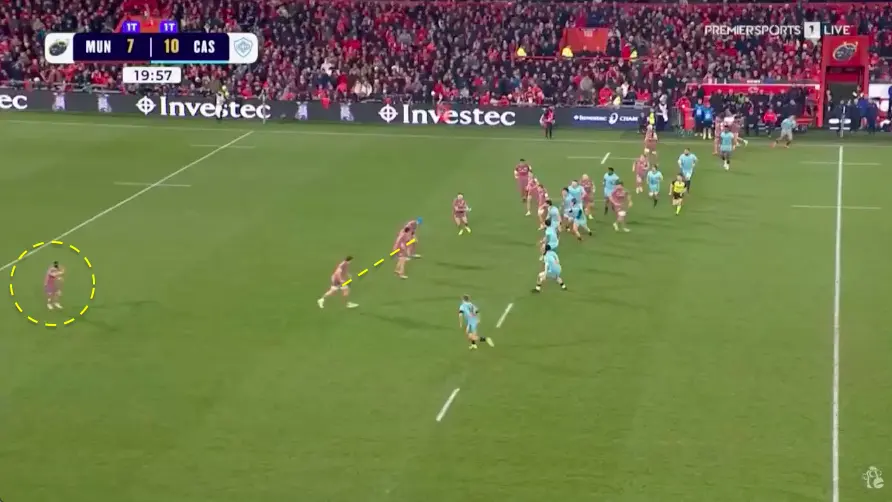
In that moment, the two options that were most readily available were way too high-risk.
- The pass to the pod of forwards risked a forward pass or a knock-on because they had overrun Daly’s line.
- Abrahams was being blitzed by Goodhue, and Daly risked passing it to him right as Goodhue arrived on him. Daly can see this as he makes his decision.
So the only decision Daly has here, as the second playmaker on this play, is to throw a massive, looping pass to the opposite 15m tramline.
Now we end up creating a linebreak out of this, thanks to some excellent evasion from Abrahams off the back of some good unstructured attack, but even writing that feels like a mislabel. To me, it looks more like offensive scrambling, but whatever you call it, it hardly seems like something you would design in advance if you were looking for an ideal situation to attack. Teams can, and often do, put themselves into position to attack in an unstructured way, but I’m not sure this applies here.
On the second example — taken on a contestable kick by Daly — you can see the same intent.
We’re on the 10m line, we have a transition, so we get into shape.
Beirne, Wycherley and Loughman are the pinch pod off #9 to hold the defence, with Coombes acting as a +1 on that pod to create space for Crowley, Nankivell and a looping Abrahams to connect up with Farrell and O’Connor on the far wing.
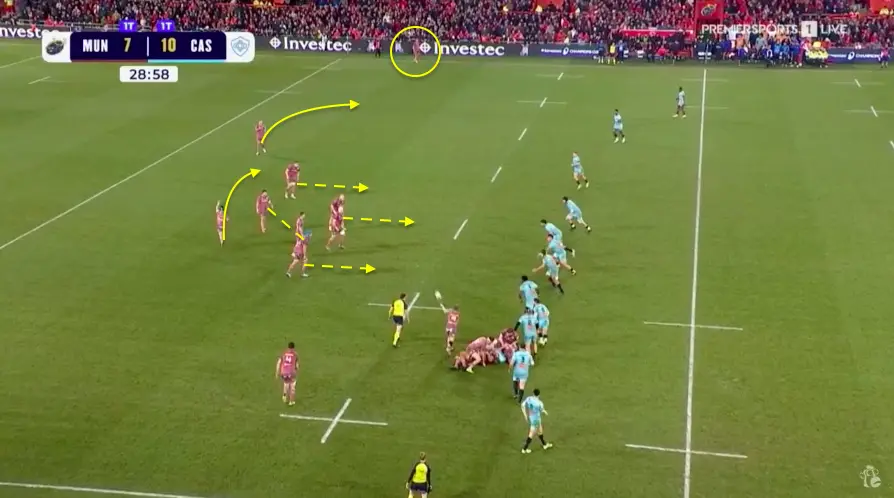
But again, the lines here are pretty flat and leave no room for anything other than a high-risk pass if the opposition blitzes at the edge, which they do.
When Nankivell is in position to make the pass here, he’s got two massive threats to worry about. The pass to Farrell running a Y line outside the blitzing defender is the killer ball here, but it’s got a huge interception risk tied up in it. If Farrell was a little deeper, maybe that’s an easier pass, but we want the danger of being outside the defender, rather than too far in front of him for him to get hands on (or possibly adapt his line to).
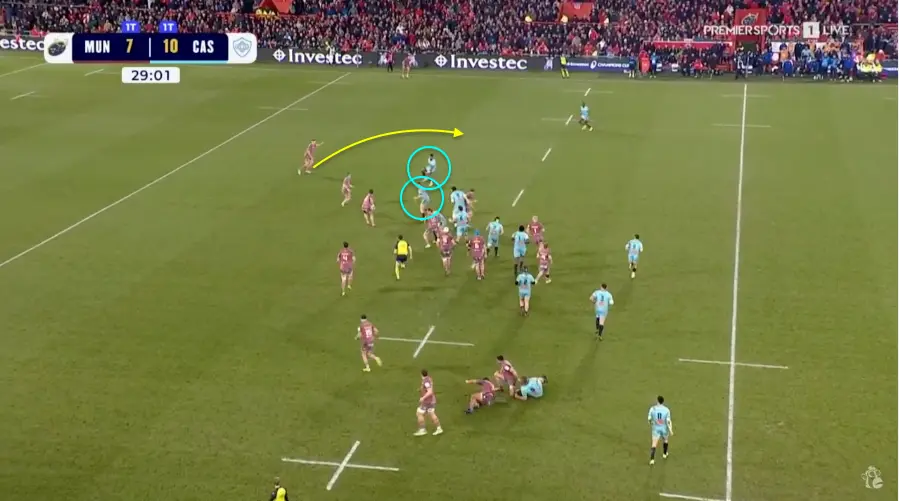
The pass option to Abrahams is risky, too. Dump the ball to him here, and he’s likely getting swallowed up at best, turned over at worst, with only Nankivell in position to secure any ruck that might come out of it.
Faced with those options, Nankivell has to turn back inside and take contact himself. Then we have another bit of unstructured attack.
How many times have you seen this from Munster in the last few years? I think we’re somewhat comfortable in this phase of play — it’s a bit like a transition phase, and those kinds of “continuity” offloads are baked into our game — and the way we moved the players to the space is definitely conditioned into the group, but it’s another phase around our 10m line.
When we come back for the next phase, we run a variant of the same play again, but it’s more cluttered.
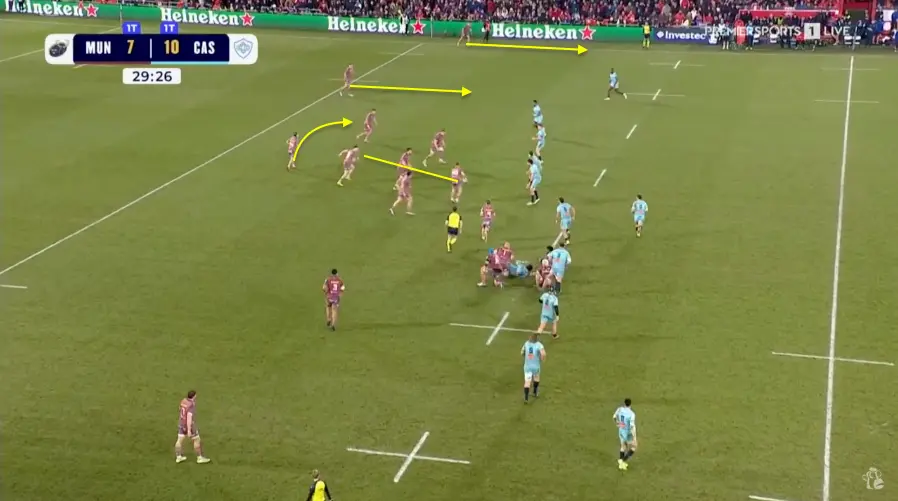
This was intended to be a split pod — where the three forwards split as they move to open up a passing lane through the middle to the space behind the compression they’ve caused — but the line is badly timed. Kleyn is in Crowley’s line of sight to Daly on the loop, so the pass is delayed, and when Daly hits Abrahams on the loop, the blitzing defender is right on the scene.
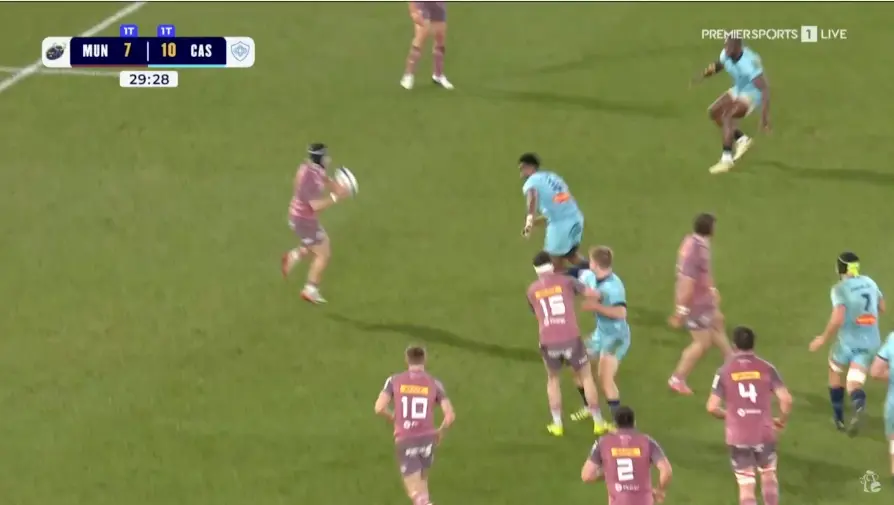
Abrahams gets scragged deep in our half — that’s the line of the 22 behind him — and we’re back under pressure based on our own decisions and the execution of them. We retained the ball here, just about, and eventually kicked to exit. Castres attacked back on that kick, and we eventually won a turnover on our own goal line.
In total, this sequence — which started from a Castres miss to touch — lasted 163 seconds, and we held the ball for exactly 60 seconds of that. None of our rucks went past the halfway line. All of Castres rucks were in our half in this sequence; only one of them was outside our 10m line.
In a general sense, we put this kind of pressure on ourselves quite a bit, both in this game and throughout the season.
This is another example from the second half. We drop back for an exit from #10, but we make a deliberate play to go for a shallow contestable across the field, and it almost blows up in our face, before we recover and then make a handling error.
Now that’s not to say we couldn’t score on transition either. Against Castres, we ended up scoring from this long transition run back, which I would say is right up our street — the ideal scenario we’d ideally look for.
A bad kick by the opposition, into an “open” zone, and we can move directly into space to play against a retreating defence.
We end up winning a penalty here, which we tapped quickly and scored in the corner, but it’s the transition we were constructed to attack.
A retreating, fragmented forward line post offload? Exactly what we scheme for.
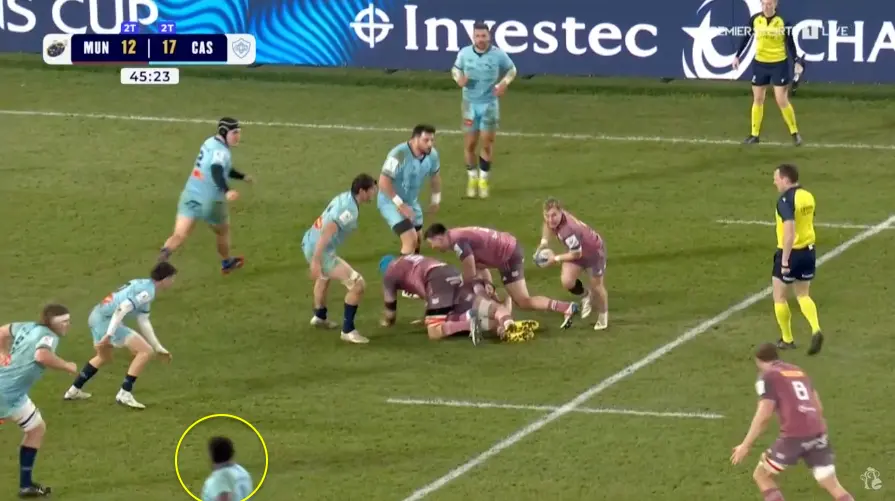
There, a pullback to Crowley so he can hit the line himself, before popping to another runner, is the kind of “attacking downhill” game we want to play.
From that restart, we seemed to want to continue the momentum, so we ran another exit, this time for a big territory gain. It worked in this instance, but this is where we come back to “read” and “intent”.
No team kicks every possible exit scenario, but last season, we seemed to really like the concept of catching teams as they pressed up post-kick, with Crowley, in particular, used as a key part of that threat.
There are three main ways to attack with the ball in hand, be it in phase play or post-transition. Playing “flat” where the threat is stretched across the field to occupy the defence’s spacing, playing “deep” where the threat is your momentum in the carry if the opposition drifts, or playing around their blitz, or a mix of both. The mix is the hardest one to coach because it relies on a lot of understanding between players and a lot of in-game comms. Stand here for this play, stand further back the next — there’s more to go wrong.
Again, speaking generally, we tended to play a flat attack shape. The forward formation we used in this general concept is relatively meaningless, but it does reflect the concept more often than not. A flat attack likes to use options to spread possible carry options across the pitch to stretch defenders. If a defence is worried about seven possible options on the front line of an attack that plays close to the gainline, it makes sense that the line itself is pretty flat — a tip on pass to a guy alongside you in a scenario where three defenders are guarding 10m of lateral space is only effective if the defence has to guard the full width of that 10m.
If the attacking threat is stacked deeper, width doesn’t matter as much because it’s the gap between where the ball is and where it’s going that is the worry. The question the defence has to ask is “if I shoot up on that option, can I get to him before the ball does, and if I don’t, what does that do to the defenders inside and outside?”
There is no right and wrong way to do it — it just has to be supported by the players in your squad. A flatter attack requires more skill because there’s more high-risk passing involved. When you do pass in a flat system, the defence is right on top of you, so if you’re passing to the side, the timing has to be good, and if you’re passing back to a runner behind you, it’s got to be on the exact diagonal to make sure the ball intersects with the intended target.
We weren’t very consistent with this through the season, and, again, the Castres game is a good example of it.
We started this play with another transition that we like — a bad kick, an open zone, and ground to run into. When the ball came back, though, we seemed to get bunched off Crowley, as if we made too much ground on the previous phases, so everyone was trying to find “flat” spacing at the same time.
There really is no way for this play to work with another “offensive scramble”. We have five forwards in a flat line, with our backline running less than two metres away in the second layer. Castres defensive line here — six players — is actually covering eight Munster players, with our “out” option on the wing fully covered too, with no realistic way of getting him the ball in a place where he has better options than the defender.
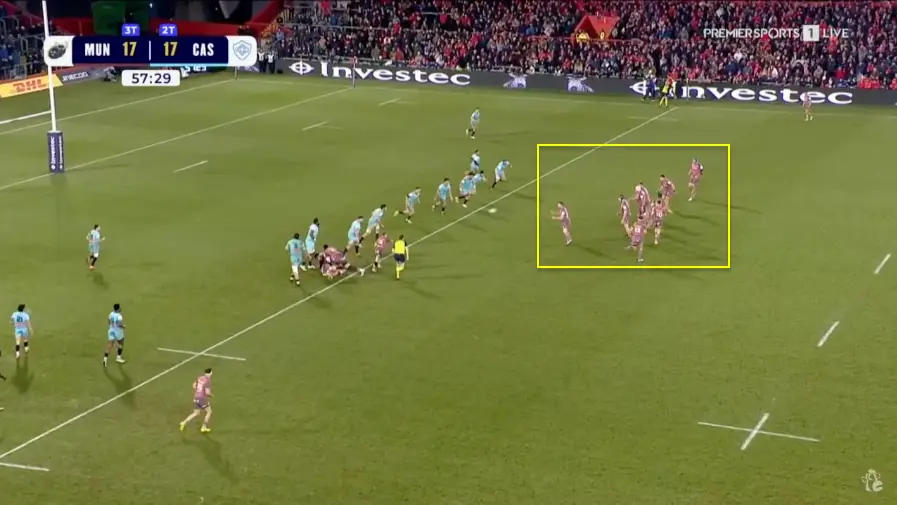
You could see us trying desperately to get a bit more depth as the play continued, but it felt like every pass, every carry, had a defender in the throat of every action, so every pass, every carry, was under pressure.
Everything in this game is connected. Your exits relate to your defensive transition and your defensive lineout. How you choose to defend those determines how quickly and how efficiently you get the ball back, and where.
Your behaviour with the ball, and how you choose to cede possession of it and where, relates directly to your phase shape and overall energy usage, which directly relates back to how you defend, and how efficiently you get the ball back. That’s the circle.
I would classify our defensive actions as broadly effective, but slow. We were really good at winning turnovers across the season, but you have to be awarded those, and I think we ceded too much ground to win them.
In possession, our attack, by default, had to be slow too. A flat attack relies on speed at the critical juncture, but to get to that point, you often need three, four, or five phases of relatively slow set-up possession to pull the defence where you want them.
Without functioning strike plays — we seemed to use our lineout to set up phase play structures, and use our scrum for scrum-half loop plays almost exclusively — it took us too long to move up the field, or we relied on an opposition kicking error to give us the look we wanted. We were a team who were built to play downhill, but our work on both sides of the ball rarely seemed to generate that against teams that kicked at volume, as Castres did in this game. In theory, that should work — we want transition, a team that kicks a lot should give us that, but where the kick landed mattered way more than it should.
Were we, essentially, baited into overplaying in our own 10m-22 zone by teams who knew what kind of defensive press we were vulnerable to, systemically? I think so.
For me, the lack of clarity comes back to this.
We needed too many defensive actions to force the turnovers we needed, and then, on the other side of the ball, we needed to play a very high-risk game, positionally speaking, to generate the downhill attack we were built to execute.
So what’s the solution?
On the face of it, it’s probably moving the go-zone further up the field — halfway and beyond, rather than 10m and beyond. Should 10m make a difference? In the modern game, I think it makes all the difference, as does the fact that we’ve been quite expansive around our own 10m line for the last few seasons. Teams know well what we try to play and where; I think this season showed us that our intent needs to change, either that or how we choose to execute it.
But it’s not as simple as just doing that and nothing else. Everything is connected.
If we’re going to kick more, we need to tackle lower and take the offload and quick ball risk that comes with that. If we’re going to kick more, we need a better scrum and defensive lineout. If we’re going to kick more, we need to be more effective and efficient with our strike plays.
Kicking begets more kicking, and you can’t just be set up for one part of that equation — you have to be ready for everything that comes with it.
