



I think 2025/26 was doubly frustrating in the end because of the promise it showed, but ultimately didn’t fulfil.
We can look at the start to the season, good as it was, even with the narrow margins, and see a team that “knew how to see out close games”. Then we can look at the middle block of games and see the opposite: a team that couldn’t see out those narrow games. Ultimately, I think that’s an expression of the same team being affected by internal conditions of the game, most often the scrum or, sometimes, the weather, or a team that approached us with a very specific kick-focused game. When we approached all three conditions, the margins often narrowed to a few small moments. If those moments fell our way, we tended to win. When they didn’t, we tended to lose.
A lot of incomplete teams fall into this bracket, and that’s what we were: an incomplete team with real, exploitable weaknesses against the elite and, in particular, sides that brought a specific, focused kick and pressure approach.
On the watchback, this falls back to two specific things.
First, our opponents using a high-volume kicking game to exploit our general lack of pace in transition and our propensity to overplay on post-transition and post-set-piece settled-phase possession. When combined with an early deficit — as we gave up in several fixtures — that would lead to a familiar scenario.
Teams kicking in the mid-to-long range against us — with a low kick to pass ratio — and then soaking up our subsequent phase play with a defensive style that ceded the ruck to us; stuffing us in contact and forcing mistakes.
| # | Match | Venue | Result | Margin | Opp PPK | Munster PPK |
|---|---|---|---|---|---|---|
| 1 | Scarlets | A | W | +13 | 1:7.7 | 1:6.9 |
| 2 | Cardiff | H | W | +3 | 1:4.5 | 1:4.8 |
| 3 | Edinburgh | H | W | +1 | 1:7.1 | 1:11.3 |
| 4 | Leinster | A | W | +17 | 1:17.9 | 1:3.3 |
| 5 | Connacht | H | W | +2 | 1:5.0 | 1:7.2 |
| 6 | Stormers | H | L | −6 | 1:3.4 | 1:3.7 |
| 7 | Bath | A | L | −26 | 1:1.6 | 1:7.7 |
| 8 | Gloucester | H | W | +28 | 1:3.6 | 1:7.6 |
| 9 | Ospreys | A | W | +16 | 1:9.3 | 1:6.1 |
| 10 | Leinster | H | L | −5 | 1:5.2 | 1:9.5 |
| 11 | Ulster | A | L | −25 | 1:8.8 | 1:6.6 |
| 12 | Toulon | A | L | −2 | 1:8.0 | 1:3.6 |
| 13 | Castres | H | L | −2 | 1:2.9 | 1:8.9 |
| 14 | Dragons | H | W | +2 | 1:3.6 | 1:6.0 |
| 15 | Glasgow | A | L | −9 | 1:16.7 | 1:6.8 |
| 16 | Zebre | H | W | +14 | 1:3.9 | 1:7.4 |
| 17 | Sharks | A | L | −45 | 1:3.6 | 1:9.7 |
| 18 | Bulls | A | L | −3 | 1:4.4 | 1:7.2 |
| 19 | Exeter | A | L | −10 | 1:4.2 | 1:13.7 |
| 20 | Benetton | A | W | +30 | 1:11.2 | 1:5.1 |
| 21 | Ulster | H | W | +27 | 1:25.3 | 1:13.1 |
| 22 | Connacht | A | L | −19 | 1:15.2 | 1:20.6 |
| 23 | Lions | H | W | +7 | 1:5.2 | 1:5.2 |
| 24 | Bulls | A | L | −31 | 1:9.4 | 1:18.7 |
The clearest example of this was our losses to Leinster and Castres in Thomond Park and then to Bath in the Rec, the Sharks in Durban, Exeter in Sandy Park, and Connacht in the Dexcom.
You could add in the narrow, troublesome, and late wins over Cardiff, Connacht and Edinburgh at home, and our narrow loss to Toulon in the Mayol, despite playing quite well in that one.
As I was watching the games back, I kept seeing what I was trying to express, but I couldn’t find a way to show it in a way that makes sense, or without loading up 30 clips.
It’s a familiar scenario.

Munster have the ball. Munster has most of the field, too. The territory bar and possession bars are mostly red, the entry count ticks upward — but the scoreboard refuses to move with it. I’ve circled those games all season as frustrating, to say the very least. But why?
Earlier in the week, I did the painful task of doing up our Net Efficiency for the season, and then it hit me in the side of the head.
What if there’s a correlation between the kicking data that I have and the efficiency data for the season?
I started with the question I wanted to answer: did the opposition’s kick-to-pass ratio predict anything? On results alone, it was barely anything. Munster beat kick-heavy sides and lost to them; they beat ball-in-hand sides and lost to them, too. As a standalone dial, the ratio we faced and the kick differential in the games was just static.
But lay it against points per 22 entry and the static resolves into something very specific — not about whether Munster won, but about how hard we had to work in the one area of the field that decides games.
First, let’s split the 24 fixtures by how the opposition chose to play. Against the thirteen sides who kicked more than they passed — the low-possession teams content to hand Munster the ball and the field — Munster’s net 22 efficiency was minus 0.88 points per entry. Against the eleven who kept the ball in hand, it was plus 0.85. That is a swing of better than a point and a half per visit to the opposition 22, determined by nothing more than the other team’s appetite for possession. Strip out the South African maulings and the medians say the same thing: minus 0.3 against the kickers, plus 1.2 against the rest. When a side ceded Munster the ball, Munster got less out of the territory and possession that kicking produced.
When a side tried to play, we tended to feed on that more often than not.

This is the mechanism behind every game that felt like wading through waist-high water. A team that kicks and defends with clarity and physicality is not trying to have a firefight with Munster from range; it is trying to burn out our possession game. And it worked.
The clearest illustration is the run of narrow home games against opposition we should have dispatched handily. Against Connacht at home, Munster won by two, with a net 22 efficiency of minus 1.5. Against the Dragons, won by two — net minus 1.5. Against Castres, lost by two — net minus 1.6. Three games, three kick-heavy visitors, either in general style or for that particular game, and in all three, we were out-converted in the red zone by around a point and a half per entry.
The kicking teams won the 22 battle
Each dot is a game: opponent passes-per-kick (left = kicks more) vs Munster’s net points per 22 entry. Shaded zone = kick-heavy opponents.
Munster 2025/26, all 24 fixtures. Kick-heavy = opponent 1:5.2 passes-per-kick or lower. Source: RugbyPass · Three Red Kings.
So how did Munster win two of them? Not by fixing the conversion rate. By volume. Sixty-six per cent territory against Connacht, sixty-five against the Dragons — Munster were in the opposition 22 so relentlessly that even a poor strike rate eventually outscored our opponents. The volume papered over the inefficiency. Against Castres, the same inefficiency went unpapered, and a side that took four of its four conversions and a penalty walked out of Thomond Park with the win, while our five tries to four counted for nothing. The margin between a scrappy win and a sickening loss, all season, was whether the entry count was high enough to survive the strike rate.
That is why the 22 battle, unlike the kick-to-pass ratio, predicts results almost cleanly. When Munster won the points-per-entry battle, we went 9–3. When we lost it, 3–9. And the three games we stole while losing that battle — Edinburgh by one, Connacht by two, the Dragons by two — are precisely the narrow home wins over kicking sides I’m talking about. The exceptions to the rule are the rule’s own evidence.
None of this means kicking sides were automatically our undoing. The kick-heavy group splits hard on quality. Against the weak ones, Munster’s volume was the difference: plus 2.0 a visit against a dud Gloucester side, plus 1.3 against a limited Zebre side, the win flowing late in the second half once the defence finally cracked.
It was the well-drilled kicking sides who turned the tactic into a weapon — Sharks at minus 5.0, Bath at minus 4.3, Exeter at minus 2.1, Castres at minus 1.6. The Sharks’ afternoon is the season’s nadir on every axis: five entries, zero points, five conceded per opposition visit. A team that kicks well and defends its 22 with efficiency and physicality caused us endless trouble.
The season closed at minus 0.05 points per entry across all competitions — a campaign that finished, by the finest margin, on the wrong side of break-even in the red zone, and it was a quarter-final landslide in Pretoria that tipped it under.
The reality of it is, Munster were a fine red-zone side against teams that wanted to play — who we would tackle to a standstill, and then turnover — and a vulnerable one against teams that didn’t. The attacking efficiency was there, 2.34 per visit, comfortably built on chances created. What drifted was the conversion of those chances against sides whose entire plan was to dare us to break them down — and the goal-kicking and ball-security that should have closed games out let us down.
If there is one line for the off-season, it is this. Munster spent 2025/26 showing that teams that beat us had already worked out that when we had the ball, that was exactly where they wanted us to be.

In a way, this is a repeat of what I showed in the first article, just with a little more context. I think it shows, again, that who we wanted to be was exactly the team that a lot of opponents wanted us to be. Ideally, that wouldn’t be the case.
We clearly wanted to be a possession team — or seemed comfortable slipping into that game, at least — but our opponents, more often than not, encouraged that.
When Clayton McMillan spoke about “clarity”, I think this is part of what he was talking about. A team with the best turnover rate in the URC were stymied by teams that ceded us the ball at a higher rate than we did — which makes sense — but that’s apparently what we wanted. Last season, we spent a lot of time and energy figuring out what we wanted to be in the period before and after Rowntree’s departure. One of the big flashpoints before Rowntree’s departure was his apparent desire to move to a game less focused on possession, a point of disagreement with the rest of the coaching unit.
We felt, perhaps rightly, given our personnel and build to that point, that we had to stay the course. This season, we seemed to start with a more conservative plan. Our kick-to-pass ratio stayed pretty conservative for the opening three games, with the Edinburgh home game something of an outlier as we spent most of the second half chasing a nine-point deficit.
Then came the Leinster game; an off-ball, counter-punch masterclass where we consistently handed Leinster the ball, defended them to a standstill, and then hurt them over and over again on limited opportunities.
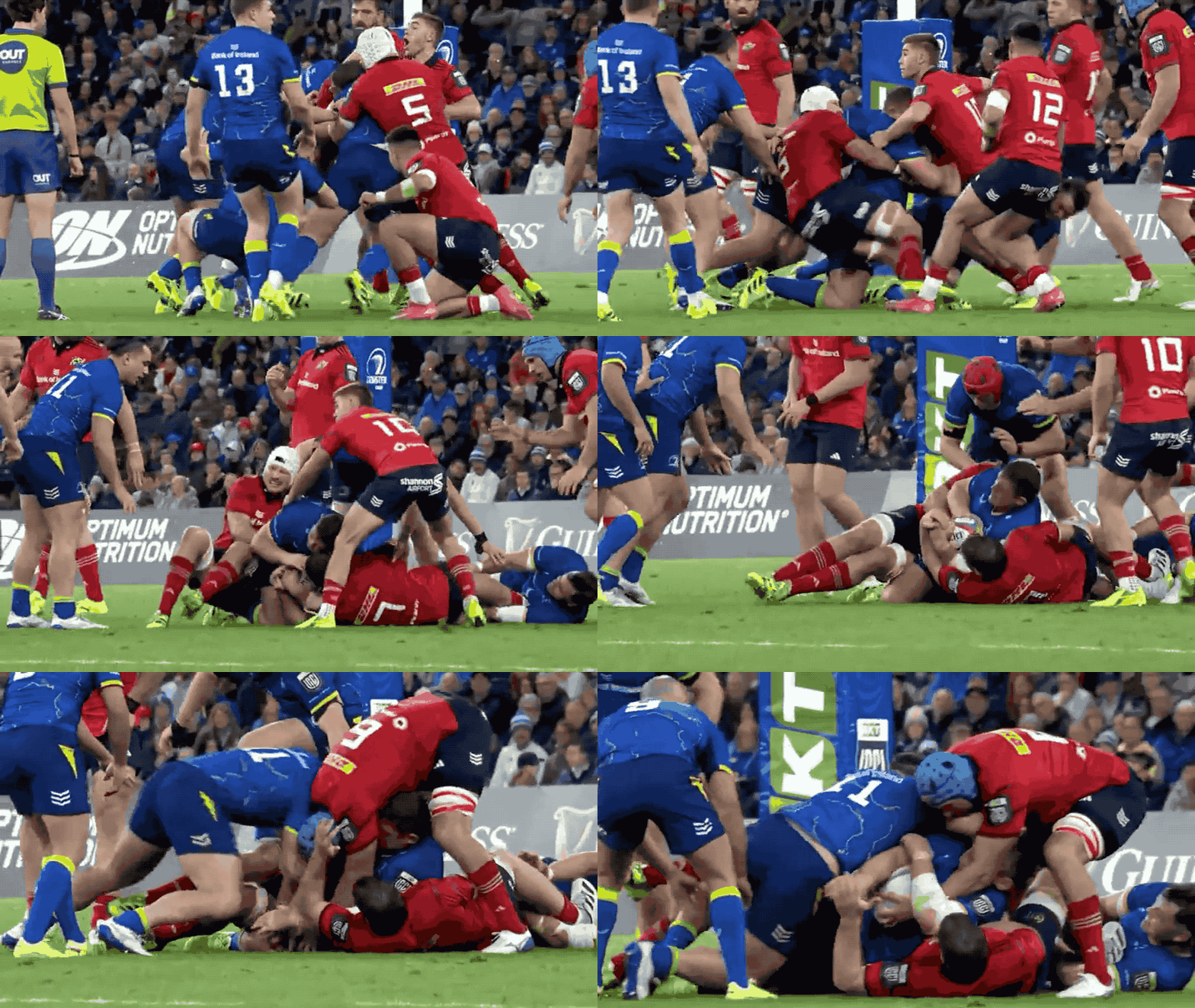
After this game, it felt like we saw something that worked at an elite level against elite opposition, but then seemed to move away from it, gradually as we headed into November and December.
You can see it clearly when we plot it into chronological order.
When the pattern settled in
Running (cumulative) average of Munster’s net points per 22 entry, split by how the opponent played. The two lines part early and lock into a steady gap from the Castres–Dragons games on.
Munster 2025/26, fixtures in season order. Kicking team = opponent 1:5.2 passes-per-kick or lower (13 games); ball-in-hand = above 1:5.2 (11 games). Source: RugbyPass · Three Red Kings.
It’s almost like we used the November break, with the incoming Champions Cup block, to change tack. Or is that unfair?
Did we lose kicking battles because we fell behind on the scoreboard and felt we had to chase the game with the ball in hand? Or were we playing broadly in windy conditions — far more often than you’d think — where we’d have to hold the ball for one half, and then kick more freely in the next or vice versa?
Either way, the pattern forms early. By the fifth game — Connacht at Thomond Park, the first of the narrow home wins over a side content to kick and sit — Munster’s running return against kick-heavy opposition had already dipped below the break-even line in the 22, while their return against ball-in-hand teams sat comfortably above it. The two populations were pulling apart before the leaves had turned.
Then, for a spell, the doubt crept back. Through the away block, either side of midwinter — the Ospreys, Leinster at home, Ulster away, the loss in Toulon — the gap narrowed. A couple of flat games and a defeat to a side that liked the ball were enough to make you wonder whether the early trend had been a trick of the small numbers. For four or five games, you could have written the opposite article.
What ended the argument, for me, was the December double at home: the Castres defeat and the Dragons win, back-to-back, both against teams that handed Munster possession and territory and dared them to convert it. In both, Munster lost the points-per-entry battle and won only the territory and possession count — and those two results dragged the kick-heavy average back down for good. From that fortnight to the final whistle of the season, the two lines never crossed again. They ran parallel, a steady gap of around a point and a half per 22 entries, through the South African trips, through Exeter, through the run-in. The vulnerability had hardened from a tendency into something resembling a statistical fact
A note of context, too. Early in a season, each category holds only a game or two, so the wild early swings — the lurch after Bath, in particular — are noise, not necessarily tactical outcomes I can definitively point to in the data like I’m Columbo about to leave a room. Just one more thing. The fair reading is not that something broke in Munster’s game around the midpoint; it is that by the midpoint, there were finally enough games for the data to stop wobbling. Castres and the Dragons did not create the pattern. They were simply the week that it became undeniable, even allowing for the weather conditions in the Dragons game specifically.
This was also the period when the players, reportedly, demanded more clarity from the coaches on what we were trying to do — specifically after the Castres loss, given how damaging it was to the season at large.
After the January block was finished with a loss to Glasgow — a decent performance with a depleted side away from home in context — there was time for the coaching group to reflect and rebuild. Without wanting to juxtapose two things that might be unrelated, Mike Prendergast handed in his notice in the weeks that followed before the game against Zebre in late February.
Make of it what you will. The numbers and the dressing room had circled the same game — Castres — and in the weeks after, the man in charge of the attack announced he’d be gone by summer. That isn’t proof; coaches move on for all sorts of reasons, and his might have had nothing to do with any of this.
Were the supposed philosophical differences between McMillan and Prendergast rooted, in part, in what this data shows? I won’t leave it open-ended. I think it did, or at least played a part.
What is this data actually saying, though?
On the face of it, it says that Munster were less efficient when we played teams who kicked at a higher rate than we did. We were less efficient on our own entries and conceded more. That is then inverted for teams who kept the ball in hand against us.
| Against… | Munster pts per own 22 entry | Pts conceded per opp entry |
|---|---|---|
| Kicking teams (13) | 1.95 | 2.83 |
| Ball-in-hand teams (11) | 2.76 | 1.92 |
That, to me anyway, says clearly that we would be better as a kick pressure side, and that if we had a fully functioning scrum and lineout, that it would put us into a much higher conversation than we were this season. Now, the context here is that the good teams we faced happened to be kicking teams — either in general, or specifically against us — so that dragged the conversion rates into the negative for us. At the same time, though, that shows something too.
In a general sense, teams were very comfortable kicking to us at volume and then handling whatever came after that. Our transition work was good, but it would need to be elite. I think, at a very functional level, we weren’t fast enough to be as elite as we needed to be, or as creative across the backline.
This is a profile issue, too. Outside of Jack Crowley, we don’t really have any two-way threats anywhere in our outside backs — physical runners and creative passers or kickers.
We have good relief kickers (O’Connor, Haley), but neither is overly creative with the ball in hand as passing threats. Our system under Prendergast liked to loop in runners from the edges to provide passing options for Crowley or Hanrahan, but that was less effective than in previous seasons, either because of injuries in the backline — Nash, in particular — or due to opposition analysis.
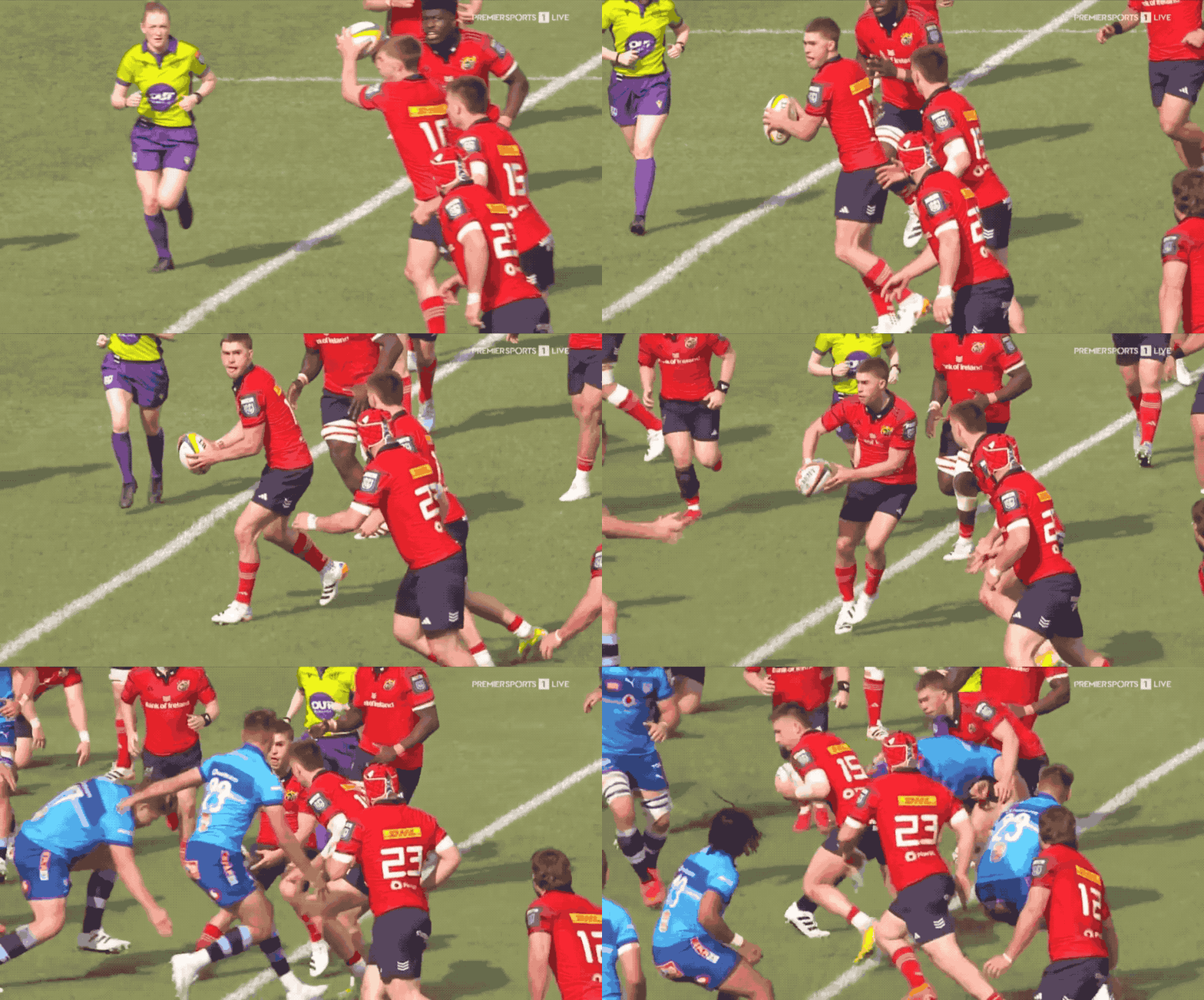
The Crowley issue is worth looking at, too, albeit with context. His injury run at the end of the season, plus the knock he suffered for the Bath game, blow the numbers up here a little. He was mostly unavailable for some of our hardest fixtures, or for ones where we clearly rotated, like Ulster away.
Even then, the numbers are worth looking at.
| Crowley Status | Games | Mean net 22 eff. | Median |
|---|---|---|---|
| Crowley featured | 12 | +0.60 /entry | +0.85 |
| Crowley absent | 12 | −0.78 /entry | −0.9 |

If Crowley is our best outside back and primary creator, it makes sense that we’d be worse without him, even in a team that’s broadly malfunctioning and even allowing for the context that he was missing for Bath (a), Ulster (a), Sharks (a), Connacht (a) and the quarter final against the Bulls (a). But were those heavy defeats going to happen with Crowley regardless, or were they lopsided results because he wasn’t there?
Munster’s 22 efficiency, with and without Crowley
Net points per 22 entry in each of the 24 games, shaded by whether Jack Crowley featured. A clean 12–12 split across the season.
Munster 2025/26, all 24 fixtures in season order. Availability from all.rugby game sheets; Crowley unavailable for the four games after Benetton. Source: RugbyPass · all.rugby · Three Red Kings.
With Crowley in the side, Munster averaged 10.2 visits to the opposition 22 per game; without him, 8.0. So we got into the 22 about two more times a match when Crowley played. The medians are closer (9.5 vs 9.0), which tells you the means are being stretched by a few big-entry games at one end, but the direction holds either way.
So the Crowley factor is a thing. It just is. We are plainly — both watching the games back and looking at the data — significantly better with him in the team. His injuries this season, especially for the run-in, were something of a disaster because while Hanrahan didn’t do badly in his stead, this is a team built around Jack Crowley and what he does well.
The data says we were less efficient against kicking teams in general, but the video tells us that was especially true against teams that kicked at volume with a defence that prioritised numbers in the line as opposed to pressurising our breakdown.
What this tells me is that we need a rethink offensively with regards to our shape, the depth we play at and how long we play with the ball in hand; how we use possession, essentially. Teams will continue to kick at us next season because, as far as they’re concerned, not much will have changed. We have to make sure we can exploit that, especially if our reliance on Crowley isn’t going anywhere soon.
That has to be tempered with a more expansive kicking game, which will need a backstop of a better scrum, lineout and maul.
Fundamentally, we have to make teams wary of kicking to us, either through improved transition play, a better set piece, or a kicking game that tilts the pressure back on opponents more regularly.
