


Steve Borthwick’s England aren’t what you think.
It’s fashionable as of late in the Irish media to look at England’s kick-heavy game and decide that they “don’t want to play rugby” or some other nonsense, so hopped up freshly ground hubris are some of our pundits and journalists. But it’s not just our gobshites at it. The English media have been pissing in their own sleeping bag for the last two weeks since their loss up in Edinburgh.
Why?
Kicking.
Well, that’s not fully true. It’s kicking mixed with losing – a heady brew if woe is your drink of choice.
There is nothing as divisive in the modern game of rugby as playing the game with a kick-heavy focus, especially a box-kick-heavy focus. Seeing a scrumhalf setting up a caterpillar ruck 10+ times in a game is like watching someone try to eat steak through a paper straw. It’s boring. You’ll find no argument from me on that one. I’m not trying to convince you that what England are trying to do at the start of this cycle is great to watch, but I will try to explain why they are playing the way they are, what they are trying to do and what they aren’t trying to do.
Ireland are the raging hot favourites for, not only this game but also to win back-to-back Grand Slams, something no team has ever done in the history of this tournament.
These are halcyon days. The World Cup is in the rearview mirror now – it has to be – we can’t change it, we can’t do it over and Ireland have moved on with a new pack build, a new bench configuration and a new #10 who has taken to the Big Jersey with ease. Twickenham will be a different challenge, it always is, but these are the days we have to cherish. It sometimes feels like Irish Rugby is living in the shadow of giants and that any sustained success we have is done so while one or both of them sleep.
Garrett Fitzgerald, the legendary Munster CEO, said in the late 2000s that when Leinster got their act together with their schools and pathways, everyone else in Ireland was going to have a hard time. That’s because he understood that rugby is a game of numbers. You can only have 15 on the pitch at any one time but your demographics, the wealth of the game and how you funnel those numbers up to the elite level determine success more often than not. Put simply, if you have more people playing the game and the funds to properly track them on the right pathways up to the senior level, success is almost inevitable if you make good coaching decisions at the elite level.
The big fear for Irish Rugby is that England get their act together in this regard, as France did under Fabien Galthié, and begin to make the weight of their playing population count consistently. Imagine England’s first two years under Eddie Jones post-2015 combined with the first two years of Fabien Galthié’s French revival, all while Warren Gatland builds Wales with a free hand.
This is the big fear. Our cycle at the top of the game from 2017-2018 with a dip in 2019-21 before returning to the top table from 2021 until now comes to an end. The wheel always turns in this game. Sometimes it turns slowly, but it’s always moving. We slow the turn by winning relentlessly, over and over again and heaping pressure on our opponents while they’re down. Put the boot on the neck and never let up so they continue to chop and change and flounder. Elite-level rugby is as much about oppressing your rivals as much as it is about improving yourself.
That’s how we keep our spot.
Keep the boot on the neck.
Ireland: 15. Hugo Keenan; 14. Calvin Nash, 13. Robbie Henshaw, 12. Bundee Aki, 11. James Lowe; 10. Jack Crowley, 9. Jamison Gibson-Park; 1. Andrew Porter, 2. Dan Sheehan, 3. Tadhg Furlong; 4. Joe McCarthy, 5. Tadhg Beirne; 6. Peter O’Mahony (c), 7. Josh van der Flier, 8. Caelan Doris.
Replacements: 16. Rónan Kelleher, 17. Cian Healy, 18. Finlay Bealham, 19. Iain Henderson, 20. Ryan Baird, 21. Jack Conan, 22. Conor Murray, 23. Ciarán Frawley.
England: 15. George Furbank; 14. Immanuel Feyi-Waboso, 13. Henry Slade, 12. Ollie Lawrence, 11. Tommy Freeman; 10. George Ford, 9. Alex Mitchell; 1. Ellis Genge, 2. Jamie George (c), 3. Dan Cole; 4. Maro Itoje, 5. George Martin; 6. Ollie Chessum, 7. Sam Underhill, 8. Ben Earl.
Replacements: 16. Theo Dan, 17. Joe Marler, 18. Will Stuart, 19. Chandler Cunningham-South, 20. Alex Dombrandt, 21. Danny Care, 22. Marcus Smith, 23. Elliot Daly.
At a base level, England do not want to play anything more than two phases in their half of the field in settled phase play. Their average ruck speed inside their 22 is 10.80 seconds. Why? Because they mostly box kick in this position so do not need quick rucks.
Between their 22 and the halfway line, their average ruck speed is over seven seconds. Why?
You know why.
They do not want to play ball in this zone – or even much outside the opposition’s 10m line – so they will either box kick off #9 or hang a high diagonal contestable kick by Ford to the 15m tramline. Borthwick’s England are massively data focused so they have cut out all the “inefficient” actions that teams take in areas of the field that don’t lead to scoring points.
Playing multiphase sets in your half of the field is, from a purely data-focused perspective, completely inefficient when it comes to doing the things that win games – scoring points and avoiding conceding points. It’s stupidly obvious but, from a data perspective, playing multiphase sets inside the opposition’s 10m line is unlikely to lead to point-scoring opportunities, with the likelihood of scoring points dropping the further back into your own half you go. Data says that you are, in fact, more likely to concede points in that scenario.
Go back to last Friday night and look at Munster conceding a try on phase 6/7 of playing around the halfway line after a ball went to ground; Borthwick has made a decision on style that means mistakes like that can never happen to England in that area of the field because they will always have kicked it multiple phases before.
Quite simply, England are kicking the ball more than anyone – more box kicks and up-and-unders than anyone else in particular – while also kicking shorter than anyone else. They are also, you won’t be surprised to hear, passing the ball less than anyone other than Scotland. They have a kick-to-pass ratio of one kick for every 4.2 passes, which is the second lowest after Scotland, who have one for every 3.3 passes. Scotland are kicking more than England, they’re just kicking longer and mostly off #10 so their kicking doesn’t feel the same to the viewer.
England, when they play at their best in their current set up, give you absolutely nothing to work with and kick into really awkward areas of the field. Here’s a good example where they have a two-phase strike play designed to engineer an up-and-under targeted at the the Scottish scrumhalf.
It almost works out – #14 Freeman takes too much out of the ball after they win it back – but you can see the principles they’re playing under. The lineout is designed to lead to a contestable kick from around the 10m line, they have a distinct target they want to isolate and they have designed for Sam Underhill and Ollie Chessum to contest the ball if the Scottish scrumhalf takes the ball.
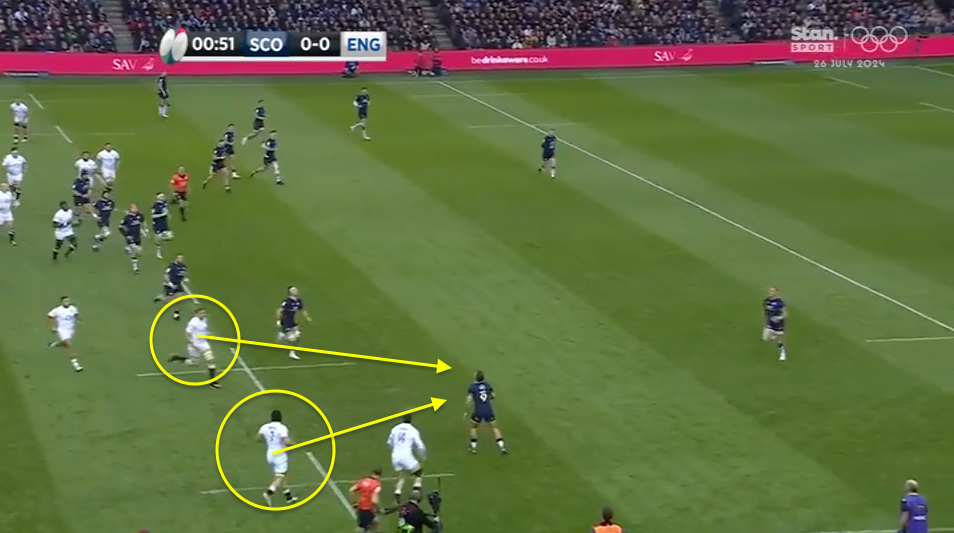
Either Freeman will win the aerial contest, in which case Underhill and Chessum secure the ruck or Ben White wins the ball and Underhill/Chessum force a turnover at the breakdown or they can shove him into touch or there’s a knock-on and England get a scrummage they can go after.
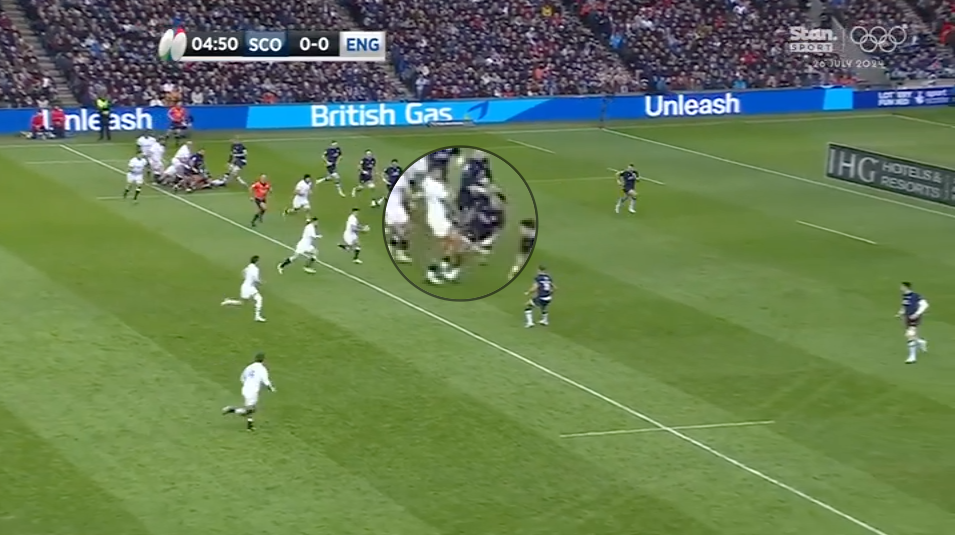
When England get a scrummaging position in and around the 22, they can be really efficient in taking their scores. Look at this nicely designed strike play that lead to their first score against Scotland.
It’s the one time you’ll see England passing short. The key to this play was a nice block line off the first receiver to set up a cascading series of gaps as the play developed. Look for Slade or Lawrence to do the same to Aki in this game.
Ultimately, I think the big lesson England will have learned from their defeat to Scotland is to be smarter when it comes to the usage of their core concept. England are a team who are focusing on three main areas at the moment at the expense of all others.
Defence, Offensive Transition and Set Piece.
They have conceded the most amount of tries from counter-attacks in this year’s Six Nations so far purely because of the two counter-attack tries they gave up against Scotland. The first one was because they are still learning how to play this style consistently. In this instance, England won the ball back inside the Scottish 10m line so they decided on-field to go into attack phase play in transition. Knowing what we know about their style, what did they do wrong here?
When they won the ball back, Scotland did a really good job of slowing up the first ruck on transition, to the point that the only move for England to make – the only on-scheme move – was to kick contestably to pressure Scotland in their 22 with the position their defence had earned.
This is a dead offensive transition. The ruck took 10.86 seconds to complete and Scotland were completely set defensively.
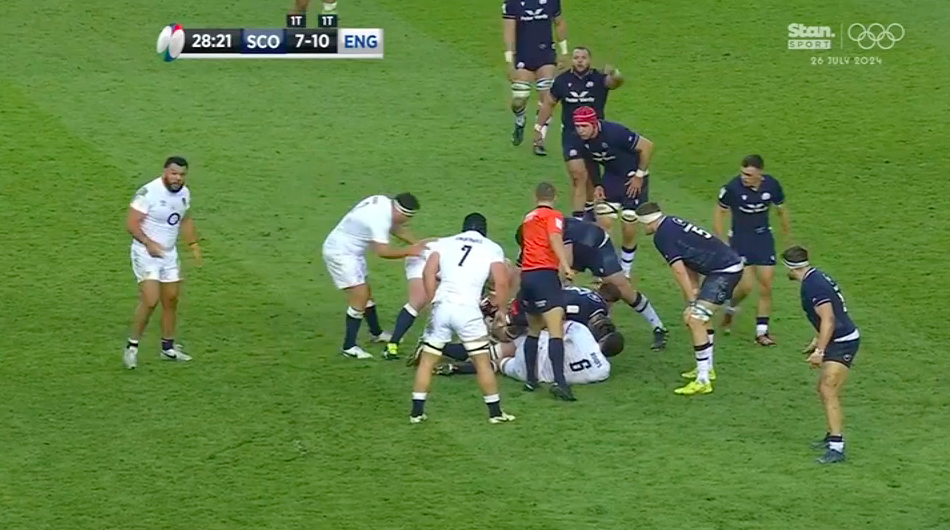
Ford called for the ball and went after some attacking phases – likely under pressure himself to “make something happen” after Scotland scored a try to narrow the gap to 3 points – but he needs to be comfortable just kicking this at Finn Russell in the backfield and… seeing what happens.
Instead, I think he’s fooled by these defensive spaces that aren’t really there.
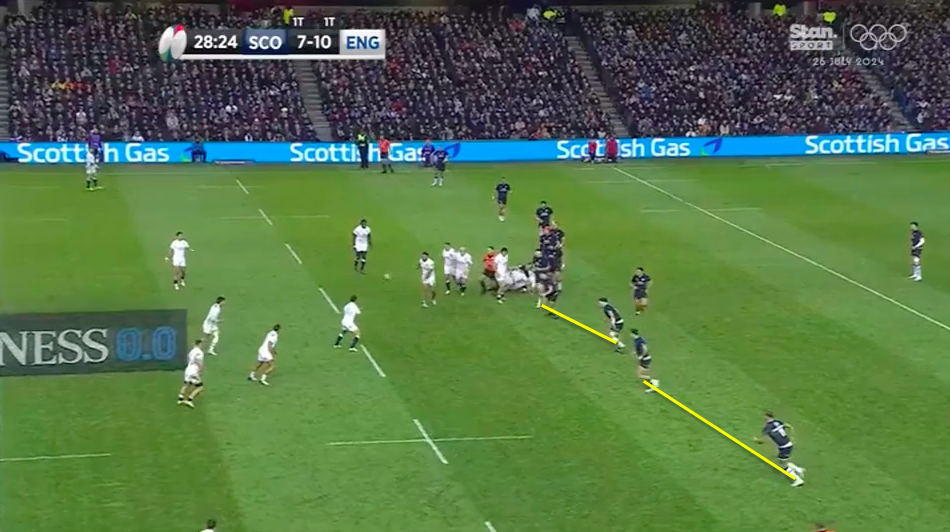
When we run the frames on, we can see Finn Russell was guarding the backfield and there was an opportunity to run Freeman directly onto him with Earl and Lawrence chasing hard behind him.
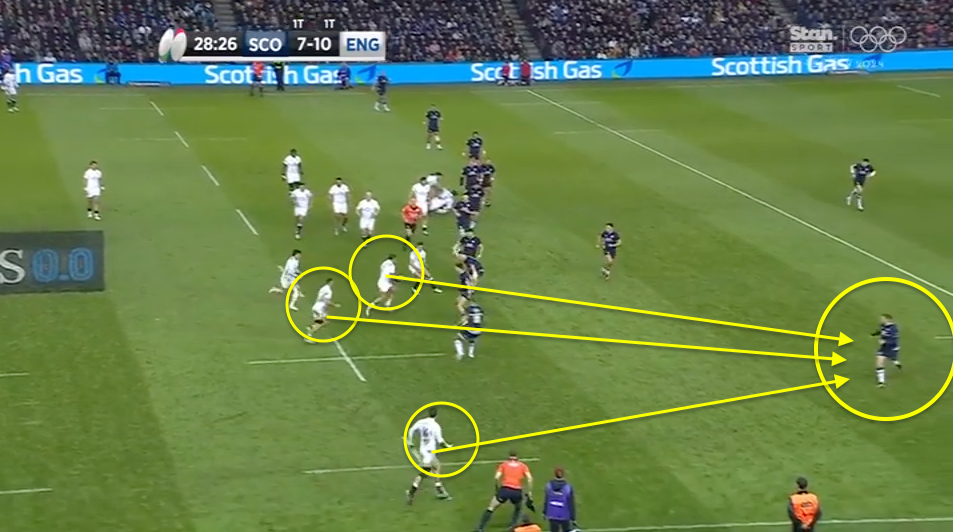
That is on-scheme for this England team. Instead, they hit a dopey phase that takes over five seconds to recycle, before going through some rudimentary phase play that ends with a turnover and a killer try for Van Der Merwe. They will have learned their lesson when it comes to this game.
In the last game, I was sure that Wales would play a shortened kicking game to pressure Ireland’s back three under the high ball and take the scrummaging load that came with it. Instead, they kicked way less than the previous two games and way longer on average. They gained 33m of territory on average per kick against Ireland because I think they wanted to keep us at arm’s length and reduce the scrummaging load, given their problems there in the previous two rounds.
England’s average territory gain per kick is 23.1m – the lowest in the Six Nations – because they kick to contest almost every single time.
This brings the focus back to Ireland’s high-ball work IF England can maintain a platform to kick, pressure and harry us as we go into our on-ball sequences. Wales didn’t have a platform to play but England will, or should, I think.
That will bring our offensive transition work into focus – can we evade England’s chase pressure? Can Nash, Keenan and Lowe stand up to the bombardment? If we have 10+ scrums in this game, can we hold up against a side that have picked a three-lock starting pack specifically to bully us at scrum and in tight defensive contact? The answers to those questions will determine our comfort levels in this game.
