


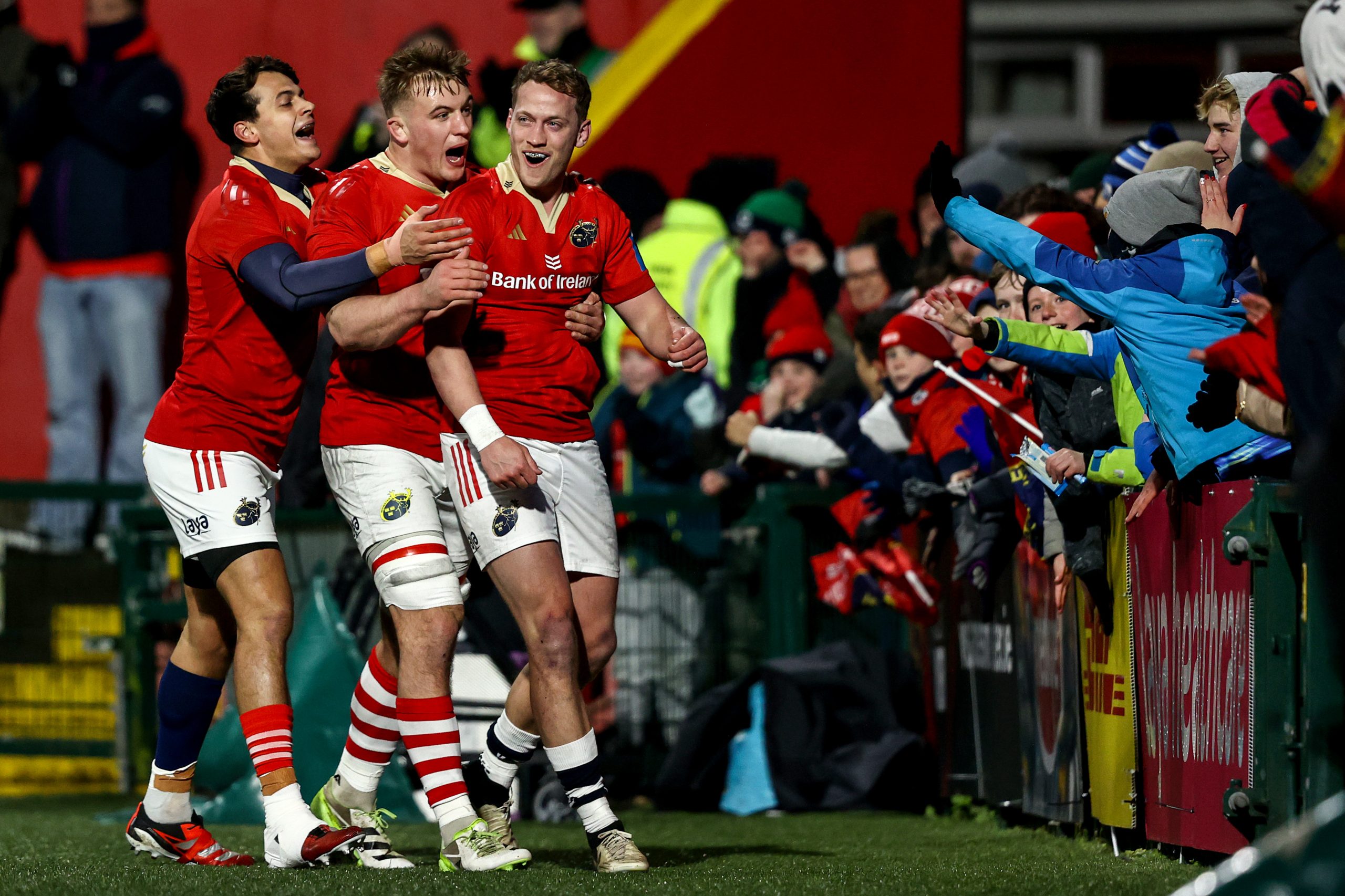
The headline take from this game is this; seven tries, five match points, and no injuries that we’re aware of as of the time of writing.
That’s as good as expected during a down week in the Six Nations. Yes, things got a little scuffed in the second half – and we’ll look at why – but, on the face of it, this was ideal for the bounce into the rest of the season. There’s enough good stuff to give the players real confidence albeit with enough errors to anchor them for the hardest game of the block against the Ospreys in Swansea in three weeks. With some handy results elsewhere we could finish Round 12 clear in fourth – the home playoff spots – so the only really important thing from this game was that we took the maximum from it.
Let’s focus on the positives first with another big take; this Munster side is playing some of the most intricate, ambitious and high-skill offensive rugby I have ever seen this province play. In this game, we kicked the ball 17 times total against 281 passes. That gives us a ratio of one kick every 16.5 passes with a pass-per-carry ratio of 1.65.
Simply put, Munster kicks the ball way less frequently than most other teams in Europe so they can play high pass volume multi-phase possession rugby that goes against all the conventions of how winning rugby is supposedly played in 2024. Munster won the URC playing this way last season and we’ve doubled down on the concept while also using some of our unique athletes to create brand-new attacking concepts you’re not seeing anywhere else.
For example, look at this lineout strike and tell me what you notice about it.
Thomas Ahern – our starting second row – is running a full orbit loop line from one tramline to the other to show up on the second phase as the extra man on the edge of the play.
He starts in the middle of the lineout and then sets off on a deep loop run as Frisch runs that Y-Line off Butler to open a window for Nankivell to punch the ball up with Quinn in support.
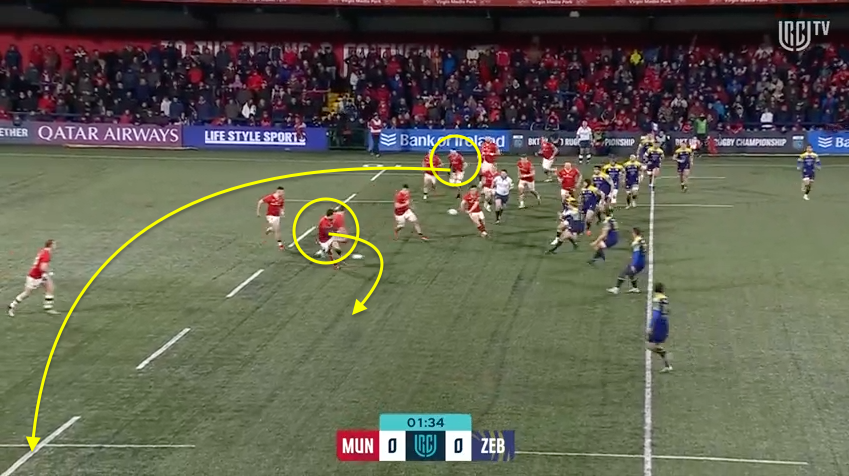
As Scannell and Coombes come around the corner, Casey splits them with a pass to Butler, who has Frisch, Haley and Daly running a pod with Ahern lurking deep in the fourth layer of the attack.
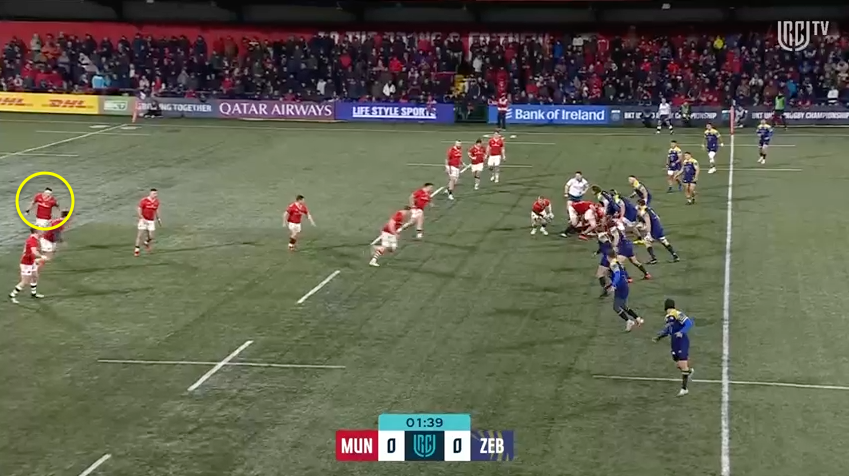
That sets up a sweep around the corner where the killer overload arrives right as the pass goes to Daly – it’s Thomas Ahern, all 6’9″ of him – hitting the line at pace with O’Brien outside him.
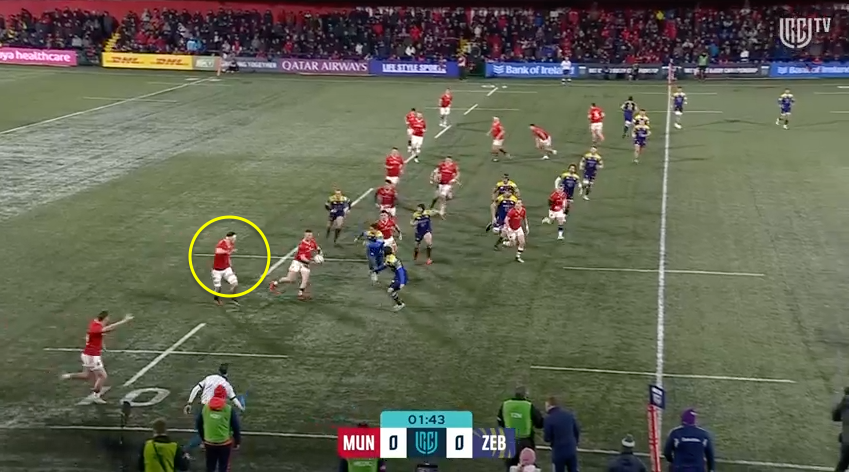
The pass isn’t what it needed to be here but this play – a two-phase strike play off the lineout with a Y-Slip off #10 and a deep loop by the #4 lock off a screen pinch in the opposite 15m tramline – is not a play that is easily duplicated by other clubs at the moment. With a little more go-forward and quick ball on that first phase, I see Ahern breaking up the wing for a try directly off the second phase.
Ambition.
You’re thinking that something about that above clip looks familiar. You’re right! Munster’s opening try was a variant of this with RG Snyman – our other lock – running a loop line off the maul to show up on the edge on phase 3 off a maul break.
That offload off the ground to Ruadhan Quinn is the kind of thing that is unique to Snyman but it’s the concept to have him running this line at all is interesting. By the time he hits the line, he’s running at a prop and a winger; his unique skillset does the rest but look at the options running off him. Alex Kendellen, Ruadhan Quinn or Shane Daly could have taken that ball. Quinn did in the end, and finished strongly, but the fact there were three legitimate try scoring options for Snyman to pick out is the kind of offensive rugby that brings people along for the ride.
Look, I’m well aware it’s a test window Zebre Parma we’re talking about here but I’ve seen Munster beat plenty of teams during test windows under previous coaching regimes – Van Graan, Erasmus, Foley and Penney – and it never really looked like this game did at times.
For most of the first half, we looked unplayable.
This is a long video but please look at it – Munster went from their own 22 to the opposition 5m line in one sequence of phases. There was an offside that the referee ignored right at the end – Zebre only conceded three penalties all game – but that ambition to go from one end of the pitch to the other while flowing through that 3-3-X shape with our back-line linking up everything is outstanding rugby.
That’s nearly two minutes of Ball-In-Flow rugby where the opposition doesn’t have the ball. It all starts on that exit with so much moving depth in the second and third layer that Zebre have to stay flat until it’s too late and we’ve already broken out. On the next phase, we’re reading what Zebre are showing us with the depth of their defence on different phases.
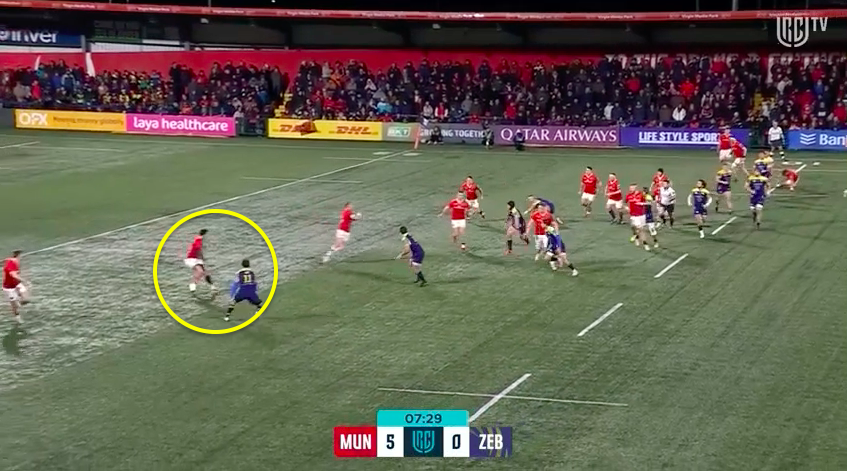
Their #11 Gesi advances on a high-edge blitz so we know not to play that – we adjust by attacking back against the grain through Haley. This ability for the attack to read and react to high-edge blitzes will be very important as the season develops.
At times, though, it felt like the early success we had running around Zebre had us chasing ever more complex passing networks – especially in the second half.
After the game, Graham Rowntree spoke about how he asked Munster to be “ruthless” when it came to putting Zebre away at half time and it felt like the players saw what tore Zebre up in the first half so we doubled down on that to… mixed results.
Rowntree also spoke about One More Ruck in that presser too which is basically – maybe every phase doesn’t need to have two or three or four passes before a ruck. Maybe sometimes the right decision is to… truck it up and go again. In the second half, a lot of our work in phase play was a little forced and a little overly complex at times.
But I can’t be too hard on these because for every tip on that got snagged or pass that maybe should have been a carry, it was that intent to ball out that created some of the outstanding tries we saw in this game and some of the opportunities that should have been tries.
Shane Daly will still be kicking himself that he didn’t convert this opportunity, for example, but look at the quality of the handling and improvisation in the build-up.
The offload is so well taken by Haley there but look at Scannell’s shortened loop line tailored to attack up the lane of O’Sullivan’s carry.
I would take a game like this – where three of Zebre’s four tries game off the back of Munster handling errors – to help bed in an offensive system as complex as this. We needed to maybe be a little more conservative with our intent at times relative to the spacing Zebre were showing us – especially off #9 – but we know that when this system hits, it rains tries with a system that, by design, makes opposition possession incredibly expensive.
As the ground hardens and the weather becomes more settled, what we saw in parts here suggests this is a team that can beat anyone – anyone – on their day. We just need to make sure those days show up when it’s important.
| Name | Rating |
|---|---|
| Josh Wycherley | ★★★ |
| Niall Scannell | ★★★★ |
| John Ryan | ★★★ |
| Tom Ahern | ★★★★ |
| RG Snyman | ★★★★ |
| Ruadhan Quinn | ★★★★ |
| Alex Kendellen | ★★★★ |
| Gavin Coombes | ★★★★ |
| Craig Casey | ★★★★ |
| Tony Butler | ★★★★ |
| Shane Daly | ★★★ |
| Alex Nankivell | ★★★★ |
| Antoine Frisch | ★★★★ |
| Sean O'Brien | ★★★★ |
| Mike Haley | ★★★★★ |
| Eoghan Clarke | ★★★ |
| Jeremy Loughman | ★★★ |
| Stephen Archer | ★★ |
| Fineen Wycherley | ★★★ |
| Jack O'Sullivan | ★★★ |
| Ethan Coughlan | ★★★ |
| Rory Scannell | ★★★ |
| Ben O'Connor | DNP |
