



Rugby in 2026 is rewarding the old ways. This is what World Rugby has been legislating for, and what your eyes have been telling you. Not just this season, I should be clear; this has been obvious since the last World Cup and, with the next one around the corner, the instructions are clear. You either have a scrum and maul that can win you games, or you don’t, and you’ll usually lose them.
For a time — I would argue from 2020 until this summer — it was possible to play around this fact with a variety of set piece gimmicks, but the new (old) maul law tweak has cut off the last avenues of escape. You could, after all, get pumped in the scrum and then make the ensuing penalty lineout and maul so much of a mess that converting it became a lottery.
You’ll remember this one from the 2023 World Cup.
Ireland sacked the maul on the try line and beat the Springboks as a result.
You’ll notice, immediately, that Ireland stopped this via means that would result in a penalty in today’s game.
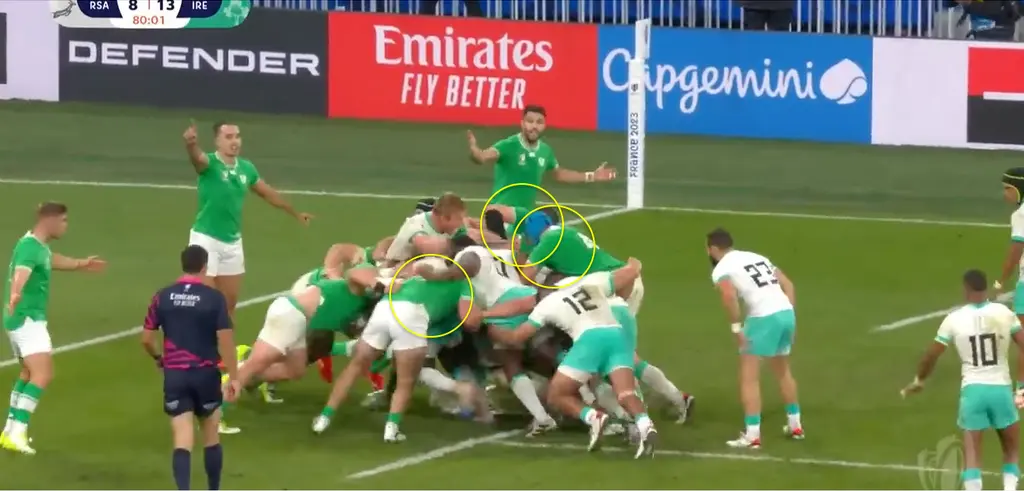
There are three, maybe four penalties to South Africa here under today’s laws — and arguably one or two back then — but that’s the core difference.
You could get smashed up in the scrum, and Ireland often were, but this is a good example of how you could mitigate against it. South Africa had the size here, and more numbers, but Ireland were choking this maul at the flanks. Beirne and Henderson had used their initial binds to swing up the side of the maul to pull at the drive section, with the front of the maul driving into the lift section.
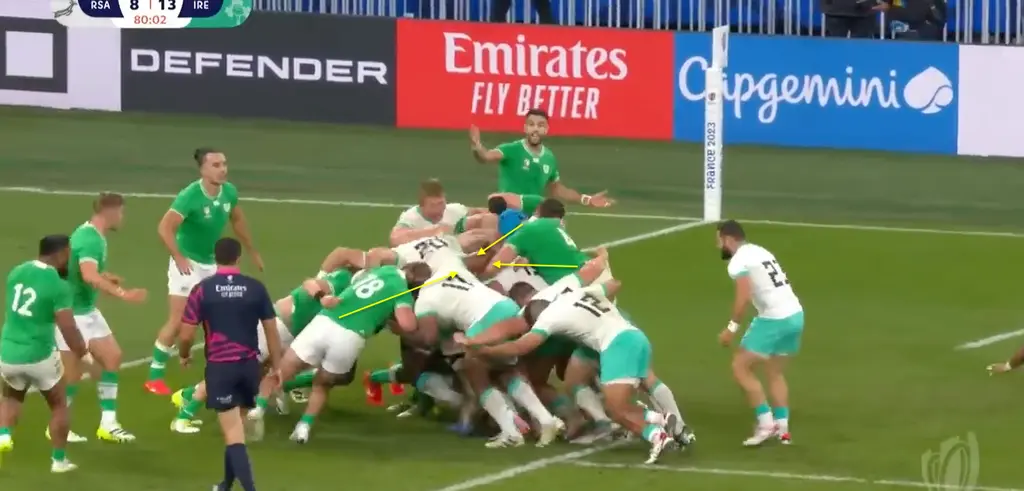
The Springbok maul was feeling repelling pressure at the front of the maul, and their power in the second layer was being pulled away from the direction they wanted to push. When it came to it, there were three South African players driving in the main engine of the maul, against four Irish defenders.
This is no longer possible with the majority of referees — although they still have to call it.
As a result, the sequence of scrum > penalty > lineout > maul > try or further penalties and possibly cards is now the “easiest” way to play this game. And what is easy will be done.
A few things have become incrementally more valuable now, as a result. The scrum was incredibly powerful; now it’s even more so. A scrum that can win penalties and prevent the opposition from doing so — almost as important — has never been more important.
A good maul is, obviously, a requirement, but what counts as a good maul has changed. Last season, you needed to have a maul that could drill through flank “swimmers”, which, against well-drilled teams, was verging on impossible.
Teams could, quite feasibly, push you at the front of the maul while, simultaneously, dragging your drive section backwards, away from the tryline.
All they had to do was keep their initial bind, and whatever happened at the back of the maul was legal.
The counter to this was double-banking at the front of the maul to essentially drill through the front of the maul defence, making the dragging on the secondary more expensive, but this was also a hot-button topic for officials. As a result, most fully engaged mauls ended in a stalemate or a turnover.
Under the new laws, you don’t need to have an elite maul to do well — you just need to have a decent to good one to prosper, as the handbrake on what counted as a good maul under the old law interpretation has been lifted.
The third most valuable trait that you can have in your team now is a kicker who can get 25-30m up the sideline on penalties.
If you have all three, it has never been easier to find your way into the 22 and score. If it’s not a focus for your team this season — or was in preseason — you are going to find it incrementally harder to deal with teams that did make it a focus.
The starting point here is the scrum.
Last season, Munster’s scrum was the most visible weakness in the team by some distance. You could go back and forth on the reasons, but the clearest one, for me anyway, was personnel. Scrummaging is a personnel position, first and foremost.
Sure, specific scrum unit coaching makes a big difference — because it determines the focus it’s given in training and planning — but you either have the horses there to make a dent against good scrums or you don’t. That becomes more important when you realise that almost every side you’re likely to face at the top end of the URC or Europe has a good scrum, offensively at least.
Munster realised that early on and made it a point of focus in recruitment, namely: Marnus Van Der Merwe, Jack Aungier, and then, late in the season, Kieran Brookes.

As I wrote back in the summer about Brookes;
In the post-Jager depth chart, we badly need someone we can plug into any game and get solidity at the scrum. We don’t necessarily need an all-court, physical game changer in the loose. Brookes is a solid carry and a good defender in close, but that’s the default expectation. What we badly need is someone who can brace our tighthead side if we’re under pressure against Porter, Nche, Mchunu or any other of the looseheads that caused us problems this season.
It doesn’t have to be a dramatic improvement — going from where we were this season to something like the Bulls or the Stormers — but if he can help prevent us from conceding on the opposition put-in at the rate we were this season, and help secure our own ball at 90%+, he’ll have been more than worth it.
And as I wrote about Jack Aungier;
That characterises so much about Aungier’s scrummaging work in general — he’s a proper operator, knows when to wheel, knows when to drop it and has the technical chops to handle mutants when they come his way, as they so often do in the modern era. The URC and European competition regularly throw up tighthead matchups against elite, physically imposing loosehead props, and Aungier has, by and large, acquitted himself well in those encounters.
Against the Stormers in Cape Town, he had three scrums up against Oli Kebble — who destroyed us in Thomond Park earlier this season — and did incredibly well. The second one in this clip was bad luck, more than anything else, as he was being visibly pulled down by the Stormers’ loosehead after the engage. He doesn’t need to win every single scrum engagement — although that would be nice — he needs to be able to hold the ones that go badly, and that is a discipline he has refined into something close to an art form.
Yes, it’s a self-pat-on-the-back, but I highlight it to show you that these signings reflected a knowledge within Munster that the scrum was killing us, and it needed to change.
Your scrum isn’t an inherent trait. Sometimes I think we get locked into the idea that some clubs or countries have a great scrum, and that’s always how it’ll be, or the inverse. It comes back to focus. What players are you promoting or signing? Are they signed with scrum first or second in mind? I know everyone says that the scrum is the first job for a prop, but for a while, that wasn’t truly the case for every front row, even at big, successful teams in the mid-to-late 2010s and the early 2020s.
You’ll remember something of a shift in what was expected of props — and even hookers, even though they were always something of a two-way position — in the 2010s. This was driven by guys like Tadhg Furlong, primarily, even though his scrummaging was always somewhat underrated and by the need for props to become more mobile, more skilled. They were expected to do more, even with props splitting games 50/30, or even 40/40, and with that came some body changes. Playing north of 125kg became a hindrance to what the game demanded at the time, and that was offset by a change in the meta of the game. The Phase Era, marked from around 2014 to 2019 and then augmented in what I’ll call the adjusted Japanese Era of 2019 to 2023, meant that scrum dominance, or a focus towards it, was something of a luxury rather than a requirement. Nice to have, but not the thing that decided whether you won or lost.
The numbers back this up, and they come from the governing body itself. World Rugby’s statistical report on the 2019 World Cup is worth a read in full, but a few figures in it explain how the game looked at the peak of that era.
Start with how little scrummaging some front rows actually did. Across the tier-one fixtures in Japan, the average front-row forward took part in five scrums. A third of them took part in four or fewer. Only five of the 148 front-rowers packed down for more than ten. The tighthead was replaced in every single tier-one game, and the loosehead in 91% of them. If you’re a coach in 2019, that changes the maths entirely. Why build your selection around a 130kg scrummaging tighthead when he’ll pack down five times, and spend the other fifty minutes he’s on the pitch hitting rucks and making tackles?
It wasn’t just that there were fewer scrums. Some matches went long stretches without one at all. The report notes that several games went 20 minutes or more without a scrum, and in both of Ireland’s pool games against Scotland and Japan in 2019, the first scrum didn’t arrive until the 18th minute. You can’t be dominated in a set piece that isn’t happening.
Then there’s the Japan template, which is the clearest example of the play around it approach I mentioned at the top. Japan didn’t treat the scrum as a contest to be won. They treated it as a way to restart the game as quickly as possible, and for a while after, everyone did. When they won their own ball, it was out in roughly five seconds, sometimes three or four. Ireland took eleven. Japan did the same at the lineout: they mauled only six times and moved the ball off the top 31 times. They beat Ireland and Scotland playing that way, and they reached a quarter-final. If your scrum isn’t going to win you penalties, you make sure it can’t lose you any either, by getting the ball away before the opposition pack can get to work.
Georgia is the reverse case, and it’s just as telling. They won more scrum penalties on their own put-in than any other side at the tournament. They also conceded five penalties on the opposition’s ball while winning only one. And they lost both of their games against tier-one opposition, by 29 and 19 points. Having a big scrum didn’t win games on its own back then. You needed more than that.
Now, I have to be honest about the obvious counterpoint. South Africa won that World Cup with the most dominant scrum in the tournament. They won the most penalties on their own put-in and the most turnovers and penalties on the opposition’s. The scrum still mattered, and the Springboks proved it. But my argument was never that the scrum didn’t matter. It’s that it wasn’t compulsory. You could reach a World Cup quarter-final as a Tier 2 team by bypassing it, and you could win a Six Nations Grand Slam without dominating it. We did exactly that in 2018 and again in 2023, with a scrum that was solid and not much more, because the phase game was good enough to cover for it.
The report’s lineout figures hint at what came next. Nearly half of all tries in Japan, 49%, came from lineout possession. Almost 40% of those came from lineouts within nine metres of the line. From that close in, teams scored roughly once every three throws. The path from penalty to lineout to maul to points was already the most productive route in the game. The only thing holding it back was that a well-organised defence could disrupt the maul, as Ireland did against the Springboks in Paris four years later.
That option is gone now. And once it went, the first step in that sequence — the scrum that wins you the penalty in the first place — became the most important one.
Fewer scrums, more whistles
The scrum count hasn’t really moved. What a scrum is has changed completely.
I went through World Rugby’s game analysis reports for the Six Nations from 2023 onwards, and the numbers stay remarkably steady from year to year. In 2023, there were 11 scrums a game, and almost half of them ended with the referee blowing for a penalty or free kick. In 2025, it was still 11 a game, four of which ended in a penalty. That meant a team actually won the ball and played from a scrum only seven times in a match, on average. In 2026, there were fewer than 12 a game, and 43% ended in a sanction.
Think about what that means. In 2019, winning your own scrum ball was close to a formality: put-in teams won around 95% of their own scrums at the World Cup that year. In the current game, roughly four in every ten scrums don’t produce a restart at all. They produce a penalty or a free kick for whichever pack won the engagement.
The workload numbers make the same point. More than 60% of front-rowers in the 2025 Six Nations took part in five scrums or fewer. Corris Thomas, a World Rugby statistical consultant, worked out that they’re physically engaged for about seven seconds per scrum, which comes to under 40 seconds of actual scrummaging across a whole game. Forty seconds. And those seconds decide whether you get a shot at goal, a lineout five metres out, or nothing at all.
That’s what matters to us. If only 40 seconds of a prop’s game is spent scrummaging, the old logic says you pick the more mobile prop, the one who’ll be useful for the other 59 minutes and 20 seconds, based on usual usage. That was the Furlong-era reasoning, and for a while it held up, but those 40 seconds now feed straight into the most profitable sequence in the sport: scrum, penalty, kick to the corner, maul. Under the new maul interpretation, that last step is far harder to stop than it used to be. Each scrum is worth more than it has ever been, even though there are no more of them than there were 10 years ago.
We found that out the hard way last November. Ireland’s game against South Africa in Dublin came down almost entirely to scrum penalties and the advantage the Springboks played off them. You can be the best phase-play side in the northern hemisphere and still lose a Test match in a handful of scrums.
You’ll spot the counterpoint immediately. The 2026 Six Nations didn’t show a neat link between winning scrum penalties and winning games, and anyone who wants to argue against this piece will point to that. My answer is that the 2026 Six Nations was a strange tournament: it had the most tries in the championship’s history, defences were falling apart, and it finished with a 48-46 game. When everyone is scoring from everywhere, the set piece looks less decisive.
We know from experience that it often looks very, very different.
That’s the game Munster recruited for over the summer.
The first real example of Munster’s scrum improvement came against the Bulls in Round 2 of the URC inside the first ten minutes.
This is the kind of scrum that we conceded penalties in regularly last season, and the kind of scrum that the Bulls specialised in earning penalties on.
We locked it out completely and forced the Bulls to exit — which they did very well in this instance. While it’s true that this wasn’t against a Bulls scrum with Gerhard Steenekamp or Jan Hendrik Wessels in it, that same Bulls scrum destroyed Zebre the week before and likely would have done the same to us last season.
In 2025/26, most of our troubles came from the tighthead side of the scrum, although it wasn’t as clean as that suggests, either.
Visibly, that’s where most of the issues presented themselves. Last season’s game against Leinster is a good example of this, as well as using some now-illegal maul defence of our own to compensate.
We were under significant pressure in the scrum in this game, and we were fortunate not to concede a yellow card or more scrum penalties than we did. All of the pressure was coming through our tighthead side, first through McCarthy and then Porter on John Ryan.
John Ryan was — in his prime, and even for a good while beyond it — an excellent scrummager, but he was 37 years old for most of last season, and he was struggling against physically strong looseheads. Technically, Ryan could go with pretty much anyone, but when it came to the physical battle, last season was the first time he properly looked like his career was done.
When your tighthead is going backwards, the rest of the front row can only do so much, and it’s worth being clear about what that is.
The hooker is the first line of support. He’ll bind tighter and lower onto his tighthead and shift his hips across, putting as much of his own weight as he can behind the tighthead’s left shoulder. The aim is to stop the opposition loosehead from splitting the tighthead off from the hooker, because once that gap opens, your tighthead is on his own and the referee has a clear picture to penalise. On your own ball, the hooker’s other job is to make the scrum as short as possible: strike quickly, get the ball out quickly, and take away the time the opposition needs to build the pressure.
The loosehead can’t help his tighthead directly — he’s on the other side of the scrum — but he can change what the referee sees. If he’s winning his own battle, the scrum turns rather than going straight back, and the referee is looking at two sides that are each winning somewhere rather than one pack being driven off the ball. That’s usually the difference between a reset and a penalty.
Behind them, the lock and flanker on the tighthead side have to stay in longer and push harder than they’d like, with the flanker driving through the tighthead’s hip instead of getting ready for the next phase. We generally did this quite well throughout the season, as it’s the most obvious fix, but it often wasn’t enough.
Done well, all of that turns penalties into resets, and resets into something like parity. What it doesn’t do is win you the scrum. Against Porter, in a game like that one, mitigation was the best we could manage, and on a few occasions we didn’t even manage that. With Ala’alatoa, our issues were slightly different, even allowing for the fact that we had to overplay him by around 400 minutes* as the season progressed. Ala’alatoa was a heavier scrummager than Ryan and harder to dominate physically but as the season wore on he started to give away the kind of tired penalties you often see from a veteran tighthead — he got caught off balance a few times and was prone to overchasing on the bore when he thought he had dominance and got caught.
*Equivalent experienced tightheads around Ala’alatoa’s age played 550 club minutes across last season on average. Leinster used Slimani and Furlong for 500 and 522 minutes respectively last season. Glasgow used Sam Talakai for 615 minutes. The Sharks used Vincent Koch for 640 minutes. Ala’alatoa played 950 minutes for Munster last season, from December on.
That’s the real case for the signings. You can coach the hooker and loosehead to cover for a struggling tighthead, but you can’t coach the tighthead into holding his own against a loosehead who’s physically stronger than him. Either you have that player, or you don’t. For most of last season, we didn’t.
The Anchor
The tighthead is the one position in the front row where a weakness affects everything around it.
That’s down to where his head goes. The tighthead’s head sits inside the opposition’s front row, between their loosehead and hooker, so he’s taking pressure from two players at once while carrying a large share of the weight coming through from his own pack. If he holds, the scrum has a solid base. If he doesn’t, the whole scrum tilts towards him, and everyone else has to work to fix that instead of doing their own job.
You saw that last season. Our hooker spent too many scrums propping up the tighthead’s shoulder rather than pressuring their tighthead. Our loosehead spent too many scrums trying to hold the scrum together rather than attacking the opposition tighthead. The lock and flanker on that side were stuck in, pushing harder and longer than they wanted to, just so we wouldn’t go backwards. Everyone was compensating, and because everyone was compensating, nobody was attacking.
A strong tighthead changes that. The hooker can stay square and get on with his own work: the strike, the timing, and attacking the opposition hooker and tighthead. He sets the scrum where he wants it, not where he has to. The loosehead gets the most from it. Once he knows the right side won’t give way, he can go forward and take the fight to the opposition tighthead. That’s where scrum penalties actually come from. You don’t win them by surviving. You win them when one side of your scrum has the freedom to go after theirs.
So signing Aungier and Brookes improves the tighthead position, but it also changes what everyone else in the front row is allowed to do. That’s particularly true alongside Van der Merwe, who arrived with a reputation as a genuinely strong scrummaging hooker. Pair him with a tighthead who holds his ground, and they don’t cover for each other — they combine. The side of the scrum that cost us last season becomes the side we can go forward on, with two strong players working against the opposition loosehead and hooker instead of one trying to hold out alone. Whoever wears 1 gets to play on the front foot as well. The scrum goes from a set piece we had to get through to one we can use as a weapon.
There’s a less obvious benefit too. Tightheads have bad days, and over a URC season you won’t always have Aungier or Brookes on the pitch. When that happens, a hooker who can scrummage at an elite level is the best cover you can have. Everything I described earlier — binding tight, shifting across, holding the tighthead’s shoulder up — is much more effective when the hooker doing it is strong in the scrum himself.
It isn’t a cure-all. A strong tighthead doesn’t cover for a weak loosehead, and good opposition will just target the other side. But of the three front-row positions, tighthead is the hardest place to hide a weakness, so it’s the right place to start fixing one.
That’s what we saw against the Bulls. It wasn’t one player winning one scrum. It was a front row that could actually work as a unit.
This one was on their put-in, and it’s a prime position for the Bulls to get after us — it’s what they do, and they had a massive crack at it.
We won the penalty.
But why?
We won this scrum, despite the Bulls looking for a coordinated flex “pop” to get underneath our entire front row as a unit, because we had strong biarticular lines all the way through our front row, Aungier in particular.
What’s a biarticular line?
It’s a direct line through the main points of contact on the body, from the shoulder, through the knee, to the foot in contact with the ground. Watch Aungier control that engagement all the way through, despite starting high.
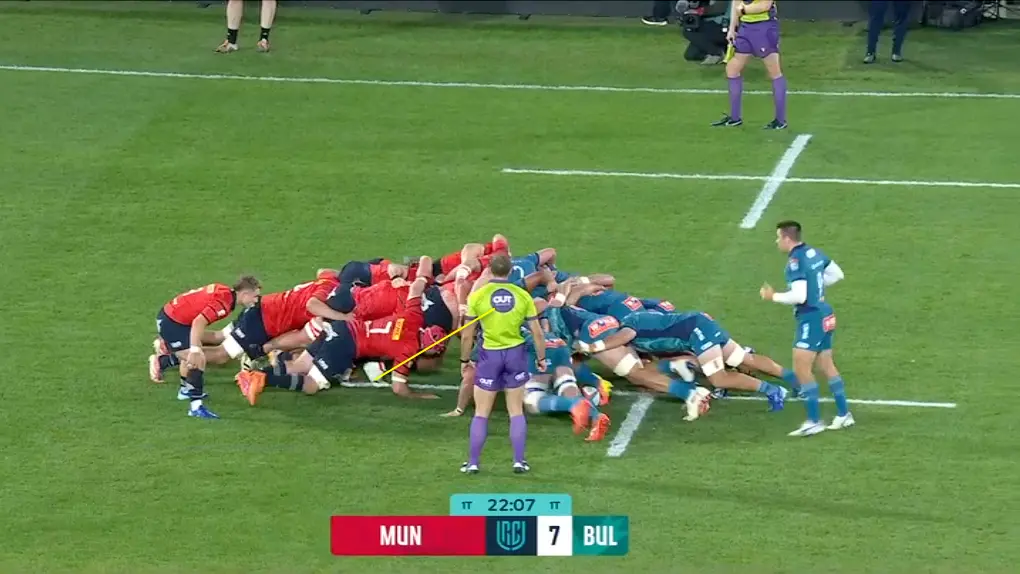
Why is that important? It allows you to scrummage relatively high — and keep your max power position — for the entire engagement, and in this case, it popped the Bulls out and around as they chased after Van Der Merwe and Loughman.
Why is it interesting?
“The biggest mistake we can make as scrum coaches is telling our players to get low. Because low isn’t strong.” — Jason Ryan, All Blacks Scrum Coach
Who do you know who learned how to scrummage with Jason Ryan, as a tighthead, for six or seven seasons straight out of secondary school as a converted backrow?
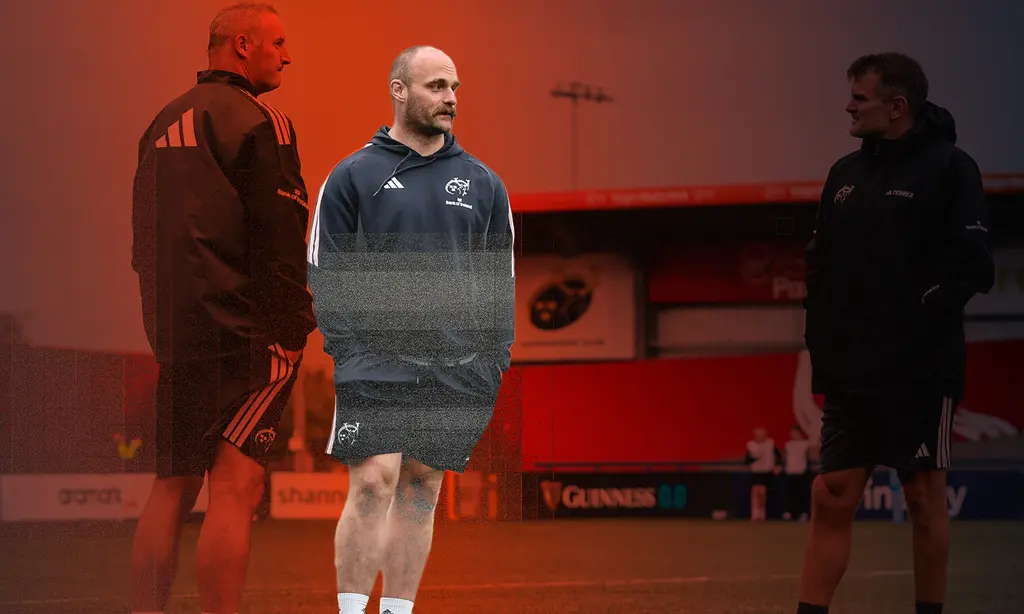
Oli Jager. The same Oli Jager who has been helping to coach Munster’s scrum since the preseason post-retirement. The more I look at Munster’s scrum this season, the more I see that throughline from Jason Ryan’s Crusaders to Oli Jager, to our improved scrum focus front row.
Coaching helps, sure, as does a specific focus on the scrum since pre-season, but guys like Aungier, Van Der Merwe and Brookes, in their prime (Brookes is still a power scrummager, despite being in his mid-30s), make the main difference.
And because our tighthead side can hold that line — and its power — for the whole engagement, we can attack opposition scrums on both put-ins. Van Der Merwe, in particular, isn’t spending his scrums propping up a tighthead’s shoulder anymore, which frees him to direct the pack’s weight at whichever side of the opposition feels weakest on the day.
It’s early days yet, and Racing 92 will pose a classic French scrum challenge on Saturday, but the signs so far for our scrum — and the benefits that come with it — are positive.
