



Losing in week one wasn’t the biggest deal — certainly not against Glasgow — and losing this game wouldn’t have been that big a deal either, on paper at least. It’s an 18-game regular season, after all, and we know well that nothing is secured by November. A good start, a bad start, a middling start — they’re all the same thing: a start. That’s all it is.
But the game isn’t played on paper, and it’s never experienced in the cold light of day, no matter how cold or how bright that day is. It is experienced in the realm of vibes and momentum, players, staff and fans alike.
Had Munster lost this game, it would have felt far more meaningful than a narrow loss to dangerous, high-quality opposition suggests. There is the reality of a result and the truth of it. Had we lost this game, the reality would be that we have 16 games, stretched over the next eight months to put it right. The truth would have been that we were 0-2 at home, with even harder games to come, and off-field tumult as rhetorical seasoning.
It was just a second-round URC game, but it was much, much more than that, too. Thankfully, we came out on the right side of it. Not just with the result — a bonus-point win — but with a performance that should resonate long beyond this result.
Last year, around this point, I realised pretty early that I was writing a variant of “we’d have lost this game last season” after a succession of narrow Munster wins. Sure, the data in those games wasn’t great and way too many of them — all of them bar Leinster and Scarlets — were won by the skin of our teeth, with massive energy exertion and very little in the way of efficiency. We hustled our way to three of those five wins in a row at home against Cardiff, Edinburgh and Connacht. We tackled more, carried more, and just about won more of the big moments than we lost. As it transpired, that was not a sustainable way to attack a season, which the rolling efficiency data later showed quite clearly.
This year, I’m going to do the same thing and tell you that, without question, that’s a game we wind up losing last season. We lost a variant of it to Castres, Leinster and the Stormers in Thomond Park, before doing the same to Bath, the Bulls (twice), and Exeter away from home.
Early on, one thing gave me hope that this game would be different.
This scrum.
It’s right under the Bulls’ posts, on their put-in, and it’s the exact type of scrum they specialise in blowing through you on for a full penalty.
Aungier keeps parity on his side, while Loughman and Van Der Merwe lock out Francois Klopper on the other. Zero forward movement. The Bulls exited really well, but as early signs go — never mind that we’d coughed up a great scoring position in the build-up — that showed me we could compete with the Bulls in an area we’d certainly have been under significant pressure in last season.
That’s the starting point to beating the Bulls. If you can’t hold your own scrum, or resist theirs, you lose.
This, for example, was the exact kind of moment that typically leads to a scoring sequence for the Bulls. Their put-in, on your 10m line, you know how this goes — usually.
Instead, watch what happens.
Loughman holds out Klopper on his side, Aungier holds his position, and the Bulls try to walk around the corner to generate a penalty — instead, it goes the other way. You’re never going to dominate the Bulls on their put-in, but if you’re strong on the basics, you can ride them out. That’s what we did.
The Bulls had six scrums, and we didn’t concede a penalty on any of them. That, alone, is a huge sign of our development from one season to the next.
Of course, they were as lethal as you’d expect inside the 22 through their maul and close-range finishing, but this season, I think the main challenge is keeping them out there in the first place. We did well here; we defended them strongly for the most part, and our biggest weakness was giving up full penalties at the offensive breakdown. Jeandre Rudolph, in particular, was a constant menace as we struggled to get to grips with the new spacing our system provides, along with the physical pressure the Bulls were exerting in contact.
That’s a systemic work-on, mixed with some situational context of the opposition in question. The Bulls are probably the heaviest centre-line and collision-pressure team in the league, but I think it’s also more than fair to say that we weren’t as sharp as we could have been, and it almost cost us.
But here’s the thing: this was a young Munster team. I think a good few people saw the selection before the game and thought this game was only going one way. A lot of the think pieces written on Thursday night for publication on Sunday seemed to think that quite clearly.
What do Munster fans want to see? A winning team, first and foremost, however that is attained, yet anyone sensible knows that it is not always possible to win. Sure, it would be great, but losing is the most readily available option to most teams, most of the time. The great team of the 2000s lost more big games than they won, when it came down to it. What Munster fans always recognise is a team that fights. We fought hard last week, and still lost, but most of the feeling post-game was broadly OK because the fanbase saw the fight and that, as far as the result was concerned, we ran out of gas.
What Munster fans will always react to, even when things aren’t perfect, and they aren’t, is a young team fighting for absolutely everything. People watching in the stands, or at home, who do a lot more than get into games for free for the last 20 years, see a performance like that against the Bulls and think, “see, I recognise that”.
When you ignore the noise, you’ll see this team for what it is: a young team looking to go from one place to another. And then you’ll realise that, if you’re around long enough, you’ve seen that before.
Very little exemplifies this more than Charlie O’Shea.
Twenty years of age. Making his first competitive start in his first year in the academy. People will tell you that he’s only there because of injuries, but you’ll also remember that as far back as last May, I’ve been telling you that Munster know that both Tom Wood and Charlie O’Shea are a key part of the future of this club, and will be using them accordingly.
What would I expect from a young lad making his first start in a game like this, against a team like this? That he’d take it handy. Let Casey drive the team around the field. Take your moments when they come, sure, but build into the game.
This is Charlie O’Shea inside the first minute of this game.
Look at that pass to O’Brien.
O’Shea is a student of the game, as much as anything. He knows that this is the exact type of pass that the Bulls love to pick off, and even though he was off-balance, he threw it anyway because he knew it was (a) the right play and (b) that he could land it.

That’s not a young fella feeling his way into the game; it’s a guy realising that if Munster are going to win, he has to attack everything. He didn’t see his role as a guy along for the ride, kick your points and see how it goes — he was going to play a decisive role in a win. He believed that implicitly.
And the system we are now using empowers this belief.
Look at the depth on this play. The layers to this attack mean that a young playmaker has the exact time and space he needs to let his natural skill set play out.
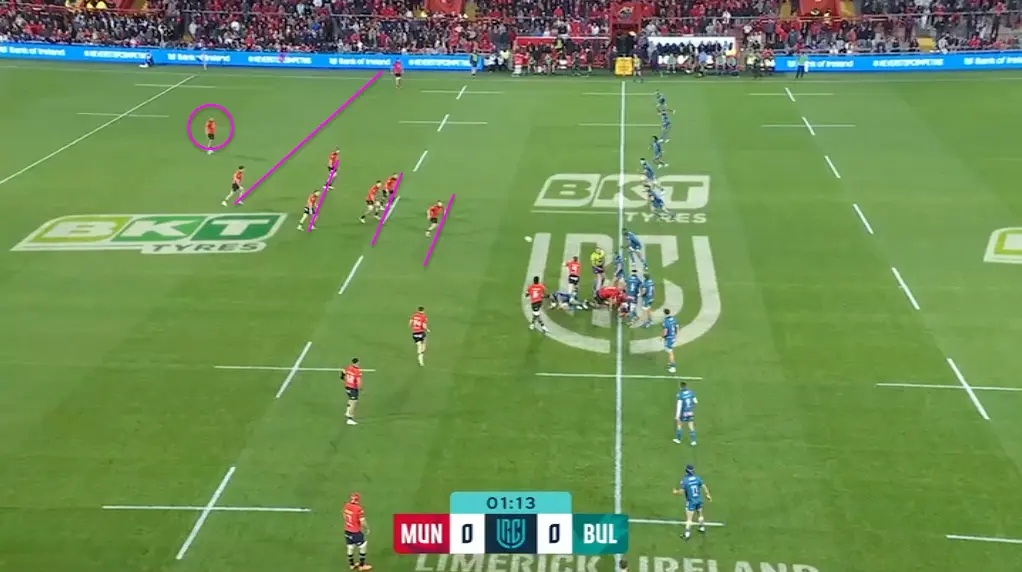
A pod of two forwards off him, space in front of him, and layers of runners to hit if he’s accurate. He doesn’t need to be Superman to pick the right option here — the right option is there for him to select.
Let’s go to the first try — a strike to score lineout launch.
Look at Gleeson’s massive punch up the guts first — that’s exactly what we needed from him.
But watch Charlie O’Shea on the next phase. For a young #10, this. is the exact moment where, if you’re going to make a rash mistake, you’d make it. He had Daly outside him, McCarthy on the touchline and Edogbo on his shoulder. Let’s go through the potential mistakes.
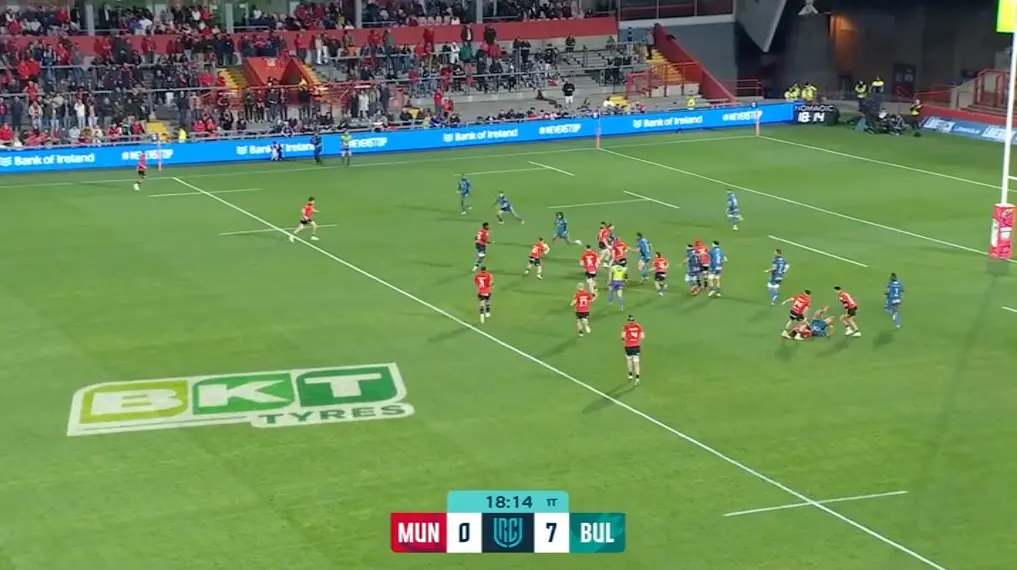
- Dumping to Edogbo with two defenders on him. Understandable, but Edogbo would come under huge breakdown pressure after the tackle, and our other forwards are on the other side of the ball.
- He could get it to Daly, but the same would be true. He’d have two defenders on him immediately, plus a hard scramble across to McCarthy, which would either end in a forward pass, or McCarthy getting bundled into touch.
- He could fire a long pass over the top to McCarthy — or try a chip through — who would either get defender and ball simultaneously, or be a live intercept threat.
What does he do instead? He sees all these and rejects them, choosing to take contact himself.
He lets the play develop and, when he sees the spacing he wants, he calls for a screen ball because he knows Kelly’s line will give him a heartbeat of space, and backs himself to land the crossfield kick.
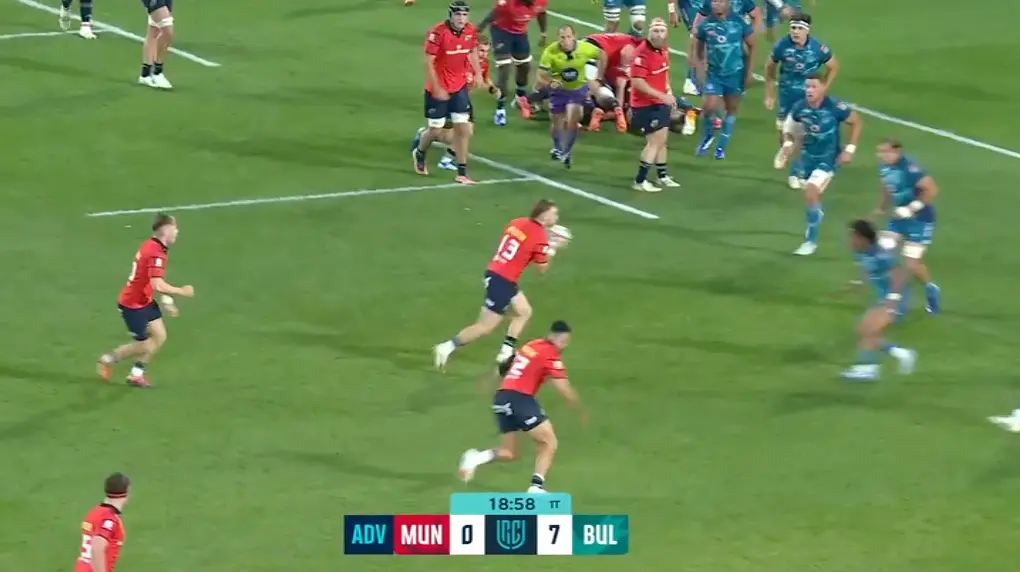
This is not a guy who’s letting the game come to him and, sure, it doesn’t really matter anyway; he’s making his first start. This is a guy who chooses to impact the game and has the bollocks to do just that.
And then he nails the conversion from the touchline.
He never let himself get trapped into a running game either. Again, that would be easy to do. He had success with it, so a young guy could get trapped into continuing with it, come what may. He didn’t fall into that trap.
Again, look at how much depth we’re playing with here. Everyone who gets the ball has more space to get a run-up on the ball, so the collisions are markedly better than last season. When O’Shea gets the ball in the key phase, he has the space and time to pick the right option.
Last season, it felt like our system in phase play was designed to produce one decision that was obvious if everything worked in the build-up. When it worked, it looked inevitable. When it didn’t, it looked like getting beaten at rock, paper, scissors three times in a row.
Last week and this week, it seems like the system produces multiple options that can be risked depending on the read on the ball.
It’s far from settled — lots of rugby to be played — but it seems a little more fluid right now, and it’s producing better collisions from almost everyone in a way we didn’t really see at all last season, or the one before.
I think that change has empowered a guy like Charlie O’Shea to come into a game like this and look so at home. Not just because he has more space to work, but because of the better collisions it’s producing on almost every phase.
But all of that is just a path into the game. You have to execute against the Bulls, and we did.
Most of the second half was spent controlling where we played them. That was a key part of beating them, as I spoke about here.
The key here is to avoid defending them in this area of the field in the first place. You start that with field control, positional control (slightly different) and managing your own possession when you have it.That starts with your kicking game — the Bulls back three struggle kicking under pressure — and how you handle your own set piece.
The second was trying to exploit the positioning of their centres on strike plays. I used the lineout as an example, but it was a scrum strike aimed at their centres that led to the killer moment.
We nailed our own scrum again — Foxe got a great hit on the tighthead side to keep the Bulls’ flankers on the flanks — and Casey found Kelly directly, and he was able to target Gans at outside centre.

Gans had to drift to keep eyes on Daly — who was right behind Kelly and inside Wood’s line — and that produced the moment. Wood powered through, got his presentation perfect, and Casey found Kendellen coming around the corner off the scrum for a try that looks easy, but already shows the impact of Jared Payne’s coaching.
The Bulls were never just going to go away. They have the type of power and pace throughout their side that will, inevitably, produce opportunities. They took one to make it 26-22, and that meant the last five minutes were all about who could dig in harder and further.
Sometimes digging in is ugly, especially late into a game like this. Sometimes it’s about who wants it more, when it comes right down to it. This was the moment that exemplified it for me.
That Gordon Wood was heavily involved with that killer defensive play tells you that familiar story you’ve been looking for.
This season isn’t going to be perfect. We’ve already seen that. But what Saturday night showed you is that if you show up for this Munster team, they’ll dig deep to show up for you too.
They can’t do it without us, and we can’t be who we are without them.
Next week will be another difficult game — the schedule doesn’t let up until January — but with the principles we saw here, there’s no reason why we can’t continue this upward curve.
| Players | Rating |
|---|---|
| 1. Michael Milne | N/A |
| 2. Marnus Van Der Merwe | ★★★★ |
| 3. Jack Aungier | ★★★★ |
| 4. Evan O’Connell | ★★★★ |
| 5. Tom Ahern | ★★★★ |
| 6. Sean Edogbo | ★★★★ |
| 7. John Hodnett | ★★★★ |
| 8. Brian Gleeson | ★★★★ |
| 9. Craig Casey | ★★★★★ |
| 10. Charlie O’Shea | ★★★★★ |
| 11. Shay McCarthy | ★★★★ |
| 12. Dan Kelly | ★★★ |
| 13. Sean O’Brien | ★★★ |
| 14. Diarmuid Kilgallen | ★★★ |
| 15. Shane Daly | ★★★ |
| 16. Kieran Brookes | ★★★★ |
| 17. Jeremy Loughman | ★★★★ |
| 18. Ronan Foxe | ★★★ |
| 19. Gavin Coombes | ★★★★ |
| 20. Alex Kendellen | ★★★★ |
| 21. Ben O’Donovan | DNP |
| 22. JJ Hanrahan | ★★★★ |
| 23. Gordon Wood | ★★★★ |
