


It’s been another Week. But I’ll get to that later. Like, later later. Sunday, maybe.
As for off-field tumult, I’d rate this week a five out of ten—we have a scale—but we’ll have plenty of time to process it all over the next few weeks. For now, it’s the second round of the URC: the Bulls, and a massive challenge.
Last weekend, the Bulls almost put 50 on Zebre in Parma — a rockslide of a performance, with a level of physicality that Zebre had no answer for — so this weekend is arguably as difficult, if not more so, than last week’s game against Glasgow.
As starts to a season go, playing three of last season’s semi-finalists is about as tough as it gets, but that’s the draw, and with one loss already in the books, there’s no room for error, especially given The Week in question.
- 15Shane Daly
- 14Diarmuid Kilgallen
- 13Seán O’Brien
- 12Dan Kelly
- 11Shay McCarthy
- 10Charlie O’Shea
- 9Craig CaseyC
- 1Michael Milne
- 2Marnus van der Merwe
- 3Jack Aungier
- 4Tom Ahern
- 5Fineen Wycherley
- 6Seán Edogbo
- 7John Hodnett
- 8Brian Gleeson
- 16Kieran Brookes
- 17Jeremy Loughman
- 18Ronan Foxe
- 19Evan O’Connell
- 20Gavin Coombes
- 21Ben O’Donovan
- 22JJ Hanrahan
- 23Alex Kendellen
Munster: Shane Daly; Diarmuid Kilgallen, Seán O’Brien, Dan Kelly, Shay McCarthy; Charlie O’Shea, Craig Casey (capt); Michael Milne, Marnus van der Merwe, Jack Aungier; Tom Ahern, Fineen Wycherley; Seán Edogbo, John Hodnett, Brian Gleeson.
Replacements: Kieran Brookes, Jeremy Loughman, Ronan Foxe, Evan O’Connell, Gavin Coombes, Ben O’Donovan, JJ Hanrahan, Alex Kendellen.
- 15Hakeem Kunene
- 14Sebastian de Klerk
- 13Stedman Gans
- 12Stravino Jacobs
- 11Thaakir Abrahams
- 10Curwin Bosch
- 9Zak Burger
- 1Alu Tshakweni
- 2Juann Else
- 3Francois Klopper
- 4Ruan Vermaak
- 5Reinhardt Ludwig
- 6Marcell CoetzeeC
- 7Hanro Liebenberg
- 8Jeandre Rudolph
- 16Janco Uys
- 17Sti Sithole
- 18Khutha Mchunu
- 19JF van Heerden
- 20Nizaam Carr
- 21Paul de Wet
- 22Cheswill Jooste
- 23Willie le Roux
Vodacom Bulls: Hakeem Kunene; Sebastian de Klerk, Stedman Gans, Stravino Jacobs, Thaakir Abrahams; Curwin Bosch, Zak Burger; Alu Tshakweni, Juann Else, Francois Klopper; Ruan Vermaak, Reinhardt Ludwig; Marcell Coetzee (capt), Hanro Liebenberg, Jeandre Rudolph.
Replacements: Janco Uys, Sti Sithole, Khutha Mchunu, JF van Heerden, Nizaam Carr, Paul de Wet, Cheswill Jooste, Willie le Roux.
Facing the Bulls always has a profound physical challenge. Under Johann Ackermann, they have decisively moved away from the kick pressure they were known for under Jake White. Last season, that change produced some weird, error-strewn results in the first half of the season, before it broadly clicked for them in South Africa in the Christmas and Spring stretch of the league.
In the last ten games of the regular season, they earned 36 points from a possible 50 — the best form of any team in the URC — and that turned around a run of 3 wins and 4 losses in the first seven games to see them finish in the top four, before making another final against Leinster.
That’s the thing with the Bulls. On ball or off-ball, no team has contested more URC finals and that largely comes back to a fundamental truth about this game: if you are bigger and stronger than most of the teams you are likely to face, you will almost always do well, all other things being broadly the same.
Their style under Johann Ackermann reflects this in a very modern way when it comes to a penalty-generating offence combined with a lethal set-piece and strike-play game, balanced with an excellent defensive set-piece and transition game. In 2026, that is how you win games. At their best, the Bulls lock you into their physical dominance and refuse to let you out.
Here’s a good example on a kick transition return. They load up Coetzee as the first carry option; he flies through 10m post-contact, and the Bulls pick and go around the corner for a not-rolling-away penalty under pressure.
On their general phase play, they will do this too — albeit without the run-up. They’ll rinse you through 3/4 phases of Coetzee, or Klopper, or [insert large human being here] and look for the natural outcome — someone trapped in the ruck post-contact, which they are very good at highlighting, given their collision dominance and hurt you with pick-and-goes if you try to stand off them.
On this one, you see the gimmick. Tight carry, tight carry, defensive cluster around the ruck, hard inside line forces the linebreak, then the penalty as the Zebre cover try to scramble.
The key here is to avoid defending them in this area of the field in the first place. You start that with field control, positional control (slightly different) and managing your own possession when you have it.
That starts with your kicking game — the Bulls back three struggle kicking under pressure — and how you handle your own set piece.
This comes with a warning label; the worst position to give the Bulls is a lineout turnover. It’s where they are most dangerous and most punishing with their tight physicality post-turnover.
At a bare minimum, your lineout has to function against the Bulls if you want to work yourself into a position to beat them. They will give you lineouts, but how you control them determines your outcomes more than anything else, even the scrum.
Retaining your own scrum is a necessity and, for the most part, you can game that with your put-in and strike. If you can get away with 90% on your own put-in, you’re doing well. On their put-in, you’re going to have a rough go of it, that’s for sure, but the path to beating the Bulls doesn’t run through dominating them on their own ball. If it did, nobody would ever beat them.
The key is the lineout. Yours, and theirs.
Last season, they were most vulnerable to teams who consistently attacked their throw-in. All of the games they lost — or almost lost away by a score or less from home up north — in the URC last season, bar one (away to Connacht), saw their lineout reduced to sub-85 % completion.
That has to be the focus here, and why Tom Ahern’s availability was so crucial. Every single Bulls throw has to have either Ahern or Edogbo in their throwing window. If they get 5+ scrums — the teams who beat them reliably keep that to under five — it’s logical to expect penalties will flow from that, so you have to make sure they can’t convert those into easy lineout/maul possession that will lead to five/seven point concessions. You can live with three points.
They kick in three states, primarily — exit to touch from their own 22 through #9, box kicking contestably to increase the likelihood of scrums, and then cross-field or diagonally to exploit their speed on the edges relative to the compressions they force in the middle of the field.
Off this kicking game — which you can hack with longer kicks to Abrahams, Kunene and De Klerk — the conversion of your own lineout via strike plays is a key point to pressure them.
This is where Charlie O’Shea comes in.
Why Charlie O’Shea? I think there’s a very good reason why O’Shea has been selected for this, on top of Munster being seriously committed to investing in both him and Wood in the short, medium and long term.
It’s this.
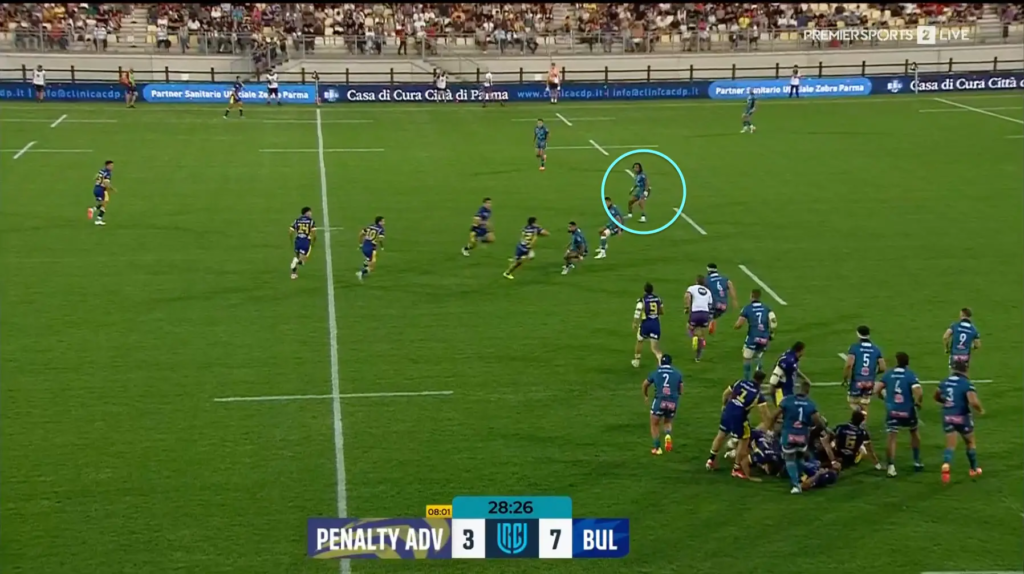
The Bulls’ defensive set-up off the lineout is mostly what you’d expect — they are incredibly strong around the #10. They have Stravino Jacobs at #12 and while, sure, he’s nominally a winger, he’s more than big enough to hold any direct attacks at Curwin Bosch, especially when Coetzee is positioned inside him.
Take a full lineout against the Bulls, however, and you pull Coetzee into the set piece. What that does is stretch the positioning of Jacobs and Gans, relative to Bosch.
This is where an incredibly quick run from #10 — off a killer, long flat pass off the top of the lineout via Casey — unlocks this picture here.
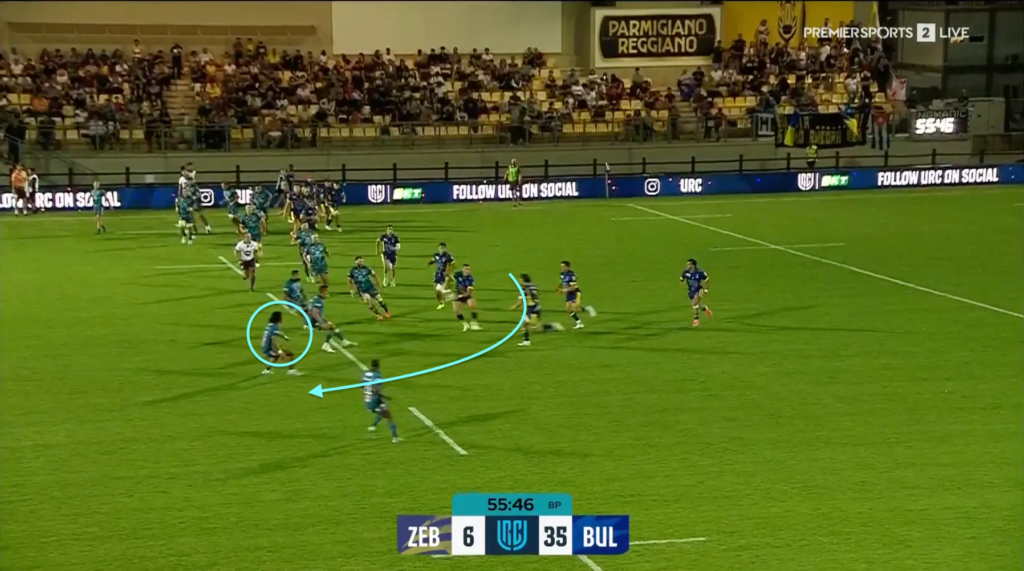
Zebre didn’t really manage it consistently, but it was there all day. O’Shea’s ability to bounce from first receiver to being outside Gans inside the same phase will be a key part of this game, and Munster’s ability to win it.
If you can exert efficiency pressure on the Bulls — what possession they give you, you hurt them with — it will encourage the worst parts of their game. Overplaying narrow, or overplaying out the back and edges through Bosch. That’s how we win.
