


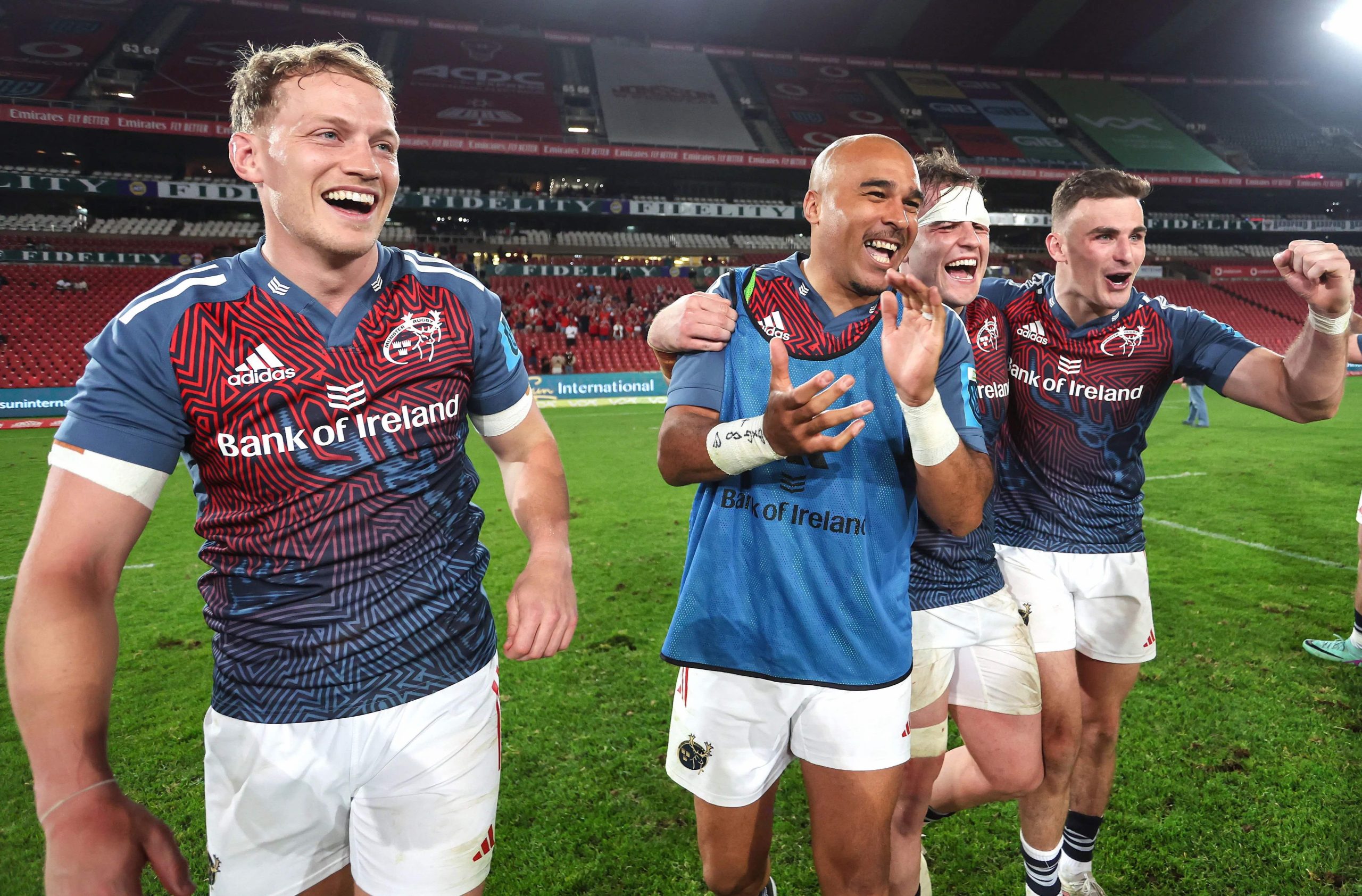
When the altimeter starts going up, so does Munster’s performance levels.
Two games on the high veld.
Two wins.
Eight tries.
Ten points. And, for the first time in the URC, a touring team has won both games with the maximum. In doing so, Munster have blown up the equations for the end of the season and now have three games to shoot for a top-two finish, with two of those at home.
Finishing first is not out of the question which, when you consider where we were in January – 11th on 24 points – is something of an achievement.
Since then, we’ve earned 29 points from six games.
To think about what might happen if Glasgow got nothing from their South African tour and Leinster maybe took their eye off Ospreys and Ulster so we might earn the right to a home knockout run… that’s what this team has done since that dog night in Galway on the first of January.
Long may it continue.
***
For the last two seasons, pretty much, I’ve been detailing Munster’s transition from Van Graan’s hybrid game to Rowntree’s On Ball Rugby, where we look to dominate teams with the ball in hand by reducing our kicking volume and distance. Just three rounds ago, Munster were 15th in the URC for kicks made and kick distance.
Today, we’re up to 13th on both metrics, which doesn’t sound like a massive jump but it is when you consider that everyone else has been kicking at the same rate in those last few games while we’ve changed our strategy considerably.
I think part of this is a lesson learned from the guts of the season between December and January where we were consistently beaten by teams who kicked the ball to us, and stuffed us in defence and at the set piece. Every single game we lost (or drew) in Europe this year saw the opposition out-tackle us by an order of magnitude. Toulon out-tackled us in the Mayol, but only because we bossed possession for the last 10 minutes. We won that game defensively and kicked the ball TWENTY more times than Toulon for a kick-to-pass ratio of 1.44.
When we exclude the passes made against the Bulls inside the 5m line and get an average for both games at altitude? One kick for every 4.25 passes.
Almost everything we spoke about in the Red Eye and Blood & Thunder Podcast this week came to pass, at least when it came to the starting strategy. Start playing off-ball/low-gear counter-transition rugby, give the Lions plenty of lineout ball and counter-punch until you bring on the heavy artillery later in the game. We didn’t finish the game exactly as intended because, to be fair, the Lions threw the kitchen sink at us during the last 20 minutes; we did well to only concede once. There was no scope to play on-ball rugby in that environment but we did finish strong when it counted with a classically efficient scrum penalty to maul try sequence.
Defensively, we had the Lions read back to front. This is a good example from early in the game;
In the middle of the field we hit in pairs and only contested obvious defensive rucks with poach actions. We knew coming into the game that the Lions’ superload on the edge of their 3-2-X shape on transition and off the set piece, so we shut them down at the point where they would activate that option.
This isn’t just about blitzing at the edge of the defensive line – if you did that mindlessly, they’d pop the ball over the blitz or in behind it. We took a slightly higher risk tactic to give them the space and then blow up the player they’d use to exploit it. In this passage, we see Nash sitting back in the secondary line and reading Nohamba’s body language.
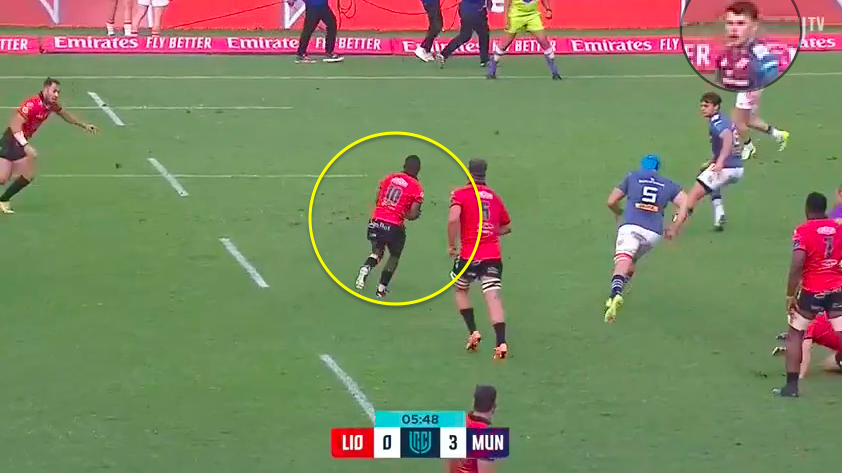
Nash only shoots up into the line once he sees Nohamba wind up for the pass and he goes straight for the only guy he can pass it to – Jaden Hendrikse. Nash batters him in contact and forces the ball back inside. If that ball goes out, Van Der Merwe takes the 5m tramline with Horn, Nohamba and Hendrikse all flowing through on his outside.
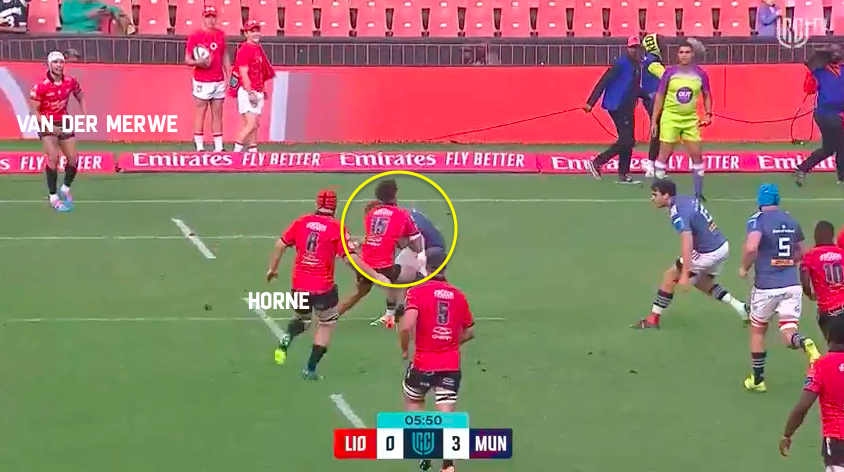
If Nash blitzes too early, the ball goes over the top of him so he waits until he sees the cue from the playmaker and reacts to that, rather than to a spatial trigger. A spatial trigger in this instance is “when they go past X position, you blitz”. The Lions had another go on this sequence and worked their way back across the field in a more structured 3-2-X shape.
In the Red Eye, I spoke about looking to pick off Louw’s passes for intercepts because he’s slow to move the ball across his body and tends to load up in that screened position. That suits Nash down to the ground here who, once again, only makes his decision to blitz after he’s sure the ball is going to Hendrikse.
When Nohamba passes to Louw, Nash gets on his bike and shoots straight onto the only man Louw can pass to.
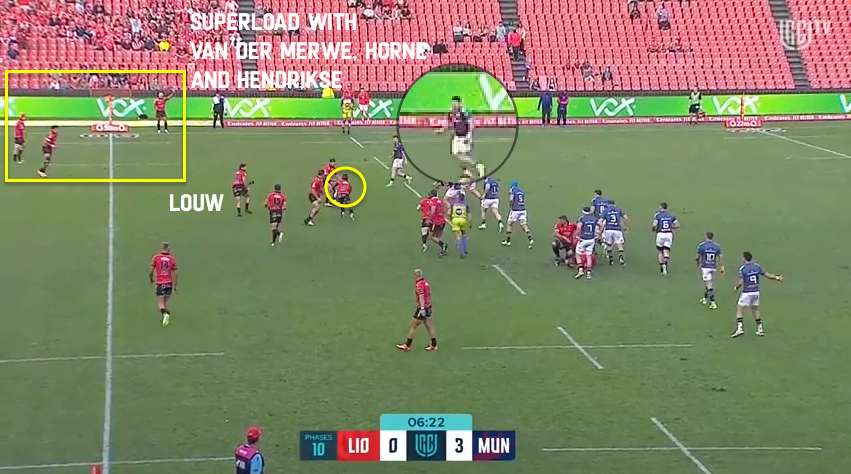
Nash’s pace, coupled with that slow pass action puts him right onto Hendrikse as the ball arrives and it spills out and backwards. Again, if this ball gets shipped on, you’re dealing with Franke Horn and Edwill van der Merwe in the 15m channel and they probably score directly from there, as they have done many times this season already.
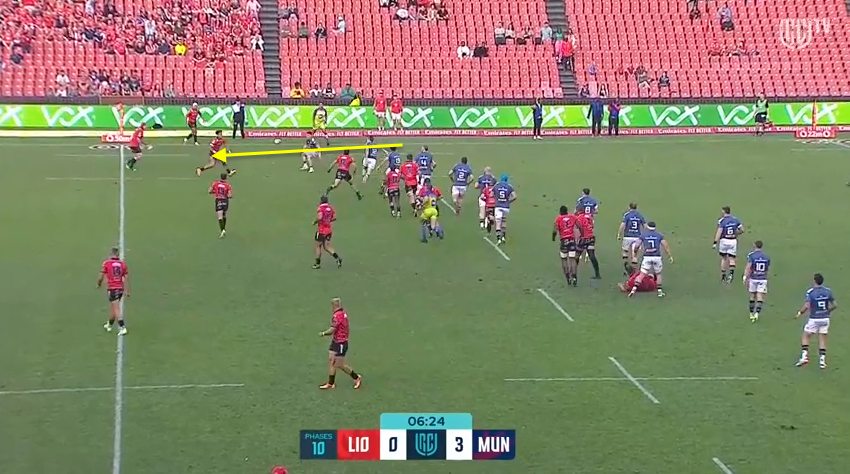
But Nash does enough to force the error and kill another Lions attack. Sean O’Brien almost scored directly from an intercept on Louw midway through the first half under the same principle. “Move on the pass action”.
Without access to their edge superload, they started to look narrow where they tried to overpower us. That didn’t work either. When we had tight numbers, we wiped across the defence and went after supported jackal attempts where the Lions were slow on the recycle off #9.
In this instance, we spotted an isolated back running too close to the ruck and we attacked him when he tried to come back inside for the reset.
It’s a poor Lions attack, but it’s very heavy, oppressive Munster defence.
In the second half, we looked to be suffering from the altitude earlier than last week against the Bulls. We were a few hundred metres higher up, of course, so we started our transition to the bench around 45 minutes. It paid off almost immediately with Casey and Coombes playing a key role in our third try.
From there, it really was about muscling up in defence against a Lions side who started running everything, getting a few penalties along the way and pressurising us with offloads and pace.
Once we survived their last go at our line because of a double movement, the win was more or less secured and we could shoot up the field looking for a bonus point. We’d find it with the clock in the red to secure a statement tour win.
These last few weeks felt like Munster remembering who we were at the end of last season after a campaign dogged by bad luck and injuries.
This Munster team will fear absolutely no one in this league and, for me, will take some stopping when it comes to the knockouts. If we can bring our high veld rugby up north with us in the next few weeks… watch out.
The Champs are here.
| Players | Rating |
|---|---|
| Jeremy Loughman | ★★★★★ |
| Niall Scannell | ★★★★★ |
| Stephen Archer | ★★★★ |
| RG Snyman | ★★★★ |
| Tadhg Beirne | ★★★★ |
| Peter O'Mahony | ★★★★ |
| Alex Kendellen | ★★★★★ |
| Jack O'Donoghue | ★★★★ |
| Conor Murray | ★★★★★ |
| Jack Crowley | ★★★★★ |
| Shane Daly | ★★★★ |
| Sean O'Brien | ★★★★ |
| Antoine Frisch | ★★★ |
| Calvin Nash | ★★★★★ |
| Simon Zebo | ★★★★ |
| Eoghan Clarke | ★★★★ |
| Josh Wycherley | ★★★★ |
| Oli Jager | ★★★★ |
| Tom Ahern | ★★★★ |
| Gavin Coombes | ★★★★ |
| Craig Casey | ★★★ |
| Joey Carbery | ★★★ |
| Mike Haley | ★★★ |
