


You already know this, but the Lions are very good.
They’re currently 11th – tied on 39 points with four other teams and one point behind the Ospreys and Stormers in 6th and 7th – but with a little more luck on some razor-thin losses earlier in the season, they could easily be 4th. It isn’t out of the question that they could still finish that high; if they do, it’ll be richly deserved.
I think they came to most people’s attention this season when they battered Connacht in the Sportsground with just 14 players – and seven forwards – for most of the game. Now Connacht had their issues at the time, but it was a huge win for the Lions who looked seriously imposing despite losing the next two games on that tour.
Fast forward to last week and you’ll see them piecing up a heavily rotated Leinster team in the same stadium we’ll be playing in this weekend. Again, imposing, despite it being against a Leinster team so shorn of their game changers that it looked like a teamsheet out of a multiverse where Eamon De Valera decided that the Irish capital city should be Clonakilty.
Long story short, if we want to turn this tour into a 9/10 pointer – an achievement in and of itself – we’ll have to do it by beating a team with a game far stronger than their reputation suggests. I think there’s a tendency from this side of the equator to look at the Emirates Lions, scan for current Springboks and then rate them accordingly when you see… none.
But that’s far from the truth. They have quality in every line of the team, a good defence, a very good attack and a formidable scrum; beating them in Johannesburg will be every bit the achievement that beating the Bulls in Pretoria was.
Munster: 15. Simon Zebo; 14. Calvin Nash, 13. Antoine Frisch, 12. Seán O’Brien, 11. Shane Daly; 10. Jack Crowley, 9. Conor Murray; 1. Jeremy Loughman, 2. Niall Scannell, 3. Stephen Archer; 4. RG Snyman, 5. Tadhg Beirne (c); 6. Peter O’Mahony, 7. Alex Kendellen, 8. Jack O’Donoghue.
Replacements: 16. Eoghan Clarke, 17. Josh Wycherley, 18. Oli Jager, 19. Tom Ahern, 20. Gavin Coombes, 21. Craig Casey, 22. Joey Carbery, 23. Mike Haley.
Emirates Lions: 15. Jordan Hendrikse; 14. Richard Kriel, 13. Erich Cronje, 12. Marius Louw (c), 11. Edwill van der Merwe; 10. Sanele Nohamba, 9. Morne van den Berg; 1. Morgan Naude, 2. Jaco Visagie, 3. Ruan Dreyer; 4. Willem Alberts, 5. Ruan Delport; 6. JC Pretorius, 7. Emmanuel Tshituka, 8. Francke Horn
Replacements: 16. PJ Botha, 17. JP Smith, 18. Asenathi Ntlabakanye, 19. Reinhard Nothnagel, 20. Ruan Venter, 21. Sibusiso Sangweni, 22. Nico Steyn, 23. Gianni Lombard
The Lions do not construct their team in the same manner as the other South African franchises. They actually can’t – they don’t have the budget. So when you look at that back five build, for example, you’ll see a strike wing forward (JC Pretorius), a super athletic combo-flanker (Emmanuel Tshituka) and a heavy wing forward (Franke Horn) balanced out by their props and lock combination. Willem Alberts (120kg and 6’3″) has spent the last four years migrating to the second row full-time after making his name as a big ball-carrying back row. He might not be the most athletic lineout jumper – Tshitsuka more than compensates for that – but he gives them ballast behind their core of experienced props to start before he departs and their super-heavyweight finisher props come on with their 6’7″ second row Reinhard Nothnagel. They have 6’6″ 21-year-old Ruan Venter on the bench who can play as a backrow but is more suited to lock.
They have quite a small build midfield and outside backline with Richard Kriel, one of their wingers, as the one outlier at 6’4″. He is a target for their cross-field kick game. The rest of their outside backline ranges from 5’4″ to 6’1″ max and have a very balanced skill set. Their biggest quality is PACE.
In transition attack – the Lions’ preferred game state – you’ll see them run through a 3-2-X structure with a massive backline overload in the 3/4 space as they progress across the field.
The Lions convert a tonne of linebreaks for this reason; when they get the ball to the edge spaces, they always have numbers and this is where guys like Franke Horn, JC Pretorius and their incredibly quick backline come into play. This is their overload in action, which you can see building behind their big carry off #9 in the clip above.
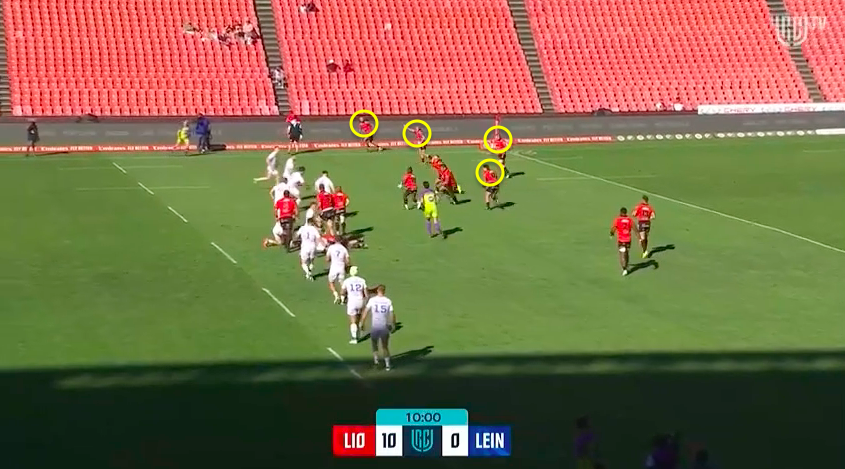
Once they get outside the blitz – Nohamba is really good at this as he has an excellent long-range pass – there are always options to advance the ball into space, with short easy passes on the run.
If they get that flow of numbers across the 3/4 space, they are a nightmare to live with because they have pace and power on the edges to hurt you over and over again.
You can trace Leinster’s poor first half – and second half, really – back to their tactical kicking. Leinster kicked long off #10 quite a bit in this game and it didn’t have the required effect.
You can see there that it almost led to a transition back up the tramline in the first instance but that it allowed the Lions to slot into their 3-2-X shape really quickly. That isn’t what you want.
Ideally, I think you want to box them in like you would the Bulls and make them contest under the highball. That time and space on the long infield exit only gives them time and a guaranteed first and second phase of transition. Shorter, more contestable kicks off #9 or #10 force them to play slower.
That’s what we want. When they move to bring JP Smith and Asenathi Ntlabakanye on in the second half, that’s when we can start exiting long down the field to try and find their front five in the middle of the field.
When the Lions kick long, we have to ride out their transition defence and kick short in return – box them in. We also need to be sure we get the ball off the field early and often so we can attack Noshambe’s pass-first game and their overreliance on Horn and Tshitsuka as jumping options.
When they go heavy off the bench, we have to match them with our transition and then start upping the pace of our attacking game.
RED EYE DIGEST
Early Game Strategy:
- Box kick or high bomb in the short to mid-range.
- Stay out of rucks, two-man tackle max, jockey on their 2-X to guard the overload.
- Look for intercepts off Louw in the screen
End Game Strategy:
- Move to an on-ball structure. Up pace of phase play. Use Carbery and Crowley to extend lines and drag their heavier forwards out of shape.
- Heavily contest rucks.
- Kick at Ahern on the third phase off a lineout for a mismatch with Van Der Merwe and Hendrikse.
