


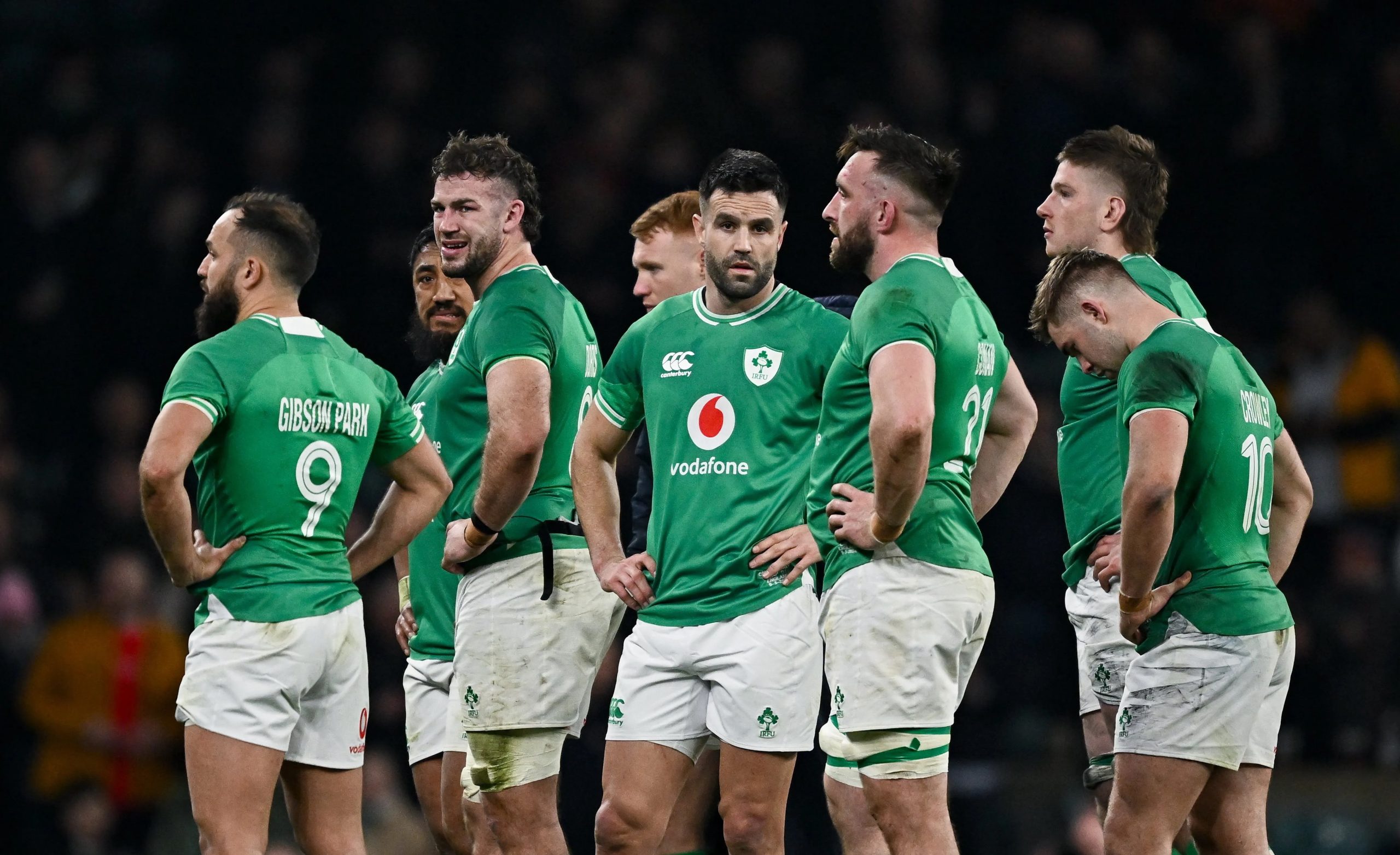
This result was a surprise for some, but not for us.
Reading the Green Eye last week will have told you how England could win this game—territory management through kicking, blitz defence, offensive transition and set piece. Ireland still should have won – both due to pre-game expectations and how the game itself played out – but England’s excellent return in those four areas of the game set the platform for a famous win. For the first time since the World Cup Quarter-Final, Ireland looked brittle, skittish and small against a bruising England pack picked specifically to do the job they would end up doing.
Ireland haven’t turned into a bad team overnight by any means but this game highlighted some of the problems from the World Cup that remain unaddressed. The biggest one, for me, is that this team seems to have an unnerving trait of quietening down when they get smacked in the mouth by a team who are every bit as physical, every bit a match or more at the scrum and lineout and, crucially, every bit as willing to go right up to the edge and beyond at the breakdown.
When that happens, Ireland’s dominance falls back and results fall into the 50/50 range. In the World Cup against South Africa, for example, we lived to fight another day because South Africa left 11 points out there off the tee and got held up over the line at the whistle. We didn’t get away with the same trick against a bruisingly physical and efficient New Zealand in the knockouts who knew exactly where and how to hurt us. And now here, against England, who brought the same level of clarity and hard edge to hurt us where we can’t afford to get hurt.
Why does it keep happening?
It didn’t start that way. We carried narrow off a lineout and took away the main teeth of England’s high-edge blitz. England infringed, Ireland took a 3-0 lead.
A few minutes later – right after England’s try – we killed their high-edge blitz right at the point of the whip with Crowley finding Aki – who made a bull of a carry into the space inside the blitz – before Ireland found Crowley again to put Sheehan away outside Furbank.
Sheehan maybe let the ball off to Lowe a little early here but we showed that when we had a platform, we could work their blitz defence in the way our attack is designed to. We caught
The problem was, that we spent way too much of the game camped inside our 10m line with a malfunctioning lineout in a game where our primary ball carriers got repeatedly stuffed.
And that is, ultimately, how we lost this game.
***
In the Green Eye, I wrote the following;
Ultimately, I think the big lesson England will have learned from their defeat to Scotland is to be smarter when it comes to the usage of their core concept. England are a team who are focusing on three main areas at the moment at the expense of all others.
Defence, Offensive Transition and Set Piece.
Those three things – in line with excellent box and tactical kicking – won them the game. Ireland’s lack of platform – and complete collapse from an Offensive Ruck Work perspective – is almost entirely down to England’s management of possession and their ability to spoil critical Irish launch points. England kicked contestably for an average of 25.2m per kick, swarmed the contact points and played almost all their rugby on kick transition, set piece transition or their own setpieces inside the Irish 10m line.
England’s kicking game and high-edge blitz as they stand needs to have a top-class offensive and defensive scrum and lineout bolted onto it with a really sharp two-phase at most offensive kick transition game.
Why? Well, if you’re going to kick most of your possessions to the opposition at short range, it’s natural that scrummaging will follow from the excess of knock-ons that style of kicking produces. You have to have a formidable scrum to bump the fear factor for the opposition when you kick – “I can’t knock this on!” – win penalties or, at the very least, sap the legs out of the opposition front five.
It also follows that if your defence is aggressive enough on these contestables, the opposition will look to reset with long kicks up the field so they can catch you with counter-transition plays. This is a weakness in off-ball styles. If you can’t threaten the opposition when they kick the ball back to you and you’re not a threat on phase play outside their 10m line, you will always end up falling back. This was a core weakness of Johann Van Graan’s Munster in the first two seasons. Teams worked out that you could fire the ball long downfield, hurt us on our offensive transition and then slowly march us back up the field without expending too much energy.
Steve Borthwick is aware of this fact and his selections in the backfield are entirely focused on this area of the game. Why is Freddie Steward not involved? He’s super solid under the highball, yes, but he’s a sub-elite transition attacker at fullback. He can’t move at the speed Furbank can, nor can he stitch together attacking plays on transition with the same dynamism.
When Ireland blew our exit – more on that later – right after the restart after going 3-0 up, Furbank didn’t need another invitation.
Furbank’s run across the field took out twelve Irish defenders, who were slow to move up on defensive transition. There were two reasons for this.
The first was James Lowe dropping a little too deep into the pocket off the ruck to stay out of Ben Earl’s range.
That meant when he kicked, everyone but Hugo Keenan was offside, which meant that only Hugo Keenan could put our forward chasers onside because we had nobody on the near side to follow the kick.
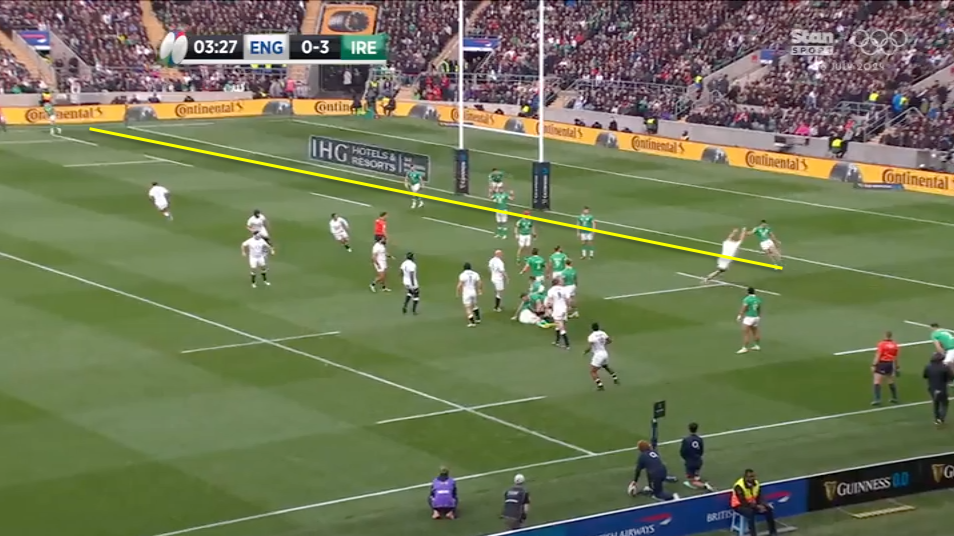
I think Lowe knew this and was trying to get the ball in touch but slightly overcooked the kick under pressure. As a result, Keenan is the only guy who can allow our forwards to start advancing.
That’s when we need our forward pack to really haul ass and fill the field on defensive transition. Calvin Nash got knocked out making a key tackle – that actually bought our forwards more time to resource the defensive line properly but only Doris, Beirne and Van Der Flier of the players on that side of the restart got there in time.
Furlong did his best to fill space but we needed a little more hustle from McCarthy here to free Beirne and Doris to attack the blindside. They couldn’t risk shooting off before the ball left because of Alex Mitchell’s breaking threat.
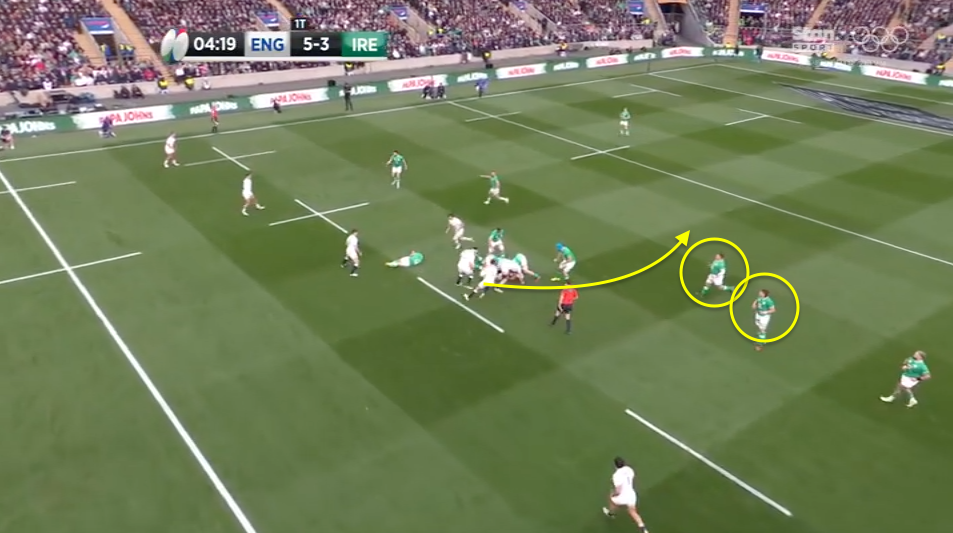
England were able to execute the 4 v 2 primarily line overload on the next phase and once the ball was in this spot, it was a try unless there was an offensive error.
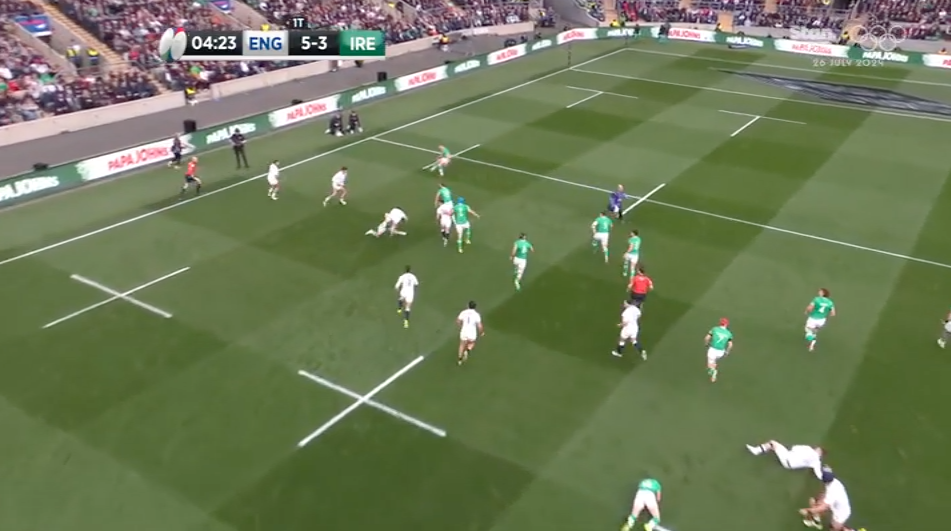
Crowley stayed on the first line about as long as possible before the pass but couldn’t close the gap on Lawrence, who had all the power running straight while Crowley was scrambling side-on.
England’s offensive transition was eating up Ireland’s lower volume, higher distance kicking game. A few minutes later, Gibson-Park launched a long-range box kick after an extended series of long-range kicks from the backfield. Gibson-Park kicks it 32 metres, which is outside the reach of our initial chasers.
England spot a gap in the Irish pillar defence early and Mitchell runs Earls right at Doris, putting him in a blender before releasing Jamie George upfield.
Their crucial second try came from, once again, the same kick transition platform. Gibson-Park kicked deep on the box kick exit but it was too far for our chasers to force a lineout. Ford kept the ball in play but it wouldn’t have mattered – England would have went quickly anyway – and their kick transition was set.
You’ll see again how we were too slow filling the field on this. McCarthy didn’t hit the defensive line until 14 seconds after Gibson-Park’s exit and when you combine that with England rightly spotting that we’d overfolded on that first transition ruck and you’ve got trouble. McCarthy tried to kill the play with a big blitz on the screen and then the screen runner but it was too far for him to influence.
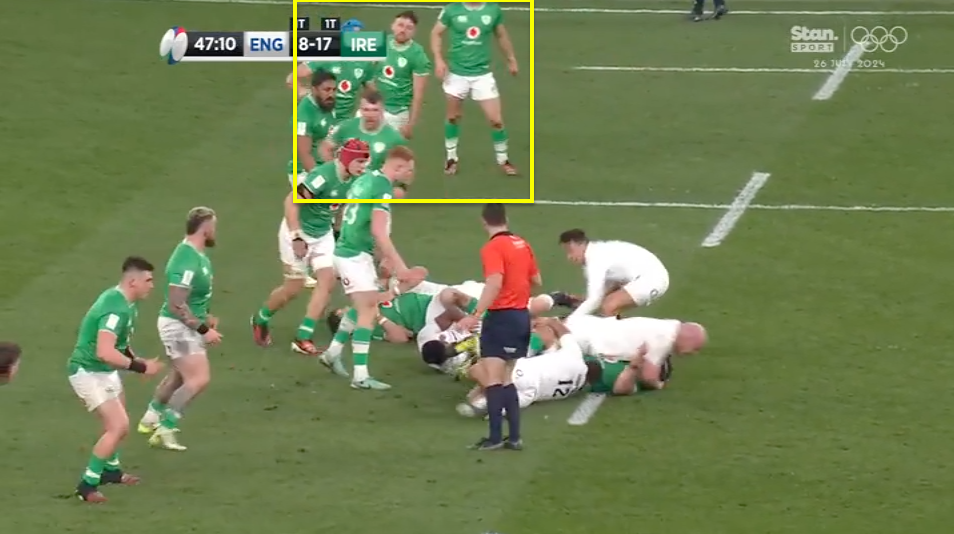
Frawley tried to cover back across as fullback – to be fair, he got a concussion on the previous play so tracked the ball infield in a way he probably wouldn’t otherwise – but the damage was done. England were back in it.
England would win a penalty to go 8-3 up a few minutes later. They spotted a mismatch – McCarthy and Furlong in midfield behind Doris – and attacked it directly when it was on. England learned a big lesson from the Scotland match and that was the simple identification of what balls should be played and what balls should be kicked. This understanding meant they gave Ireland very little to work with outside of deeper lineout positions won from penalties.
When we did manage to put pressure on England in their half of the field – a rare occurrence in this game – we let them off the hook with daft penalties or handling errors.
In short – well, not that short, I’m 1600+ words in – England-controlled territory to the point that they were almost always playing in the zone they wanted. 49% of their possession was in between the halfway line and Ireland’s 22.
That was driven by a kicking game that is properly conservative when we drill into it. Their pass-to-kick ratio was swollen by multiple close-range phases. When we look at their ruck-to-kick ratio, however, we see they have one kick for every 3.42 rucks – that gives very little scope for Ireland to attack their breakdown. Ireland only managed to steal one ruck from England all game which, if you wanted to know why it felt like we barely had the ball, is a big reason why. England only ran the ball when they had control of the situation on transition or it was inside Ireland’s 10m line. When they did pass, they were almost always short-range hit-ups to hyper-aggressive pods off #9 so we had very little opportunity to win back the ball on the floor.
Ireland’s ruck-to-kick ratio was one kick for 2.96 rucks, a good but more conservative than England’s, but they forced four ruck turnovers. When you combine that with a sloppy 85% return from Ireland at the lineout – in reality, the effective possession we earned here was much lower – you get the picture of Ireland having to work with scraps.
Just like at the World Cup, when England pressured our throw, we went to the dreaded two-man cutout to try and find the tail of the lineout, which led directly to this linebreak.
O’Mahony took a yellow for this and rightly so. He’s dived over the ruck to play Mitchell and I don’t think he did it unknowingly. He’s seen the massive gap opening up on the blindside on the run-back and that Lowe and Murray are guarding 18m of space with Ford and Feyi-Waboso surging into that space.
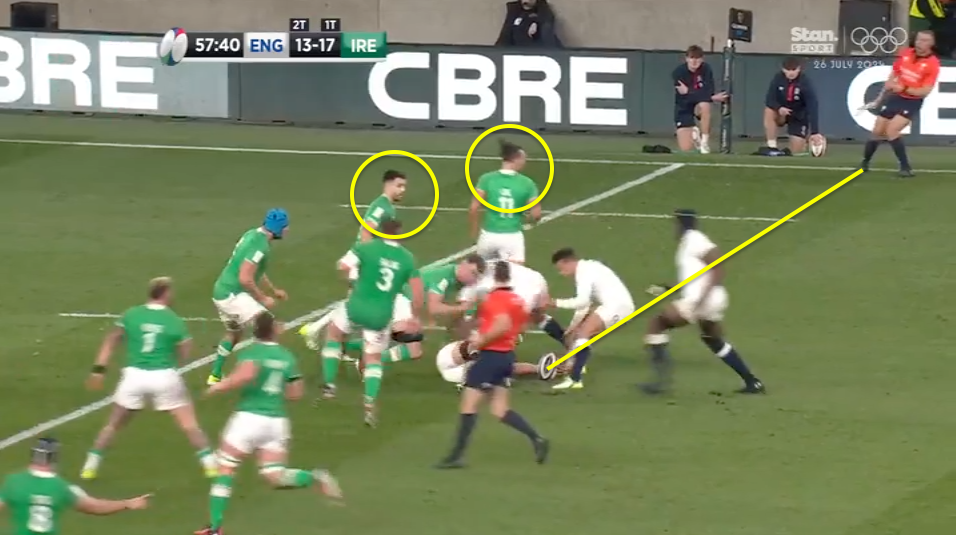
England went the other way but O’Mahony couldn’t have known that so he rightly killed the ball and took a yellow to save a seven-pointer under the posts. England would score on the next possession after multiple close-range phases regardless but I get the thinking, such as it was in the heat of the moment. Far more concerning though is O’Mahony’s waning impact on days like this against a big build English pack.
That yellow card didn’t cost Ireland the game though, as some have been jumping out of their skin to shout in the last few days. No, what cost Ireland the game was leaky first and second-phase defence. England ran the same strike concept as their try against Scotland off a scrum from the game-winning lineout.
Multiple one-man runner screens with a blocker on the second pass to take out a transiting defender to set up cascading space on the edge.
Multiple one-man runner screens with a blocker on the second pass to take out a transiting defender to set up cascading space on the edge. England’s blocker takes out Crowley here and that creates just enough cascading space for England to make a big surge in the first phase. Ireland’s attempt to hold up the carrier actually helps England in this instance as it means we have no effective short-side defence.
Aki has too much ground to cover on the edge and Waboso can blow past him because he’s running straight and Aki is struggling to catch him from a weak angle of approach. Lowe bit in on the failed maul turnover and then got caught on the wrong side to give England the free play.
England scored the winning drop goal a few phases later. Game over. Slam gone.
Ireland haven’t turned into a bad team overnight, as I’ve said, but the manner of this defeat and our inability to move the ball through the forwards from out the pitch shows a bit of a disconnect from what we’ve seen in the previous few weeks. For three games we were essentially an on-ball team. In this game, we ended up kicking a massive amount of our possessions from deep through Lowe like we were a low carry volume counter-transition team, only to get absolutely nothing from England on those transition starters of Lowe and Gibson-Park.
What style are we running? If we want to play on-ball, high pass-per-kick, low ruck-per-kick rugby one week, we can’t then decide to play it safe and at arm’s length the week after. Even more concerning, England’s heavy three-lock pack build completely shut out our forward carriers to the point that we were a non-threat between the 22s – that tells me we need more tight power forward build players in this pack for South Africa, who will look to piece us up in the exact same way this summer.
For now, the Six Nations is still there to be won against a Scotland team who will not be able to pose the exact same questions that England did. A win in Dublin will mean this game will be forgotten by most but it should be a daily re-watch for the coaches from March to June.
| Rating | |
|---|---|
| Andrew Porter | ★★★ |
| Dan Sheehan | ★★ |
| Tadhg Furlong | ★★★ |
| Joe McCarthy | ★ |
| Tadhg Beirne | ★★★ |
| Peter O'Mahony | ★★ |
| Josh Van Der Flier | ★★ |
| Caelan Doris | ★★ |
| Jamison Gibson Park | ★★★ |
| Jack Crowley | ★★★ |
| James Lowe | ★★ |
| Bundee Aki | ★★★★ |
| Robbie Henshaw | ★★★ |
| Calvin Nash | N/A |
| Hugo Keenan | ★★★ |
| Ronan Kelleher | ★★★ |
| Cian Healy | ★★★ |
| Finlay Bealham | ★★ |
| Iain Henderson | ★★★ |
| Ryan Baird | ★★ |
| Jack Conan | ★★ |
| Conor Murray | ★ |
| Ciaran Frawley | ★★ |
