


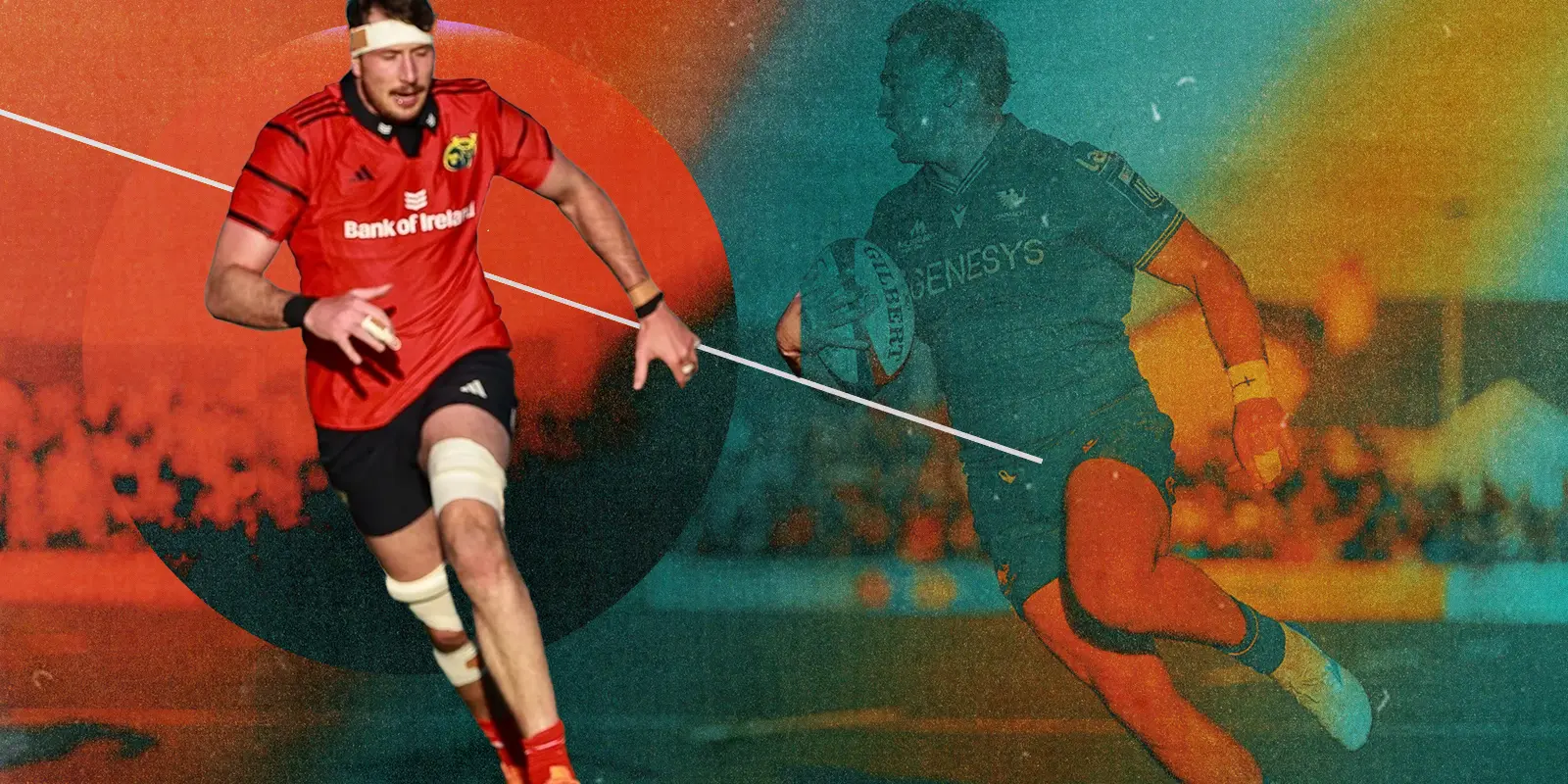
The worst thing about last night was that even a slightly better performance, or one or two marginal calls going our way instead of Connacht’s, we’d probably, maybe, perhaps have left Galway with a losing bonus point. No great, but not bad.
Instead, we left on the end of a 5-0 match point defeat that came as something of a hammer blow after two of the most damaging weeks in the province’s history.
Back in 2015/16, the only recent analogy for what has played out this season in both our domestic and European performance, the angst, such as it was, belonged on-field. We weren’t playing well — to put it mildly — but that’s where the majority of the heat came from.
During that season, the recently garden-leaved Andy Farrell, who had signed for the Irish test squad as a defence coach for November 2016, came to the HPC to assist the coaching staff at the time, while at the same time doing a review of the entire professional set-up. At one point, I had multiple people in the UL canteen telling me about a conversation Farrell was having with individual players across the span of an afternoon about where they thought it was all going wrong.
Fun times.
After that — maybe as a result of that review, or in tandem with other information — the IRFU decided that wholesale coaching changes would be required. All of the coaches, bar Anthony Foley, were out, Felix Jones, Jerry Flannery, Jacques Neinaber and Rassie Erasmus were in. And you know the rest of the story from there, with all the comings and goings, tragedies, and, later, recrimination.
There is no time for sentiment in professional sports, and rugby is no different. Everything moves on far, far quicker than you think.
By the middle of last season, it was clear that Munster needed another review. The rigid, process-driven approach of Johann Van Graan was ditched in favour of a freer, more old-school, more flexible approach under Graham Rowntree. The players responded. They had more freedom. Rowntree was — and is — a deeply charismatic, old-school coach at heart, and, when combined with the expansive attacking concepts of Mike Prendergast, was seen as something of a breath of fresh air relative to the somewhat technocratic Van Graan. I don’t think those descriptors do either man any injustice.
What tends to happen, though, is that when you go from technocratic to something more old school and instinctive, things can get a little too loose. Detail gets missed. It’s OK, though, because we have a new environment now, you say, there’s more margin for error here. We don’t have to be perfect robots; we’ll just get better. How do you get better? That was sometimes quite vague. We were playing more expressive rugby at our best, which the players enjoyed, while also leaning into a very old-school training regimen that put a big value on being “battle hardened”. Being battle hardened and running an expansive, possession-based game suited who we wanted to be, or felt we wanted to be.
Early in 2024/25, it was clear that there were deep divisions in the coaching group on these standards — Prendergast and Leamy broadly “against” Rowntree and Kyriacou. When Chris Boyd, who came in as a Performance Consultant two months after Rowntree and Kyriacou departed the club, found something of an outdated high-performance environment.
The rugby itself wasn’t the issue, even though we weren’t playing all that well — it was the structures around the rugby that were the issue. I don’t know the exact report that Boyd gave to Munster and the IRFU, but reading between the lines, I think he most likely recommended that whoever the head coach was going to be, they needed to be experienced in building structures over any on-field speciality. Enter Clayton McMillan, who had extensive experience in that very thing at the Chiefs over a period of five years.
Mike Prendergast, Munster and the IRFU felt, would provide the on-field attacking structure to build on what had come before if he could get over the disappointment of being “passed over” for the main role. By all accounts, that disappointment never fully dissipated, and perhaps rightfully so. I had heard in January of 2025 that Mike Prendergast was highly likely to get the role full-time, before it broke relatively late for McMillan. Rumours, of course, can be true or false, but when you hear them from multiple different places, all suggesting the same thing, it suggests that it’s something that’s commonly believed. Inevitable, even. Of course, people can be all wrong — it wouldn’t be the first time — but I do believe that Prendergast, completely naturally, felt a little rug-pulled.
Maybe it would have been better for everyone to fully move on in that scenario, something I believe Prendergast considered at the time before turning around on it as the months progressed.
That brings us this season, where it became clear that the “floor” McMillan spoke about raising, to much derision since, was incongruent with how we were structured to play the game.
This became quite apparent across the dire November/December/January block, where we tried to manage and rotate the squad, but found out what we always knew — this system needs week-to-week consistency and cohesion to function properly. Think about it. When this system worked at its best — the 2022/23 run-in, the 10-game winning streak in 2023/24 — it was all built on playing the same team every single game, for multiple games at a time.
During 2023/24, we organised mid-Six Nations friendlies to keep the team “sharp”, because it couldn’t be functionally maintained in that state in isolation. Cast your mind back to that game in Thomond Park against Glasgow in 2022/23, coming off a long break during the Six Nations — we looked like we’d been revealed to each other from mystery boxes right before running onto the field.
It is not possible to rotate this squad to keep everyone fresh and play this structure while also maintaining a floor of performances. There are too many moving parts, in my opinion.
If I were to guess, and I am guessing, I think that the core philosophical differences between McMillan and Prendergast have their roots here. When you combine that with a squad missing a player as important as Jager — and we only truly understood how important when he was gone — and a system almost too tailored to what Jack Crowley does better than anyone else, with no stylistic replacement ready, the floor was always going to collapse. And collapse it did.
That’s before we come to the last month, which has been an absolute mess off the field, and sometimes on the field. Good performances against the Bulls, Benetton and Ulster A (effectively) have been dotted around complete collapses against the Sharks, Exeter and now Connacht.
Of course, you can point to Munster missing eight Category A players against Connacht as mitigation, some of them being core leaders, physical pillars, system levers and most of our few level raisers — Milne, Jager, Kleyn, Beirne, Crowley, Farrell, Nash and Daly — and that would not only be accurate, but also a pretty key indicator of performance. Your best players are your best players for a reason. We currently do not have a system that can mitigate for that.
18 of the team of the 23 who featured away to Ulster in January featured in Galway, with similar results. We needed to be tactically perfect, handle Connacht’s kicking game, and defend well — we did none of these, so we lost.
The off-field mess is harder to untangle. Munster have investigated the facts around the Randle “issue”, but that review is now going to an external company for further scrutiny, with a finding to be produced back to Munster and the IRFU on completion. It is not expected to take very long at all. At the core of this review are three people primarily. Clayton McMillan, Ian Flanagan and Ian Costello. Clayton McMillan is involved in this, but I don’t believe he’s the primary focus of the review itself. Everyone at Munster and the IRFU wants him to stay on, and I believe he will, at this point. The main focus is on CEO Ian Flanagan and General Manager Ian Costello, both of whom had a difficult time at the “town hall” meeting for all staff, coaches included, at Thomond Park last week.
There’s no doubting that this process — this storm, in reality — will have been hugely stressful on two men with bills to pay, families to look after, and careers to manage. I’ve been trying to imagine what it’s like at the centre of this, being central to it rather than writing or talking about it, and I can’t fathom the pressure they must be feeling.
At the same time, this seems to be a case where facts are needed to determine what happens next, and when I see something like this being sent for an external, independent review, my own experience in this field tells me that whatever actions are to come must have completely independent, beyond reproach findings to be legally and procedurally defendable, whatever those actions may end up being.
The last time we were here, it took wholesale change, a period of real pain, and eventually the right people in the right roles to turn things around. That’s just history. And as we’ve seen, history in professional rugby moves faster than you expect. Whatever the external review finds, the clock doesn’t stop. The work of rebuilding starts almost immediately after. It always does.
The difficulty is that Munster currently needs answers on two separate fronts simultaneously — one legal and procedural, one sporting — and neither can wait for the other. Whatever the review concludes, it won’t fix the structural problems this squad has been carrying for two seasons. That’s a separate, and arguably more important, conversation that will need to be had clearly and honestly, without the noise of everything else surrounding it. It needs decisive action and an off-season.
Rugby clubs are not just organisations. They’re institutions built on relationships, trust, and shared suffering — and right now, those relationships are strained at almost every level. Whatever comes next, and something will, the work of repairing that matters as much as anything that happens on the field.
We’ve been here before. We found a way through. The question, as it always is in these moments, is whether the right people are in place to do it again.
