


So, it’s confirmed. Jean Kleyn will leave the club at the end of the season to take up a multi-season deal in Gloucester.
It’s a blow, no two ways around it, but the key for Munster now is the next part: how do you make the squad better without him?
To answer that question, we need to look at Munster’s style, what’s gone well with it, what hasn’t worked, and where it might evolve to in the coming seasons. That evolution is the question: what takes us from where we are now up to the next level?
There’s no easy boilerplate answer, but I’m going to give one anyway; we need more punch in the middle of the field to literally make everything work as it should. This is particularly meaningful post-Jean Kleyn, and I’ll explain why in a minute.
In the data so far this season, for players who had played 240 minutes or more at the time the stats rolled over — so guys like Edogbo, Casey, Ala’alatoa and Gleeson aren’t included in this set — we get the following data point breakdown of the squad up until before the Toulon game. Beirne also hasn’t yet been added to this set, for whatever reason, so I’ll add him when it updates. It doesn’t change my point, anyway.
Munster Offensive & Defensive Data
“`html
| Player | Min | DomC% | GL% | Ev% | AR/80 | Tkl/80 | Tkl% | Jack/80 |
|---|---|---|---|---|---|---|---|---|
| Front Row | ||||||||
| Jeremy Loughman | 334 | 23.3 | 33.3 | 3.6 | 21.3 | 16.3 | 91.9 | 0.0 |
| Diarmuid Barron | 299 | 16.2 | 48.7 | 7.7 | 19.3 | 12.0 | 90.0 | 0.0 |
| Lee Barron | 295 | 38.9 | 45.0 | 0.0 | 17.6 | 16.8 | 95.4 | 0.5 |
| John Ryan | 281 | 12.5 | 24.0 | 4.0 | 25.3 | 12.2 | 95.6 | 0.0 |
| Michael Milne | 265 | 17.2 | 31.0 | 7.4 | 16.3 | 16.3 | 93.1 | 0.3 |
| Second Row | ||||||||
| Jean Kleyn | 471 | 25.4 | 55.6 | 1.6 | 17.8 | 14.8 | 92.5 | 0.0 |
| Fineen Wycherley | 582 | 20.5 | 58.1 | 5.4 | 17.5 | 15.3 | 94.9 | 0.1 |
| Tom Ahern (Lock/6) | 346 | 29.4 | 82.3 | 15.8 | 9.7 | 8.8 | 90.5 | 0.2 |
| Back Row | ||||||||
| Jack O’Donoghue | 524 | 31.3 | 50.0 | 12.5 | 18.3 | 14.1 | 92.9 | 0.5 |
| Gavin Coombes | 517 | 37.7 | 53.3 | 16.9 | 18.4 | 14.1 | 95.8 | 0.1 |
| Half-backs | ||||||||
| Jack Crowley | 422 | 16.7 | 66.7 | 42.3 | 3.2 | 11.4 | 90.9 | 0.0 |
| JJ Hanrahan | 271 | 25.0 | 55.6 | 0.0 | 2.1 | 11.5 | 81.3 | 0.0 |
| Paddy Patterson | 243 | 14.3 | 60.0 | 28.6 | 1.6 | 5.6 | 70.8 | 0.3 |
| Centres | ||||||||
| Alex Nankivell | 594 | 50.0 | 51.4 | 31.8 | 10.5 | 8.6 | 94.1 | 0.7 |
| Dan Kelly | 480 | 17.5 | 47.7 | 17.1 | 11.3 | 8.0 | 84.2 | 0.2 |
| Tom Farrell | 400 | 25.5 | 52.5 | 23.3 | 8.4 | 7.4 | 94.9 | 0.4 |
| Back Three | ||||||||
| Shane Daly | 490 | 32.6 | 75.0 | 13.9 | 7.3 | 3.3 | 74.1 | 0.0 |
| Thaakir Abrahams | 472 | 43.2 | 84.6 | 37.2 | 3.9 | 3.6 | 67.7 | 0.0 |
| Mike Haley | 326 | 28.1 | 62.8 | 24.2 | 7.6 | 2.5 | 66.7 | 0.3 |
| Calvin Nash | 240 | 33.3 | 50.0 | 23.3 | 3.7 | 6.3 | 79.2 | 0.0 |
What the squad profiles tell us about how Munster are actually playing
When you strip the noise away, these data points describe a squad that’s built to work, not necessarily to punch holes right now. We’ve got a pack that turns up in huge volume at the breakdown — Ryan, Loughman, Coombes, JOD, Kleyn, Wycherley, Barron all living in the 17–25 attacking rucks per 80 range — and that’s actually quite valuable. It confirms the underlying idea: we’re trying to play a tempo, phase-led game where our shape stays intact and we win through repeatable pressure rather than miracle moments.
The problem is that volume isn’t automatically creating stress. The reason teams have been swarming into the space behind the pod is visible in the carry profiles. We’ve got some really good carriers in space — Abrahams’ gainline rate is absurd, Ahern and Daly are high too — and Crowley is doing Crowley things with his evasion and try involvement numbers.
But the attack pod is only truly frightening when the defence has to pay for doubling up and blitzing. Coombes is the cleanest example of that: he’s dragging two men into contact at elite rates and still staying efficient at the ruck. Nankivell is the other big one — he’s basically the squad’s collision cheat code, with dominance that most centres simply don’t give you, while still adding ruck work and keeping our tempo moving. We often talk about “one more ruck”, and it’s guys like Nankivell that really hammer that home. Almost all of our players are highly comfortable hitting rucks and doing so efficiently, which you would expect with the pressured possession system we want to play.
What you end up with is a very Munster pattern: we have the bodies to resource, and we have the shape to play, but we don’t always have the consistent “bend” that forces opposition defenders to react as we want. When the carry is contained rather than won, the defence can fold hard, fill behind, and suddenly our “out the back” shape looks like a nice idea rather than a threat. That’s when Crowley has to create under pressure — and his try involvement numbers suggest we’re leaning on him heavily to turn sub-optimal pictures into actual outcomes.
Why the defence numbers matter
Defensively, the data reads like a team that can survive volume because the defensive engines are doing the graft. Our forwards are putting up serious tackle counts with strong success rates — the kind of profile that supports a connected line and repeated sets under pressure. That’s not nothing. It’s the foundation of a defence that wants to stay in system, keep line speed, and squeeze the opposition into low-percentage decisions.
But the warning light, for me, is in the backfield/edge tackling efficiency. Some of the back three numbers are simply too low for comfort, and the “first tackler” rates suggest those players are being asked to make high-leverage tackles without help — the kind that happen when your chase is late, your fold is fractured, or you’re defending space in transition. That ties directly into the same theme as the attack: if we’re not consistently winning the carry and controlling the next phase, we get dragged into the messy middle ground where everything becomes harder — including defence.
What has to change for Prendergast’s 1-3-3-1 to stress good defences
If we want Mike Prendergast’s flat 1-3-3-1 to consistently threaten the best teams, we need to make the pod hurt again. Not just “gainline”, but dominant — the kind of carry that forces the defence to stop folding so aggressively and makes them respect what’s in front of them. When that happens, the space behind the pod becomes real space, and Crowley gets to play off a staggering defence, rather than shooting up on him.
That doesn’t mean reinventing the system. It means sharpening the point of it. Coombes is already giving us the “magnet” effect, and Nankivell is one of the few players who can win collisions at centre while still keeping our tempo alive. Edogbo and Gleeson are building into being elite threats here, too, but we need more.
If we can build the attack so those four profiles are consistently leveraged — and the pod carries become more “win” than “meet” — then everything else follows: our ruck numbers stop being a badge of survival and start being a weapon, our “out the back” threats stop being swarmed, and our looping backs get separation.
In other words, the data doesn’t say we lack work-rate or structure. It says we need more punch in the carry — because consequence is what buys time, space, and control.
***
Post Kleyn, this is where our pack build becomes really interesting. Right now, it feels like we have a lot of mechanics in the pack and our one primary collision winner in seasons gone by — Coombes — has adapted his game to a more all-round skillset, rather than being a pure banger.
Kleyn is a perfect example of this; a hardworking, set-piece dominant lock that we’re not really seeing the best from in this system. At the time of writing, we are using Kleyn as a primary ball carrier — he is in the 99th percentile for carries among all locks in the URC. Yet his dominant carry% and gainline percentage is relative modest, even with that usage. He has beaten one defender so far this season — Joe McCarthy — and it seems like we want that #4 lock to be a ball-carrying outlet for us, especially seeing as how Tadhg Beirne seems to have moved into the back row permanently.
We haven’t used Edogbo in the same fashion, and we’ve exclusively used them separately; Edogbo comes on for Kleyn, or vice versa. That’s almost entirely down to getting Edogbo back up to speed after two seasons, more or less, out of the game, and I think by the time we hit the end of the season, you’ll see Edogbo’s on-ball usage shoot up.
It makes perfect sense for (a) Munster to want to use Kleyn’s size in that role and (b) for Kleyn to be less than optimal in that position. Carrying at that volume simply isn’t in his game as it stands, and, at 32, it’s unlikely to ever be that way.
Yet, we need heavy runners, and he fits the bill. When I watched him playing Edinburgh in Virgin Media Park a few weeks ago, I kept coming back to the idea that he seemed to be playing way smaller than he is, almost entirely because we’re using him as a primary middle line ball carrier.
That is what the system demands of him, and will eventually demand of Edwin Edogbo.
That might also go some way to explaining why we weren’t willing or able to match terms with Gloucester. As it stands, Kleyn does not fit the system we want to play, and with the set piece fluctuating from week to week — maul work, scrum and lineout — we’re not getting the value we need at the other end, either.
In fact, the data shows us that we’re essentially getting what Jean Kleyn gives us — at least during phase play — from Fineen Wycherley, which, to me, scans with the eye test so far this season.
So, with that in mind, I think we need to move away from the idea of replacing Kleyn like-for-like. Hopefully, Edogbo will give us that and more, in tandem with more heft in the front row.
For years, Kleyn has been our physical rock; to get to the next level, we need to disseminate his tight physicality into the front row — signings required here, of course — and power up the area we need with more direct ball carrying.
This is the hole we have to fill.
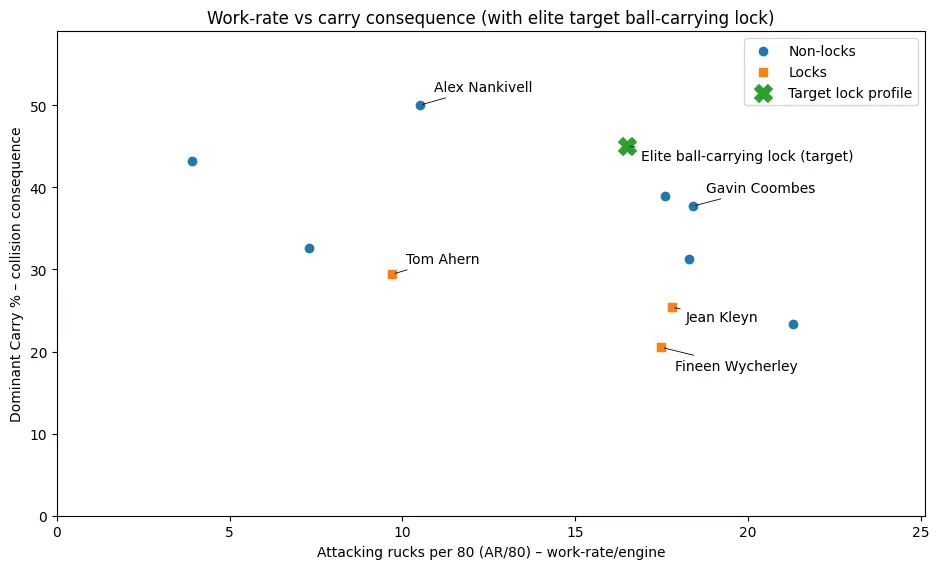
Our tight work in the scrum and maul can rest on Edogbo, plus our prop rotation — we need to beef up our primary carrying out of the second row to round out our middle line carrying rotation, and if we can do that, the system will go from working in fits and starts, into working most of the time against almost any opponent.
That’s not the only area we need to look at, but that’s the place to start.
