


Your history isn’t your present.
It’s an important part of therapy that I’ve learned over the years. When you are too focused on the past – which existed in a different context, a different world to today – you can miss all the nuances of the now. The world is different, the past is gone.
Munster are currently in the chasing pack of maybe 10/15 teams who are trying to close the gap on the Big Four in Europe this season; Leinster, La Rochelle, Toulouse and Union Bordeaux Bègles. Where Munster are in that pack of 10/15 teams depends on our current injury level more than anything else but, even with a fully fit squad I think we’re in “puncher’s chance” territory against fully loaded versions of those top four European teams.
That’s the reality. We hope it won’t always be the reality, but for now, it is.
However, if you’re stuck in 2006 this doesn’t make sense to you. When you are huffing nostalgia, Munster’s “European Tradition” counts for a lot more than it does in 2024. What matters in European rugby in 2024 is what matters in every professional sport in 2024 and it’s this; the more money you can put on the field in wages, the better your chances of winning trophies. That isn’t romantic, but it’s the truth – usually – in environments where there aren’t any controls on overall wage spend without caveats. Look at Major League Baseball this season. The two finalists in the World Series this year were the New York Yankees and the LA Dodgers who were technically the 2nd and 3rd on the MLB wage chart behind my beloved New York Mets but were able to put more money on the field in a practical sense. They contested the World Series and the team with the highest total spend won out – the Dodgers.
It’s usually the same story in soccer, especially in the Premier League. A study I read recently suggested that it isn’t just wage totals either but having smaller amounts of salary disparity at the top end correlates with success. So, essentially, when a lot of players are being paid a lot and mostly the same at a soccer club, that usually means a greater chance of success. The same should translate to rugby and when you consider the top four I mentioned earlier, I think it does. A lot of well-paid players, a few guys getting more per year but not radically more than the rest of the top earners; that would describe the Big Three quite well with the aspiring member of a potential Big Four – Union Bordeaux Bégles – not far behind.
Of course, wages spent don’t automatically mean success – just ask my fellow baldist Eric Ten Hag – but they are a good place to start.
Why is this relevant? Because on Friday night, Munster played for most of this contest with three of the front row that were named in the match day 23 against Scarlets in the PRO12 final of 2017. It would have been four if John Ryan hadn’t been rested for this game, but his importance to the squad today is arguably only a level or two below what it was eight entire seasons ago.
Even the matchday squad from the second last time we played Castres in this stadium back in 2018 features Niall Scannell, Dave Kilcoyne, John Ryan and Stephen Archer. It’s the one area of our squad that catastrophically bad luck with injury, a lack of standout academy products and a lack of dispensation to sign NIQ props to help bridge to the next generation have cost us in the last two seasons. All three of our 36-year-old props – Kilcoyne, Archer and Ryan – still have something to offer the club but in a fit-for-purpose IRFU ecosystem, we might only have to rely on one of the three for a game like this off the bench away to one of the gnarliest teams in France historically and contemporally. To be in a position where we have two 36-year-olds in the squad – with one more being rested for use next week – is far from ideal, even with five other senior props being injured. Relying on academy guys is on the same scale, just the opposite end. Power is expensive, tight power is incredibly expensive, and we don’t have enough of it for a slugfest like this right now.
What’s my point? That, even though we still should and could have won this game, a losing bonus point away to a team who have beaten La Rochelle and Toulouse this season in the same stadium is a decent result from a bad, injury-ridden performance. My point is that anyone expecting the boilerplate 10-28 handy night’s work against this particular Castres team is living in a different reality to the one this game was played in.
That doesn’t mean that winning was impossible – we should have won, to be clear – but the fact that we lost shouldn’t be a massive shock or something to stop the presses. We were an incomplete side coming into this game and we finished it even more incomplete and disrupted. That is reality, not nostalgia talking.
When you deal in reality – how things are as opposed to how you want them to be – a lot of this result begins to make sense.
Go back to the Wally Ratings from that game in December 2018 and you’ll get a good summary of how this game went. When I read it on Sunday morning I had to be careful not to copy it flow for flow because the parallels are stark. That Wally Ratings from 2018 focuses a little too much on refereeing for my current taste, but most of the same stuff might apply to Friday’s narrow loss.
The headline points are the same; ugly game, sloppy mistakes, flyhalf errors, should have won, lost instead.
Ultimately, we lost this game the way that a middle-of-the-pack, mid-budget team that rotated out some key players to the bench or the stands would do – with a lot of regrets. Our indiscipline, for example.
We conceded 17 penalties – a seasonal high by some distance – and that comes off the back of what I was talking about; fellas losing collisions under pressure or adjusting to mistakes late or trying to cut a corner on a maul defence set or at a counter-ruck. When you see players giving up high tackle penalties in 2024 it’s mostly due to being out of position and struggling to get low.
This is a good example early in the game. Archer got caught moving laterally, had to swim around a blocker and couldn’t get low enough to make a legal tackle on a slippery smaller runner.
Archer is about as solid a veteran as you can get in the game right now. There aren’t many 36-year-old tightheads still operating at this level, and that’s a credit to him and his professionalism. But he’s caught for pace there off a maul creaking backwards. That’s where you concede penalties – under pressure.
Dave Kilcoyne gave away a fair few penalties too and again, it’s pressure.
Kilcoyne gets folded across here quite decisively as Collier catches him and drives across him after a clever step across from the Castres pack. When you see this picture here…
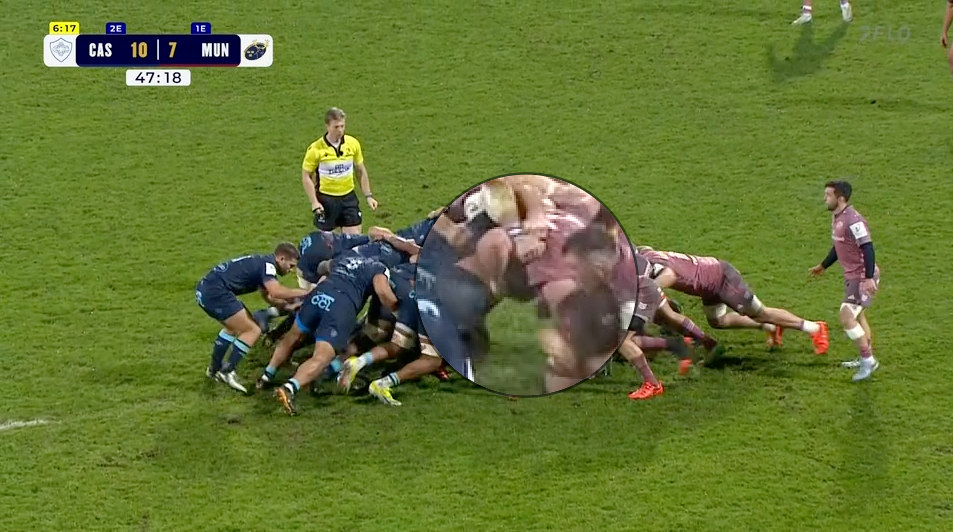
It tells you all you need to know.
But Dave Kilcoyne last played a game of rugby in December 2023 – after a full year out, he could probably have done with 10/15 minutes max in this game against a heavy Castres front five but an injury to medical joker Dian Bleuler meant he had to do the majority of the game.
But our regrets don’t end there.
This one, for example, early enough in the second half that a try would have forced Castres out of their shells a little more, will be a key source of regret.
What went wrong? It seems to me that Kilcoyne didn’t go with Gleeson’s catch to keep Collier out of the guts of the fast build, no-jump maul we tried and, to be fair, did a great job of disguising.
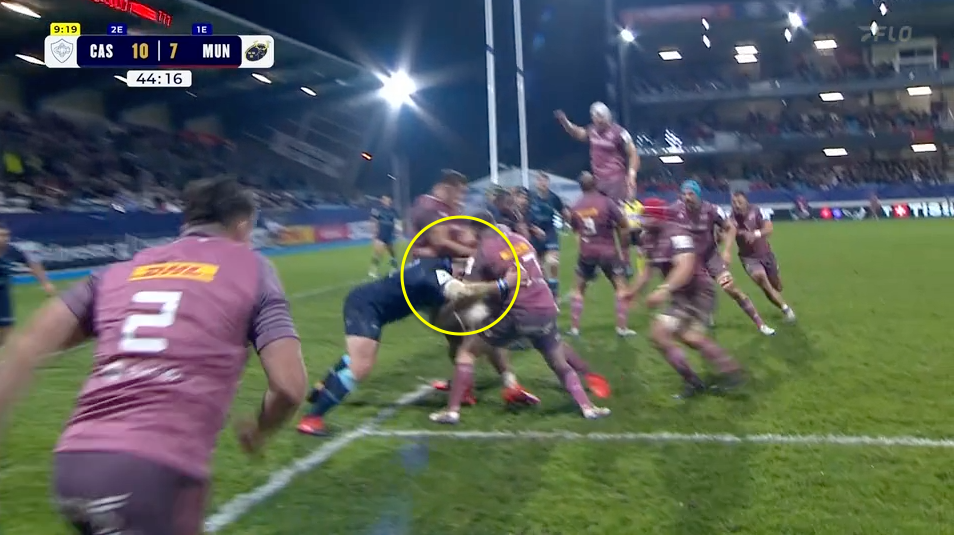
The ball was immediately disrupted and the moment was gone. Castres won a full penalty off the resultant scrum and advanced up the field where they scored three points a few minutes later.
As in 2018, Castres had multiple yellow cards, but the heavy conditions and the sheer weight of their stops in defence made finding any kind of space quite difficult. One clip, in particular, illustrates this difficulty.
What to look for;
- Castres conceding quick ball to us because they don’t rate our middle-line carriers and know that if they fill the field, we’ll have to skip around them
- How heavy the defensive collisions are
- Jack Crowley being tackled “late” after the ball is gone on every single touch – it was like this the entire game and 100% knocked him off his stride. In a year he’ll realise that the “smart” thing to do here is to go down looking for a penalty early on so the referee has to take notice of it.
- Crowley’s pass to O’Mahony can only go forward at the end because O’Mahony is in line with Crowley on the release – he needs to keep more depth here so the pass has space to breathe.
That was the entire game. It was a day for long studs and trench warfare, and Castres excelled in that type of game. It is what they are built on – winning ugly.
Ultimately, the loss of the game came down to three moments.
Right after taking a lead in the last 10 minutes from a series of close-range pick-and-goes, we lost this restart through a Mike Haley knock-on. This kind of catch is his stock and trade, so he’ll be disappointed to have shouldered this one forward. If we take this restart, I think we probably grind out a win.
Castres almost immediately went for the scrum because, to that point, they had been drilling through Dave Kilcoyne for most of the second half. They duly opted for the scrum and got the reward. Elbow down. Penalty. Three points. Lead restored.
This kind of picture in a scrum is a penalty against the loosehead every single time. It’s almost exactly what referees are shown to look for when officiating scrums.
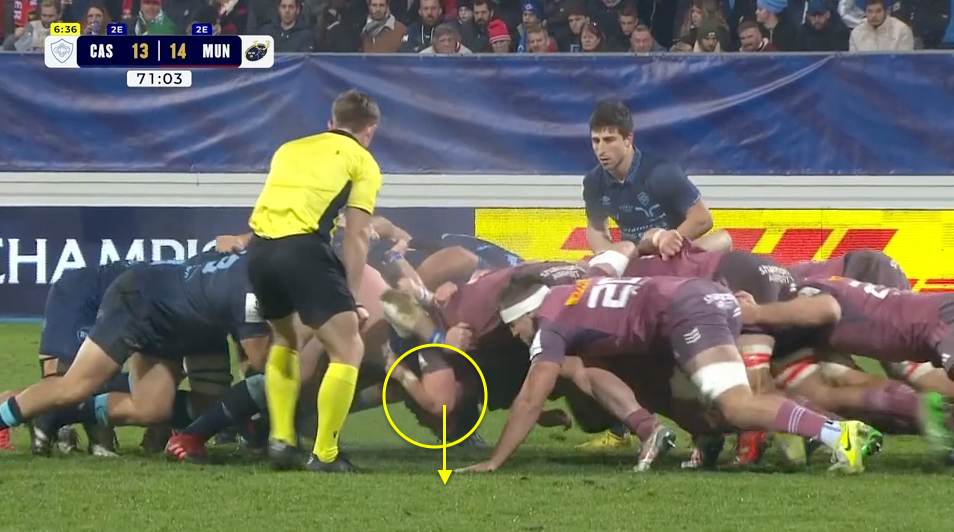
Even though we forced a scrum just outside their 22 off the restart, it was asking a lot for Jager to move over to loosehead. He attacked this scrum the way a tighthead would – sinking low – but the elbow down right at the end tells Ridley where the penalty should go.
But we’d have a chance to win it right at the death and this is the moment that I feel most people will use as their key takeaway. A big Munster moment missed, so to speak. Crowley lined up this kick with the wind, aimed for every last bit he could get to find the 5m line or close enough to it and… it was kept out by good Castres defence.
The kick leaked a little off the right side of his boot, curved away from the line too much and became all too catchable – with the clock gone red, it was game over. It’s a tired-looking kick from a guy who was heavily involved all night and, a bit like Carbery six years ago almost to the day, it’ll be the big thing coming out of the game for him. Any flyhalf with 60+ offensive involvements – and most right on the gainline – is either going to have a five-star game or a two-star one depending on how the moments pass. Young players – and Crowley will only turn 25 next month – and particularly young flyhalves learn from moments just like this in the modern game.
Speaking of nostalgia, on Saturday morning I was waiting in the queue in my local Spar and heard a guy ahead of me talking about how Ronan O’Gara in 2006 wouldn’t have missed that kick down the line. They were probably right. At the same time, though, Ronan O’Gara was 29 years old when he had those games against Leinster in Lansdowne Road and Biarittz in Cardiff in 2006. Back when Ronan O’Gara was 24, however, I remember that 9-8 loss to Northampton in the Heineken Cup final where his goal-kicking lost Munster the game. That didn’t define him, this poor performance won’t define Crowley. I fundamentally believe that you learn more from a shocker in Castres than you do from a cakewalk in the URC at home you win by 40 points. The only difference is how others see you.
Where does this leave us? In a tricky spot, in one way. The injuries to the outstanding Craig Casey and Thaakir Abrahams look like they could be somewhat serious. O’Mahony and Kilcoyne hobbled off too. This is not a time of year that can easily absorb injuries like this. At the same time though, the European Champions Cup pool round has never been more forgiving. A win at home to Saracens and we’re back on track like this game never happened. This isn’t the do-or-die pool games of years gone by. We qualified last season with one win, one draw and one losing bonus point so with a nasty away fixture out of the way, we can concentrate on the one thing these pool games incentivise – winning your home games.
Ultimately, this Munster team have decided that their point of difference is going to be speed. We are not a complete, all-court team. We have areas in our squad that are “weak” and, as such, can’t sustain multiple injuries. As a result, this is not a team that can expect to handily put away Castres on the road on a heavy, cold December night. We have decided to use our budget to tilt us towards performing on the harder ground of April, May and June.
That’s the thing with being a mid-budget team; winning isn’t impossible, you just need to be 90% healthy in core areas when the knockouts come around and you need to play on your terms. You have to pick your battles to hope to win the war.
There are a good few battles left for this Munster team, and we have to hope they pick and choose the right ones.
| Players | Rating |
|---|---|
| 1. Dian Bleuler | N/A |
| 2. Niall Scannell | ★★ |
| 3. Stephen Archer | ★ |
| 4. Fineen Wycherley | ★★ |
| 5. Tadhg Beirne | ★★★ |
| 6. Peter O'Mahony | ★★ |
| 7. John Hodnett | ★★★ |
| 8. Brian Gleeson | ★★★ |
| 9. Craig Casey | ★★★ |
| 10. Jack Crowley | ★★ |
| 11. Thaakir Abrahams | ★★ |
| 12. Alex Nankivell | ★★★ |
| 13. Tom Farrell | ★★★ |
| 14. Calvin Nash | ★★★ |
| 15. Mike Haley | ★★ |
| 16. Diarmuid Barron | ★★ |
| 17. Dave Kilcoyne | ★★ |
| 18. Oli Jager | ★★ |
| 19. Tom Ahern | ★★★ |
| 20. Alex Kendellen | N/A |
| 21. Paddy Patterson | ★★★ |
| 22. Rory Scannell | ★★★ |
| 23. Jack O'Donoghue | ★★ |
