


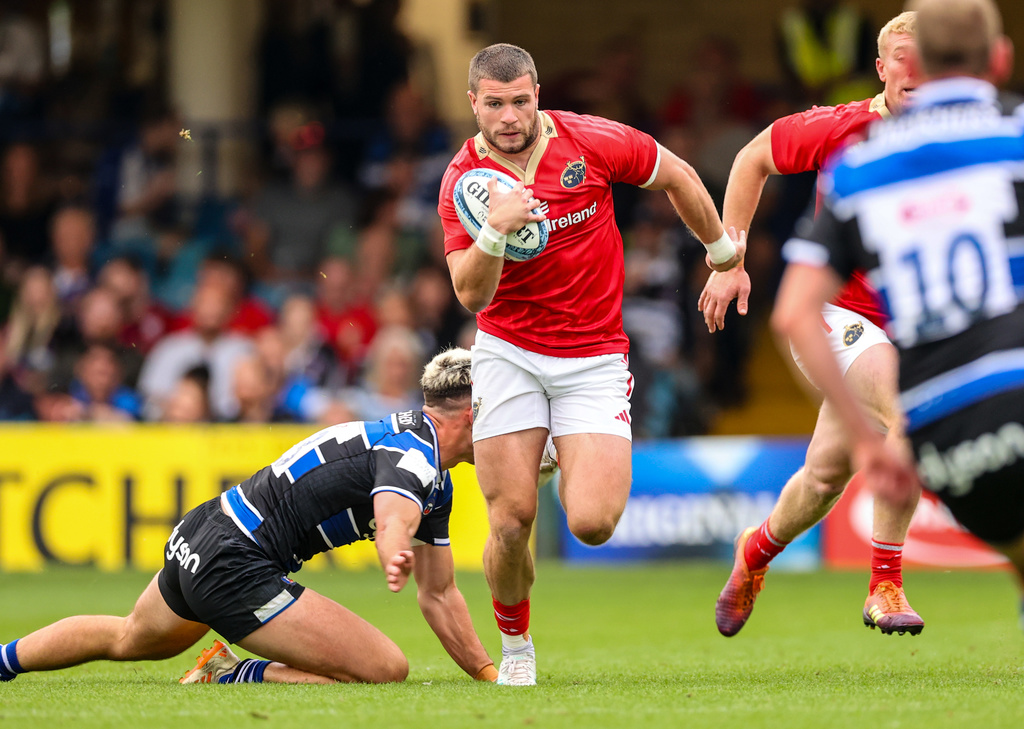
When Mike Prendergast took over as Munster’s attack coach, it would be fair to say that I was excited about what he might bring to the team after a number of successful years in France with Grenoble and Racing 92, in particular.
At the time, Munster had come to the end of Stephen Larkham’s 3-2-X era and Johann Van Graan’s chimaeric use of game states with that shape.
Graham Rowntree wanted to do things differently, and there was no better man in the game for that job at Munster than Mike Prendergast. I predicted that we’d transition to a 3-3-X shape under Prendergast back in May 2022 and I turned out to be correct on that.
Prendergast runs a 1-3-3-1 at Racing with, as I’ve said, a lot of segmentation between backs and forwards. What do I mean by this? Well, a 3-3-1 system is essentially two banks of three forwards in the Off #9 and Off First Receiver slots but because more central space is occupied by forwards – three as opposed to two – it means you’ve got more edge space to work with but less space occupied by forwards. You’ve also got less attacking depth to work with because your key middle ground ball carrying is all forwards so you need less depth arrayed off your second handler. You can play flatter and with more “backstage” space for your backs to work with but that means you’ve got to change up your profile of midfielders to “untether” your #10 from the first receiver position.
Tom Savage, really good. Three cheers for Tom Savage.
In reality, there wasn’t much predictive work used there. He used that shape at Grenoble and Racing so it stood to reason that he was hired to do the same thing at Munster and when he did, he brought the same principles of play. We kicked at a much lower rate than under Van Graan and demanded a lot from players at the offensive breakdown.
It would get worse before it got better. Munster only began to click offensively in November of that year before hitting top gear late in the season when a good run of injuries allowed us to show what we were capable of. We won the URC in Cape Town playing a style of rugby that was unrecognisable from what we had been playing a year earlier.

In our second season under Prendergast, we were still playing some lovely stuff but watching the season back, it really felt like teams got a handle on our attacking structure in key games; most notably against Glasgow in the URC semi-final. I think we’d inadvertently walked into some of the problems that Prendergast faced in his last season at Racing 92 with Kurtley Beale. As I wrote back in May 2022;
I think [Beale’s] addition over the last two seasons has slightly unbalanced Racing’s attacking structure by adding too many handling options in a way that seems to clutter their flow of possession. That said, I get why they signed him in the first place. Before Fickou’s arrival midway through 2020/21, Racing had Henry Chavancy at #12 who offered some of the playmaking they needed but not to the level they needed so Beale was a key part of their attacking scheme at fullback. Since Fickou’s arrival, Beale has sometimes struggled for impact as a lot of his playmaking involvements have gone to Fickou […]
We duplicated that same problem with Antoine Frisch and Simon Zebo, albeit inadvertently. When it came to it, we were desperately one-paced against Glasgow. Yes, sure, part of that was how badly we missed Nash for that game and, in the grand scheme of it, how badly Conway was missed after his retirement but the answer to our problems was pretty clear looking back on the whole season, really; we needed pace.
This was something that Munster were well aware of because Prendergast had solved this problem before, although he never got a chance to properly implement it at Racing due to his move home. Prendergast looked to replace Beale – a retiring Zebo in this analogy – at fullback with a lightning-fast transition specialist.
[…] It’s no surprise to see (a) Beale leaving at the end of the season and (b) Prendergast scheming for Warrick Gelant to arrive to replace him from the Stormers. Why is that? Gelant isn’t a massive playmaker for the Stormers but he is the 2nd highest offloader in the URC, has the 6th highest metres gained in transition and the eighth-highest number of carries.
We did the same with our contracting last season by bringing in Abrahams and Kilgallen. It was seen as being needless in some quarters at the time – why sign two back three players?? – but it makes complete sense when you watch the season back. Against Glasgow, the game that I’ll be using as my primary example, you can see how that lack of pace stung us.
We lined up in that one with Daly, Zebo and Haley in the back three which was probably our slowest first-class combination last season.
Simon Zebo still had top-class finishing power – remarkable finishing power for 34 years old, actually – but a lot of his top-end speed and acceleration had dipped from his electric, game-changing peak. To be completely expected, I should add. Mike Haley was injured for the first half of the season after a hip operation and while he was a little more elusive than he was pre-injury, and every bit as solid positionally as he’d always been, top-end pace was never his thing. Haley was more of a burst runner, with the size and durability to burst through transition contact.
Then you had Shane Daly whose biggest strength was his all-around game as a third midfielder of sorts. Daly is a fantastic defender, a really good positional player, and an aggressive chaser with great size, aerial ability, and a consistently good kicking game. He was also constantly available, which is a huge bonus for any professional player of his quality.
The one thing I’d say in the negative is that Shane Daly is probably a consistent 10 tries a season guy if he had an extra few steps of pace.
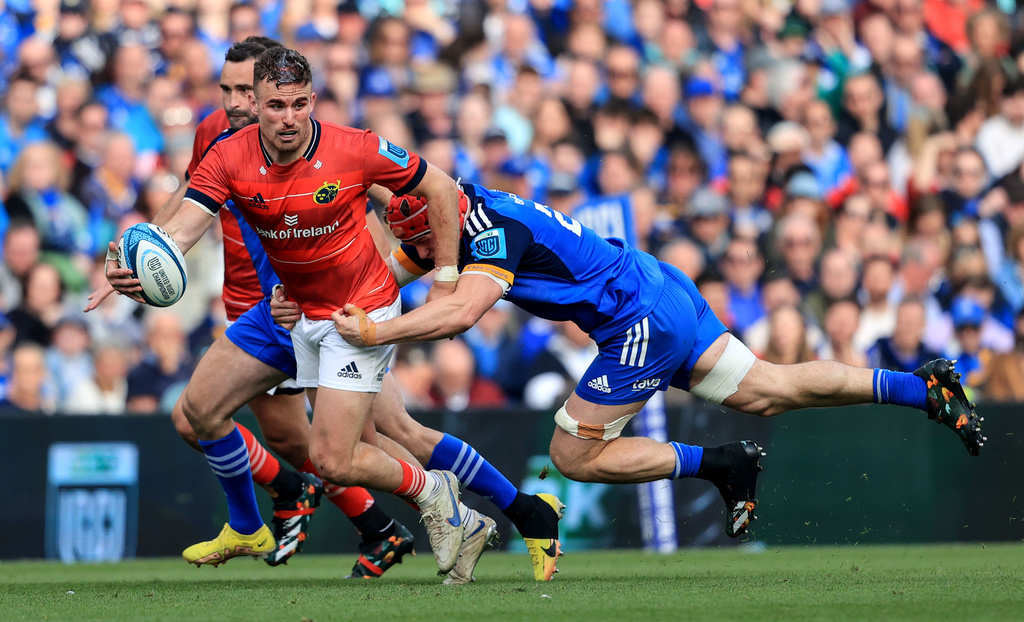
Watching back last season I often felt that Daly would nearly offer a little more for us than Frisch at outside centre given Antoine’s wildly fluctuating performance levels. That was in part because Daly would consistently make a clean break on the edge or in transition – he made the third most clean breaks in the URC last season despite Munster making only enough in total to rank 11th in the league – but have to cut back inside or chop his feet. You’ll see it over and over again.
Here’s one that stuck out for me last season where the hard work was done with the 3-3-X shape and good hands creating the linebreak, but both Shane Daly (and Mike Haley) didn’t have the wheels to convert.
It was a meaningless game that Munster had won (fairly) comfortably at that point but that moment was a little too emblematic of the season where the hard stuff was done but the relatively simple part – winning a foot race – lacked that killer edge when it wasn’t Calvin Nash receiving the pass before the break.
Shape and Speed
The 3-3-X shape is heavily reliant on speed to make it work at its peak, especially during settled phase play. Munster’s use of this forward structure has seen Calvin Nash rise from a guy in his mid-20s who was stalling out under Van Graan to become a CORE 1-level talent and a regular Irish international under Graham Rowntree.
Yes, some of that came down to taking opportunities as Keith Earls aged out and Andrew Conway succumbed to injuries but a lot of it was the right guy being in the right place at the right time. I was once told by someone who regularly watched Nash train and play for both Munster and Young Munster that he was the most naturally fast player in the squad alongside Keith Earls. He might not have been the fastest over 100m in a straight line, say, but he was almost always the fastest out of the blocks and elite at changing direction at pace without losing velocity.
Nash, as a Slashing Outside Winger, was a perfect fit for the #14 role in this system which included a lot of looping infield while also making sure that you kept that pace in the edge spaces too.
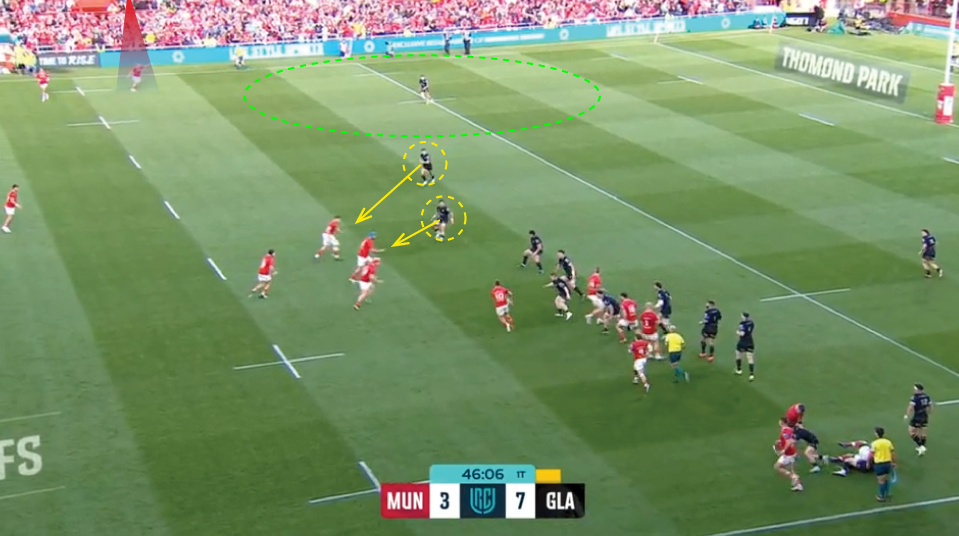
At its core, 3-3-X looks to create a wider block of forwards in midfield that the backs unit can surge around. It’s a very distinctive shape with two edge forwards operating in the 15m tramlines and two blocks of three forwards in the middle space.
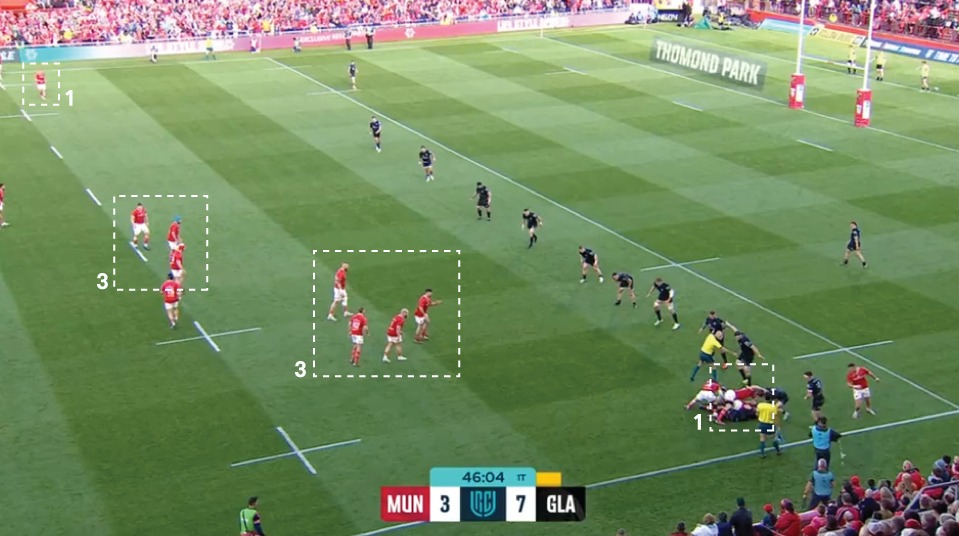
In this instance, Munster played a screen pass out the back of the first pod to Crowley, who hit the middle runner of the second pod of forwards. Those two passes drew in those two edge defenders to guard against the tip on and isolated the Glasgow winger in 30m of space.
The pass action from Munster – one pass from Casey to Barron, one pass from Barron to Crowley and one pass from Crowley to Beirne – gets 23 metres of lateral width before defensive contact is engaged.
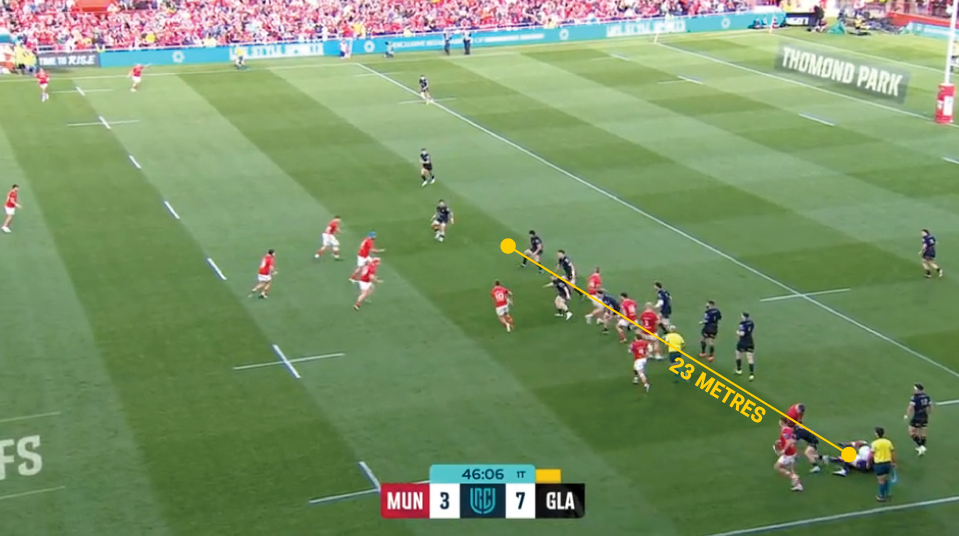
That compressed the primary Glasgow line – they had been guarding 40m of the field but by the time Beirne hit the gainline, they had been pulled into guarding 30m of lateral space.
Huw Jones and Tuipuloto had to compress in 10m and then shoot back out while the defensive fold went around the contact point.
This meant the next phase for Munster had six players attacking 30m of lateral space guarded by four Glasgow defenders.
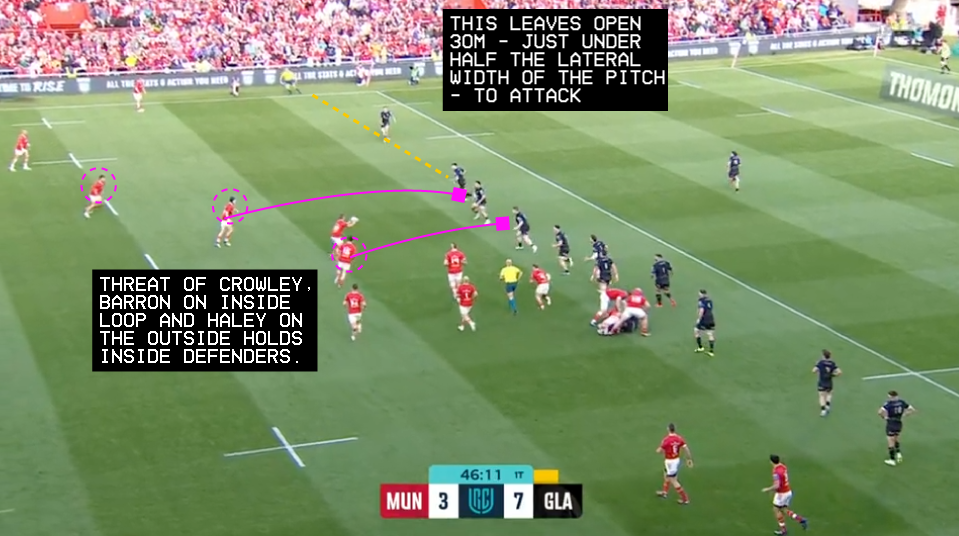
Crowley hits Nankivell, who tries to float a pass above the edge defender to Hodnett but can’t get enough loft on the ball and we get turned over. The only threatening option on this play, when Crowley got the ball exactly halfway across the pitch, was a direct carry himself at Matthews, a risky kick pass to Hodnett or the ball to Nankivell that he ended up throwing. Haley was not a threatening option in this play because he was not a legitimate threat. He would only slow the transit of the ball. At its core, rugby is a game about opening up lateral space and then getting through it with the ball before the defence fills that space with defenders.
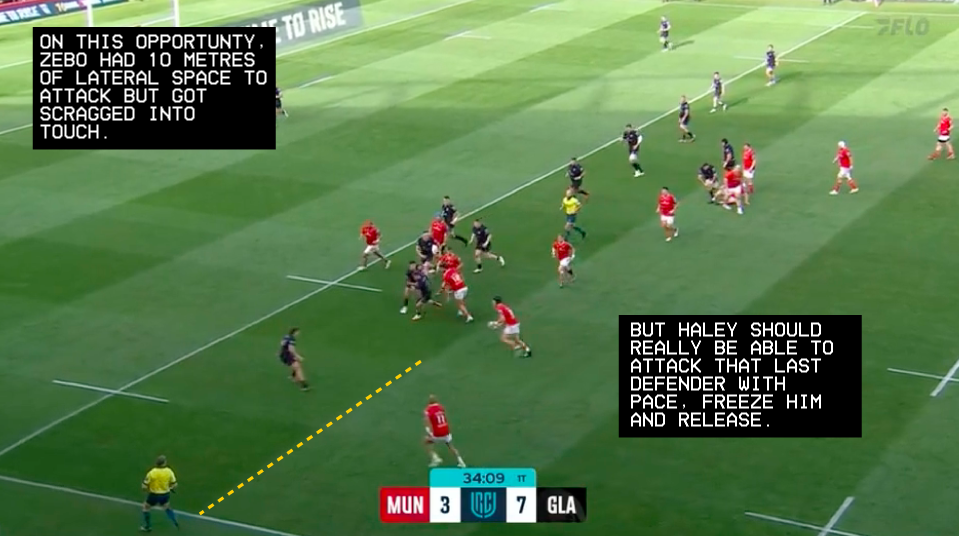
This is another good example of the structure creating space that we couldn’t convert.
Zebo got the ball in enough space to do better here, in my opinion, but Haley didn’t exactly light up the place either. This should have been a try directly, or at the very least lead to a try within two phases of the linebreak.
The pace we’ve signed – Abrahams and Kilgallen – directly addresses some of these issues and, with the likes of Campbell emerging for, hopefully, an injury-free season, we have guys already in the squad alongside Nash who can take advantage of the opportunities our shape creates.
This concept—a block of central forwards forcing a central compression to open up 35m of space to attack—is the core part of Munster’s attacking identity, and based on the evidence of the Bath game, it looks like we’re doubling down on that. To do so properly, we’ll need as much speed as possible to take our game to the next level. Essentially, if we’re creating 20+ metres of space during phase play, we need players that can attack that space before the defence resettles.
Against Bath, we saw how that might look. We primarily used 1-3-3-1 again (a 1-3-4 at one point, which I’m going to be looking for against Gloucester) but what was most interesting was the variety we used.
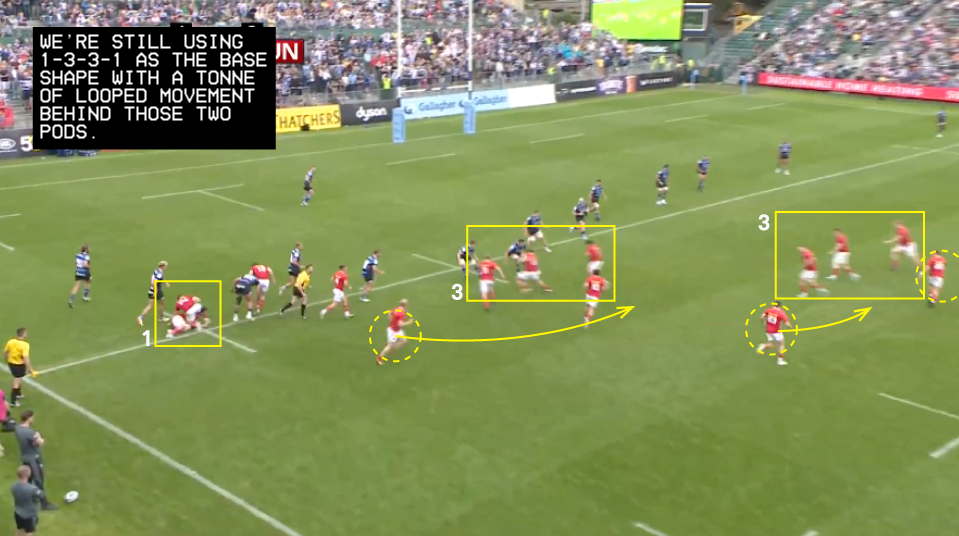
In this instance, we got Kilgallen around the corner into the 3/4 space really quickly and used a pod roll to open up the space.
The middle and outside runners run blocker lines, the pass goes to Coombes in the inside barrel and he hits Kilgallen to attack a central isolation.
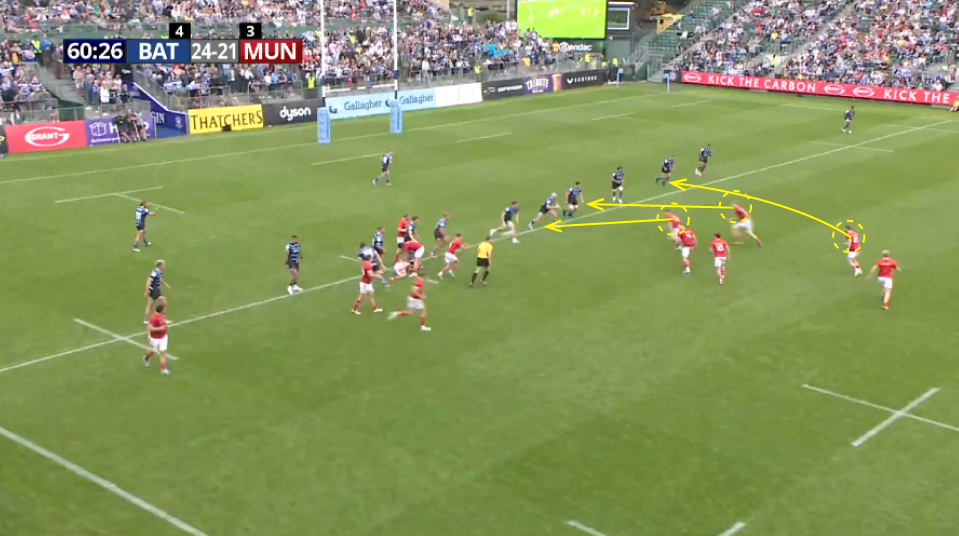
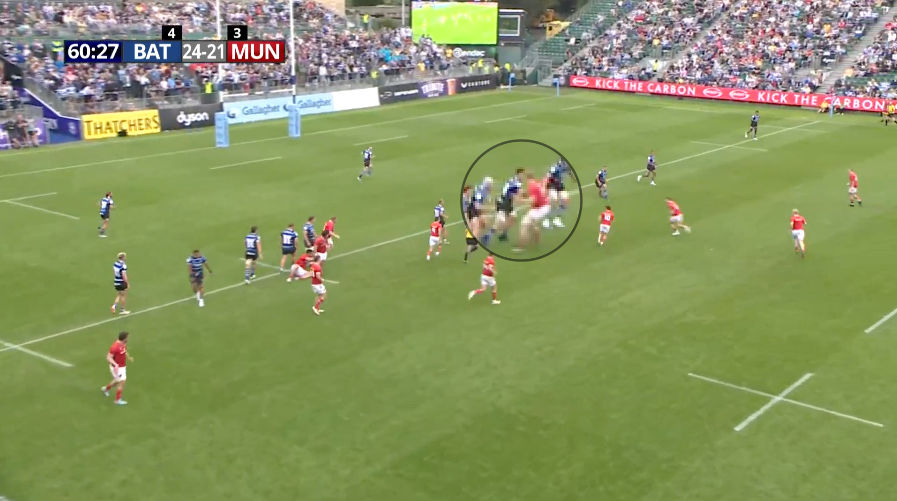
Kilgallen got dominantly stopped here with a two-man tackle here and we got turned over a phase later but you can see why – we didn’t get a good enough block on the scrambling defender, and he went on to make the dominant tackle.
I want to see if Munster will continue to target that 3/4 space for linebreaks, rather than compressions for a linebreak on the edges. Last season, we tended to play a lot of short balls around this space to work our way around the blitz but against Bath, we saw Burns, Butler and Haley throw long skip passes straight to the edge forward to create a fully wide-wide ruck in the 15m tramline.
It was in the aftermath of one of these that we saw that central four pod.
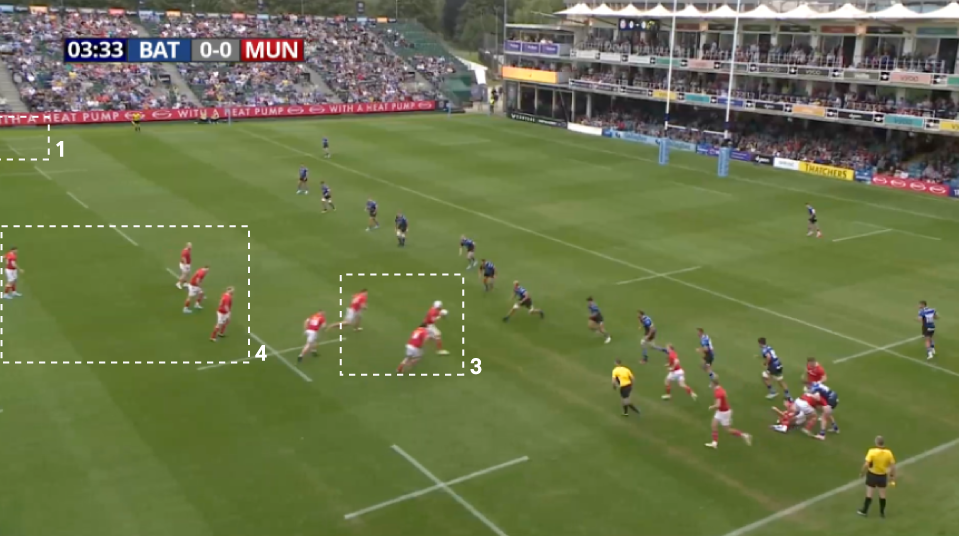
It’s also worth noting Patrick Campbell – a Slashing Outside Runner – attacking the screen behind the first pod here. He’s not really a “playmaker” at fullback by any means, he’s a killer transition runner and a powerful burst runner in tighter spaces. Was this a possible offload route?
And if O’Donoghue is really part of a four-man central pod, what kind of compressions could that generate on plays like this where you can extend your full shape? Could you use that to occupy 35m of attacking space on one phase? Could that draw in defenders from as far away as 50m out? If you had a back three of two Slashing Outside Wingers and one Heavy Strike Runner as well as the power and athleticism of Nankivell and Crowley, what could you do?
A lot, I think. Something to keep an eye on.
