


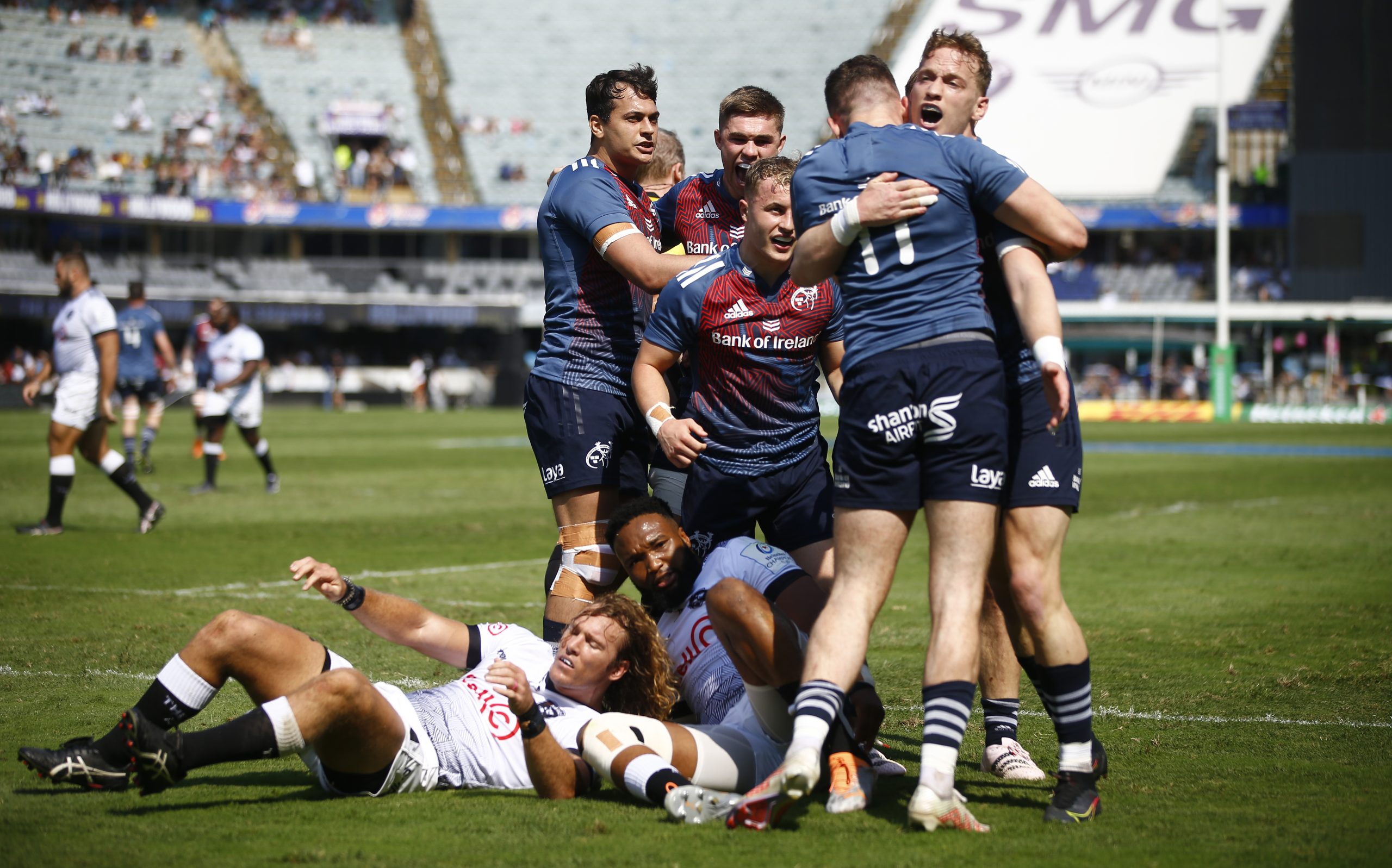
There are things you know and there are things you feel.
I know that Munster are less than a year into a full rebuild of the squad from both a personnel perspective (without an offseason of new recruits or releases) and a radical on-field “style” perspective. I know that, given those changes plus the rapid upscaling of younger players like Hodnett, Barron, Crowley, Salanoa, Casey, Edogbo, Ahern, Nash, Daly and others from habitual rotation guys into starting regulars when they are fit and available. I know that what Munster are trying to build here won’t properly be visible – or be properly judged – until 2024/25.
I know all that.
But does that mean I feel any better after a 50-35 pumping in Durban? No. I feel like this team is running on fumes at the moment. I feel that Snyman/Ahern/Wycherley/Edogbo’s injuries for the first half of the season and Beirne’s for the second half were brutal campaign killers that holed us below the water line at key points. I feel that, when push comes to shove, we’re still just a little bit too small to impact teams with serious packs. I feel that we are not a team with a serious pack, not even close, and until that changes nothing else will.
These are the two states I’ve been juggling with over the last 24/48 hours in the aftermath of this defeat. I know that this is early for this team, for this squad, but it still hurts to see them getting taken apart physically here, especially with the maul being such a dominant part of how we lost this game.
Ultimately, when the game was there to be won in the second half, we conceded three tries and 19 points in 15 disastrous minutes that killed off our European campaign, with a few scores for either side peppered around in the garbage time that followed.
I’ll show you lost breakdowns and bad offensive and defensive mauls later on but I want to look at the completeness of our game first and the roadblocks that have popped up this season.
The standout metric to me from this game was the Pass Per Carry ratio of both sides. Munster’s was an expansive 1.44 – our average for the season to date in almost every single game – and the Sharks was a very, very direct 0.96. That level of directness, combined with a super heavyweight scrum and maul has been a constant issue for Munster going back a number of seasons. In an environment where winning jackal penalties is harder than it’s ever been, tight power has to be met with tight power and we’ve only got so much power to throw at a team as big as the Sharks.
But we know this.
Munster have been trying to work an on-ball game (post-set piece and post-transition) this season where we hang onto the ball for multiple phases to mitigate against what happens if we’re playing a large, direct off-ball team. What does this mean practically? It means that we try to starve the opposition of the possession and position that they have traditionally used to beat us on the biggest days. We kick much less than most other teams in the URC and in Europe and, when we do kick, it’s not usually over a large distance. In practical terms, I think we kick to put the opposition into a position where kicking back to us is the smart play for them, we claim the long counter-transition kick or the short contestable and then we slide into transition and post-transition phases. The 3-3-X forward shape we settle into, coupled with a lot of backline movement behind those forward shapes means that, in theory, we’ve got constant variety, layers and passing targets to hit with an ever-resetting offside line from the rucks we use along the way.
In this system, the ruck is incrementally more important to us than it is to Leinster and Ireland because we are not a counter-transition kicking team. We don’t have the tight power on the defensive side of the game to answer the heavy, at-speed impacts that come as standard with a counter-transition kicking game at the elite level.
We can’t tire out this Sharks team in the same way that Leinster would, for example, because we don’t have enough heavy collision winners that we can move at pace up the field in 30m increments and that we can then expect to be effective for us in the other areas of the game we need them to be. This would be an informed decision on our overall style that we would have taken in the preseason, as rushed and compressed as this year’s preseason was.
So what do we do? We kick relatively short once or twice in a starter sequence and then look to retain possession for the phases that follow or launch off the set piece if the opposition kicks to touch.
I believe this style is used to best take advantage of where we’re relatively strong with everyone fit – the back five – and mitigate against where we’re relatively weak – all six front-row positions. Our Category A selection this year with everyone on the board fit was, in all likelihood, some starting combination of Snyman, Kleyn and Beirne with Ahern on the bench. A high possession, post-transition phase play game with these players as the back five core, would give us the athletic ball carrying, high lineout retention and competition that we would need to make us an incredibly difficult team to live with. Snyman, Beirne and Ahern, in particular, are incredibly rare physical specimens that are capable of playing through you while also having the creative capacity to throw short, medium and long-range passes. Combine those players with Coombes and a combination of O’Mahony/Hodnett/Kendellen with our front row options filling in the blanks on phase play as screen passers and ruck support players, Munster could, in theory, run through multiple phases of play through the forwards before you get to an incredibly active and balanced backline picking options on deep loop routes.
Why didn’t that work here?
We don’t have 80-minute power as it currently stands so everything is far lighter than it perhaps should be. The higher the Pass Per Carry ratio, the more passing errors and turnovers hurt you. We turned over the ball 25 times compared to the Sharks’ 16. In every loss bar one this season, we have conceded more turnovers on a high PPC ratio than our opposition.
In this game, we had more possession and more territory but we bypassed our forwards to stretch the Sharks’ heavy press off the ruck. We wanted to bypass where they were heaviest and then pull that heaviness across the pitch on phase play to open up opportunities created by the movement.
You can see Casey chasing the snipe opportunity here after getting some good dynamic possession post-transition.

An excellent blocking line by Wayne Barnes prevents Casey and Crowley from having a crack off the space generated on the previous ruck but we already had the compression we wanted.
A phase later, we were able to catch them on the edge for our opening try.

It was the perfect illustration of what we wanted to do here. Error-free handling, depth drawing out blitzing defenders and passes finding the right man in space.
But we weren’t able to find this combination regularly enough.
Our second try in the first half came from the exact action I was talking about in the Red Eye – stretching the Sharks off the set piece – pulling their backs across the field before rolling across gapped-out forward defenders.

These opportunities were few and far between when we needed them because we either couldn’t see the opportunities in front of us or they were denied to us by attacking the transit of our breakdown across the field.
In the first instance, by way of an example, check out when Peter O’Mahony didn’t realise he was playing with RG Snyman and not an undersized lock that couldn’t win a collision and offload.

This past week was the first time Peter O’Mahony would have trained as a starter with Snyman since August 2020 so, look, it happens but you can see the opportunity playing with a genuine Tighthead Lock Power Forward creates for you. On the previous ruck, you can see the struggle to remove Tshitsuka and Nche from the “pocket” to open up a clean grab of the ball for Casey. That type of slow ball disruption was present all through this game.
Here’s a good example of the narrow resources the Sharks committed to our breakdown – Kolisi and Hendrikse swarming on Scannell with Mapimpi scragging Casey and preventing the pass.

To make our high PPC game work, we needed numbers in the line to make the passes. The Sharks understood this. They pressed their power advantage in the counter-ruck, took us off scheme and created a low-pass-quality environment for our half-backs to operate in.
This, for example, should be perfectly on scheme. Our primary front-row ball carrier flying into a collision with his two front-row partners cleaning out with a good run-up?

Not dominant enough, not clean enough, not enough pop on the cleanout.
But, to be fair, we were losing way too many collisions throughout the game at key points. When Sharks went direct, right up the middle of the field, we struggled to live with them physically.


These are just a few examples, but you could look at any sequence throughout this game where it looked like some of our tight forwards were playing a different sport. Sliding off tackles they didn’t soak, shouldering ruck cleanouts like they were push-starting a Hiace and getting stuffed repeatedly in the carry.
The key maul concession that really did us in showed all three of our front row getting peeled (#18 Archer), falling off an entry (#2 Scannell) and making ineffective entries (#1 Kilcoyne).
We shoved hard on the infield side, we needed the touchline side to stop them but we had nowhere to go.

This isn’t about them though, to be fair. They are no more at fault for the loss than anyone else. They are who they are at this stage of their careers and they were up against the biggest pack they’ve faced all year with multiple World Cup winners in situ. Those that weren’t World Cup winners in that pack, were some of the most explosive guys they’ll play all year. There’s nobody making a massive case from beneath them in the depth chart that they should be further ahead of them at the moment. The front row is the latest frontier of evolution in the modern game and until you’ve got four or five freak bruisers there, your progress is limited at the very highest level and, as we’ve discovered, there’s no mitigating for it, at least with only two fit full-size lock forwards.
How did we lose this game?
We don’t have the tools. Not yet.
But the season isn’t done yet either so this group needs to find some answers from somewhere.
| Names | Rating |
|---|---|
| Dave Kilcoyne | ★★ |
| Niall Scannell | ★★ |
| Roman Salanoa | N/A |
| Jean Kleyn | ★★ |
| RG Snyman | ★★★ |
| Peter O'Mahony | ★★ |
| John Hodnett | ★★ |
| Gavin Coombes | ★★ |
| Craig Casey | ★★ |
| Jack Crowley | ★★★ |
| Shane Daly | ★★★ |
| Malakai Fekitoa | ★★ |
| Antoine Frisch | ★★ |
| Calvin Nash | ★★★★ |
| Mike Haley | ★★★ |
| Diarmuid Barron | ★★ |
| Josh Wycherley | ★★★ |
| Stephen Archer | ★★ |
| Fineen Wycherley | ★★★ |
| Jack O'Donoghue | ★★ |
| Conor Murray | ★★ |
| Joey Carbery | ★★ |
| Alex Kendellen | ★★★ |
