



Munster have been here before.
Not this Munster team, but the Munster of old. Right before an away European Cup knockout game against Harlequins in the spring of 2013, Munster were humiliated in the league by the Glasgow Warriors by a score of 51-24. Munster came out the next week in the Twickenham Stoop with a team packed with young prospects and produced a game that turned around all the narratives that had begun to form over the new coaching team who had just arrived that season.
Fast forward 10 years, almost to the day, and we’re in broadly the same position.
A bad loss last week against the Glasgow Warriors, an arduous away knockout game on the horizon and a bunch of young prospects given a shot in the biggest game of the season by a new coaching staff in their first season on the job?
I’m a sucker for rhyming history, as you know but just because it rhymes doesn’t mean that the bars will end the same.
This is an almighty challenge for Munster. Travelling to Twickenham ten years ago is child’s play in comparison to travelling 14,000km to Durban on Tuesday of this week to play in a stadium that has a real, no-foolin’ swimming pool in it against some of the biggest human beings you’ve ever seen in your life.
It’s a very different rugby world from ten years ago.
The world might be very different from the way it used to be but the demands on Munster are the same. Win. Progress. Keep the season alive by hook or by crook. Crush your enemies. See them driven before you. You know the rest.
Of course, it’s easy to write, but much harder to do, especially off the back of an incredibly deflating first-half performance last weekend at home to Glasgow Warriors. I only captured the full scale of it when I went back and watched it five entire times to get all my GIFs and other metrics recorded.
We were flat, we were shy, we were soft and we got the roasting we deserved on both sides of the ball in that first 40 minutes and at times inside the third quarter in the second half.
Please believe that if the Munster that showed up in the second half against the Scarlets and the first half against Glasgow show up here, we’ll get battered.
But we know that. The thing with this coaching crew is that they don’t go along with bullshit. Last weekend, they were blaggarded a small bit by the lads they entrusted to drive the team to a home quarter-final in the URC. That was massive for the club and while it’s not dead and buried by a long shot, that was the day to make it happen. Last season, they’d have been given a shot to redeem themselves from the start, but this season they’ll be standing on plugs to go out there and win this game for us in the last quarter of this game, injury-allowing.
The Sharks are full to the brim with Springbok World Cup winners in their front five and outside backs and captained by arguably the best Springbok captain there has ever been in Siya Kolisi. They are a fearsome prospect and, purely from a size perspective, they are right up there with the biggest and heaviest we can face in Europe this season.
We have experience dealing with a pack that size (if not bigger) with our recent games against Toulouse but make no mistake, this is going to be as tough as it gets.
The Hard Way, as always, is the Munster Way.
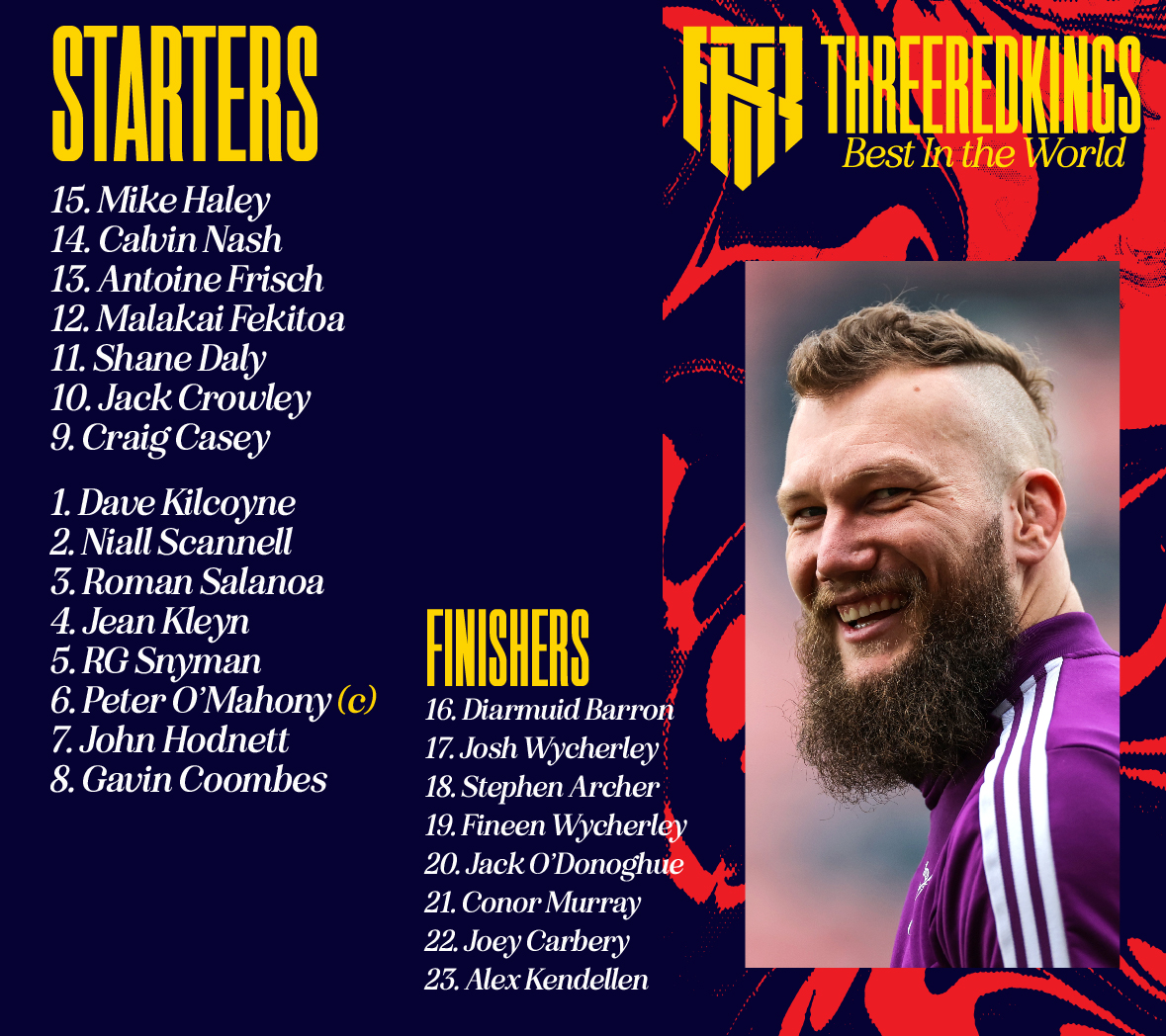
Cell C Sharks: 15. Boeta Chamberlain, 14. Werner Kok, 13. Lukhanyo Am, 12. Rohan Janse van Rensburg, 11. Makazole Mapimpi, 10. Curwin Bosch, 9. Jaden Hendrikse; 1. Ox Nche, 2. Bongi Mbonambi, 3. Thomas Du Toit, 4. Eben Etzebeth, 5. Gerbrandt Grobler, 6. Siya Kolisi (C), 7. Vincent Tshituka, 8. Sikhumbuzo Notshe
Replacements: 16. Kerron van Vuurren, 17. Ntuthuko Mchunu, 18. Carlu Sadie, 19. Emile van Heerden, 20. Phepsi Buthelezi, 21. Grant Williams, 22. Ben Tapuai, 23. Thaakir Abrahams
The Sharks, stuffed to the gills with South African internationals as they are, share a lot of qualities with the Springboks when it comes to their framework – but in a very specific way.
They play heavy, they play direct and if you don’t have your plan right they’ll run right over the top of you.
If we classify the Bulls as quite a low Pass Per Carry team and the Stormers as a relatively high Pass Per Carry side by South African standards, the Sharks would be midway between those two on a sliding scale. A lot of their play action through the forwards will be very, very direct with an incredibly heavy cleanout coming behind it. It’s not like their forwards never pass to the screen or tip on – Etzebeth is the most likely, actually – but they don’t do it that often or with much variety. When everything works well for the Sharks, they don’t have to pass all that much.
It’s a simple equation but a very difficult one to solve. Can you stop them in the carry? If you can – or create enough separation in the carry to open up poach opportunities – then you can bring their halfbacks into the game, both of whom have serious pass quality and consistency issues. Hendrikse, in particular, can be an incredibly dangerous runner around the fringes but his pass quality is a constant issue for the Sharks and Munster would do well to exert maximum pressure on his “eye” by squeezing his passing lanes with line pressure. That pass quality issue also creates issues for Curwin Bosch – a talented player – but one who struggles to react under stress and close in pressure.
You might say the same is true of every flyhalf but Bosch is particularly prone to hurried decision-making and poor execution.

Every exit is worth chasing down, every pass is worth pressuring – there is a return to be had there.
The key for Munster in this game is, in my opinion, the scrum.
We might as well accept now that they will get a dominant shove and penalty on us at least once. It is almost a certainty but it doesn’t matter. We’ll have to compete heavily at the front/middle regardless to prevent them from getting set and mauling us to death early on.
What matters is not conceding penalties or turnovers on our own put-in.
If we can retain our scrum possession in the wider channels, we can exploit a key weakness in the Sharks’ pack – their speed off the break. The Sharks are always trying to kill you on your put-in through their massive front five and flankers. If you can retain possession and hold that big counter-shove, you can catch those flankers around the corner.

The key here is how engaged the Sharks are when they are counter-shoving – the harder you are pressing the put-in, the more space there is around the flanks and the slower they recover on the break.
There are opportunities here for Coombes, Casey and Nash.
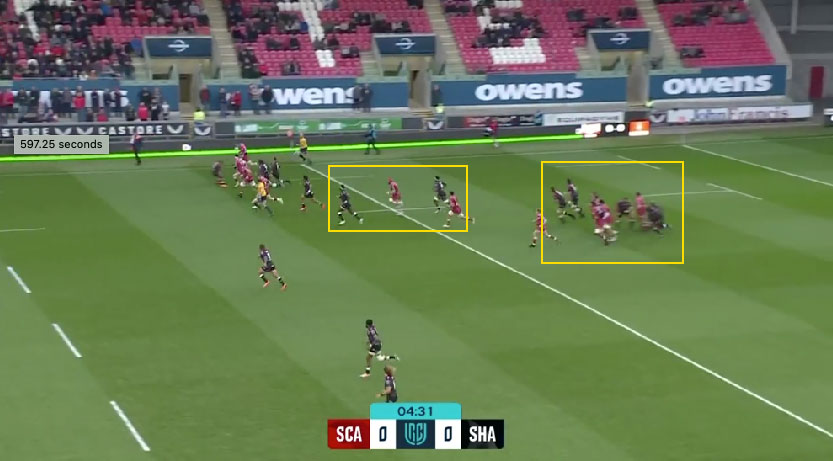
The real opportunities come when you can secure your scrum possession in between the 15m tramlines – that’s when you can really have a crack off the Sharks’ transit from scrum to the next ruck point.
Watch the space that develops on the inside of Siya Kolisi on this wide strike from Scarlets.

Werner Kok will always try to blitz this edge pass so you’ve got to be accurate with it but you could see Munster running a scheme here where Coombes pops to Casey who drifts to an approximate first receiver, before hitting Fekitoa on a pinch line with Crowley and Frisch running “out” lines create that edge pressure.
Remember Frisch’s offload in the build-up to Shane Daly’s try against South Africa A in Páirc Uí Chaoimh? It could look quite like that.
Sharks’ outside backs have to infringe to slow the transit of the ball because of the massive space opened up on the inside.

Look at the spacing here as the Sharks tight five transits across the pitch!
If we are accurate with our breakdown work on these wide ruck points, we can really stress the progression across the pitch by Sikhumbuzo Notshe, who is the main covering forward on these scrum sets. Vincent Tshitsuka will file out to the same touchline he scrummaged on to act as the edge forward defender.
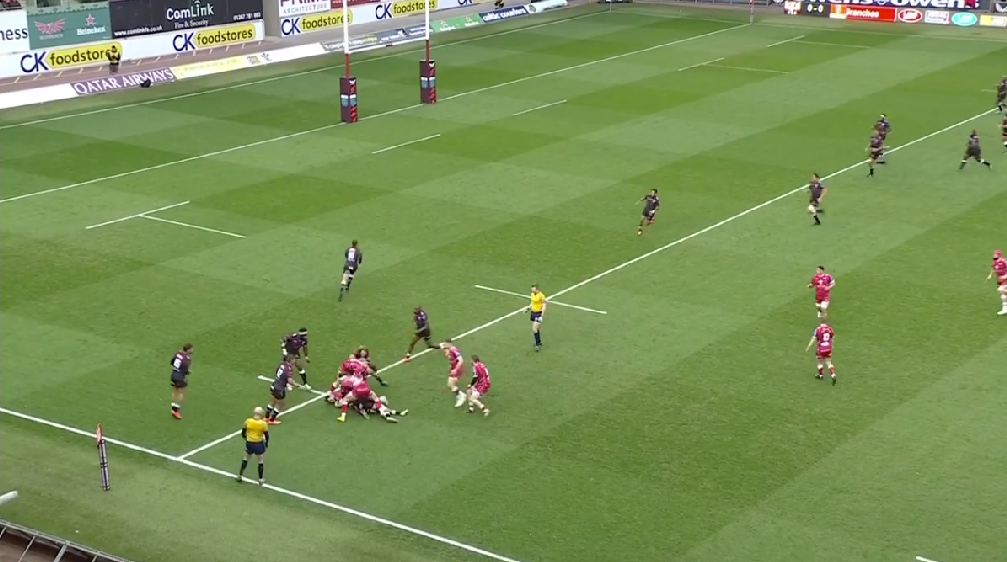
Without that penalty concession, Scarlets could have scored directly off the next phase. When they make the play across the field – a quick reset is vital here – they’re able to expose massive spacing almost as a matter of course.

Sure, there’s a bit of luck at the end of the play with the last pass but the Sharks were completely unable to handle any kind of deep loop movement as this came back across the pitch. Their tight five was almost hard locked into place and you can see how RG Snyman, for example, might be able to attack the positioning of Du Toit and Nche as they transit across and look to get an offload away.
That space will be there all day for us and, with enough variety in our usage and enough scrummaging smarts to retain possession, we can hurt the Sharks repeatedly.
