


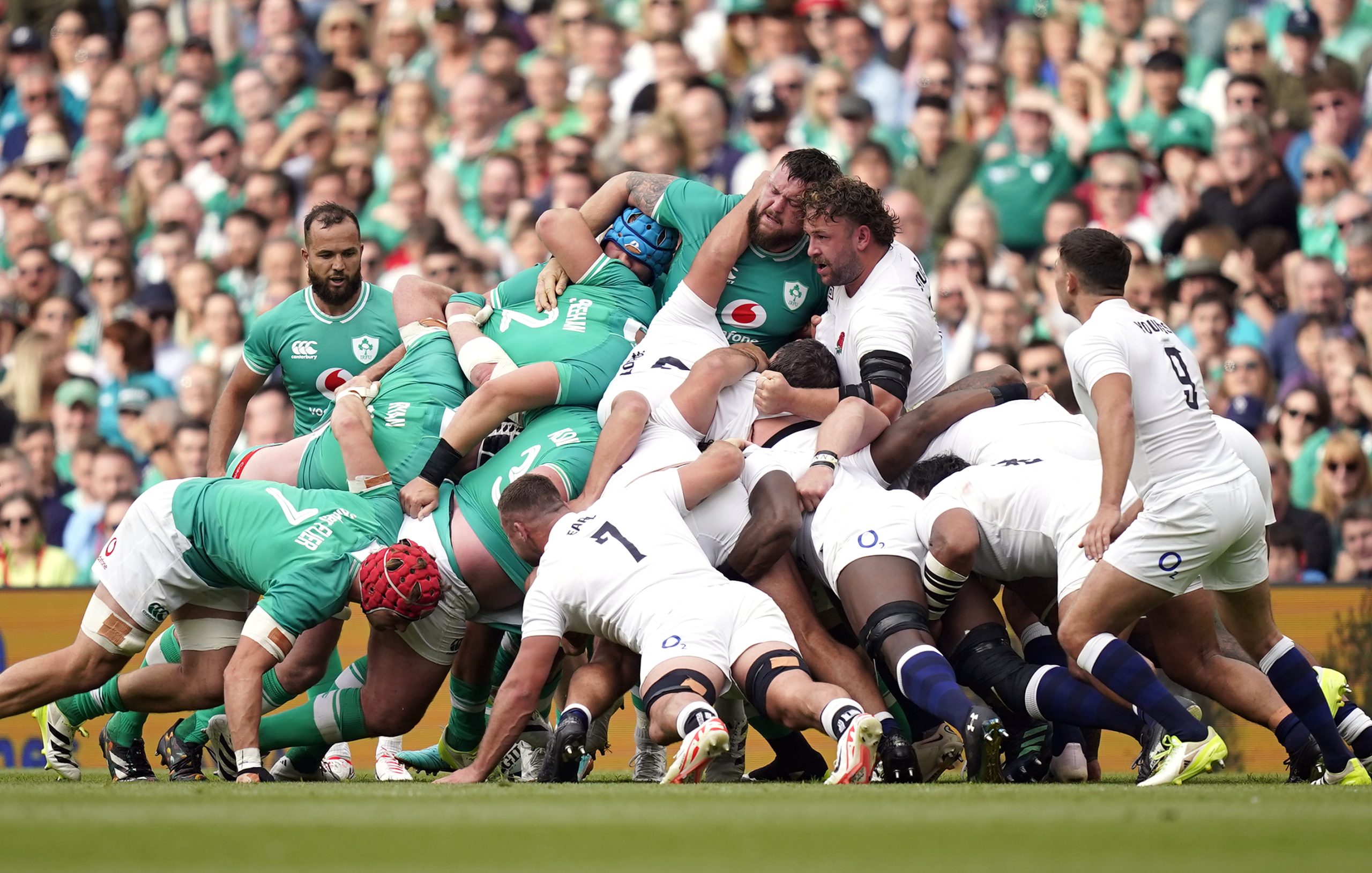
The breakdown always shows you what actually happened in a game, sometimes even more than the score. That’s a proper spoofy way of putting it, I get that, but when you assess the quality of the ruck entries and map them out, you get a great idea of how the game progressed according to the baseline of your game plan.
Ireland have a lot of rucks relative to most teams so you can track how well we’re playing in our system by the quality and volume of the ruck entries we’re producing as we implement our Counter Transition gameplan. When you combine the individual Offensive Ruck Work scores you get a Combined Offensive Ruck Work score which will show you how effective you were in games where you played well. I use this metric to judge other performances, especially when I break down the Combined Offensive Ruck Work (CORW) scoring into quarters.
By using this metric, I was able to successfully plot Munster’s run to the URC title last season – here, here, here and here. The overall score is instructive but you can especially see it in the quarter-by-quarter breakdowns. Ireland, for the most part, have a higher CORW score than Munster. At test level, we attribute this to the amount of transition possession most teams give to Ireland as standard off the back of our high kicking volume.
In the last year, Ireland’s lowest CORW scores have come against on-ball teams – Scotland and Italy – and an off-ball one-third-counter transition, one-third heavy kick pressure, and one-third absolute chaos English side.
We’ve won all of the games against those sides, albeit in a little more scuffed fashion than we’d expect. Against Scotland, for example, I think we lose that game 8 out of 10 times but for Scotland’s brainfart in the second half when we had no recognised hooker on the pitch for almost the entire second half. Against England back in March, that game was defined by Steward’s red card and England’s high-kicking volume forced us to play more conservatively. That game was 10-9 to Ireland heading into the last 20 minutes until the damn broke late on.
On-ball teams don’t kick back to Ireland with the same volume so, as a result, we have a lower OWR score against them and performances fluctuate off the back of that. England’s kicking volume means we’re often starting our transition phases deep in our own half, which can limit the scope of our ambition in those phases.
As a result, it’s not a shock to see what we produced at the breakdown in this game.
IRELAND’S OFFENSIVE RUCK WORK SCORE vs ENGLAND
- A Dominant Clean is an action that decisively secures possession when the ball carrier takes contact. A Dominant Clean does not have to be the first arrival at the breakdown but it is rewarded in the context of effectiveness. We will assign this action 3 points.
- A Guard Action is where a player plays a role in helping to retain possession after we have “re-won” the ball on the floor. Sometimes this can happen on a carry/ruck point where there is no active contention by the opposition. Let’s assign this action 2 points.
- An Attendance can be anything from standing as a “kick shield” on a ruck to adding a bit of bulk to ward against a counter-ruck. I’m marking this down as being worth 1 point.
- An Ineffective Action is a blown cleanout, a lean, a breakdown penalty or an action that I couldn’t see any direct benefit for. This will be worth -2 points.
| Dominant Clean | Guard Action | Attendance | Ineffective | Ruck Work Score | |
|---|---|---|---|---|---|
| Porter | 14 | 2 | 1 | 28 | |
| Sheehan | 1 | 3 | 9 | ||
| Furlong | 10 | 2 | 16 | ||
| Beirne | 1 | 15 | 3 | 36 | |
| Ryan | 4 | 10 | 1 | 2 | 29 |
| O'Mahony | 1 | 2 | 1 | 8 | |
| Van Der Flier | 2 | 14 | 1 | 1 | 33 |
| Prendergast | 1 | 11 | 25 | ||
| Gibson-Park | 0 | ||||
| Byrne | 1 | 2 | -2 | ||
| Lowe | 2 | 1 | 1 | 1 | 7 |
| Aki | 2 | 8 | 1 | 2 | 19 |
| Ringrose | 1 | 6 | 1 | 13 | |
| Hansen | 3 | 1 | 4 | ||
| Keenan | 2 | 3 | 5 | 2 | |
| Herring | 11 | 1 | 23 | ||
| Loughman | 0 | ||||
| Bealham | 4 | 8 | |||
| McCarthy | 1 | 2 | -3 | ||
| Doris | 2 | 4 | |||
| Murray | 0 | ||||
| Crowley | 1 | 2 | |||
| Earls | 0 |
TOP FIVE ORW SCORERS VS ENGLAND
- Tadhg Beirne – 36 points
- Josh Van Der Flier – 33 points
- James Ryan – 29 points
- Andrew Porter – 28 points
- Cian Prendergast – 25 points
Honourable Mention: Rob Herring 23 points in 43 minutes
Watching the game live felt like Ireland were playing quite poorly but I couldn’t quite put my finger on why. The breakdown scoring shows me. It was 12-3 – and should have been 12-6 at least – up until Vunipola’s red card in the 53rd minute and we were already trending well below the CORW score per quarter based on the game against the same opposition back in March.
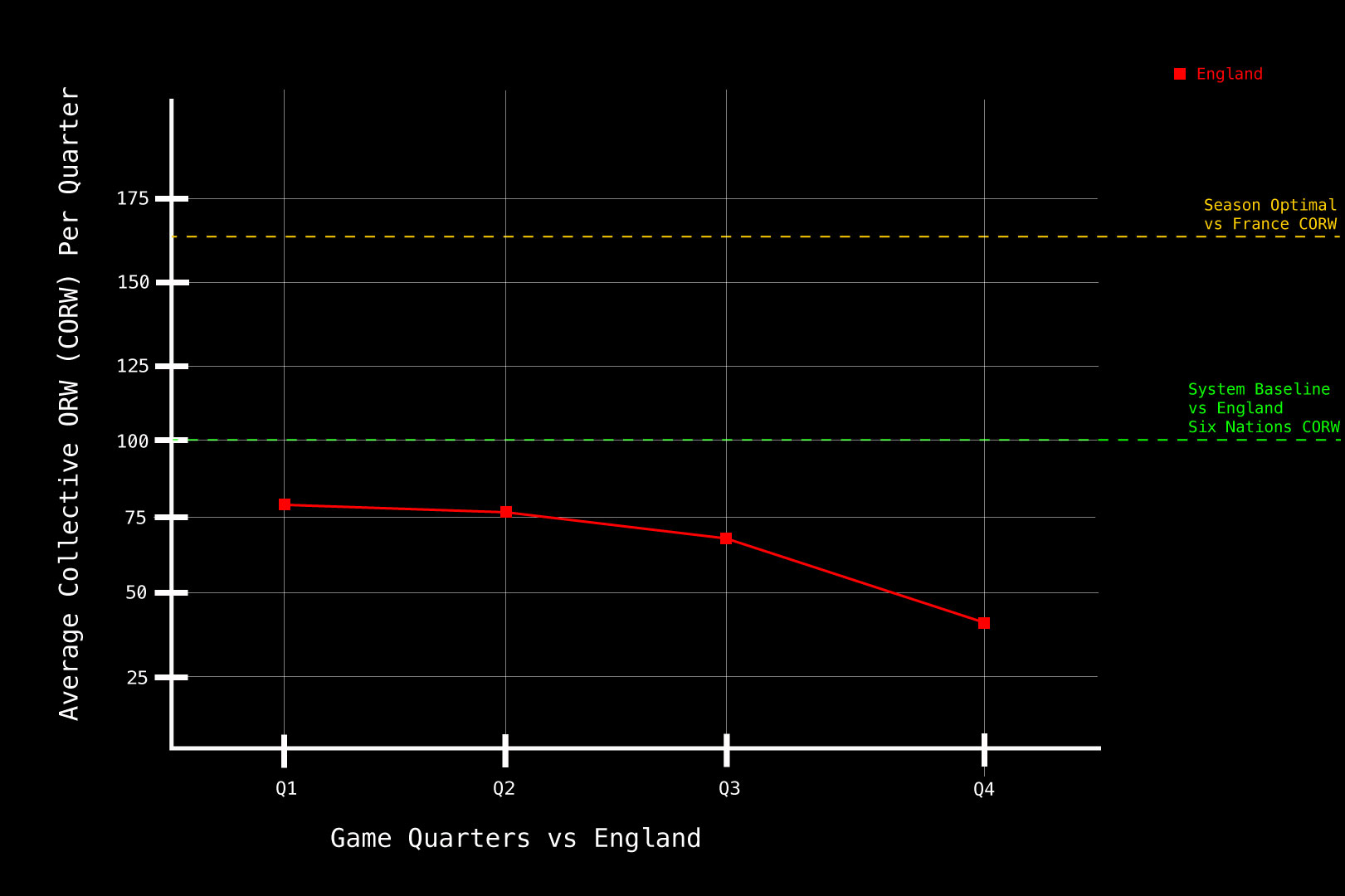
That’s a concern. The biggest issue, for me, was how difficult we found it to move the ball into the wider areas of the pitch. We know there were issues building and sustaining possession in those zones because Peter O’Mahony, our primary edge forward selected specifically to guard and advance possession in those zones, had a low-scoring day at the breakdown, as did Garry Ringrose.
In the Irish system in attack, the midfielders have a key role to play in the attacking breakdown. Aki normally produces big numbers at the breakdown but Ringrose is a key player in the wide channels for sustaining width. When we hit those wider spaces – as opposed to sniping on the blindside – you’ll see O’Mahony and Ringrose producing big breakdown numbers. This is a canary in the coalmine statistic for Ireland so when those numbers are down, we know that something was off.
In this case, it isn’t a massive deal because England’s discipline and transition defence were so bad that winning was almost impossible for them but it will concern Andy Farrell when he drills into this game. Our CORW score across the quarters was the lowest this Ireland team have produced in years and we’ll need to shake that out of our system in the next three games before we tangle with the new look, on-ball Springboks.
