



A thrilling comeback like the one Munster produced on Saturday night in Durban is a spectacle in and of itself. Munster have specialised in these over the last few decades and, as you read, you may think of the big comebacks over Clermont, Sale and even earlier this season away to Edinburgh.
What they can mask, however, is how you came to need a big comeback in the first place. That’s a bit like looking at a 16-time (woo!) World Champion and realising they lost their title 15 times to get that accolade but I digress.
Having watched this game back in detail, I’m pretty comfortable in saying that we left a bonus point win on the table here, and not just with the last play of the game which was bizarrely not even shown on the TV once. We had more than enough possession and efficient possession, at that, to have won this game and won it comfortably.
In the previous game against the Sharks, we buffed our scoring in the final quarter as the Sharks tired.
If anything, this game was the inverse.
MUNSTER’S OFFENSIVE RUCK WORK SCORE VS THE SHARKS
- A Dominant Clean is an action that decisively secures possession when the ball carrier takes contact. A Dominant Clean does not have to be the first arrival at the breakdown but it is rewarded in the context of effectiveness. We will assign this action 3 points.
- A Guard Action is where a player plays a role in helping to retain possession after we have “re-won” the ball on the floor. Sometimes this can happen on a carry/ruck point where there is no active contention by the opposition. Let’s assign this action 2 points.
- An Attendance can be anything from standing as a “kick shield” on a ruck to adding a bit of bulk to ward against a counter-ruck. I’m marking this down as being worth 1 point.
- An Ineffective Action is a blown cleanout, a lean, a breakdown penalty or an action that I couldn’t see any direct benefit for. This will be worth -1 point
| Dominant Clean | Guard Action | Attendance | Ineffective | Ruck Work Score | |
|---|---|---|---|---|---|
| Loughman | 1 | 8 | 1 | 20 | |
| Barron | 9 | 14 | 1 | 53 | |
| Archer | 6 | 14 | 4 | 1 | 48 |
| Kleyn | 6 | 8 | 34 | ||
| F. Wycherley | 8 | 17 | 5 | 1 | 61 |
| O'Mahony | 5 | 10 | 35 | ||
| Kendellen | 6 | 11 | 1 | 38 | |
| Coombes | 6 | 12 | 1 | 43 | |
| Murray | 0 | ||||
| Crowley | 1 | 4 | 11 | ||
| Daly | 1 | 3 | 9 | ||
| Fekitoa | 2 | 10 | 1 | 24 | |
| Frisch | 3 | 13 | 35 | ||
| Nash | 5 | 10 | |||
| Haley | 2 | 6 | 18 | ||
| Buckley | 1 | 1 | 5 | ||
| J. Wycherley | 2 | 3 | 1 | 13 | |
| Knox | 0 | ||||
| Edogbo | 1 | 3 | 9 | ||
| O'Donoghue | 1 | 4 | 11 | ||
| Casey | 0 | ||||
| Healy | 3 | 1 | 11 | ||
| Earls | 0 |
Top Five ORW Scorers
- Fineen Wycherley – 61 points
- Diarmuid Barron – 53 points
- Stephen Archer – 48 points
- Gavin Coombes – 43 points
- Alex Kendellen – 35 points
As you can see, our individual work rate was through the roof. When you consider that the top ORW scorer from the Champions Cup game – Gavin Coombes on 39 points – would have just scraped into fifth place in this game, you get a good idea of how much more effective we were at retaining the ball phase for phase. Coombes, once again, showed his ever-more complete game and is becoming a Duane Vermuelen role twin with every passing game as he adds more lineout detail to his already broadening breakdown game.
If he’s been asked to up his work rate by Andy Farrell, Gavin Coombes has more than done that and is playing elite-level stuff at the moment. He blended his game here with a more ball-dominant first half and a ruck-dominant second half.
Stephen Archer’s constant output for the full 80 minutes was outstanding, with a tonne of double efforts to guard and then attend the ruck post-counter-ruck.
Diarmuid Barron’s breakdown work was of such high quality that I’ve increased his Wally Rating score to a Five Star rating. His Dominant Cleans were vicious and consistently effective in creating workable possession with very little inefficiency.
Fineen Wycherley had a game-of-the-season level performance here in all facets. He carried well, impacted well in the defence, and ran an excellent lineout but his breakdown output was outstanding. Anyone scoring north of 50 has had an excellent game, anyone north of 60 is entering elite-level performance – that’s where Fineen Wycherley was here.
As a baseline for what Wycherley can do against super-heavyweight packs, this was very exciting and hints at a player slotting right into a role set that suits him down to the ground.
Collective ORW (CROW) Breakdown Per Quarter
When we look at the collective ORW score per quarter, we can see the inverse to the Champions Cup game. We actually scored below our CORW rating in the first quarter – a penalty taken when we had the Sharks on the ropes was the main culprit there – but we also suffered with some poor passing in the face of excellent blitz defending.
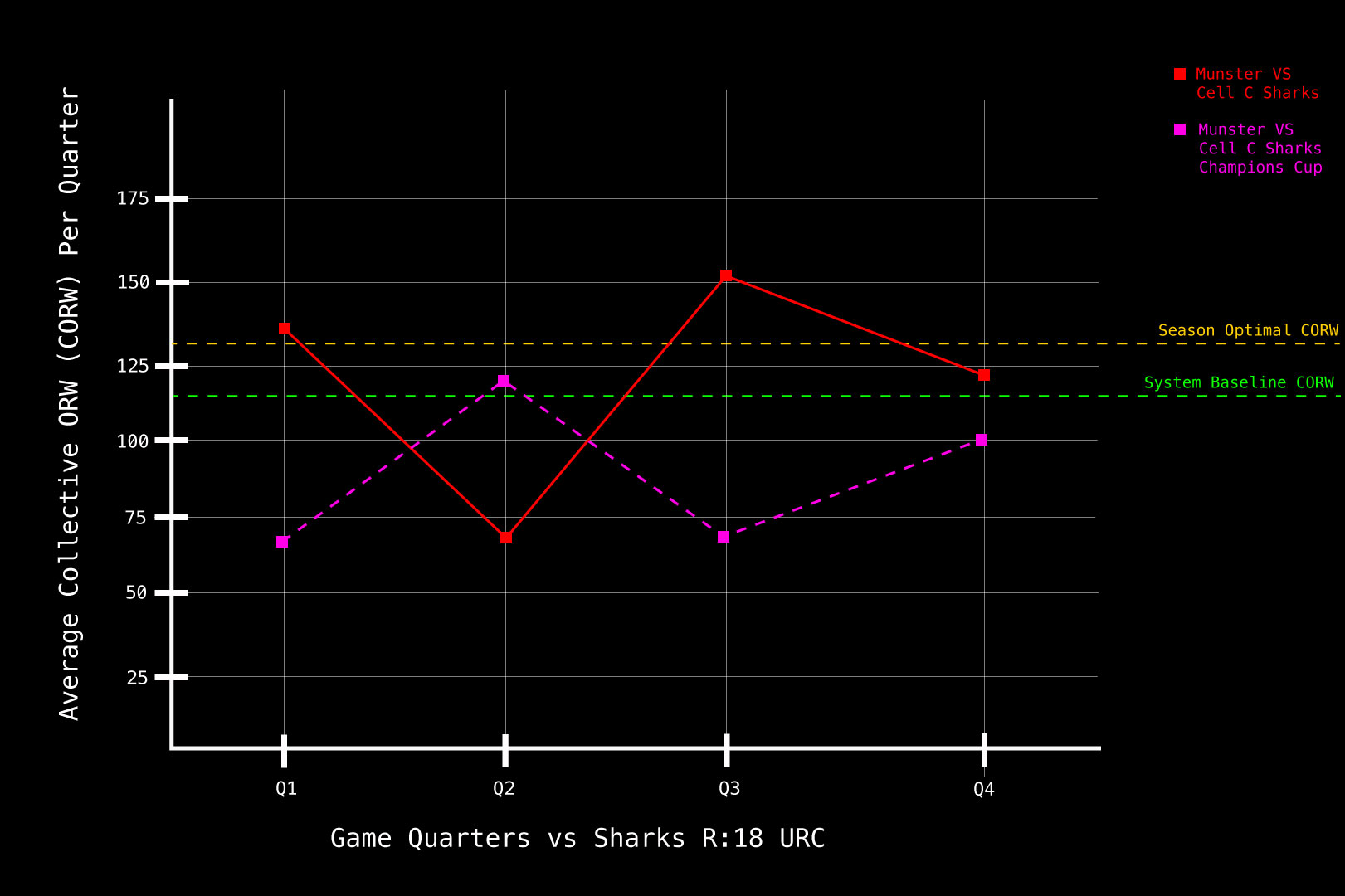
In the second quarter, you can see our efficiency level dip down to the levels of the first quarter against the Sharks and, of course, we conceded 14 points in that segment of the game.
Our second-half performance from around 45 minutes on showed season-best levels of breakdown output and efficiency. We retained the ball excellently and scored 19 unanswered points.
The biggest factor in this game getting away from us at multiple points of the first half, for me, was the scrum. It was a penalty machine for the Sharks and time and again, it allowed them passage up the field in a way that their attacking framework or kicking game could not. Our relatively high PPC game in the early game conditions – humid, greasy, sweaty rugby ball stuff – gave them a platform to attack us, but so did our own short kicking game where we ran the risk of aerial knock-ons to keep them in slugfest range, quite like Ireland did to the Springboks in November.
In essence, the CORW chart above tells a story of Munster slugging it out with the Sharks, losing the early rounds but winning the later ones because of the lost rounds, not in spite of them.
With a more solid, heavier scrum to keep the Sharks from advancing up the field – or at least not concede as many penalties – I think we win this game 5-0 with time to spare.
An incredibly impressive performance against the scrum that’s the worst match-up for us in the playoffs by far.
