



Ireland are the #1 ranked team in the world heading into Rugby World Cup 2023. We are the reigning Grand Slam champions. In the last 18 months, we have beaten every single Tier 1 side, including an incredibly notable series win over New Zealand in New Zealand to take our record against the All Blacks since 2018 to four wins against just two losses. Add to that a win over France in a titanic battle in this year’s Six Nations – our first win over France this cycle – along with going unbeaten against England in the last three years and very credible wins over Australia and the World Champion Springboks last November and you have the best build-up to a World Cup in our history.
We are the favourites for this World Cup regardless of what any bookie tells you, make no mistake about it, and every test coach in the game knows it. Ireland are the team to beat, every bit as much as France are as hosts and the Springboks are as holders.
Forget about the past – this new Ireland has no reason to get hung up on the invisible wall at the Quarter Final stages. Why shouldn’t we win it all? Why can’t win the Webb Ellis when the lights are brightest and the pressure is at its highest?
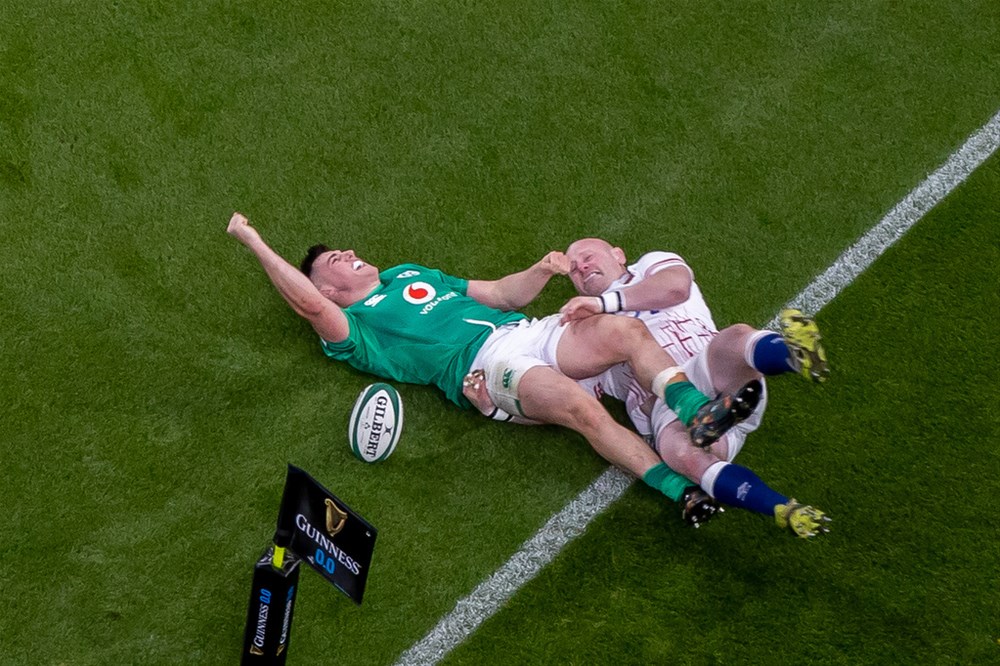
If we win this World Cup, it’ll change the trajectory of the sport in this country for a generation and complete our journey from wooden spoon collectors in the 90s to World Champions thirty years later. It’ll turn this Irish squad into icons and raise the profile of the game in this country to levels we’ve never seen and probably can’t even comprehend.
If we are to do all of that, it won’t be as dark horses, it won’t be as a surprise package and it won’t be as underdogs. These are the labels Irish rugby has traditionally embraced but that we now need to leave in the past.
If we lift the Webb Ellis in October 2023 it’ll be as the World’s Most Wanted side, and they’re coming for us dead or alive.
***
In my Tracking The Boks series – which returns next week ahead of their game against Argentina – I’m having a look at Ireland’s most dangerous pool opponents at a granular level but, to greater understand Ireland’s route to a possible final, we’ve got to know ourselves first and foremost.
This is going to be a World Cup of clashing styles and tactical arms races. I think sometimes we can get lost a little in trick plays and set-piece strike moves when it comes to saving things for the World Cup when the complexity and depth of understanding in your base game are by far the most important.
These are boring things in comparison to secret strike plays and set piece movez but they win you trophies.
In 2019, our base framework failed to keep up with the trends of the game at that moment in time. We were a highly structured, highly scripted possession team at a time when off-ball rugby – playing primarily without the ball – was the ascendent style in the game. This trend happened quite late in the cycle for the World Cup. What do I mean by “trend”? In this instance, it’s where the laws of the game and the application of law interpretations by referees combine with emergent tactics applied by perfect player role fits to tilt the game in one direction or another.
In 2019, that style was Heavy Kick Pressure. South Africa came from nowhere to win it all off the back off an outside edge blitz, box kicking, an outstanding kick chase and transition defence, an outstanding first-phase transition game with peak Cheslin Kolbe and a massive, world-beating scrum and lineout. Did they have a complex phase play game? No. They kicked inside three phases almost every time. It didn’t matter. Weirdly enough, if you showed people in September 2019 the fundamentals of kick pressure, they’d have assumed you were talking about Ireland. Ironically, I think the way everyone thought Schmidt’s Ireland played was exactly what would have won that World Cup. We had moved away from anything resembling kick pressure at least two years out from the World Cup, despite what you might have thought.

In the 2018 Six Nations, for example, we had more carries than anyone else, handled more possessions than anyone else, kicked for the second fewest metres and made the fewest tackles in the tournament. We won a Grand Slam that year but when we consider the trends of the game as they were shifting we can see Wales in a position to completely out-perform in 2019. They kicked the furthest, handled the ball the second least and made the most tackles. Is it any surprise that they pushed South Africa the hardest out of any side other than New Zealand in the pool stage? We were heading into a season of off-ball rugby where defence was the biggest weapon and we were doing the opposite, albeit to almost unprecedented success in 2018.
We made a distinct decision post-November 2018 – where we’d beaten the All Blacks to go #1 in the world for the first time – to not change what we were doing ahead of the Six Nations. Why? Well – and this was logically quite sound – we’d just become #1 in the world with the style we were playing, so why make a change? Why not just double down on what you knew worked against elite opposition so you could peak at the right time with a game plan you knew the squad were comfortable with?
That was the plan – essentially, do what we know we’re good at, just better. It didn’t work.

In the 2019 World Cup, you were better off playing without the ball but we were doing the opposite.
This World Cup, on the surface at least, we seem better prepared at a surface level and, just looking at optics, our Six Nations campaign in the build-up to this World Cup was vastly superior than in 2019. This isn’t a guarantee of success in and of itself but it shows that this group didn’t peak in July or November of 2022 at the very least. From a trend perspective, I think we’re right where we need to be to run through this World Cup before the move to on-ball, high-possession, low-kick volume rugby comes to the fore post-2024.
We live in the era of Counter Transition Rugby.
I’ve spoken about this quite a bit in the last three years without ever really sitting down and officially codifying it. At a base level, Counter Transition Rugby is a reaction to the success of Heavy Kick Pressure pre and immediately post-pandemic as informed by the 50/22 law change and, most importantly, the implementation of the goal line dropout.
The goal line dropout – law 12 – that;
12. Play is restarted with a goal line drop-out when:
(12.a) The ball is played or taken into in-goal by an attacking player and is then held up, grounded or otherwise made legally dead by an opponent.
(12.b) An attacking kick, other than a kick-off, restart kick following a score, drop goal, drop-out or penalty attempt, is grounded or made dead in in-goal by the defending team.
(12.c) An attacking player knocks on in the opponent’s in-goal.
This law change, in combination with 50/22, meant that the balance of kicking was likely to move from the scrumhalf to the #10 or another outside back kicker.
Why?
Well, if 50/22 opened up space in the primary line by making the space 5m outside your 22 vulnerable to a tactical kick that was as dangerous as conceding a penalty and the opposition could now kick deep down-field towards the goal line knowing that if you dot the ball down you get chained to your goal line, the benefit of your scrumhalf kicking – box kicking, essentially – was greatly reduced.
This also meant that now you needed multiple kickers in your backline to take advantage. Ireland’s options in the midfield were set but that law change meant that James Lowe and Hugo Keenan – two men with huge boots – became vital cogs in Ireland’s backline because of what they could do with the boot. Mack Hansen’s ascension to the Irish first team from almost nowhere is also down to his counter-transition suitability in that he’s a natural and varied kicker of the ball as well as a good handler, aerial defender and finisher.

Counter Transition Rugby is based on a different style of kicking and a different use of what comes after. There are three tenets of that game that mark out Counter Transition teams from other styles and they are;
- A high-volume, mid-to-long-range infield kicking game from your #10 and two or more outside backs.
- These kicks are designed to unbalance the opposition backfield and unsettle their primary defensive line as they move up and down the pitch in 30/40m increments.
- Your kicking is primarily done from inside your own 10m line with a distinct “infield” targeting unless you’re under pressure and can kick off-field in a way that gains territory. Kicks that look like “bad” exits because they don’t make touch are often designed specifically to isolate a runner in the tramline while your transition defence fills the field.
- At a core level, Counter Transition Rugby demands long sequences of play that keep the opposition forwards – the heavier the better – involved in multiple sequences of play up and down the field. It aims to burn them out vertically and laterally in positions where they can’t impact the ball.
- If the opposition wants to bail out their forwards by kicking to touch, you have to be in a place where you can hurt them there repeatedly.
- You run with a “smaller”, two-lock pack with a lineout dominant Stretch 4 lock that can take an oversized share of your lineout ball or a lineout dominant combo-flanker.
- The smaller pack has to be capable of covering the extra ground that comes as a default with longer infield kicking but that also ensures that the excess lineout possession that counter-transition is designed to produce can be retained and utilized.
- The smaller pack has to have a lot of mobility in the back five (combined with two defence-dominant midfielders or other outside backs) to lock down the opposition when you kick long to them so they have nowhere to go. Your pack has to beat the opposition pack into position for the first phase post-transition.
- Your primary attacking states radiate from the lineout and in the first two or three phases of transition.
- Counter Transition kicking produces a lot of lineout possession so you need to have a set of highly automated lineout strikes to advance up the field as well as a powerful close-range maul to punish tired opponents
- When the opposition kicks the ball back to you and your transition leaders spot an opportunity, your forwards have to beat the opposition into shape and your primary playmaker has to stitch the pods and phases together to open the linebreak.
You’ll see Ireland and other counter-transition teams mix this up with an occasional abnormally high pass-per-carry sequence around the opposition’s 10m line but the core principles are efficiency, fitness, accurate kicking, accurate kicking decisions and a rock-solid offensive and defensive lineout and maul.
Once we understand this, we can start figuring out where we match up well with certain opponents and where the World thinks they can break us open.
Coming Next
WORLD’S MOST WANTED: Part 2 – How We Lose
