


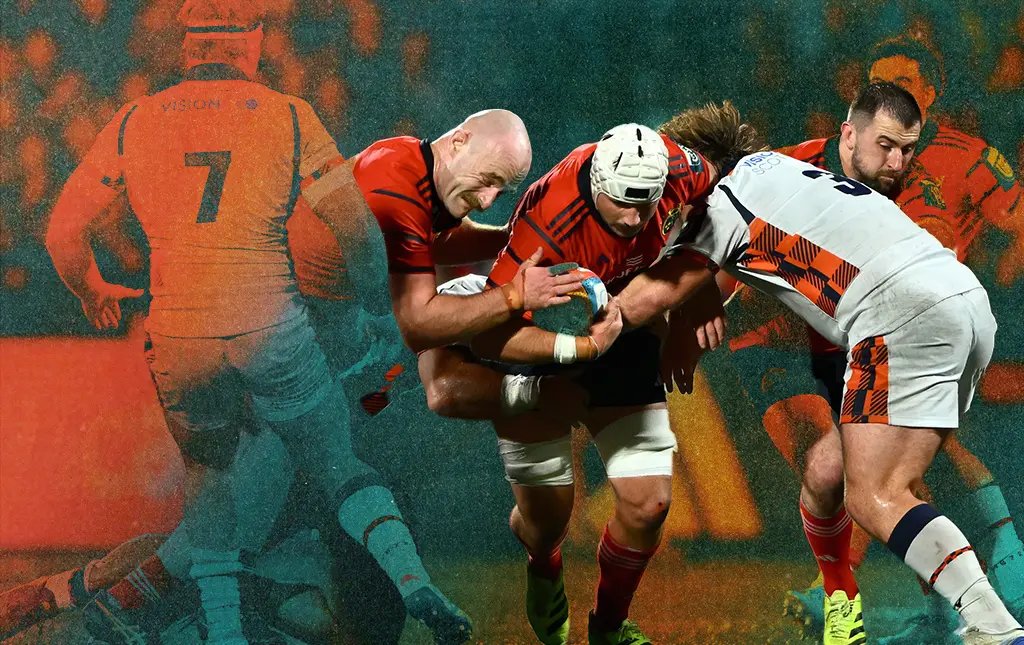
You don’t need me to tell you that Munster’s narrow win over Edinburgh was just that — a game teetering on a razor’s edge for almost the entire game.
Watching it live, it felt like the ruck and collision points were brutal, and that played out again on the replay. It was a great night for wider-bore rugby, in theory, but all the flashpoints seemed to be focused on that close and middle space as both sides jockeyed for an edge on that lightning-quick and bouncy Virgin Media Park surface.
So let’s have a look at the numbers.
Munster’s OFFENSIVE RUCK WORK SCORE vs Edinburgh
- A Dominant Clean is an action that decisively secures possession or that puts the defending player on the ground and keeps them there. It is worth 3 points.
- A Guard Action is where a player plays a role in helping to retain possession and either secures against a counter-ruck or ensures the players we’ve put on the ground stay there. Let’s assign this action 2 points.
- An Attendance can be anything from adding a bit of bulk to ward against a counter-ruck to extending your leg to make space for a box kick. I’m marking this down as being worth 1 point.
- An Ineffective Action is a blown cleanout, a lean, a breakdown penalty or an action that I couldn’t see any direct benefit for. This will be worth -2 points.
| Player | Dominant | Guard | Attendance | Ineffective | Total Actions | ORW Score | ORW / Action |
|---|---|---|---|---|---|---|---|
| 6. J. O'Donoghue | 9 | 23 | 0 | 1 | 33 | 71 | 2.15 |
| 5. F. Wycherley | 5 | 25 | 0 | 2 | 32 | 61 | 1.91 |
| 18. Ryan | 2 | 24 | 6 | 0 | 32 | 60 | 1.88 |
| 11. Smith | 9 | 10 | 0 | 1 | 20 | 45 | 2.25 |
| 4. Kleyn | 2 | 19 | 2 | 1 | 24 | 44 | 1.83 |
| 2. D. Barron | 4 | 15 | 1 | 0 | 20 | 43 | 2.15 |
| 8. Coombes | 6 | 11 | 3 | 0 | 20 | 43 | 2.15 |
| 1. Milne | 0 | 17 | 5 | 1 | 23 | 37 | 1.61 |
| 12. O'Brien | 0 | 18 | 0 | 0 | 18 | 36 | 2.0 |
| 13. Farrell | 0 | 18 | 0 | 1 | 19 | 34 | 1.79 |
| 23. Kelly | 4 | 7 | 0 | 0 | 11 | 26 | 2.36 |
| 7. Quinn | 2 | 8 | 0 | 0 | 10 | 22 | 2.2 |
| 16. L. Barron | 3 | 6 | 1 | 0 | 10 | 22 | 2.2 |
| 3. Jager | 0 | 8 | 2 | 0 | 10 | 18 | 1.8 |
| 19. Edogbo | 4 | 3 | 0 | 0 | 7 | 18 | 2.57 |
| 15. Haley | 0 | 8 | 0 | 0 | 8 | 16 | 2.0 |
| 20. Gleeson | 3 | 2 | 1 | 0 | 6 | 14 | 2.33 |
| 17. J. Wycherley | 1 | 3 | 0 | 0 | 4 | 9 | 2.25 |
| 22. Butler | 1 | 1 | 0 | 0 | 2 | 5 | 2.5 |
| 14. Nash | 1 | 2 | 0 | 2 | 5 | 3 | 0.6 |
| 10. Hanrahan | 0 | 1 | 0 | 0 | 1 | 2 | 2.0 |
| 9. Patterson | 0 | 2 | 0 | 2 | 4 | 0 | 0.0 |
| 21. Coughlan | 0 | 0 | 0 | 0 | 0 | 0 |
An outstanding performance from Jack O’Donoghue, a proper ruck mule game from Andrew Smith, with a typically impactful cameo from Edwin Edogbo. You can sort the table yourself to see the granular data.
***
This week I asked Clayton McMillan about Munster’s half-time turnaround in the last two games — you can listen here, I’m not going to buff the word count with a quote — and it’s fair to say he’s impressed with how his team have responded to difficult first-half performances.
So I decided to see if I could track that response in my ORW scoring.
| Seg. | D. | G | A | I. | Total | ORW | ORW p/A | D % | G % | A % | I % | Rucks | A. p/ Ruck | ORW p/ Ruck |
|---|---|---|---|---|---|---|---|---|---|---|---|---|---|---|
| 1st Half | 17 | 81 | 7 | 3 | 108 | 214 | 1.98 | 15.7% | 75.0% | 6.5% | 2.8% | 49 | 2.20 | 4.37 |
| 2nd Half | 39 | 150 | 14 | 8 | 211 | 415 | 1.97 | 18.5% | 71.1% | 6.6% | 3.8% | 45 | 4.69 | 9.22 |
| Full Game | 56 | 231 | 21 | 11 | 319 | 629 | 1.97 | 17.6% | 72.4% | 6.6% | 3.4% | 94 | 3.39 | 6.69 |
Rucks: H1 = 49, H2 = 45 (total 94).
D – Dominant, G – Guard, A – Attend, I – Ineffective, A – Action
What changed after halftime?
There are some esoteric things we can’t measure, like internal motivation, clarity or getting a jolt off the coaches, but we can measure what happened ruck for ruck, action for action and phase for phase. When we look at that lens only, we find the following;
Workload doubled without losing quality. Actions leapt from 108 → 211 (+103%), yet ORW/Action held at ~1.98 → 1.97. That’s the headline: more work, same standard. A drop-off here would look like more work being done, but a drop in standards to handle the extra volume.
Platform per Possession Exploded.
- Actions/Ruck: 2.20 → 4.69 (+113%)
- ORW/Ruck: 4.37 → 9.22 (+111%)
We generated far more productive ruck actions per carry/phase in the second half.
More displacement, slightly less protection. The action mix shifted from Guard (75.0% → 71.1%) and Dominant (15.7% → 18.5%). In non-gibberish, this essentially means: more bodies were put on the ground, not just rucks being protected.
Error control held under volume. Ineffective rose 2.8% → 3.8% (counts 3 → 8) but stayed low relative to the much higher workload.
Bench flipped the momentum. Biggest H2 gains in ORW came from:
18. Ryan* (+22), 16. Lee Barron (+22), 23. Kelly (+20), 8. Coombes (+19), 19. Edogbo (+18), 20. Gleeson (+14).
They drove the late-game displacement that sustained field position and pressure.
* Ryan came on early for Oli Jager, but produced excellent numbers.
Why it mattered
The second half wasn’t just “more of the same” — it was more of everything at the same quality bar. That combination (volume ↑, quality steady) is what closes out one-score (or one point) games.
How it fits the season trend (Rounds 1–3)
- Actions/Ruck: R1 2.36 → R2 2.31 → R3 3.39
- ORW/Ruck: R1 4.71 → R2 4.48 → R3 6.69
- ORW/Action: R1 2.00 → R2 1.93 → R3 1.97
Munster are scaling up the ruck workload per possession while keeping efficiency in the same range — a strong indicator of late-phase durability and closing power beyond 60 minutes.
I’m in the process of reverse engineering this for the other two games, and will do it for this week’s upcoming games against Leinster, Connacht and the Stormers.
What this shows us is that Munster’s second-half performances when under duress are narrower, which draw more tight collisions and, with it, more ORW output because the cleaners are closer to the ball carrier.
***

When Dan Kelly came off the bench for Mike Haley, he slotted into inside centre immediately, and that really piqued my interest because, in the previous two games, Kelly had played at #13. There’s not a wild difference between the two slots — you really have to look at specific jobs in specific areas at certain times to mark them out — but, for me, #12 is Kelly’s best position.
I wrote a little about this during my Big Reset series, so getting to watch him at Inside Centre was really interesting. His ORW numbers over the last few weeks at #13 have been really good, but what was #12 like?
What we expected from Kelly at 12
- Carry-or-pass hub inside Crowley: tighten spacing, attract two-man tackles, and free Crowley for runner/loop options.
- High interior work-rate: more guard/clean actions than at 13; quick reloads around the ruck to keep phase tempo.
- Low-error platform: tidy post-contact and breakdown detail to preserve rhythm, not just crash ball.
What happened vs Edinburgh (after he slotted in at #12 on 30 minutes)
Immediate interior workload & efficiency.
- H1 (10’ cameo before HT): 1 action, ORW 3 (3.00/act).
- H2 (full stint at 12): 10 actions, ORW 23, 2.30/act.
- Share of Munster’s H2 totals: ~4.7% of actions (10/211) and ~5.5% of ORW (23/415).
This is exactly the “busy inside centre” signature I was looking for.
Platform without drag. His 2.30 ORW/action during a half where the team’s workload doubled (H2 actions 211) shows he added volume without pulling efficiency down — right in line with the low-error profile we wanted.
Shape help for #10. Kelly’s inside presence coincided with a shift toward more displacement in H2 (Dominant% up 15.7% → 18.5%; Guard% down 75.0% → 71.1%). Kelly covered ruck position all over the field in that second half, in every zone, and he was effective on every single one. O’Brien had a high-volume day — and essentially played like another midfielder at times — but Kelly was more efficient.
How it compares to R1–R2 (for Kelly)
- R1 (mostly 13 → projection to 12): 8 actions, ORW 17 (2.13/act)
- R2: 14 actions, ORW 25 (1.79/act)
- R3 at 12 (H2 only): 10 actions, ORW 23 (2.30/act)
Net: the efficiency at 12 in R3 was as good or better than the early-season baseline, with a heavier interior role, which is exactly what I would have hoped back during the summer.
Is that why he retained that #12 jersey for the Leinster game? We’ll soon see.
