


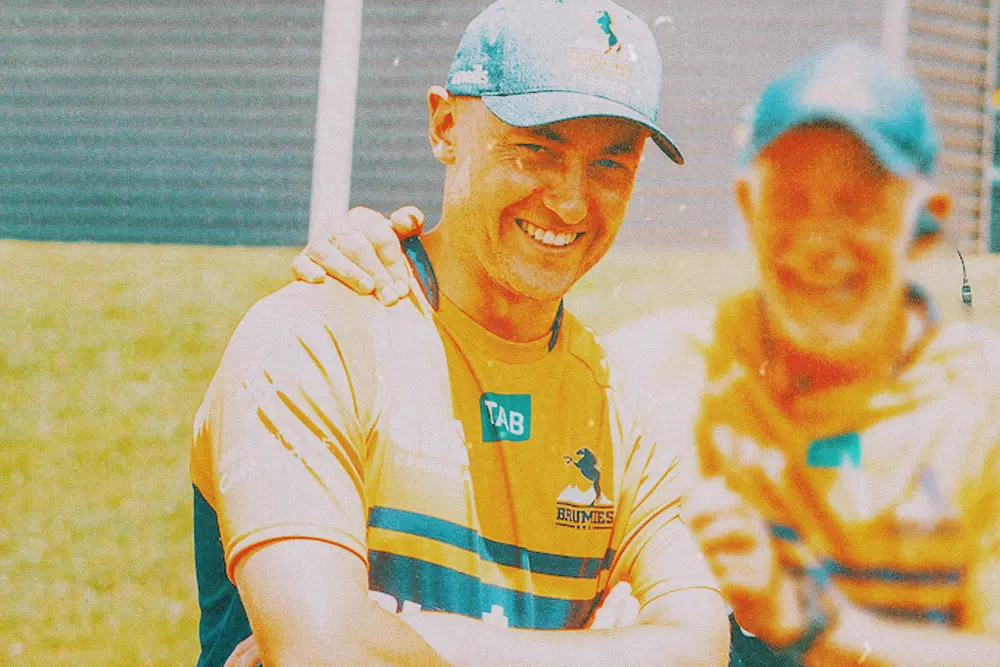
It explains how disastrous the last three seasons have been with injuries that Munster’s new Head of Athletic Performance gets his own What’s The Story With article, but here we are.
Welcome to Munster, Brad Mayo.
Munster’s appointment of the former Hurricanes, All Blacks XV, Brumbies, Chiefs and Glasgow Head of S&C is incredibly notable because of how crucial he is to Clayton McMillan’s attempts to reboot the club in the short, medium and long-term. As you might expect, McMillan recommended Mayo quite highly, given he worked with him directly on the recent All Blacks XV tour, but it wasn’t just that recommendation that sealed it. Mayo has an extensive reputation in the game and a huge breadth of experience in New Zealand, at both the elite level and through their pathways, in Scotland and Australia.
The S&C game often sees you bouncing around from country to country, job to job, on shorter-term contracts because, quite often, you’re directly linked to the head coach, either directly or indirectly. That’s because, as a head coach, your Head of Athletic Performance is arguably the most important individual in your program, and most of them don’t even have Wikipedia pages.
I say arguably because – quite obviously – unit coaches like your set piece and phase play coaches play a vital role, but your Head of Athletic Performance often dictates who is available to execute those plans, and in what physical condition. The head coach and athletic lead have to be on the same page with everything they do, because what one demands, the other must fulfil.
Here’s a simple example that I got when I was asking about the role of S&C; say your head coach wants his team to be more physically dominant than the opposition, so that means more muscle, more weight and more gym sessions geared towards achieving that aim. Now, say that the same head coach has also decided that his team should train at an incredibly high intensity week to week and that his team should have a long kicking focus.
Now we have a problem. The base approach – we need to be bigger, heavier and stronger – is directly contradicted by the other core instructions, which means you also now have to be incrementally fitter from a cardiovascular perspective, while carrying more weight and more muscle mass in a sport where you endure 30 small car crashes a game every weekend, sometimes back to back to back.
Your game-state and training philosophy must dovetail with the core demands of your athletic department, or one will destroy the other. Harmony is the key, and that has been missing from Munster’s S&C for the last few years.
On the face of it, both of Munster’s reviews into the S&C that took place in the last three seasons came to a correct conclusion in one way; there was nothing wrong with how the players were being trained, on the face of it. We weren’t doing anything abnormal relative to the other sides. There weren’t a ton of guys all getting the same injury or neighbouring injury that might suggest an obvious error in how they were being trained, but one thing was clear: players were picking up injuries at an alarming rate and then staying injured. At one point last season, we had 21 senior professionals out with medium or long-term injuries.
This didn’t just happen in one season either; it happened in all three of Munster’s seasons under Rowntree, if we count each pre-season taken as being under his influence. That, in itself, was the real abnormal thing that didn’t show up in the review. At a micro level, nothing was obviously wrong in the gym or during conditioning sessions. At the macro level, however, there were clear problems that went beyond bad luck.
Any club can have a nightmare run with injuries in one season. Connacht had one a few years back. For some reason, I remember that Saracens had a similar nightmare run in 2017/18. But three seasons in a row at the scale Munster had year on year on year is genuinely unheard of.
After asking around, I think I’m concluding that what Rowntree wanted from his squad – to be physically more imposing while playing a quicker game that would be fueled by more intense training while fatigued – contradicted itself and that led to the wide variety of injuries, because it affected players in different ways outside of the usual contact injuries you might pick up in a season. Ahead of last season’s semi-final against Glasgow in Thomond Park, players I spoke to that summer questioned why they were running an intense training session a few days before the game that led to Calvin Nash getting hurt. It was the tail end of a long season, and they’d spent the last two weeks playing Ulster and then the Ospreys in a quarter-final.
That wasn’t just for that game; it was every game week.
One interview with Rowntree earlier in the season, before his departure, stood out to me.
“I, we, plan training to the exact minute, who’s swapping in, how many kick-chases Thaakir Abrahams is doing this week, then it’s next one in for the next kick-chase or high speed running.
“We’ve got these racehorses, and you’ve got to limit the mileage. There’s no correlation, we’ve had a good drill down into the data, even today we’ve modified a couple of bits around training, and we’ll have to see if that’s the answer or not, but there’s no excuse to over-train the lads. It’s not over-training.
But you have got highly trained athletes. Have you seen the size of him? When Diarmuid Kilgallen walks in, he looks like a bloody gladiator. The size of them, they’re lean, there’s nothing on them. Sometimes they break down, and honestly, you can panic, look under every stone, but I trust the people here, I trust the data.”
I fully believe that Graham Rowntree looked at the data and that it showed the players weren’t being overtrained in the context of what we were doing since the summer of 2022 but that doesn’t mean that the players weren’t overworked in a general sense. That data is pretty comprehensive, but might not show a broader trend of Munster looking tired and laboured for a lot of the season and even earlier this season when we should have been at our freshest. In an attempt to be battle-hardened and, in a way, “old-school fit”, I think we too often left ourselves with absolutely nothing on matchday, and I believe that left the players who did play more prone to injury as a result.
Brad Mayo will be the man tasked with “untangling” elements of this as McMillan lays out what he wants from Munster going forward. In the build-up to this article, I went back and looked at our first five games of the season and our relative lack of “pop” in almost everything we’re doing is clearly visible. We looked tired in the first week of the season. Whatever about anything else, something went badly wrong on the conditioning side and then, somehow, got worse.
All the reports you hear about Mayo are really good; he’s got a great record wherever he’s gone, and, notably, Dave Rennie took him from the Chiefs to Glasgow in 2017. Why is this notable? Any coach making a big move wants to make sure he’s got the best guys around him to hit the ground running, and McMillan is doing the same after working with Mayo on the New Zealand XV tour. When I asked specifically about Mayo in NZ, I kept hearing how well he did with Cam Roigard’s excellent recovery from a serious knee injury as the Hurricanes’ Head of Performance.
He is known as a pretty intense worker of the squad, particularly during pre-season; while this is true of most Performance heads, Mayo is known for being particularly exacting and demanding, and for producing powerful, explosive athletes across the board.
One thing stands out when I read up on Mayo, and it was the words Dave Rennie had for him when he left Glasgow for Australia back in 2020.
“Brad Mayo is the best I have ever worked with in S&C. Absolutely world class. For me the most supportive relationship I have across the board, across the club is the one with the S&C coach.”
As recommendations go, it doesn’t get much better than that.
