


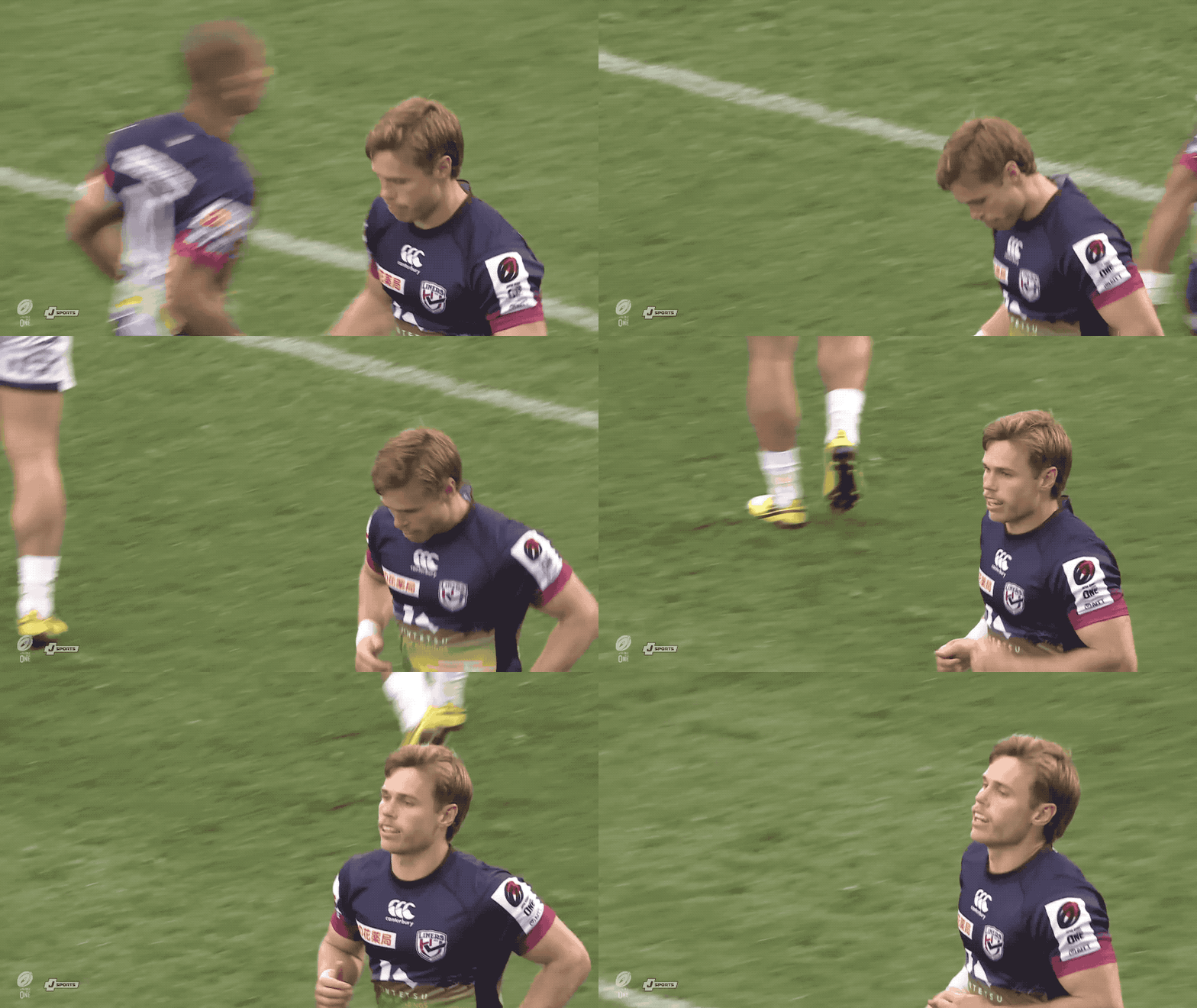
Is it a good thing that, if this were five seasons ago, signing Will Harrison would be one of the biggest stories in the game?
Like a lot of things, it depends.
If, like me, you were desperate to look at any rugby that you hadn’t seen before during the pandemic, you’ll know all about Will Harrison.
Harrison was a Randwick junior and Marcellin College product who became the youngest player ever to sign a professional contract with the Waratahs back in 2018, at a time when he was still sitting behind the likes of Bernard Foley, Kurtley Beale and Karmichael Hunt. He guided the Junior Wallabies to the final of the U20 World Championship in 2019 and, after spending 2019 understudying Foley, he was handed the starting No.10 jersey for the 2020 season opener against the Crusaders in Nelson — becoming the youngest player to debut for the Waratahs at fly-half.
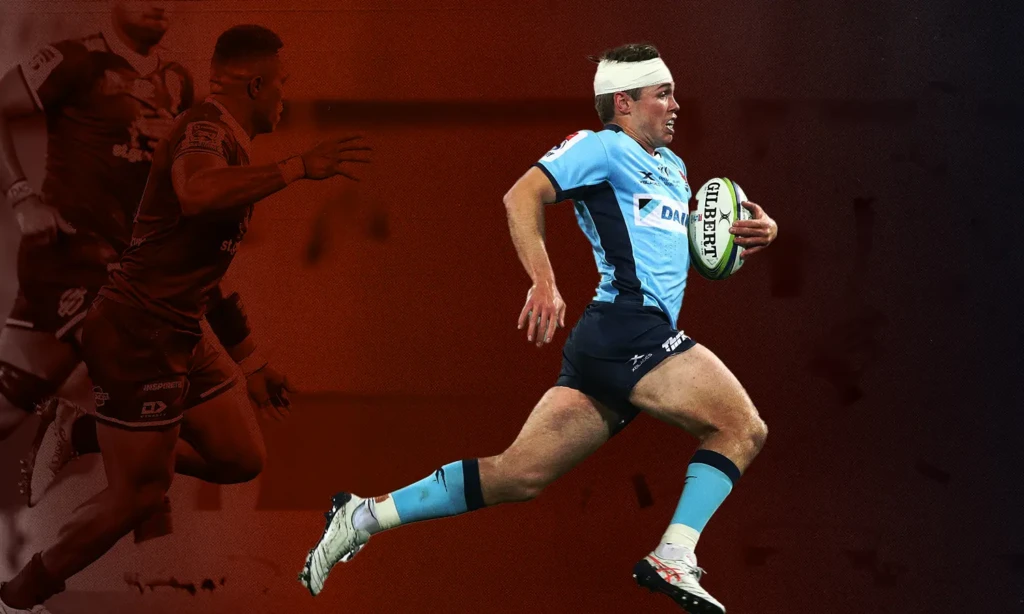
He started all six of the Waratahs’ games before the pandemic stopped the world, before carrying that form straight on through the domestic Super Rugby AU competition. Across that unusual split season, he racked up 14 appearances and 126 points.
I remember watching him at the time and thinking what a talent he was. I mean, I had very little else to be doing except looking at Super Rugby at that point, but still. Quick, great hands, outstanding game IQ and all at a ridiculously young age, too. He looked like a future Australian international.
His calling card was his boot. He kicked at an astonishing 93 per cent over eight games in Super Rugby AU — to put that in perspective, Reece Hodge kicked at just shy of 74 per cent across four Rugby Championship matches. That goal-kicking, paired with his running threat, made him the standout young 10 in the country. He himself talked about wanting to be the kind of fly-half who “just can’t miss,” invoking Jonny Wilkinson as the model. He was far from being the only player ever to model himself on Wilkinson, but he walked the walk.
The institutional endorsement was real, too. A Junior Wallaby and captain of the Australia Schoolboys side, his trajectory was only going up after he was selected in the Wallabies touring squad under Dave Rennie at the end of 2020, while he’d seemingly won the battle for the ‘Tahs No.10 jersey over Ben Donaldson and Tane Edmed.
He wasn’t actually capped on that tour, but being in Rennie’s first squad at 21 was a statement of intent. The media framed him and Noah Lolesio as the long-term future for the Wallabies — two players who, with the right management and a bit of luck, could be playing alongside each other at a home World Cup in 2027. Even allowing for his slight frame (around 5’10”, which drew “too small” concerns), analysts pointed to Richie Mo’unga and Damian McKenzie as proof that a smaller, more agile playmaker could thrive.
But.
His luck ran out early. Harrison went down with a serious injury against the Chiefs in 2022. He suffered a multi-ligament ACL, MCL and patella tendon rupture requiring surgery. About as bad as you can get when it comes to knee injuries without actively having your knee snatched away by a shark.
The comeback was brutal: his return for the Waratahs A side was marred by a toe injury, and then disaster struck again; a second knee injury playing for Randwick in the Shute Shield. All told, he was sidelined for the best part of two years. 707 days, by his own account. He spoke very openly about how dark that period got, including a stretch where he couldn’t get out of bed or shower without assistance. Back-to-back serious knee injuries, meaning he spent almost two full years on the sidelines, stopped his upward trajectory in Australian rugby dead in its tracks.
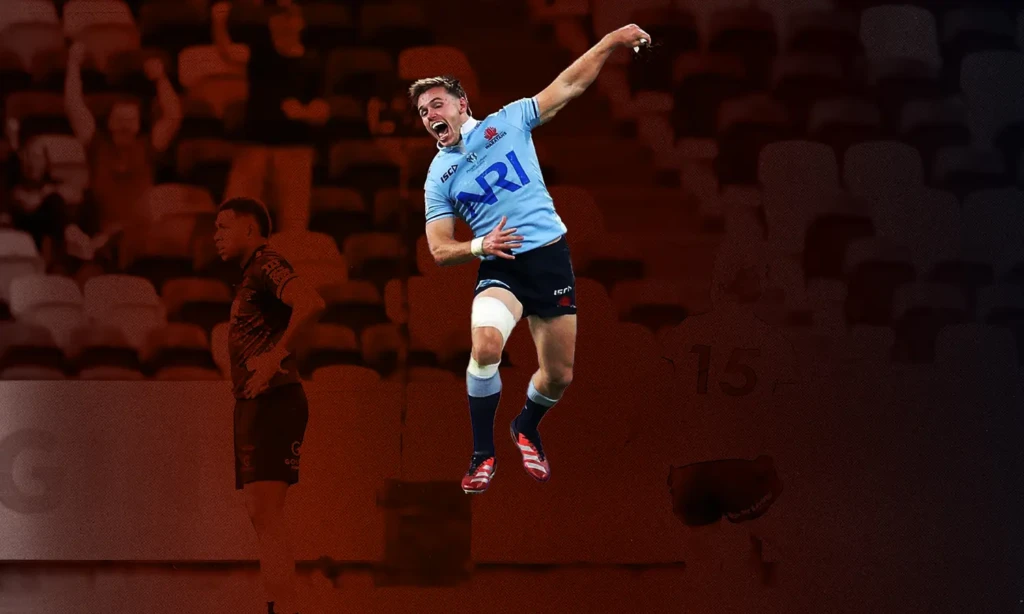
He did make it back — most memorably a drop goal to clinch a Golden Point victory over the Crusaders in Round 8 of 2024 — but by then Tane Edmed had a grip on the Waratahs’ #10 jersey, and the Wallabies window had effectively closed.
He finished with 37 games and 255 points for the Waratahs before being farewelled in 2024, before moving to Japan with the Hanazono Kintetsu Liners in the Japanese Second Division.
And now he moves to Munster on a one-year deal.
So what is the story with Will Harrison?
First, a bit of boring context, which is something of a speciality for me.
Earlier this year, Clayton McMillan identified a need for — amongst other things — more creativity in the backline with Jack Crowley, and more reliable, system-fit ability at #10 without him. To address that, we tried to sign Jamie Benson, who would go with Ulster instead, in part because he wanted to play primarily at #10 and saw an easier route to that and subsequent Irish test opportunities in Belfast.
While Benson can play at fullback (he spent the last six games of the season at fullback), he’s generally seen as a guy who can more comfortably cover 12.
When Munster were talking to him, we couldn’t really offer him much more than covering for Crowley when he was away with Ireland or rested, and then playing a lot of #22/#23 where he could cover midfield and fullback.
Another factor complicated things: Tom Wood. In the next two seasons, Munster see Wood as someone who can compete with Crowley or play alongside him if some positional versatility shows up as he develops. The IRFU see him as an AAA prospect for the Irish national team.
Signing a 23-year-old Benson, who sees himself as a #10 long-term, would inevitably get in the way of that. We couldn’t, and didn’t, promise Benson anything more than that.
With our tighthead problem post-Jager looking like it has an IQ solution, that opened up an NIQ option for our utility back.
Ultimately, we want two things;
- Someone who we can play at #10 when Crowley isn’t around, who can attack in a similar way to him.
- Someone who we can also play with Crowley, so we’re not spending an NIQ slot on someone who won’t get much usage when Crowley is available.
- Someone who can augment and help the development of Tom Wood and, latterly, Charlie O’Shea.
Harrison — who can play #10 and fullback — offers all three at varying levels.
At #10, he’s more of a running threat than JJ Hanrahan, as well as being an unbelievable goal kicker, and at fullback, he can provide the kind of creative roleset that we only have in that spot when Jack Crowley is shoe-horned in there when we run 6/2 splits. More importantly, if we intend to load minutes into Tom Wood next season — and everything I’ve been told suggests we do — having a player like Harrison at fullback could help lighten the cognitive load for a young player.
And then there’s the system fit itself.
Munster will play a deeper — in a directional sense — style of rugby next season, and that opens up the utility for a second playmaker in the outside backs, something we currently lack.
By “second playmaker”, I’m talking about a guy who can essentially operate as a second #10 on the field — either at first receiver or further out — who can also cover the strike running and finishing required of a back three player, as well as the aerial work, backfield coverage, and edge defending required of all #10s at this point of the game.
In practice, this is getting a second pair of eyes on the field who sees things like a #10, with the skill set to match.
Without wanting to take any theoretical shortcuts, McMillan’s Chiefs were arguably at their best with Damian McKenzie at fullback. That extra passing, running and kicking option alternating with Josh Jacomb at #10 allowed the Chiefs multiple vectors of attack, and they never quite looked as threatening when the heat came on with McKenzie at #10.
If Munster are to move to a deeper style, it then makes sense for a second playmaker to rotate with Crowley, but that also means that Crowley alone doesn’t have to be all things to the team on the offensive side of the ball.
To what level can Harrison provide these things? That’s to be determined.
For the last two seasons, Harrison has been playing with Hanazono Kintetsu Liners in the second division of Japanese pro rugby. To some, this is a red flag, but it’s not really something I’m concerned with. For a start, he’s playing in the same team as Manie Libbok, Akira Ioane, Burger Odendaal, and Peter Umaga-Jensen, being coached by the likes of Will Genia and Quade Cooper. Noah Lolesio plays in the same league, and so does Rory Arnold.
Harrison shares the same thing as all of these players and coaches; they are playing in the Japanese League One (Division 2) for the money and for the existential benefits that an easier schedule affords them. That sounds ugly to write, but it’s true. That’s why Damian De Allende and Lood De Jager play in Division One; that’s why RG Snyman was there before joining Munster. It’s why Dave Rennie, George Bridge and Brodie Retallik were at Kobe for the last few years. Why Malcolm Marx plays for the Kubota Spears and Pieter Steph Du Toit for Toyota Verblitz. It’s why Mark Nawaqanitawase is going there next season before going back to play in the 2027 World Cup for the Wallabies.
The rugby is high enough level to keep you sharp, keep yourself fit, and develop certain aspects of your game alongside genuinely top-class players, but easy enough that you’re not getting run into the ground in a low-pressure environment, all while getting paid serious money.
After his injury troubles — to put it mildly — knocked him down the chart at the Waratahs, he had two options: go to another Australian franchise, or Europe, for less money and more attrition right after coming back from two knee surgeries, or to bluff away in Japan for two years, work your way back into your game as it looks after those same knee injuries, all while getting your bank balance up to speed with your ability.
The closest allegory I have for it is Joey Carbery, with whom Harrison shares many similarities. Both are smaller 10/15s, with a lot of speed and agility, who started young and got thrown off course by serious injury.
When Carbery came back after his 18 months out of the game post 2019 World Cup, he jumped right back into the pressure cooker of needing to be Munster’s #1 guy, with a shot at being Ireland’s #1 post Sexton if he managed it properly. He never quite looked like the same player. There was no gradual curve for Carbery to jump back on.
Within a month of his initial comeback, he was thrown straight into a PRO14 final against Leinster. He didn’t play well. A month after that, he was playing against Toulouse in a European quarter-final. He was back on the horse immediately, but he never quite looked like he’d ever had the time to work out what his game looked like after his injuries.
Harrison took a different route and has been tipping away in Japan, working on his game as it stands now, and waiting for a new opportunity with the 2027 World Cup on the horizon. He sees Munster as an excellent opportunity to make a case for a move back to Australia next summer, and then make a run at the World Cup.
So what is his game?
Most of the reps I’ve seen of Harrison this season have been at fullback, where he’s been solidly in that strike playmaker role. A consistent thing I’ve seen from him is consistent good decisions — he makes the pass early if it’s on, he hangs onto it if the defence shows him the picture, and he can execute both of those states really well.
He’s quick — not as quick as his peak — but more than enough to get the job done. He’s a talented left-footed kicker, too, from hand and off the tee, and it informs a lot of his value as a fullback and as a #10, when required.
I think his best usage will be as an auxiliary #10 in phase play, and as a key decision maker off set piece plays, where he’ll naturally start that bit wider. He’s not Louis Bielle Biarrey pace-wise, but he’s not slow by any means — his big point of difference is his playmaking ability in those wide spaces where he’s thinking faster than the defence, or reacting faster.
In an ideal system, he’ll be empowered to do just that.
Functionally, I think a guy like Harrison, if he does what we think he can, will help cover some of our structural weaknesses from last season, add more depth and be someone who can help Tom Wood get more minutes.
The concern is that the player he was, or could have been, is no longer there in a functional sense, so when he steps up a level in competition, the positives he’s shown in Japan don’t apply. It is a risk, a calculated one, but a risk nonetheless. How will his body hold up to the jump in intensity? We can’t know. How will what he’s done in Japan over the last two seasons post-injury prepare him for what he hopes will come next? We don’t know. We’ll only know for sure once he’s here.
I suppose the real question is whether Harrison is going to be a Mack Hansen, or Paul Warwick, or a signing that never quite hits the mark, a failed punt. If he’s something in between, I think we could live with that. We don’t necessarily need him to be world-class. Maybe every NIQ player should be, but that’s rarely the case, either in status or in output, bar a few outlier examples.
At the same time, I think the questions over him — the injuries, playing in Japan for two years — might sour you on the potential there. I can’t quite shake the feeling that this is exactly the signing you’d see Glasgow, or Cardiff, or Northampton make and for it to be wildly successful, so successful that you end up paying double, or triple what we’ve signed him for to try and capture that lightning in a bottle a season or two later.
I think we’re hoping that he can be, at least, better than what we have in a changing system. He’s got a base role set that should suit it, but ultimately, we need Harrison to get us from where we are in July 2026 to July 2027, when we hopefully have Tom Wood fully up to speed. It is far more valuable for us that Wood becomes a world-class player than for Harrison to be that this season.
If we can do both, we’ll be cooking with gas.
