


The Lions is a learning experience.
You probably don’t need me to point you in the direction of the literally dozens of autobiographies that point to players learning a little bit more about themselves from their exposure to other elite players on a Lions tour. That kind of exposure to elite talent as a teammate is almost impossible to duplicate as an opponent. It’s one thing to get blown out of it by, say, Tadhg Beirne at the offensive and defensive breakdown. It’s another thing entirely to watch him train and practice those skills in the same training session.
While you’re bonding as people, you’re learning as a player.
Ronan O’Gara spoke about this after his time observing how Johnny Wilkinson trained on the 2001 Lions tour. There was what he thought was good prep, and then there was what Johnny Wilkinson was doing. O’Gara got to see where the true world-class level was, especially when he’d had such a disaster off the tee in the 2000 Heineken Cup final the season before.
He came out of that Lions tour a better, more rounded player. That’s just one example, but you could find examples if you asked any player who toured with the Lions; there’s no better place to level up as a player.
But the unsaid thing in all of this is the flow of information; who is teaching, and who is learning?
During the 2021 Lions tour, there was a big kerfuffle between the Lions and the Springboks over alleged spying. Is Rassie Erasmus above spying on an opponent to get an edge? No. Does that mean his Springboks team did spy on the Lions? Also, no.
What should have been of far more interest to Warren Gatland were the spies wearing Lions gear.
Here’s a stat for you.
Since professionalism, the team who have been the bulk supplier of players on any given Lions tour have not won the subsequent Six Nations. 1997, 2001, 2005, 2009, 2013, 2017, 2021 — they all follow the same pattern.
You might say this is explained away by the physical toll on the players of that bulk supplier nation, and that’s a good point, but it doesn’t fully explain it.
For me, it comes back to how much the bulk supplier nation gives away about itself and its systems to the teams that are domestic enemies for all but three months every four years.
Some examples: on the 2017 Lions tour, Rob Howley coached a primarily English Lions side. Andy Farrell was the defence coach for the Lions, as he was for Ireland at the time. England finished 5th in the 2018 Six Nations, but the most interesting game was Ireland vs Wales that year, when Ireland destroyed Wales in Lansdowne Road, scoring 37 points (the most Wales had conceded in the Six Nations since 2006 at that point), primarily by locking the Welsh out offensively. Maybe that was just a coincidence.
In the 2022 Six Nations, Lions attack coach and Scottish head coach Gregor Townsend finished with a negative points differential for the first time since 2019, losing to Wales and Ireland along the way, with their only win coming against England who, you guessed it, had the most players on the previous Lions tour of all the four eligible Six Nations teams.
What does this tell us, other than betting on France to win next year’s Six Nations is something of a no-brainer? That being the bulk supplier to a Lions tour, and the chief coaching unit behind how they want to play, is of more interest to your Six Nations rivals than it is to Australia, South Africa or New Zealand.
And that interest comes with a cost.
***
Andy Farrell has a very specific, very detailed game model that is, arguably, the most involved and complicated one of its kind at test level. That comes with specific selection patterns that I’ve already been over multiple times, but those are for a reason; it’s not a system that is easily picked up, so experience in the system is a highly valued commodity for the Irish coaches, all of whom, bar Paul O’Connell, were on this Lions tour.
If we accept the visual cues we saw on this tour that showed the Lions were trying to play broadly the same Farrell system as Ireland used, and the reports on the ground that the Lions were even using the same Irish calls, I think it’s fair to say that the English and Scottish, in particular, will come away with a fairly comprehensive understanding of how Ireland like to play.
What does this manifest as?
It’s as simple as sitting in the review sessions after every game and training, where what hurts the system is identified and then remedied. What does that mean? That England and Scotland are now better placed to know what hurts Farrell’s systems, what Ireland’s automatic remedy to that is, which allows you to create a counter-for-the-counter in advance.
Let’s look at what Ireland’s Net Efficiency ranking between 2024 and 2025 looks like next to the Lions, and see what the data shows us.
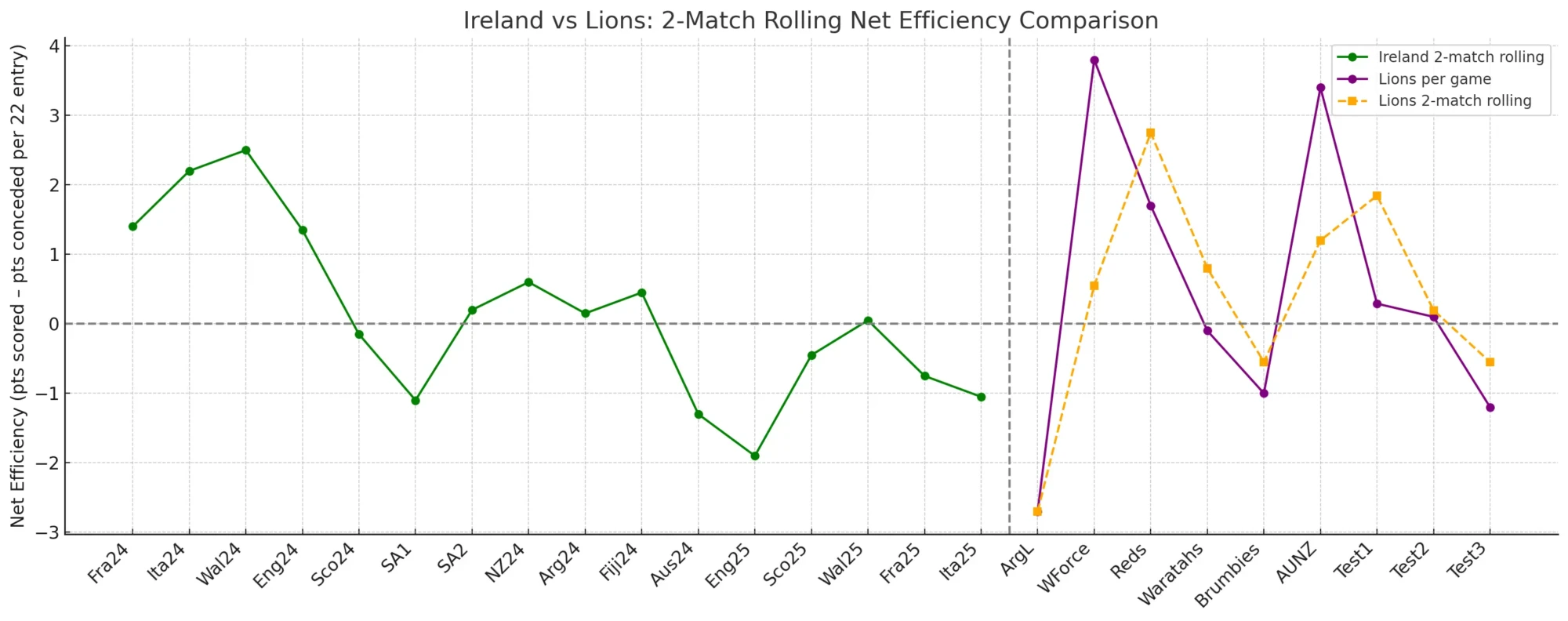
Seeing Ireland’s Six Nations campaign spending most of its time below the zero line explains some of Farrell’s omissions from his touring squad, and visualises the feeling that Ireland never really played all that well this spring. The Lions’ fluctuating Net Efficiency also reflects how up and down they were at key points, and shows an end-of-season skid that looks quite like Ireland’s.
Deep-Comparison
Ireland 2024-25 (16 Tests) vs Lions 2025 tour (9 games)
| Dimension | Ireland (mean/pattern) | Lions (mean/pattern) | Shared takeaway/difference |
|---|---|---|---|
| Net-efficiency engine (pts/att entry − pts conceded/def entry) | +0.08 season avg (±2.5 range) | +0.10 tour avg (±3.8 range) | Both hover near break-even; crossing ±0.8 flips the result. |
| Strike-rate dependence | r = +0.84 with net-eff | r = +0.81 | Quality per visit > entry volume for winning. |
| Goal-line leakage drag | r = -0.88 | r = -0.86 | ≥ 3 pts/entry conceded → immediate net-negative match. |
| Kick-tempo territory lever | 4-6 passes/kick ⇒ +2 to +3 entries; > 8 ppk ⇒ entry deficit | Fixed 4-6 ppk through tour; +4 entry edge first two Tests | The 5 ppk “kick-pressure” window fuels both templates. |
| Ruck-load threshold | 70-110 rucks neutral; > 110 in own half ⇒ efficiency slides | 60-80 every game | Lions live inside Ireland’s safe band; Irish losses see rucks > 110. |
| Late-match power attrition | Doris, Beirne, Sheehan usually stay on > 60′, but pack as a unit loses collision vs SA & FRA heavies → strike-rate falls, defence leaks | Lions kept fresh carriers while Australia lost Skelton/Valetini, driving a comeback | Common weakness: once collision % drops below ~45 % post-60′, red-zone defence yields 3 pts/entry; neither side rotates enough fresh size to withstand big packs. |
| Entry-parity hazard | 0-3 when diff ≤ 0 (Eng 24, NZ 24, Fra 25) | Only loss (Test 3) at 8-8 entries | Template unravels when territory edge disappears. |
Long Story Short — How are Farrell’s Ireland and Farrell’s Lions similar?
1. Same core model
Kick to live at midfield → create a small entry cushion → rely on ≈ 3 pts/entry strike & ≤ 2.5 conceded.
2. Same tipping points
If opponents (a) equalise entries or (b) push concessions past 3 pts/entry, net efficiency inverts within a half.
3. Power-fade nuance
- Ireland: Doris, Beirne, Sheehan stay on, but collective pack size (≈ 905 kg) fatigues vs heavier SA/FRA units; collision win-rate < 45 % after 60′ → concede tight-style tries against South Africa and France, in particular.
- Lions: maintained a fresh carrier rotation between Sheehan, Conan and Genge; benefited when opponents’ big men exited (Test 2).
Lesson: depth of heavy ball-carriers, not just starters, decides late efficiency.
Ireland and the Lions win through a tight kick-pressure/strike-rate template, but both fade against heavier packs once collisions drop late; match their kicking rhythm, rotate fresh power, and push red-zone concessions beyond three points per entry—the numbers say the net ledger swings decisively.
So, assuming the Scottish and English players and coaches were paying attention during the meetings, I’d wonder if they were asking themselves the following?
“If We Want to Undercut Ireland, What Data Would We Look to Duplicate?”
| Lever to Pull | Evidence from Ireland / Lions Data | How ENG & SCO Can Weaponise It |
|---|---|---|
| 1. Match the Kick Tempo (4-6 passes per kick) | When opponents matched Ireland’s P/K (England ’24 = 4.3; SA 1 = 7.6; Lions Test 3 = 4.4), Irish entry surplus vanished and net efficiency slipped into negative. | • Keep your own P/K ≤ 6 for 80 min.• Contest every midfield bomb; pin Ireland in their half and deny them “free” entries. |
| 2. Deny Red-Zone Volume (≤ 7 Irish attacking entries) | Ireland 0-3 when entries ≤ 7; Lions lost Test 3 only when their own entries were capped at 8. | • Kick long with chase lanes, force Ireland to ruck out from deep.• Use defensive line-out steals to erase set-piece platforms. |
| 3. Target Goal-Line Concessions (> 3 pts/entry turns their net negative) | Ireland leaked ≥ 3 pts/entry in every 2025 Six-N dip; Lions conceded 2.7 in Test 3 and lost. | • In the 22, play for tries not threes: keep ball in-hand over penalties, drive maul until card/try. |
| 4. Force Heavy Ruck Loads in the Wrong Half | Irish net plummets when rucks > 110 and entries stay ≤ 8 (Aus 24). | • Chip or grubber behind wings, make them reverse; then trap them in multi-phase exits. |
| 5. Exploit Post-55′ Carrier Drop-Off | Valetini/Skelton off → Lions comeback; Ireland post-60′ vs France 25 lost collision ratio and conceded 27 unanswered points in the second half. | • Keep fresh power on bench (big 6/8 and lock) to bang through tired Irish fringe defence at 65-minute mark. |
| 6. Hammer Blind-Side Edge in First Phase | Farrell shape overwraps to open side; blind guard often isolates. | • From scrum or middle-field line-out, send 10 + hard-running 13/14 down short side early; odds on a mismatch vs tight-five defenders. |
| 7. Jackal the Middle Third | Ireland average 85–100 rucks; slowing only 4 kills tempo. | • Deploy two genuine jackals, and sit them between the 10-m lines; even one extra steal swings territory and entries in a no-compete defensive framework |
| 8. Live-Track Pts Conceded / Entry | Both Ireland and Lions flip results once that number > 3.0. | • Use in-game analyst feed: if Ireland concede their second try inside four entries, double down on territory kicks and maul, don’t take shots at goal. |
Putting It Together — 80-Minute Flow Chart
Kick-off to 20′
Kick, chase, collide. Make Ireland exit multiple phases from inside their 35. If you win an early 22 entry, go to the maul.
20’–50′
Stay inside the 4-6 P/K band. If entries reading Ireland ≤ 4, you’re on script. Attack first phase blind if Irish wingers set deep.
50’–70′
Bench power on, up the tempo. Keep the ball after the first kick return and force a 10-phase set to tire the Irish forwards. Look for blind-side overload or midfield pick-and-jam near the line.
70’–FT
If margin ≤ 7, kick-contest everything; Ireland under Farrell seldom chases two-score deficits well. If you’re ahead, keep rucks < 3 per phase, burn clock.
Bottom-Line Cheat-Sheet
- Kick as much as they do.
- Starve them to ≤ 7 entries.
- Maul or punch until you’re > 3 pts/entry.
- Unload fresh carriers at 60′.
Do those four and the numbers say Ireland’s net efficiency tanks — exactly how the Lions lost Test 3 and Ireland lost their toughest Six Nations games. Just how much have they learned from Farrell’s Lions hothouse?
We’ll see soon enough.
