

Ireland are not playing well at the moment.
I was delirious with creche plague last week and, even in that altered state, the evidence was clear. Is clear. Compare this Ireland to the team that won a Slam in 2023 and there’s no denying it. This team is on the slide. Let’s be clear in case you feel that this is some anti-Sam Prendergast propaganda; Ireland weren’t great last season in the Six Nations either but did enough to outlast a skittish French side to win a championship.
When you rolled that in with another World Cup quarter-final exit to a team we’d repeatedly beaten in the previous four-year cycle, it was clear something was off. What was it?
My hot take is that Andy Farrell looked at the changes from the previous year and realised the only one he didn’t deliberately make himself was who played in the #10 shirt. Farrell tried every option other than Jack Crowley in the two years before the 2023 World Cup. Harry Byrne got a run. Farrell even tried to make Frawley his next #10 post-Sexton even when his province didn’t see him in that spot. In the year before the World Cup, it seemed like Farrell had decided Ross Byrne would be the next guy. He landed that kick against Australia in November 2022 and was the defacto #2 behind Sexton in the 2023 Six Nations. But it didn’t stick. Byrne had a poor end to the 2023 club season stepping in for an injured Sexton and all the inertia Byrne would have had playing alongside that Leinster team wasn’t enough. Soon he was out. Harry Byrne was out. Frawley was something of a utility back that Farrell still loved but couldn’t trust. Crowley was the only one who improved year on year but there was no way Farrell was ever going to put him in for any meaningful game that was in the balance so long as Sexton was still capable of shuffling from one foot to another.
When Sexton retired, Crowley was the one who was left but was he ever a Farrell project? I don’t think Farrell ever really saw him that way.
Crowley played really well in 2024 – too well, which was the problem for Farrell’s HPU, as there was no obvious scope to rotate him out of the #10 shirt – so the handover to Prendergast, who Farrell has picked and made a project of, became needlessly ugly. People can understand when a player plays badly and gets dropped or replaced. When the player hasn’t played badly but gets replaced regardless, it creates a void where people will create their own narratives.
Sam Prendergast is not ready for the level of scrutiny that has and will come his way. If he thinks this Six Nations has been difficult, he is not ready for the hurricane coming his way when he gets selected ahead of more complete players for the Lions.
I say “complete” here because the biggest issue with Prendergast’s game is that he is very good at what he has focused directly on as he’s come up, and awful at what he hasn’t.
Prendergast is very good at dropping back well away from any realistic challenge and then kicking contestables like this.
Ireland uses him primarily in this role and when you see it once, you’ll recognise it all the time when Ireland have possession around halfway – he drops back behind the 10m line, takes the pass from Gibson-Park and exits. The height and accuracy that he gets on these bombs are genuinely outstanding. A lot of kickers sacrifice height and hang time for positional inaccuracy but Prendergast almost always lands those balls in the right spot for a heavy contest, and usually within touching distance of the 15m hash.
With the new ban on escorting kickers, it’s become a much more valuable play than running with the ball from this area and provides a much better return on the investment with the ball. If you run with the ball here, you have to resource the rucks that follow. If you simply kick and chase, you get territory first and foremost, the ball back at best, a defensive transition at worst and maybe a scrum. It is energy-retaining rugby.
Prendergast is the ultimate product of Leinster’s heavily prescribed system depth. He produces all of the things that the Leinster system has loved over the last few years and very little of what it doesn’t.
He hardly ever carries the ball into contact so he’s usually in position when the scrumhalf goes looking for him. He allows Gibson-Park to run the game exactly as he sees fit, and follows his lead to the letter. That was most clear in this game when it came to that kicking range. Look at this one; 4.4 seconds of hangtime and it landed right on the 15m hash.
That is kicking that you can reliably build a fully functional hands-off, off-ball game on.
In attack, Prendergast’s wider passing game never really got going as Ireland struggled to get an attacking platform. Wales attacked Ireland’s scrum relentlessly and got huge rewards when Nicky Smith was on the field against Clarkson. That meant that when Ireland kicked the ball to release, it came back the other way in penalties a lot more times than normal.
When Ireland did have possession, though, Wales seemed to understand the issues with Prendergast’s game as a playmaker. Sam hardly ever cuts off the side of a screen to show a defence something different. He simply does not have that in his game as it stands. I can see why; when you carry the ball with any regularity, you have to be durable, you have to be explosive and you have to accept that you run the risk of knocking the ball on or getting buried in the tackle. That takes focus away from what Prendergast is good at, so it serves no function except to expose him to errors that get him dropped.
Prendergast will only carry when he has open space to move into, most often from a 5m offensive set where the opposition defence has compressed.
He never carries in a situation like this where he takes the ball off a screen and tests a lazy defender. Wales, after two weeks of prep, were well aware of this so all they did was swarm Prendergast’s passing targets.
Van Der Flier gets driven backwards even though the collision line is 10m behind the previous ruck. This happened over and over again. It happened against Australia in November when Schmidt’s side realised they could leave the “Prendergap” on phase play because the usual threat of the inside break was never coming.
In this clip, you see it pretty clearly when Wales didn’t blitz him and instead cut off his pass option, he had nowhere to go.
He simply accepts the turnover instead of doing what he should do, in my opinion, which is cut back inside off his right foot, fight in contact with Morgan and give Ryan, Porter and Clarkson a target to hit.
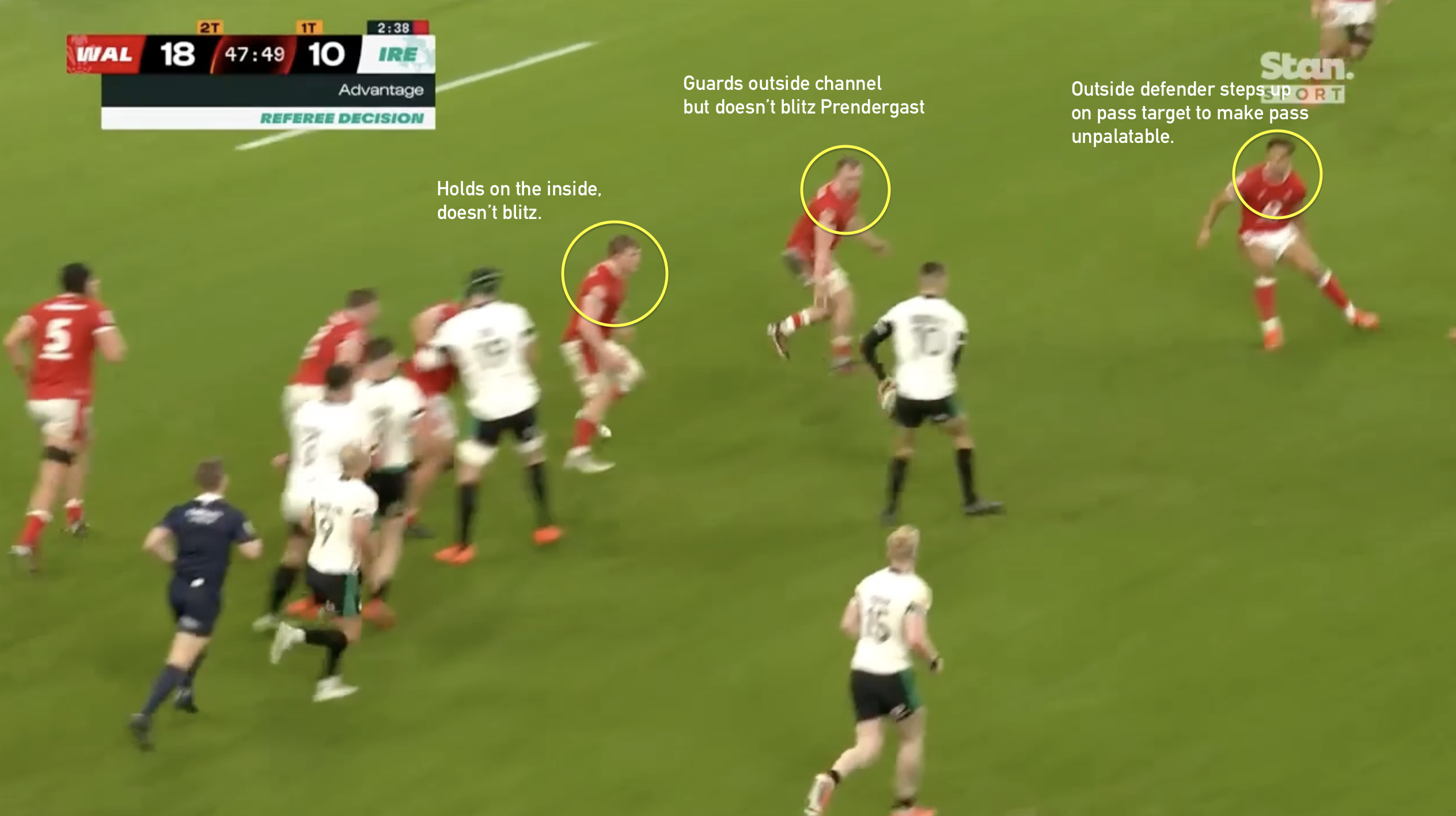
As a result of this, when Wales kept their discipline in check for the first 50/60 minutes of this game, Ireland had no platform to play off on phase play. That’s why we kicked so often; Wales didn’t give us the platform we wanted to play off, which is primarily lineout work off penalties kicked down the touchline.
This is consistent with Ireland slowly moving away from counter-transition rugby to a more off-ball configuration in line with Leinster’s shift in the same direction under Neinaber at club level. Ireland are going to focus on what Leinster are doing because Leinster make up the bulk of this squad. It is dumb rugby to do any different. If you want to see what a scratch team look like playing anything like counter-transition rugby, check out Ireland A versus England A and you’ll soon see why making sure you’re playing a similar style to what most of your matchday squad does week to week makes sense.
When you play off-ball rugby, you kick almost all turnover ball won in your half and kick everything inside your own 10m line. Ireland does not want to play phases outside of the opposition’s 10m line so, as a result, there is no point playing a primary playmaker whose game is based on being a running threat in those zones.
Ireland had 86 rucks in this game. Exactly 40 of them were inside our 10m line and we kicked at the end of every single one of those ruck sequences within two phases on average. That’s that drop-back and contestable sequence you saw earlier. That zone used to be where Ireland ran counter-transition sequences from but not anymore – now we almost always look to kick exit. Sometimes it’ll be a crossfield kick like this, but we aren’t looking to run these possessions in the way we used to.
This 50/22 isn’t included in the rucks engaged behind the 10m line, but I wanted to include it as it shows Ireland’s general principle in this zone. We want our #10 recessed back away from the gainline and getting the ball downfield with a focus on getting it back. It’s the perfect example of a big territory gain with little energy being expended.
This behaviour on rucks behind the 10m line is consistent for the two previous Six Nations games. Take the kick receipt or set piece position, use one or two rucks max to set the position and get the chase in gear, then exit. When this is what is primarily required of the #10, selecting Prendergast makes complete sense.
However, that will be completely undercut if he doesn’t get his defence in order. What I saw from Prendergast on the defensive side of the ball in this game was completely unacceptable at any level and if he doesn’t get it sorted out, it’ll ruin his season. This isn’t about missed tackles. Plenty of guys “miss” tackles during a game and they are non-factors. They often force the opposition to adjust. Sam Prendergast loses every single collision he takes on and it is at such a level that Ireland are actively trying to hide him.
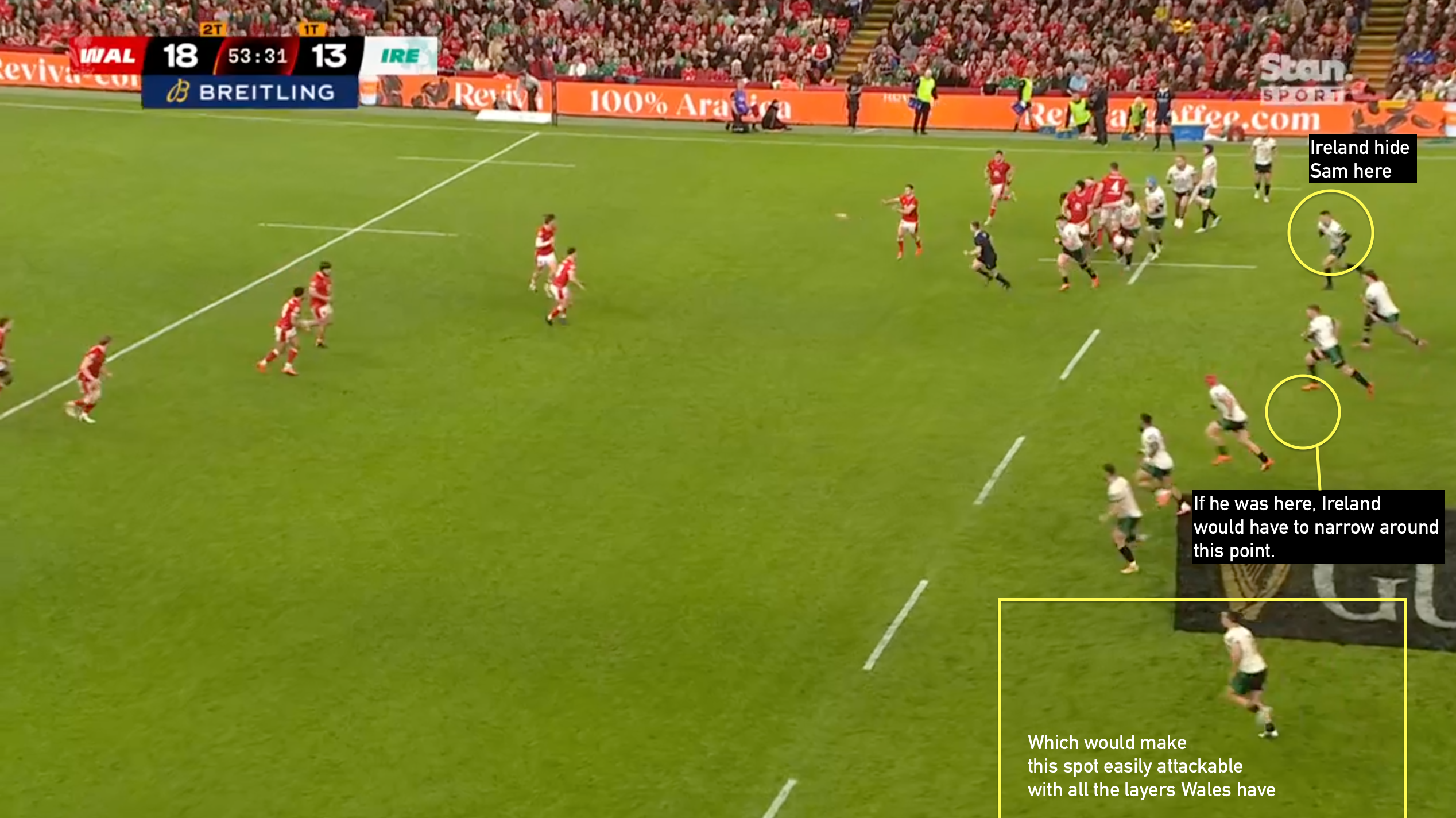
You will often see him defending at #13 off certain scrums and at blindside wing on shortened lineout plays because Ireland know they’ll have to compress around him.
On this lineout, he was hidden away from where Wales might feasibly use their layers to pull Ireland all over the place all while trying to protect Prendergast from getting isolated or, in trying to protect him, get sliced up on the outside.
When Wales went for a six+ man lineout, Prendergast didn’t fare any better and badly fell off a centre-line tackle here with zero stall on the runner. Ireland had to burn two defenders to make the stop.
This is one example. There are many, many more. If he can’t get his defence sorted out or if Ireland have to go to ever-increasing lengths to hide him, his test career is only going to end one way. You don’t need to hit like Brian Lima to be a good defender at #10 and neither do you need to be a Damian De Allende-like positional and physical monster off the set piece or phase play. At the same time, it’s not 2005 anymore when you could afford to carry a non-defender at #10. Getting your body in the way isn’t enough – it was barely good enough in 2005, never mind 2025. Ireland’s defensive work has already degraded this season because we are overloading Porter, Van Der Flier, Lowe and whoever is playing #12.
This is a great example of that principle. Wales had two players over here in part because Ireland had to stack two defenders right alongside Prendergast.
A more accurate pass gets Lowe in a two-on-one. I’ll repeat it – if Prendergast can’t get his defence up to a passable level, then he’s already coming to the end of his time as Ireland’s #10, even with his natural fit with what Ireland wants to do in possession. The biggest praise I can give him is that he managed to pull the three moments he needed to – two long-range penalties and a nicely taken 50/22 – out of the bag after a defensive display you’d hook a 15-year-old for.
That alone is a showcase of how strong he is mentally.
You can get away with defence like that against England, Scotland and Wales – all deeply imperfect teams with more problems than solutions right now – but France will be the big challenge, as will the Wallabies in the summer, the big French teams in Europe, and then the All Blacks, Springboks and Wallabies again in November.
If teams start to notice his defensive issues and hunt after them, it will only end one way. And I don’t think that’s what anyone wants, even the most ardent promoter of Jack Crowley.
***
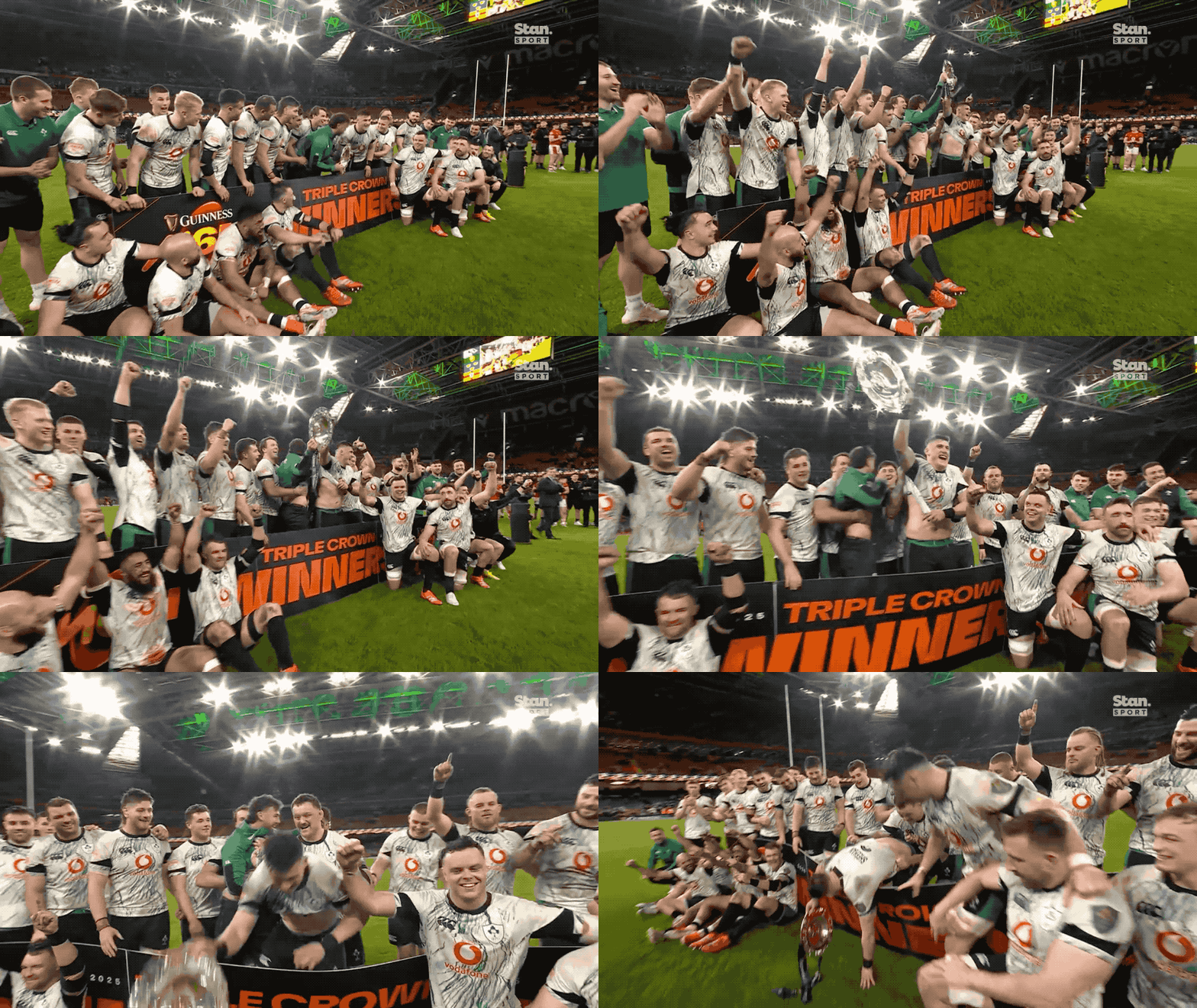
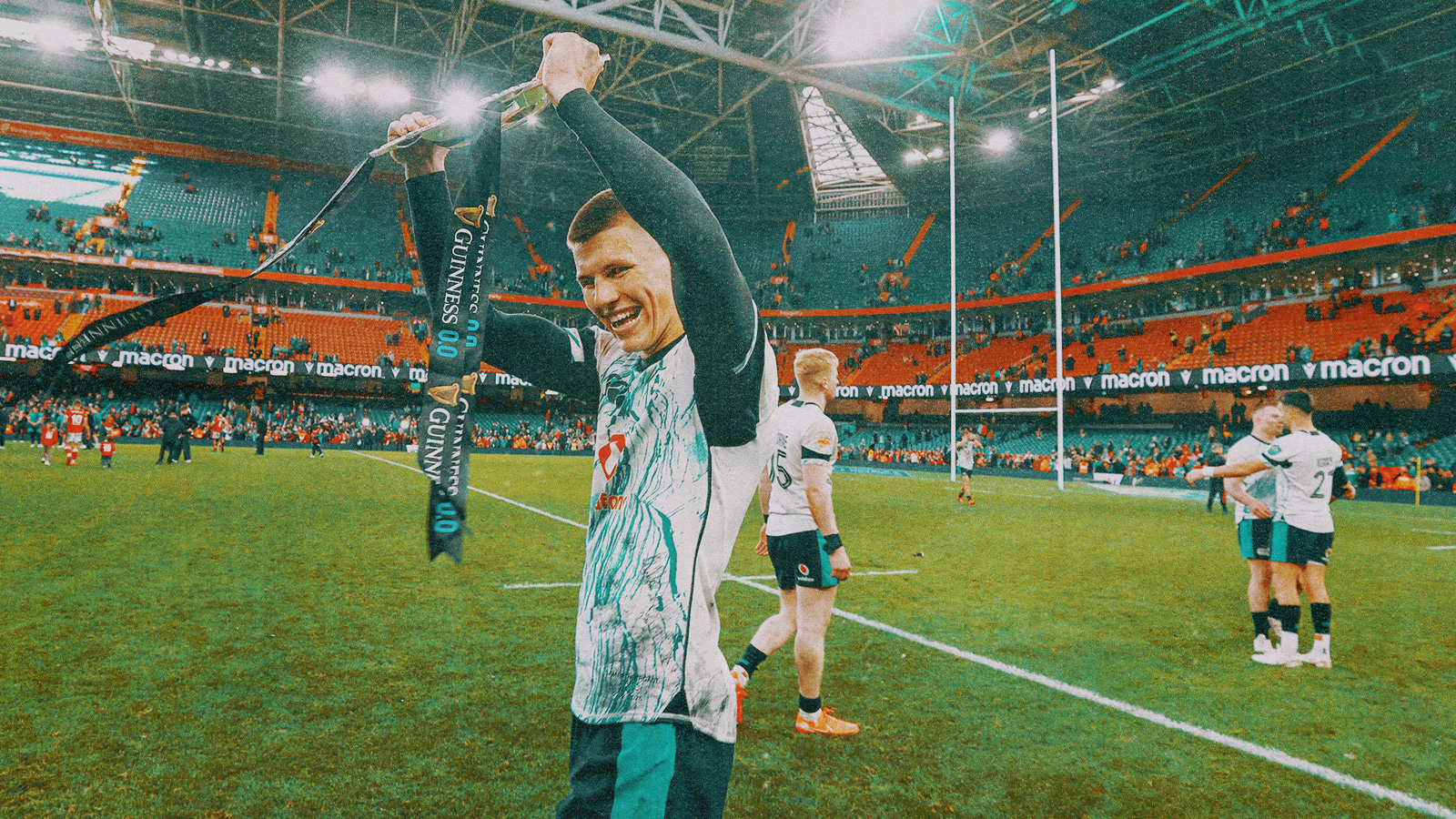
This game was, ultimately, the perfect expression of Ireland’s consistency. We were poor, again, but did just enough to outlast a Welsh side who spent a week targeting our weak points in the video room and were an inch away from having a kick to go back into the lead in the last ten minutes.
There’s no hiding from the fact that as gritty as Ireland were to see out this win, it was against the worst Welsh team of the modern era who arguably could and should have won. That Wales managed this performance without the need for a heavy counter-transition game speaks volumes, as does the fact that we hammered a better Welsh team this time last year. We are changing our style from what we knew between 2019 and 2023. That can often be ugly and this certainly was.
Ireland’s consistency and senior players saw us through, with a sprinkle of elite quality from Aki, Gibson Park and Lowe. This international season has really underlined how vital all three of those players, in particular, are to getting this Irish side over the line when we’re struggling.
The issues with this Irish side are much deeper than the #10 jersey and speak to a growing problem bubbling under the surface. These problems might not show this Spring but that A international shows you more about how precarious our current position in the world rankings is. We do not have the depth that even England can draw on and, when you scrape below our highly cohesive squad of maybe 25/26 experienced players, performances can and will fluctuate heavily.
The Irish coaching staff are now in a position where they have to use the last two years of that experienced core in their early to mid-30s – Henshaw, Aki, Beirne, Furlong, Van Der Flier, Ringrose, O’Mahony, Gibson Park, Conan and Lowe – along with prime talents like Ryan, Doris, Sheehan and Porter to build a new Ireland. What we can’t have is a situation in 2027 where we’re rolling up to the Six Nations with broadly the same squad as we saw here minus O’Mahony and Murray. Yet right now it feels like that is more likely than not.
One thing is for sure, two weeks in the Aviva Stadium against France is the biggest game for this group since the World Cup quarter-final against the All Blacks.
Where are we? How deep are the cracks that this scuffed Triple Crown has papered over? We’ll know soon enough.
| Player | Rating |
|---|---|
| 1. Andrew Porter | ★★★★ |
| 2. Dan Sheehan | ★★★ |
| 3. Thomas Clarkson | ★★ |
| 4. Joe McCarthy | ★★★ |
| 5. Tadhg Beirne | ★★★★ |
| 6. Peter O'Mahony | ★★★★ |
| 7. Josh Van Der Flier | ★★★★ |
| 8. Jack Conan | ★★★ |
| 9. Jamison Gibson Park | ★★★★★ |
| 10. Sam Prendergast | ★★ |
| 11. James Lowe | ★★★★ |
| 12. Robbie Henshaw | ★★★★ |
| 13. Garry Ringrose | ★★★ |
| 14. Mack Hansen | ★★ |
| 15. Jamie Osbourne | ★★★★ |
| 16. Gus McCarthy | ★★★ |
| 17. Jack Boyle | ★★★ |
| 18. Finlay Bealham | ★★★ |
| 19. James Ryan | ★★★ |
| 20. Ryan Baird | ★★★ |
| 21. Conor Murray | N/A |
| 22. Jack Crowley | N/A |
| 23. Bundee Aki | ★★★★★ |
