


At the start of this season, I spent a reasonable amount of time speaking about how difficult Munster would find it to make a radical change to the core tenets of our game in a compressed amount of time. Results don’t always have to fluctuate in that situation but the more significant the change, the more potential there is for disruption. That’s why most sides just to make a gradual change. Boiling the frog slowly instead of flash-frying it, essentially.
Pre-game, I expected Warren Gatland to start flash-frying some frogs and making some radical changes to the Welsh approach to this game but it was mostly the same as what we saw under Wayne Pivac. The 3-2-X, the on-ball approach in their own half (45.1% of all their possession was inside their Q2) – it was all reminiscent of what we saw from Wales last year but, given the timeline that Gatland had to work with, maybe they decided that making too many structural changes too soon wouldn’t get them where they wanted to be for the World Cup?
Whatever the reason, Wales seemed to play right into Ireland’s hands with a game plan that looked more than a little outdated and ignorant of how they actually might hurt this Ireland team. Even then, they started so poorly that, even if the previous sentence wasn’t true, they still would’ve lost this game by double digits.
For me, the core reason behind Ireland’s win here – and over most teams who don’t understand why they lose to Ireland – is the absolute dominance we exerted over Wales when it came to kicking the ball. I spoke before the game about how I felt a long kicking game mixed with heavy chase pressure and a “stand offish” ruck policy on transition phases would be a good way to build into the game for Wales. Did the loss of Halfpenny before the game nuke that plan? Neither Adams, Dyer or Williams – Halfpenny’s replacement – are natural kickers of the ball or at least natural tacticians when it comes to the kicking game.
As a result, Ireland were playing counter-transition chess and Wales were trying to limit us the way teams would’ve tried two years ago. Ireland are not vulnerable to shorter contestables in the same “critical” way that was the case during the pandemic season.
Most of Wales kick action was short and contestable. They had a higher number of balls played by hand than Ireland but kicked 221m fewer in the game. They also kicked with less variety throughout their backline.
A lot of people questioned the selection of James Lowe on the wing for Ireland before the game – especially with so little rugby under his belt as of late – but he’s one of the key tactical kicking weapons for Ireland. Lowe only handled the ball – a pass or a carry – 69% of the time and he kicked longer than any Welsh back, including both the Welsh scrumhalf Tomos Williams and Dan Biggar. Johnny Sexton’s ball handling percentage was 79%. Ireland came to Cardiff to counter-transition and did so with elite levels of efficiency thanks to the range and power Lowe, the variety of Sexton and the depth and accuracy from Murray off the box kick.
This Irish side is genuinely the best in the world at three particular things that make us a nightmare for teams who don’t get it – kicking accuracy and variety, kick transition defence and post-transition phase play. You can two of these elements in the build-up to the first try, which was engineered directly from the kick-off.
You wouldn’t blame Ireland for, at any point, “going through the phases” on this sequence but this Irish team rarely does that. In fact, I wouldn’t be surprised if the question posed to Lowe (or Hansen) in this spot during run-throughs is “can we kick that?” because this Ireland side does it so, so often.
If you want to break in ahead of Lowe and Hansen at the moment you won’t do it unless you bring what they do with the boot, first and foremost.
Wales, on the other hand, seemed intent on overhandling every phase and played with a real lack of variety that played right into Ireland’s hands. I think that Gatland’s thoughts for this game revolved around the La Rochelle method of taking Ireland/Leinster’s counter-transition starter plays and then just hanging onto the ball until you get an edge. When Wales did kick, it was usually in that mid-range contestable range of 25-30m without elite-level hangtime from Tomos Williams, who was their primary kicker in this game.
The second section of this looked very similar to Pivac’s Wales at their worst. The La Rochelle method only works against Leinster/Ireland when you have multiple players who can compress the defensive line.
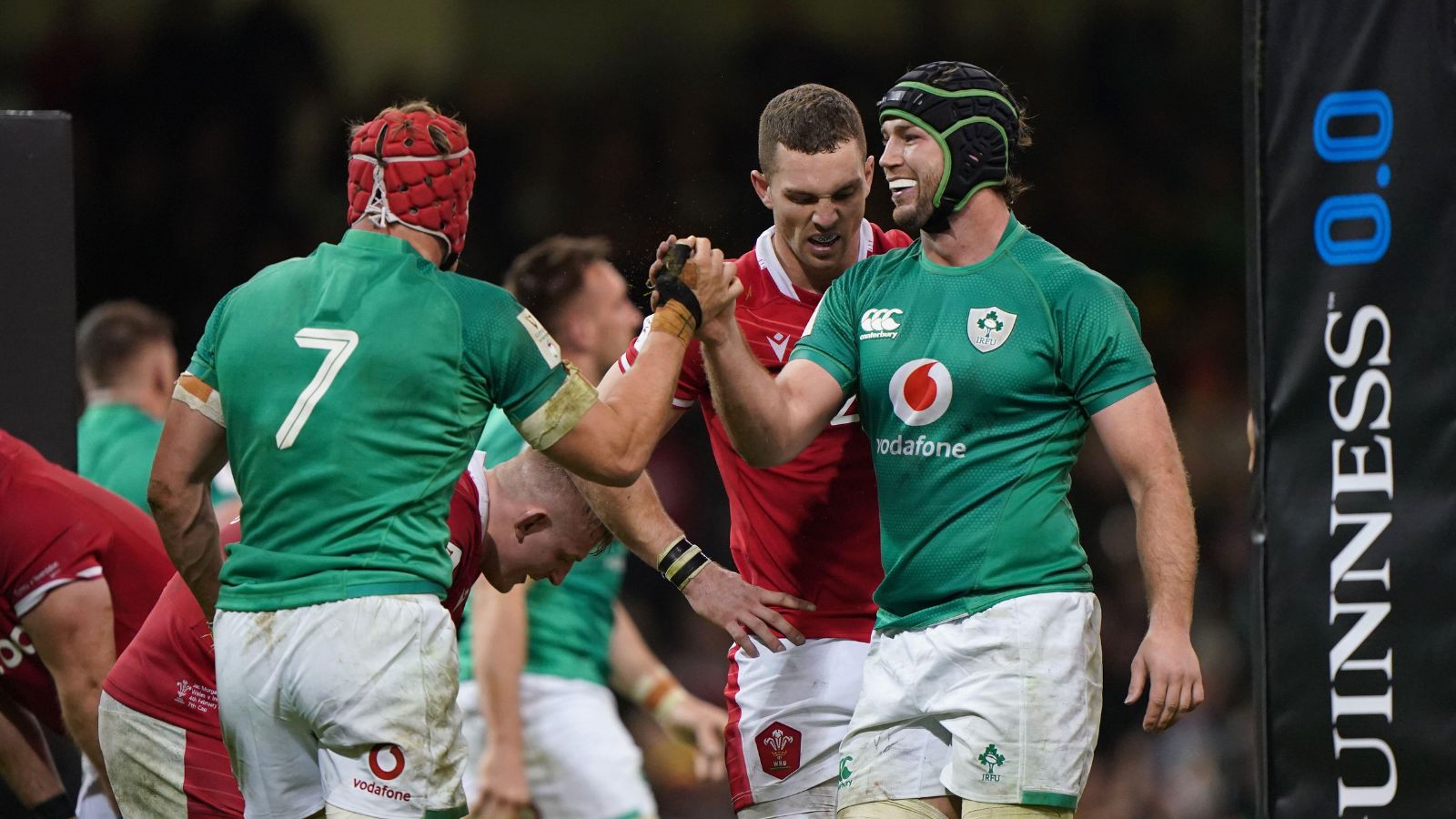
In 2023, Ireland put away teams incapable of playing effective anti-counter-transition rugby with very little fuss and, it seems, without having to stress that hard for it. We had the bonus point wrapped up a little later than we’d have liked – guess how it was scored – and that was that. This version of Wales had nothing for us but I think they’ll get better with time and this weekend was probably the best time to play them.
For Ireland, the only main concern was a few discipline issues, ongoing worries about Porter’s scrummaging and a few blips on transition defence in the second half. This, for example, could have lead directly to a Welsh try off a good kick downfield by Sexton.
This is another low XLB moment on transition.
Ringrose not getting at least a “slow down” on Williams is abnormal and the way Williams went on to beat Beirne, Ryan and O’Mahony on that runback while still getting away the offload is pretty much a picture-perfect low Expected Line Break on transition. You can look at the full sequence here to get an idea as to how it transpired. Eight out of ten times, Ireland stop that run back before the line break. That was one that got away from a Welsh perspective on a day where very little went right consistently.
That’s of no concern to Ireland, though, who dominated this game during every meaningful moment and will be disappointed that the bonus point took so long to come about. In both the smaller and larger sense, however, we have bigger fish to fry for now.
Notable Players
The Five Star guy was easy to discern here – Hugo Keenan. He is the core part of Ireland’s counter-transition game because he’s everything you could want in a fullback in a system like this. Lockdown defender? Check. Peerless in the air? Check. A talented and intelligent kicker when called upon? Check. Top-end speed and agility? Check. He’s gone up to another level entirely now that Ireland have pulled back a little on the amount of playmaking he’s called on to do. He’s at his best when he’s winning opposition return kicks and hitting the centre of the field as a post-transition starter. He was outstanding. ★★★★★
| Names | Rating |
|---|---|
| Andrew Porter | ★★ |
| Dan Sheehan | ★★★★ |
| Finlay Bealham | ★★★ |
| Tadhg Beirne | ★★★★ |
| James Ryan | ★★★ |
| Peter O'Mahony | ★★★★ |
| Josh Van Der Flier | ★★★★ |
| Caelan Doris | ★★★★ |
| Conor Murray | ★★★★ |
| Johnny Sexton | ★★★ |
| James Lowe | ★★★★ |
| Stuart McCloskey | ★★★ |
| Garry Ringrose | ★★★★ |
| Mack Hansen | ★★★★ |
| Hugo Keenan | ★★★★★ |
| Rob Herring | ★★★ |
| Dave Kilcoyne | ★★★ |
| Tom O'Toole | ★★★ |
| Iain Henderson | ★★★ |
| Jack Conan | ★★★ |
| Craig Casey | ★★★★ |
| Ross Byrne | ★★★★ |
| Bundee Aki | ★★★ |
