


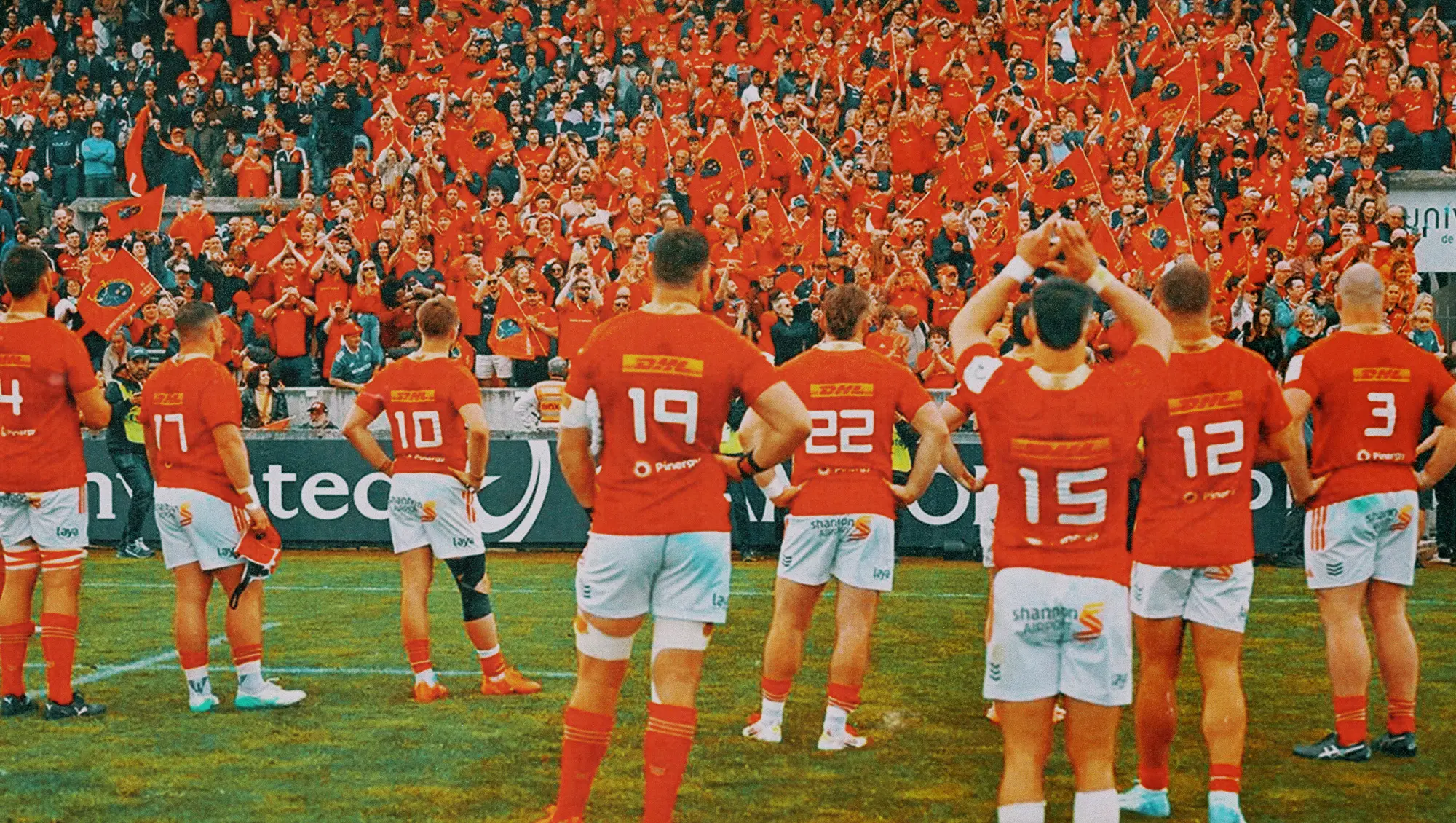
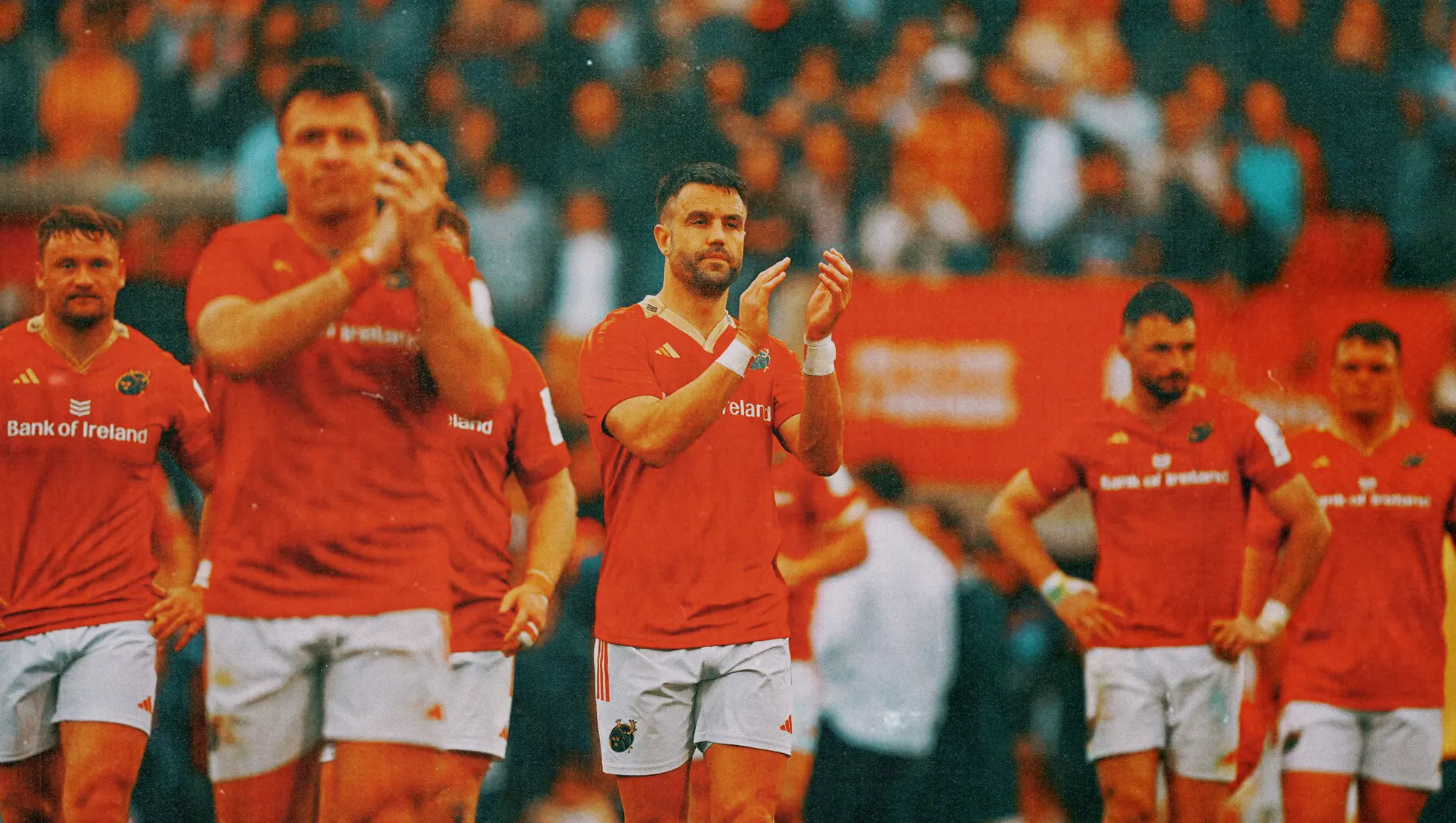
When you lose a knockout game in any sport, introspection is required; almost by default.
How you feel after that introspection almost always comes back to holding up what would be a fair expectation of your ability as a squad to the light, holding up the performance in question in its full context in front of it, and seeing what overlaps. Whatever causes a shadow needs to be fixed.
What do we see after this loss? Shadows, sure, but not as many as we thought.
I think it’s fair to say that Munster were not a top four European-level side at the start of the season – solidly top 15 but not really in the top ten based on recent Champions’ Cup performances – so being at the quarter-final stage is above relatively fair expectations. Does that mean that we were in “bonus territory”? As far as the squad and coaches were concerned, absolutely not. I know a good few subscribers who felt that way, mostly because of the vivid memories of the on and off-field chaos of September and October, but the playing group saw this game against UBB as an opportunity to, obviously, make a semi-final and have a crack at winning that and getting to a final.
And rightly so. They showed against La Rochelle that they were good enough for this level. I had Ronan O’Gara’s side rated as top four, top six in Europe at worst this season, so beating them away from home, even on the bad run they’ve been on, is meaningful. Now, do we have the squad to go deep in both Europe and the URC without one run destroying the other? No, I don’t think we do, and you can even see that in how tired we looked coming into this game after last week’s exertions, but that is a separate thing from our expectations of this game in isolation.
So when we assess the game on those merits, and with that context in mind, all I’m feeling today is frustration.
Munster were more than good enough to win this game but a combination of a thin squad facing a short turnaround back to back in France against super-heavyweight opponents mixed with a lineout disaster on a par with anything you’ll see this season at any level of the game and a lack of composure at key times let it slip.
If it’s a case that Munster were broadly out-classed for 80 minutes, so be it, but that wasn’t the case. Of course, this Bordeaux team are going to score tries – how could they not? The key was how we were able to structure our possession to make this game as difficult as possible for them, and we didn’t manage it. That was, in part, down to their excellent tactical approach hurting us early and often, but we have to look at our response to those tactics too.
Even with all that, this game was there to be won despite being 29-3 down at one stage. We fought back to be within 11 points and playing against a 14 and then 13-man UBB side that looked rattled to an atomic level.
That’s what will stick in the throat this week. As bad as we were for long patches, we still should have won.
Even with a 62% completion lineout, 19 turnovers and two yellow cards of our own.
It was there for us, and we couldn’t grasp it.
The first thing that stands out is a lack of composure in the end game. Sure, we left ourselves too much to do going on the first 20 minutes of the game, but in that third quarter we let UBB back in over and over again.
This restart after pulling the game back to just 14 points was a proper killer. Sure, the ball drifts in the air on this and every single player involved in that lift – Hodnett, Scannell and Kleyn – looks physically drained at this point, but that has to be dealt with better, even with the spill. Getting counter-rucked in that spot to the point we give up a penalty is a self-inflicted wound as much as anything.
But then as UBB’s fitness and discipline started to slip – in conjunction with a lot of their experienced forwards going off – I felt Crowley’s pass quality really fluctuated at key times. A really good pass and line would be followed with a tired looking step and sling. These two dud passes turned into a (wrongly issued) yellow card for Ahern and a try, and an (illegal) counter-ruck that led to UBB’s last try, which killed the game.
Both looked the same – heavy plant, arms shooting up and the ball following. Crowley has the workload of an inside centre and a fullback the way he plays the game, and even though he executed this assist for Smith’s second try perfectly, he definitely looked to be showing the wear and tear of three 80-minute slugfests in a row.
We’re so reliant on Crowley because not only is he the best, most complete playmaker on the island in my opinion, but we become a worse team when he’s off the pitch. So even if Burns was fit – and he isn’t – we’d still need back-to-back-to-back (to back) all-action 80-minute performances from Crowley, and something has to give somewhere.
But, for me, the real damage was done much earlier.
***
Munster’s early season troubles were multi-faceted but by far the most visible and frustrating from the outside looking in was the lineout.
As I wrote in a Wally Ratings from that period;
I think at this stage we’re in something of a death spiral when it comes to the lineout, and it goes back to last season. Teams realised early on last year – and this was mostly due to having multiple senior locks and hookers missing during the middle of the season due to injury – that if you contest Munster’s lineout aggressively, our structures can’t handle the pressure. Go back to multiple games last season and you’ll see it.
The one that springs to mind first for me is the semi-final defeat at home to Glasgow. What was the completion rate there? 75%. And that’s just a number, right? In reality, it’s almost always either momentum lost, territory lost or minutes of hard work down the drain because the set piece that’s easiest to control wasn’t controlled. And sure, you’re always going to lose one or two here or there because the opposition has pulled out a worldie steal – that happens. What doesn’t happen is losing 25% of your lineouts in a home knockout game.
The lineout issues ran so deep that they played a large part in the forwards’ coach Andi Kyriacou departing the province just a short while after Rowntree. Munster’s lineout was objectively awful and had the worst completion rate in Europe at one stage. In truth, it had been degrading year on year since Van Graan’s departure, as Kyriacou struggled to keep schemes fresh or monitor standards as rigidly as they should have been.
Two and a bit seasons of that are not so easily washed away, and while our lineout has improved in leaps and bounds under Alex Codling since late November, the crash of week-to-week games mixed with Codling’s responsibilities with the Irish Women ahead of their Six Nations has been less than ideal.
Ultimately, when the pressure comes on, you are more likely to fall back on your habits, and we’ve had bad habits at the lineout for a lot longer than we’ve had good habits.
I think UBB’s big inspiration for this game was two fixtures from earlier in the season – Leinster in Croke Park and the Stormers in Cape Town – where we had 69% and 57% lineout completion back to back on 12+ lineouts.
In both of those games, Leinster and the Stormers were very comfortable getting the ball off the pitch, giving Munster a lineout platform and then relentlessly competing on almost every throw. It spooked us then, and it spooked us here. In the first half, we had 14 lineouts, and UBB competed heavily on 12 of those, or intended to in one instance where Kleyn was able to drag Petti’s lifter away.
That is an insane commitment to counter-jumping considering they had 12 lineouts of their own across the entire game, and it was mainly done by Guido Petti, who is an explosive half-lock build back five player who they selected specifically in the backrow with the sole role of counter-jumping. He’s down for just three tackles all game and just four carries. His lineout involvements were well into double figures when you consider his work on both sides of the ball.
It was a risky strategy by UBB, but they saw how effective that kind of aerial threat was earlier in the season and made the decision that it was worth pursuing as part of their wider kicking game; it paid off big time. Munster wanted to play on-ball structure rugby to run UBB around the pitch, and UBB wanted to play transition – they knew if they just kicked straight to Munster, we’d deny them the ball they wanted, so they became comfortable getting the ball off the field.
They scored two tries directly off contested lineouts in the first half, which, in a game they won by 18 points, is all the vindication they needed.
At the core of our lineout issues is this: we don’t have a huge roster of jumpers in our usual rotation. UBB would have made a fairly decent guess that our pack for Saturday’s game would be broadly the same as against La Rochelle, with some of the same issues to start with.
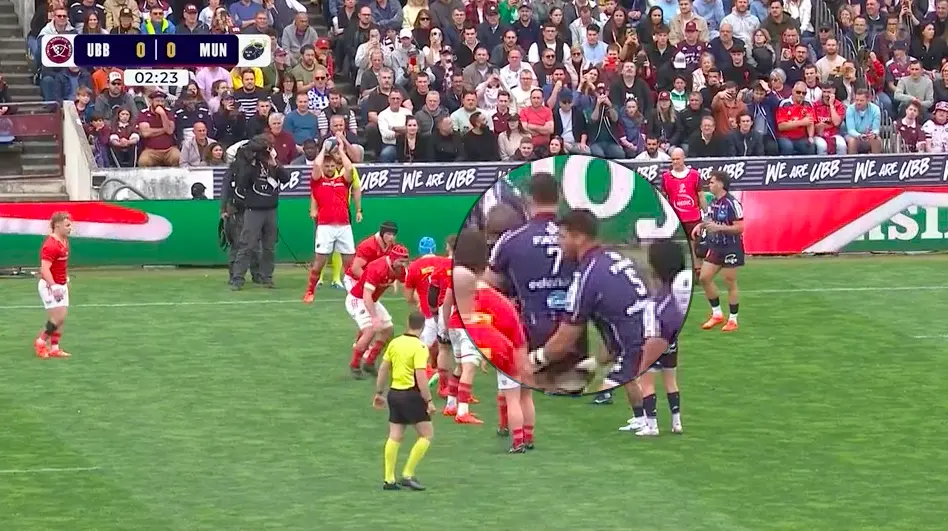
For a start, our primary bail out jumper in our starting pack build is Peter O’Mahony, so UBB tasked Guido Petti with marking O’Mahony in the middle of the lineout, counter-jumping on Barron’s throw.
You can see Petti watching O’Mahony closely here, but that’s just to confirm position – Petti intends to get after the throw as if it was UBB’s, and that seems to spook O’Mahony into fumbling the ball at the top of the jump. Cazeaux is already pre-bound onto Petti from the back right before Barron throws in, and Petti is locked onto the release. He’s not timing it on O’Mahony’s action, he’s timing it on the release of the ball.
After this one, Munster went to a five+one lineout scheme with the intent of stretching out UBB’s counter-jump. With a five-man scheme, you force the opposition to cover 10m of space with just five forwards, which should give you an advantage as you know where the ball is going and where it isn’t. Or shouldn’t.
You can see Petti is planted near the front of the lineout, broadly in line with Kleyn, who would be the base of this lineout. At its simplest, the most basic throw here is Kleyn jumping at that front position being lifted by Wycherley and O’Mahony. This is what Petti is initially guarding.
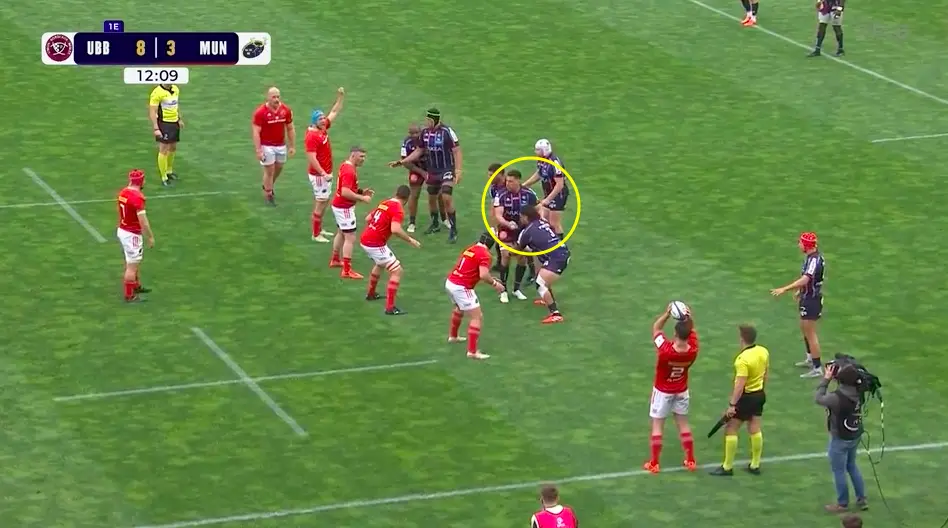
From there, Munster run a two-action decoy; Kleyn slides out of Wycherley’s way to open a lane to O’Mahony with Beirne chasing as the possible back lifter, but then O’Mahony jumps out of the lift to leave Beirne with Jager and Wycherley lifting.
But Petti never looks at O’Mahony or the Munster decoy action – he’s only focused on Barron, with Tameifuna already pre-bound at the front and Cazeaux pre-bound at the back.
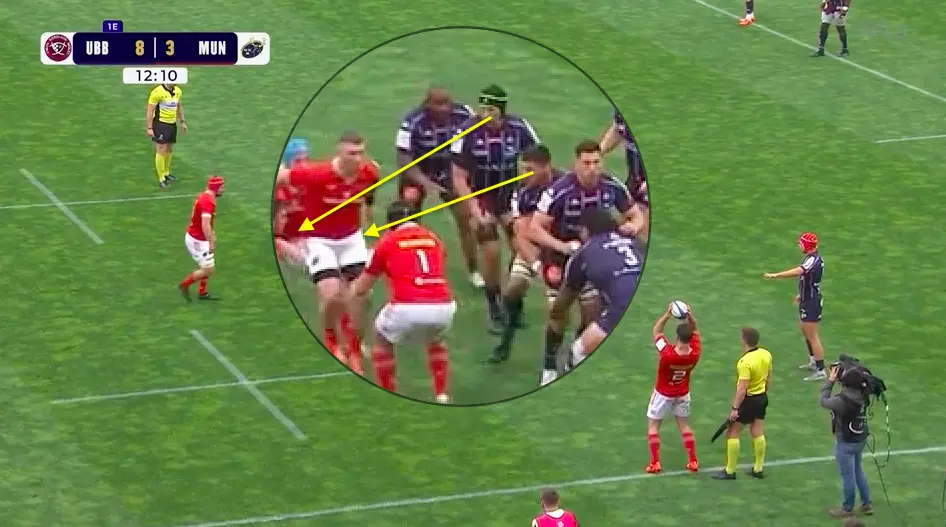
Cazeaux and Coleman are hyper-focused on Munster’s movement to react accordingly, but the intent is to always force Barron to throw over Petti, and Petti is entirely focused on just that. Our lineout scheme here was a little confusing in that we were decoying the timing of the jump and the jumper, not the positioning, so Petti’s focus on Barron was unaffected by anything we were doing. Barron was trying to shorten his throw with a lob profile on it and got under it.
You can see it play out here;
We kept going back to that five-man structure for most of the game and only got clean possession once. Some of that comes down to dud throws, some of it is down to Munster not covering the ground fast enough and some of it is down to incredibly intense counter-jumping at a scale we haven’t seen this season – they went after our lineout for longer and with more sustained effort than any team we’ve played so far.
We needed to get more height on the pitch, and that’s where Ahern’s ridiculously harsh yellow card hurt us – those ten minutes he was off the pitch would have been the perfect time to start turning their kicking strategy in on them.
You can see what I mean when I say we’re not a very tall jumping team. O’Mahony is 6’3″, which isn’t huge for a lineout jumper, but his super-strength has always been his speed over the ground and his explosivity and agility into the air. At this stage of his career, that spring just isn’t there as it was. That’s to be expected – the man is retiring this summer – but it was costly here as he was our primary lineout target.
You can see here on that killer lineout on the 5m line early in the second half that he beats Petti into the air by a fair distance.
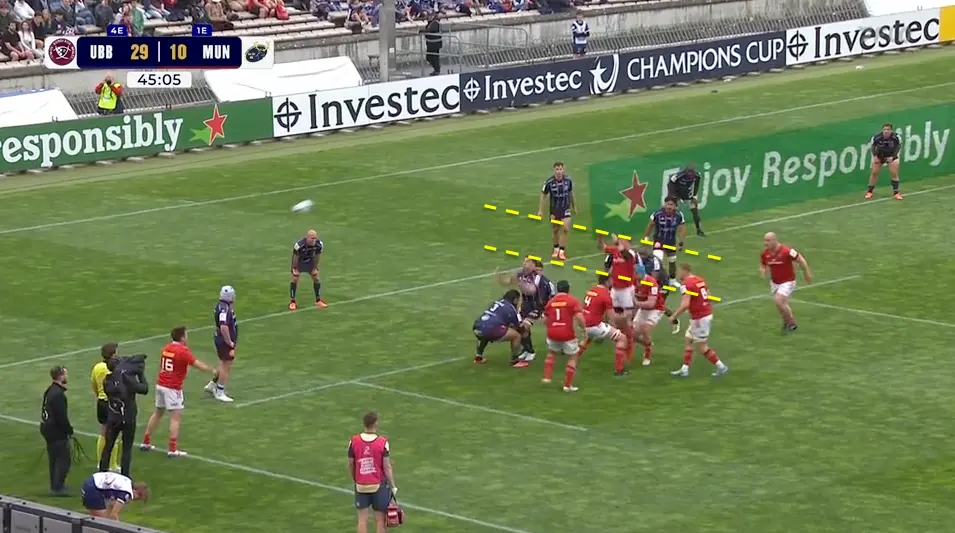
But by the time the ball reaches the catching window, Petti is already above him and O’Mahony’s spring into the air wilts to the right diagonal.
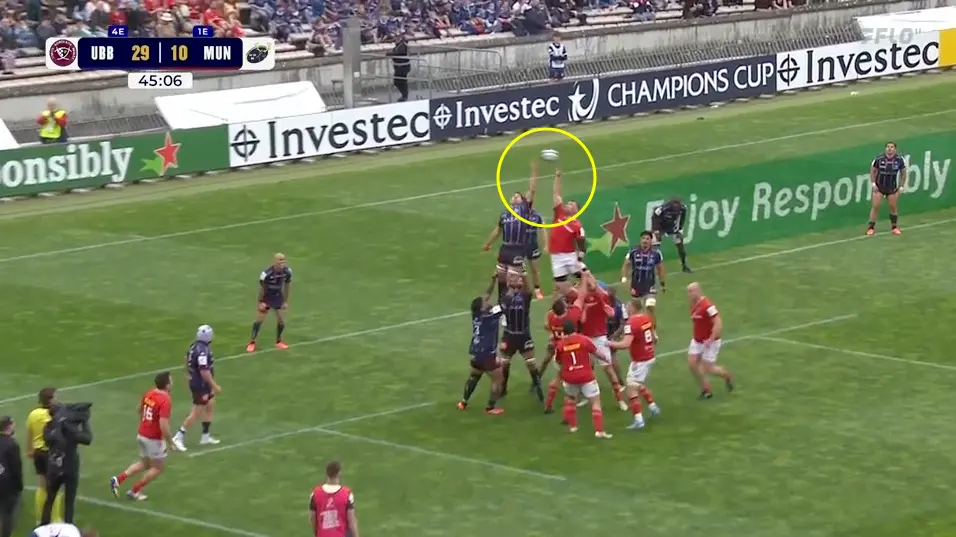
Scannell overthrew the ball anyway, but when your primary guy is under this much sustained pressure, it’s almost impossible to make UBB’s kicking into a pressure valve. Kleyn is 6’8″, yes, but he’s a guy you want jumping habitually so he can save his considerable power for the other areas we usually need it – maul defence, maul offence and scrummaging. Fineen Wycherley is a legit 6’5″, but the size he’s packed on lately has taken a little bit from his top-end jump. Beirne is 6’6,” but he’s not a massively springy lineout target at this stage of his career. Coombes can jump, but his workload elsewhere is so intense that it can overload him to bring him into that role. A lot of “buts” there.
Ahern made a big difference when we used him in the five-man scheme, albeit later in the game when the intensity of UBB’s counter-jump waned – he’s just bigger, taller and longer than our other primary jumpers.
Ultimately, our inability to crack down on our lineout possession meant that we had no way to hem in UBB’s kicking. They kicked freely all game long, and without a functioning lineout in return, we were unable to make possession expensive for them in any way, so the game fell through our hands like smoke.
What’s the solution? A full off-season with a lineout coach who can rebuild our menu from scratch, a little more height in the squad at this level and consistency, consistency, consistency.
And with all that, we still should have been facing a restart with four minutes to go and a one-score game.
We’ll need to rest, reset and go again against a Bulls side that maybe won’t be as lethal on transition as UBB, or as mentally resilient and explosive as La Rochelle, but who will have seen exactly how to attack the fundamentals of our set-piece game.
We’re a good side, albeit a flawed one; now we have to find a way to buff out those flaws and finish this season as strongly as the last three weeks have suggested we can. It’s on us, and that’s where we like it. But now we have to deliver.
| Players | Rating |
|---|---|
| 1. Josh Wycherley | ★★★★ |
| 2. Diarmuid Barron | ★★ |
| 3. Oli Jager | ★★★★ |
| 4. Jean Kleyn | ★★★ |
| 5. Tadhg Beirne | ★★★ |
| 6. Peter O'Mahony | ★★ |
| 7. John Hodnett | ★★ |
| 8. Gavin Coombes | ★★★ |
| 9. Craig Casey | ★★★ |
| 10. Jack Crowley | ★★★ |
| 11. Andrew Smith | ★★★ |
| 12. Alex Nankivell | ★★ |
| 13. Tom Farrell | ★★★ |
| 14. Calvin Nash | ★★★ |
| 15. Thaakir Abrahams | ★★★ |
| 16. Niall Scannell | ★★ |
| 17. Mark Donnolly | ★★★ |
| 18. Stephen Archer | ★★★ |
| 19. Fineen Wycherley | ★★★ |
| 20. Tom Ahern | ★★★ |
| 21. Conor Murray | ★★★ |
| 22. Sean O'Brien | ★★★ |
| 23. Alex Kendellen | N/A |
