


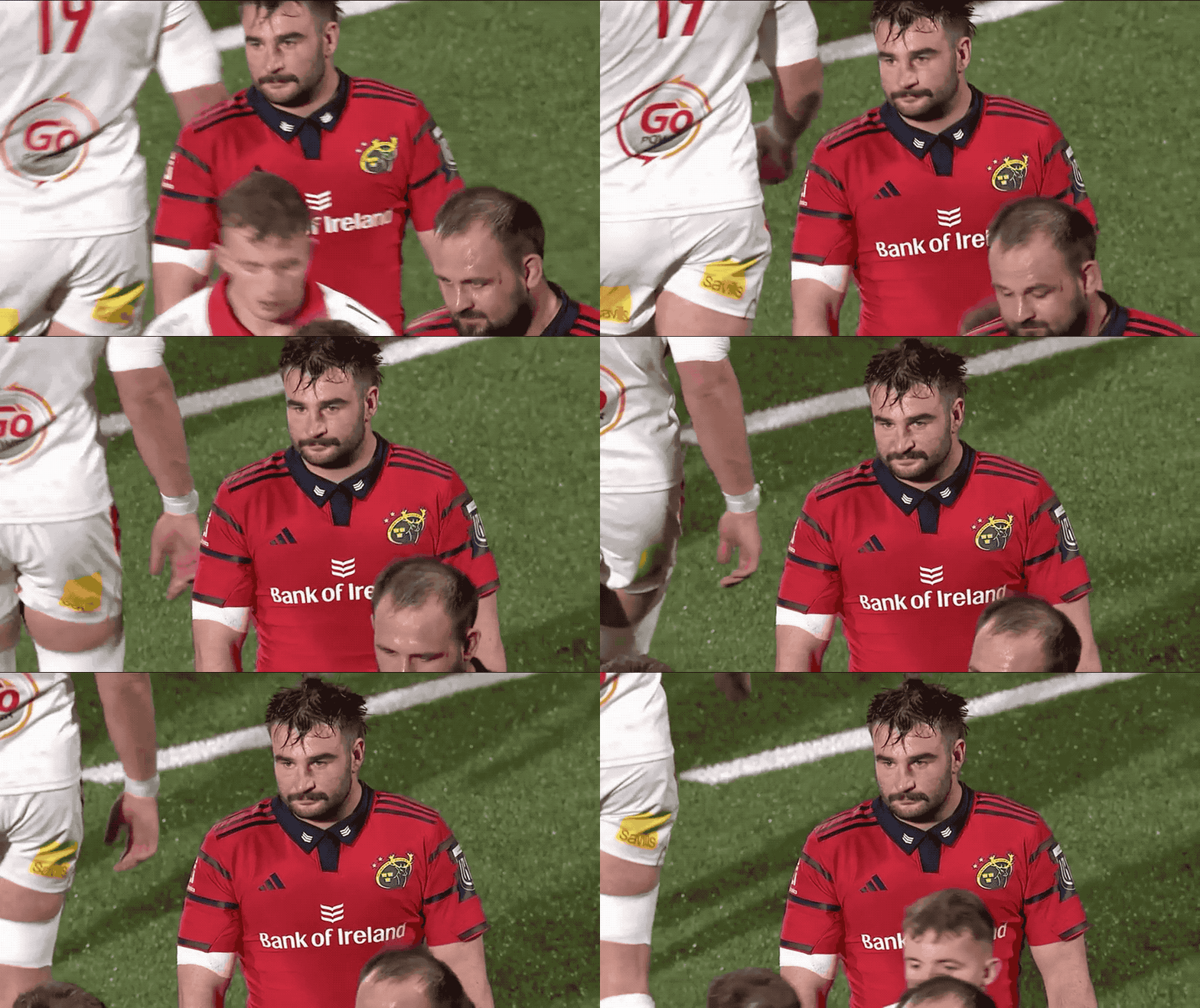
On the one hand, I’d have taken a losing bonus point here, given our struggles on this ground last season and away from home in general since the start of last season.
On the other hand, I was thinking about all five points at half-time, even with 15 minutes to go.
In the end, I’ll settle for three, just about, but make no mistake — this was a game we let slip. Frustrating, maddening, encouraging, heartening; I can’t quite make up my mind how I should feel. Maybe it’s all four of those things.
Last season around this time, we scraped our way to wins that would later become losses, because the fundamentals of our game weren’t solid. This season, we arguably should be three wins from three, with 15 points in the bank, if not for two late collapses, yet the fundamentals of our game look infinitely better.
That juxtaposition intrigues me most.
I think it’s inarguable that we look like a better side than we did last season already. We’re in the midst of a nightmare run of fixtures and, in those same fixtures last season, we earned 3 match points. This season, we have 9 points, while plainly still building core elements of our game, all without key guys like Crowley, Edogbo, Nash, Ahern (for the most part) and a few others who are in and out with knocks. That’s a big positive.
But.
It doesn’t make coughing up a 26-5 halftime lead any easier to stomach.
First, how we lost the lead, as that’s probably freshest in your mind.
When you’re defending a 21-point lead for 40 minutes, you have two things that can help you see out the game by default. Time and mental space.
When you’re three scores up, you don’t need to chase the game in the way you normally would, which can sometimes lead to the kind of discipline errors that kill you this season more than most. When you’re three scores down, you need to find something quickly, and the longer it goes without a starting point for the comeback, the harder it is to, realistically, get back into the game without a yellow card, an opposition implosion of some kind, or a few big decisions back to back.
From our perspective, you can kick more when you have a three-score lead, put the pressure back onto the opposition and, if you’re accurate in your defence — no need to risk offsides or messy rucks — with a good set piece, your opponent will spend five-minute blocks going nowhere until the time runs out.
Keeping Ulster scoreless for the first fifteen minutes of the second half was a key part of managing that time. Three converted tries in 25 minutes — in reality, the ball is in play for much less time than that — is a difficult ask. Two tries in 25 minutes is more manageable, especially at home with even a hint of momentum.
For us, it was about denying that momentum.
We did that pretty well, until we didn’t. This was the key moment in the endgame, with around 15 minutes left. Ulster hit up through the middle; we got a decent stop and covered well on the reverse play, but Hanrahan was a little slow on his transit from guarding the middle pin to the right edge, and Benson’s kick — which should have been guarded as it entered the 22 — ran onto the 5m line.
Clein’s lineout — his first moment off the bench — came out of his hands wrong and went crooked. That gave Ulster a 5m scrum, and they converted it.
Even then, that lineout position came from a moment of overplaying that we didn’t really need to chase as hard, which gave Ulster momentum and belief.
We did everything right here, up until a key moment on the transition release.
I know what we were chasing here — the killer score with space on the edge — but I think, in context, this one needed to be kicked down into Ulster’s 22.
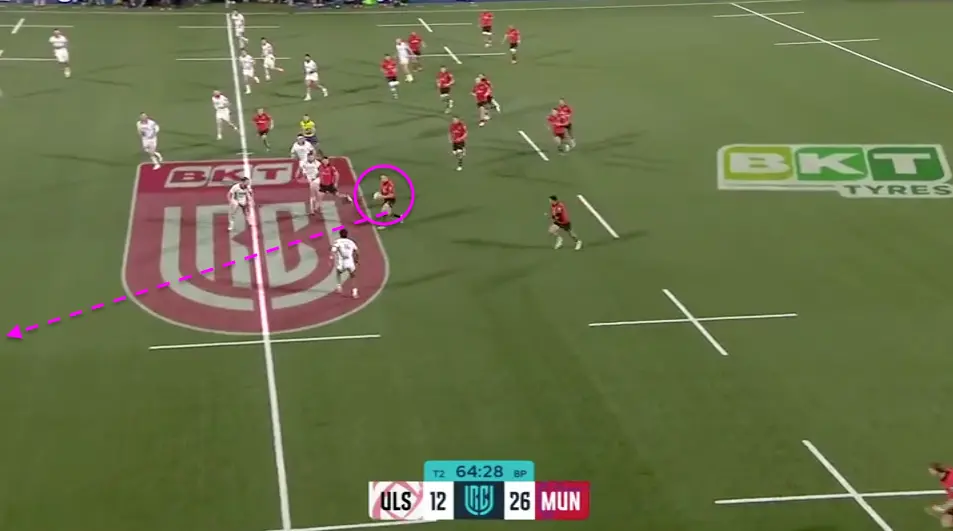
We didn’t really need to go chasing this moment. Pin Ulster in, make them exit, block out another five minutes of the clock.
In the last ten minutes, we had the position we needed to win the game with a bit of patience.
Foy and Gleeson choked up McCloskey in the Ulster 22, and we had a scrum position that should have either won us the game there and then, or blocked out five minutes to squeeze Ulster in their own 22.
We lost patience.
We had the put-in, Ulster under pressure all game long, eight minutes left. We didn’t need to chase this one, but we did. Wycherley kicks his hips out chasing McAllister as Ulster wheel around, but the ref is on our loosehead side, so he looks illegal.
Penalty.
If the ref is on the other side, this one arguably goes the other way — or gets reset, which would be a win in itself — but a clean penalty gave Ulster what they needed. Momentum and position.
A ball slapped out of their hands at the next lineout gave them another cheap penalty ladder up the field, and from there it was about holding them out.
Two mistakes followed.
- Wycherley shoots out on McCloskey and misses the tackle, taking him out of the next phase.
- We choke up McCloskey, but that gives Ulster the chance to drive 3 on 2 to the 5m line. It was almost another choke turnover, but the ball came back, and Ulster were deep in the red zone.
At that point, you were reliant on a big play on the tryline or an Ulster error — we got neither. Tied game.
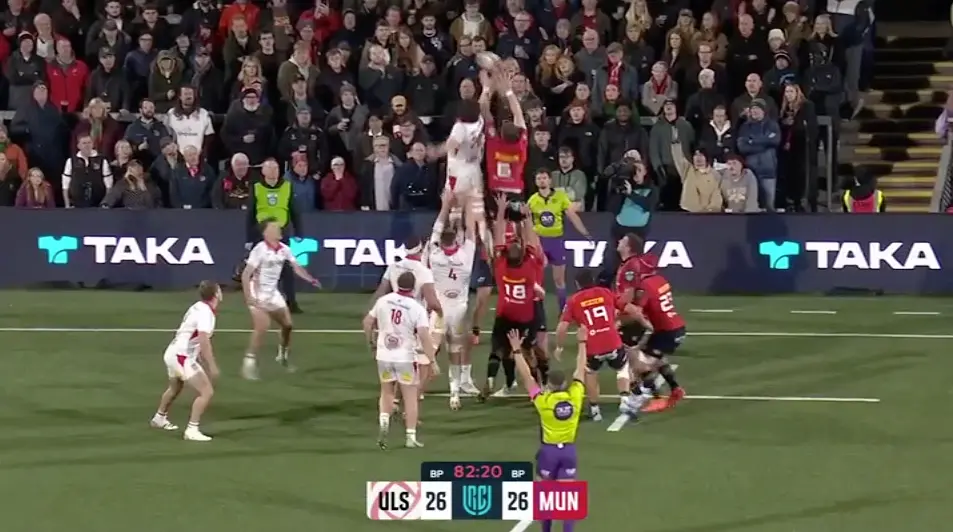
We had another chance to win it with a late scrum penalty, but we were scragged in the lineout, and that was that.
The penalty was right in the 5m tram, so getting any distance on it would be incredibly difficult, but being just inside the 10m line instead of being inside the 22 meant Ulster were always going to contest the jump.
We went to the front to make life easier for a rookie hooker who’d missed a few throws already; Ulster got up ahead — it wasn’t a good lift by us at the front anyway — but they had to go on the release, we had to feint it, so it was always going to be contested.
This is where a guy like Ahern would be invaluable off the bench.
But, in reality, we lost the big moments that we needed to win to see off Ulster with a two-score lead for the key period. They have made a habit of rallying late in games this season so far, and last season against the Stormers and Glasgow. They are a momentum and moments team, and we didn’t do enough to hold them out.
In the first half, we did absolutely everything right.
Ulster have struggled in the maul and scrum, and that’s exactly where we went after them. Before the game, I wondered if we could turn our expected scrum dominance into something tangible, and we did all of that and more — with some maul dominance added to the pile.
That was the basis for our first-half dominance. We absolutely pumped Ulster in the scrum for pretty much the full 80, so it gave us chances to move up the field and pressure them over and over again. In the second half, that dominance remained; we didn’t get the scrum position to force it.
Our phase play lacked penetration at times. Partly due to Ulster’s defensive system — they fill the field and stand off rucks, so your contact work on back-to-back phases is crucial, as is pace on the tramlines — but I would say, one, we’ve moved to a new system in the off-season, so it still needs time to bed in properly, and two, Ulster’s particular strength with McCloskey, in particular, is defensive dominance on carries that hit the line after #10. What that does is force a slowdown around the point where you’re looking to release into your layers in either 3/4 space.
Three players in the modern game provide that obstacle: Damien De Allende, Andre Esterhuizen, and Stuart McCloskey.
When you combine that with a guy like Timoney, who will max out tackle workload all night, you can see how it might be stickier than normal, especially without a running threat at #10 off your set piece launches — you end up falling into McCloskey’s gravity more often than you’d like.
You can “hack” it with killer pace on the edges, but we didn’t really have that on the night. Even so, I thought we retained the ball well and had some sequences, but our scrum and maul dominance was the killer feature of that first half.
I think it’s fair to say we haven’t quite seen the best configuration of this team as of yet this season, as a full matchday 23. That will arguably be true until Jack Crowley is back at #10, whenever that might be. That, as much as anything, was the defining issue of this game. A little bit more depth, a little bit more control, some better options, and we win. We didn’t have those, so we drew.
These three points will look a lot better in January, of course, but they feel like scant reward after being 26-5 up at halftime. That is the big work on — finishing strong. It caught us against Glasgow; it caught us here; it can’t catch us this week against Racing 92.
Of course, just because it can’t doesn’t mean it won’t. Finishing strong is rarely about S&C. In both instances this season, it’s been finishing with a less seasoned or weaker team (not the same thing) than you started with, especially against good opponents, which we’re almost exclusively playing in this first block of the season.
It’s worth spelling out how loaded this run actually is, because it’s easy to lose sight of when you’re stewing over a lost 21-point lead.
Glasgow at home. The Bulls at home. Ulster away. Racing 92 in Europe. Leinster away. The Sharks at home. That’s six games before we go quiet until Zebre in December, and five of them are against sides you’d call genuinely good. When I ran the schedule in the summer, Glasgow, the Bulls and Leinster came out as three of the four best teams in this league, and all three are in our first four league games. The Sharks were supposed to be the soft landing at the end of it, but they’re top of the table, and they’ve already beaten Leinster in Durban (only the second time they’ve ever done it). Sure, they probably won’t have many of their internationals, but that’s the Sharks in a nutshell. Awful one season, great the next, albeit with their first trip outside South Africa to follow.
So yes, it’s a hard block. That’s not an excuse; it’s just the shape of it. Things have been, and will stay, quite difficult for a while yet.
That’s also what makes Saturday sting. Ulster away was the one game in this run that the numbers had down as a win. We led 26-5 at the break and came home with three points. Now, three is three more than we took out of Belfast last season. On a cold read, a try-bonus draw away at an interpro is a perfectly respectable return.
But it’s one or two short of what a top-two campaign budgets for that fixture, OK for a top four, and the first half told you the win was there. It’s a good result off a bad forty minutes, but it’s the bad forty minutes that we’ll be stewing over.
It’s good. It’s bad. It’s grand. Ask me in January how I feel about it.
| Players | Rating |
|---|---|
| 1. Jeremy Loughman | ★★★★ |
| 2. Marnus Van Der Merwe | ★★★★★ |
| 3. Kieran Brookes | ★★★★★ |
| 4. Evan O’Connell | ★★★★ |
| 5. Tadhg Beirne | ★★★ |
| 6. Jack O’Donoghue | ★★★ |
| 7. Alex Kendellen | ★★★★ |
| 8. Gavin Coombes | ★★★★ |
| 9. Craig Casey | ★★★ |
| 10. JJ Hanrahan | ★★★ |
| 11. Sean O’Brien | ★★★ |
| 12. Dan Kelly | ★★★ |
| 13. Alex Nankivell | ★★★ |
| 14. Shay McCarthy | ★★★ |
| 15. Ben O’Connor | ★★★★ |
| 16. Max Clein | ★★ |
| 17. Josh Wycherley | ★ |
| 18. Jack Aungier | ★★★ |
| 19. Michael Foy | ★★★★ |
| 20. Brian Gleeson | ★★★ |
| 21. Ben O’Donovan | ★★★ |
| 22. Charlie O’Shea | ★★★ |
| 23. John Hodnett | ★★ |
Notes:
Max Clein had a tough one off the bench at the lineout, but there’s a bit of context for that one. With Barron being something of a late scratch for this game, Clein was always going to be under pressure for his debut away from home, especially off the bench. When he came on, his first action was a pressure throw on the 5m line, which came out of his hands crooked. I felt that, at times, we didn’t call the kind of lineouts that would have helped him into the game. He looked good around the field, though, and that’s something to build on.
Jack O’Donoghue had a solid game here but, at times, I think some of the limitations of his game were visible. He’s a bigger, more physical player at this point of his career, and sometimes that leads to him getting caught on the edges of the defensive line while being under pressure at the lineout as it goes deep. A very valuable player to have, but arguably for 50/60 minutes, or off the bench.
Michael Foy was also a late call-up to the squad, and while, sure, you’d miss the impact of a Tom Ahern or an Edwin Edogbo off the bench, Michael Foy was genuinely really good in his first appearance as a pro, to the point where it didn’t really seem like he was making his debut at all. There’s an excellent player there, and every minute he gets this season will accelerate him towards that.
I rated Josh Wycherley quite poorly for this game for two reasons: one, kicking out on that scrum and two, for that missed shot on McCloskey up the other end of the field. His last two appearances off the bench haven’t been strong, but there’s a good player in there — as the scrum penalty right at the death showed. Wycherley’s big strength has been his mobility and all-round game, but our focus in the off-season seems to have been scrum first and second, with lineout and maul third and fourth, so if he’s to turn this season around, it has to be there first and foremost.
Marnus Van Der Merwe wasn’t someone who many people knew all that much about when he signed. That’s not unusual, though. To the general public — and 99% of the media — a “good signing” is almost always someone you know offhand, even if that player doesn’t necessarily fit what you need. Marnus Van Der Merwe was, as he has shown in his games so far, exactly the player we needed in the spot we needed him. He was the dominant forward on the field here, and showed exactly why he was in the frame for the Springboks as the 1B to Malcolm Marx. He was outstanding.
