



Gah.
You know the feeling. All too well, perhaps. The win was there, until it wasn’t, and we’ll be drinking from the bitter barrel for a few days as we digest how this game got away from us.
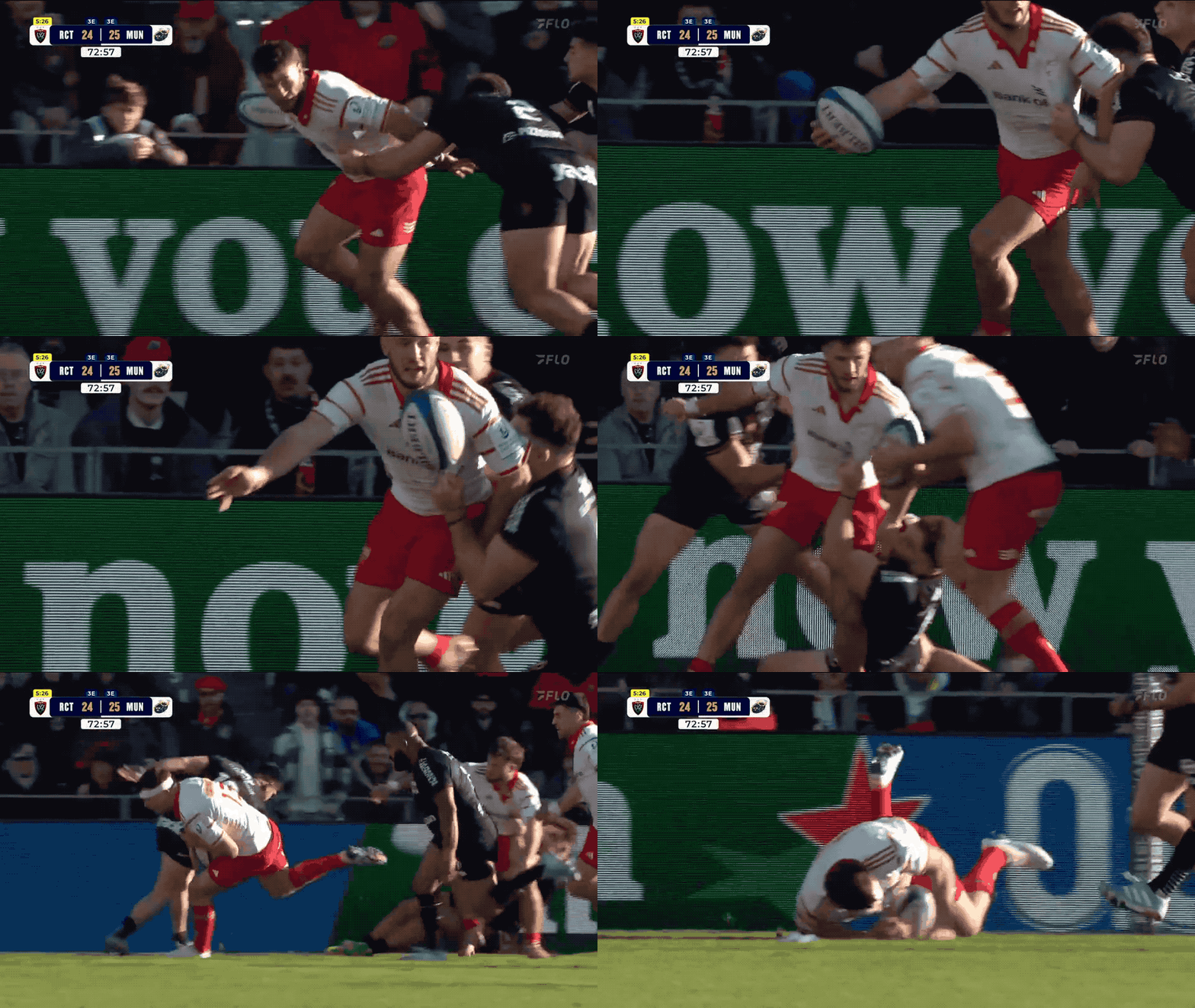
Sure, there’s the penalty at the end — that ultimately won it for Toulon — that enters into “highly debatable” territory, but the truth of it is that we were a point up, with the ball in our hands in the 73rd minute, and we let the game slip from there.
Six minutes is a long time in this sport, but we’d been defending really well to that point and, for me, if Toulon started the next phase on the 10m line or beyond, we probably win. Instead, we did incredibly well to hang onto a losing bonus point from a position where we had somehow clawed our way back to what seemed like an unlikely win.
Three sequences defined the contest for me.
The 15 minutes right before halftime from Beirne’s yellow card until Toulon’s third try in the 50th minute, and everything that happened in the last five minutes.
First, the basics; this kick had to go 30m up the field to touch. Instead it went around 8m.
Whatever about anything else, that gave Toulon position to work with and well in range of a kickable penalty.
Second, the choice to hit the outside man — Ruadhan Quinn — on this pod, sending him into a two man isolation with the ruck support out of position.
Penalty turnover. Win gone, and the very real possibility of leaving with nothing, until Jack Crowley, Dan Kelly and Ruadhan Quinn came up with a huge defensive play with the clock in the red to keep the possibility of finishing second, with a home knockout game as a prize, alive.
If, should the right confluence of events transpire, we end up playing in Thomond Park this Spring, we have this moment to thank for it.
It’s easy to lose yourself in existential dread after a narrow loss like this. To get lost in what might have happened, or what an ideal version of Munster from the 2000s might have done, or what the Munster of the future could do, but we lost a narrow game that we did just about enough to win. It stings. It’s frustrating. On Instagram, after the game, a deeply frustrated Munster fan messaged me off a story reply and said, “I’m sick of these moral victories.”
I’ll copy and paste what I said back to him.
Raging against a “moral victory” would imply that anyone is claiming that. Sometimes you just lose. You can play well, mostly, do most everything right, and still fail because of a few daft mistakes and a debatable penalty, and that’s it.
This isn’t “we lost, but we won.”
It’s just “we lost”.
And now we have to deal with what comes after against Castres next week.
Efficient Until We Weren’t
Our underlying profile is the one you normally associate with a strong European away day: kick more than the home side, defend for long stretches, and be ruthlessly efficient when you finally get entries. We did two of those three well. The two-point loss came from the margin layer: discipline, lineout stability, and one missed conversion.
The match was decided by margins, not tries
Both sides finished with identical headline scoring:
- 3 tries each
- 2 penalty goals each
- The difference: Toulon 3 conversions, Munster 2 → +2 points, the final margin (27–25).
That’s the harshest truth in the dataset: we were one conversion away from winning in Toulon. That’s the blunt headline on it, and the kick from the corner was incredibly difficult, but if we’re just talking about numbers, that’s a differential.
Munster were the more dangerous team when we had the ball
Despite having far fewer rucks and carries, Munster created more linebreaks.
- Munster: 49 rucks, 5 linebreaks
- Toulon: 109 rucks, 4 linebreaks
Linebreaks per Ruck (LBR)
- Munster LBR: 5/49 = 0.1020 (10.20 per 100 rucks)
One linebreak every ~9.8 rucks - Toulon LBR: 4/109 = 0.0367 (3.67 per 100 rucks)
One linebreak every ~27.3 rucks
That is a massive efficiency edge. It tells you we weren’t “hanging on”; we were striking when we got into the right areas, and why the poor exit at the end was so punishing. Toulon weren’t creating linebreaks at a rate we couldn’t handle, so the further away they were from our 22, the more likely we were to force a turnover or a mistake that would have won the game.
Red-zone efficiency: Munster were clinical, Toulon were blunt
This is the other big Munster-positive.
- 22m entries
- Toulon: 11 entries, 1.9 pts/entry
- Munster: 6 entries, 3.1 pts/entry
Two things can be true at once:
- Toulon had more access (11 entries) — largely because they had far more rucks, carries, and lineouts.
- Munster were far more ruthless once we got access.
Toulon lived in our half, but we did more damage per visit. All of that scans with an away win, so when I say that we did most everything right, it’s this.
Why did Toulon get 11 entries to our 6? Access mechanics
They controlled possession through tempo
- Ruck speed (0–3 sec): Toulon 79% vs Munster 66%
- Ruck speed (6+ sec): Toulon 3% vs Munster 19%
Toulon had quick ball all day, primarily because we didn’t really contest the ruck at a high volume. Our tackles were almost all two-man stops with a high tackle profile to stop the offload, and we were broadly successful in that. On our ball, we were forced into slower, more physically expensive rucks when we did have possession — exactly the kind of pattern that limits entries and forces you back to exits, on top of a few dud lineouts.
The lineout was the single biggest platform problem
- Munster lineout win%: 64% (11 taken)
- Toulon lineout win%: 100% (16 taken)
At this level, 64% is a critical failure point: you lose attacking launches, you compromise exits, and you give the opponent extra possessions in the zones that matter. Looking back at it, most of the lineouts we lost were marginal — Toulon jumping across, a jumper missing a throw window, and some excellent Toulon counter-jumping, on top of our “height” being drastically reduced by Kleyn and Ahern’s absence.
The defensive performance was good enough to win — until discipline flipped the ending
Munster defended a huge workload:
- Tackles made: Munster 203 vs Toulon 77
- Tackle completion: Munster 92% vs Toulon 89%
That’s an excellent away defensive efficiency (92%) under sustained pressure. We also edged the turnover count:
- Turnovers won: Munster 8 vs Toulon 7
- Turnovers lost: Munster 15 vs Toulon 17
So why lose? Because we lost the penalty battle:
- Penalties conceded: Munster 14 vs Toulon 7
That’s the match-management killer. When you’re defending 200+ tackles, you cannot also be the team conceding twice the penalties — because the final 10 minutes becomes inevitable: territory, pressure, whistle.
Toulon had 80% possession in the last 10 minutes, and they converted that into the late scoreboard swing. In truth, we did well to deny them a winning bonus point while maintaining our own losing one. Two big moments stand out — Beirne’s jackal under the posts, and Nankivell’s rash swipe at the ball in the ruck. Nankivell’s one is undefendable.
Beirne’s was more costly, but I get what he was thinking.
Beirne rolls the dice here that the Toulon player is off his feet — so there’s no ruck — but Carley shouts “NO! RUCK!” right as Beirne actually grabs the ball, so there’s nowhere to go for the referee except to issue a yellow card.
I get it, but it was still costly.
The game plan was coherent — and almost worked
Munster kicked more and played more pragmatically (classic away day template):
- Total kicks: Munster 30 vs Toulon 25
- Kick-to-pass: Munster 1:3.6 vs Toulon 1:7.9
That aligns with the tackle counts: we were prepared to play without the ball and strike off limited possession. The issue wasn’t the concept; it was the supporting detail:
- lineout stability (64%),
- penalty count (14),
- and one conversion.
This was an away performance built on defensive resilience and attacking ruthlessness — Munster scored 3.1 points per 22 entry and produced a linebreak every 10 rucks. That’s exactly what we needed to do! But Toulon owned the “access” layer at key points. When it mattered, they had dominant lineout control and a decisive discipline edge (14–7 penalties). In a game where most things were equal, the outcome hinged on individual errors at vital times and a debatable penalty.
That’s the long and short of it.
Offensively, this was as good as we’ve looked for several weeks.
We looked punchy on turnover — two tries directly from turned over ball — and really dangerous off our scrum, which was stable and secure as it has been in, well, several weeks. That isn’t nothing either; Toulon have the best defensive scrum we’ve faced all season, and it was a complete non-factor. In fact, we won two penalties off them on our own put-in.
That allowed us to get our strike plays into gear, and we looked really accurate, pacey and dangerous. One was a try, one should have been.
The first one is a really nice design. Nash starts as an inside pass option to hold White, before arcing behind Crowley and Nankivell to take a screen pass before scorching into the space to release Farrell. A little more pace at #13 and maybe #15, and I think we score this one.
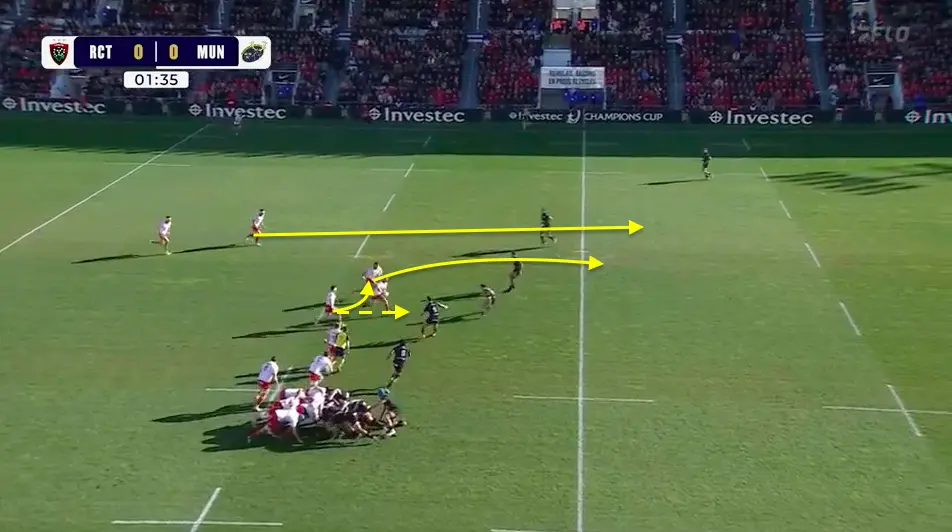
Our first try was a nicely put-together two-phase strike play. Nankivell trucks the ball up and gets good gainline. Edogbo and Beirne scorch around from the scrum — also look at Coombes trying to halt the progress of Gros at the ruck — and it’s Edogbo’s gravity that holds three defenders on the inside of the ruck.
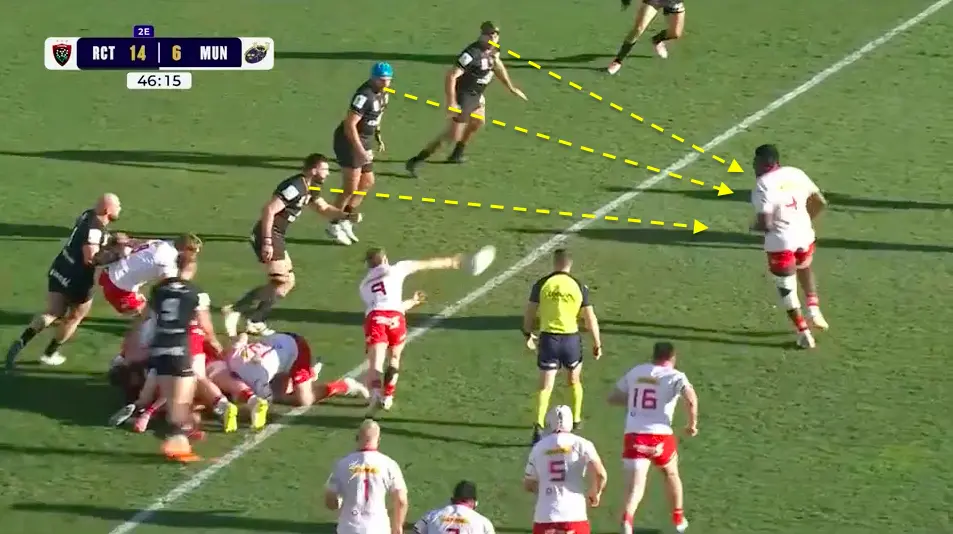
Beirne’s excellent animation for the ball draws in another two defenders, and Casey’s outstanding pass to Crowley is exactly what was needed to crack open the defence.
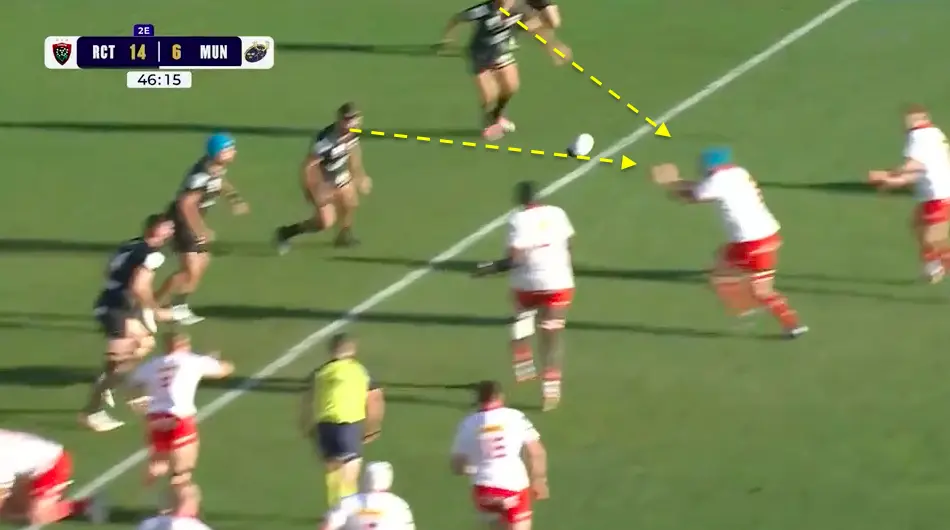
O’Connor comes around on the loop, goes through the gap and sends a killer pass to Nash for a try that got us right back into the game.
That shows what we can do with stability and a platform. The only concern is that it seems when we “fix” one thing — the scrum in this game — our lineout takes a hit. When we get both in the same game, we’ll be going places.
Our short kicking game was super effective here, too. We took a gamble that, if we kicked short, we’d stifle Toulon on transition and get our defence — which has been verging on elite for linebreak suppression all season — into gear right around the drop of the ball.
Kicking long would bring Toulon’s own high-volume kicking game into gear. We knew that they would kick after one or two phases, and that they would kick long when they did. By kicking shorter, we held them in for a few extra phases of tidy up, drained them a little — we almost took full advantage of this in the last 15 minutes — but we hemmed them in well in general.
When the knock-ons from that approach game, we held them out at the scrum really, really well, and Toulon did what we expected. Took one or two phases off the strike, and then kicked back.
Our really strong opening 30 minutes were entirely based on this concept, and it helped us get back into the game late on, too.
What we would have done for an exit like this in the last five minutes.
My main takeaway after this game is that we’re still a way from where we need to be, both this season and in the grand scheme of where this squad will hopefully go over the next few years.
A lot of that comes back to depth — we don’t really have it, and we need it, at #9, arguably in the back three too, and a sprinkling of top-end quality in the front five to augment what we already have. We knew this coming in, we knew it during the game, we know it now.
That doesn’t change the disappointment. We got one point, we deserved four. The reasons for that are pretty clear, but we’ll have to bandage those weak points up and go again.
Before the game, a lot of people asked me about this being a response to the Ulster game, but that was never really an issue for me. The loss to Ulster was a diabolical performance, without question, but I knew we’d be better here because everything about that game in Ravenhill looked like an aberration. An 80-minute version of those bad 20/30 minutes we’ve produced away to Bath and at home to Stormers, and even what we showed here in the first 10 minutes of the second half.
That, to me, shows a team that are getting a crash course in what works and doesn’t work in our current setup against good sides. Stormers, Leinster, Ulster (certainly at home and loaded up) and Toulon are all good to great sides. That crash course can be painful. It can be frustrating. But the key part is that we take the lessons on board; what’s working, what’s not, who’s working, who’s not, and who might improve what we’re doing next season and beyond.
Wally Ratings
| Players | Rating |
|---|---|
| 1. Jeremy Loughman | ★★★ |
| 2. Diarmuid Barron | ★★★ |
| 3. Michael Ala'alatoa | ★★★ |
| 4. Edwin Edogbo | ★★★★★ |
| 5. Fineen Wycherley | ★★★★ |
| 6. Tadhg Beirne | ★★★ |
| 7. Jack O'Donoghue | ★★★★ |
| 8. Gavin Coombes | ★★★ |
| 9. Craig Casey | ★★★★ |
| 10. Jack Crowley | ★★★★ |
| 11. Ben O'Connor | ★★★ |
| 12. Alex Nankivell | ★★★ |
| 13. Tom Farrell | ★★★ |
| 14. Calvin Nash | ★★ |
| 15. Shane Daly | ★★★★ |
| 16. Niall Scannell | ★★★ |
| 17. Michael Milne | ★★★ |
| 18. John Ryan | ★★★ |
| 19. Ruadhan Quinn | ★★★ |
| 20. Brian Gleeson | ★★★ |
| 21. Ethan Coughlan | ★ |
| 22. JJ Hanrahan | ★★★★ |
| 23. Dan Kelly | ★★★★ |
Star Rating Key:
★★★★★ — Outstanding performance.
★★★★ — Very good performance
★★★ — Decent performance
★★ — Below par
★ — Poor
Performance-wise, this was really good for the most part. I’ve rated Ethan Coughlan down for this one because there were two costly mistakes — one more than the other — and it was well below what we’ve seen from him this season in general, even allowing for the fact he was a late call-up to the bench. He’s a decent young player, and he can absolutely bounce back from this five-minute cameo.
We had a lot of four-star men, and the pick of them for me was Jack O’Donoghue, who looks like a player reborn this season in a role that really suits him. Our #7 role really suits what Jack O’Donoghue does really well — he’s a decent carrier, a big body at 6’4″ and 110kg plus, and with a natural lineout game — and he doesn’t stop working. He was top tackler for us here, and more than a little unlucky on some of the decisions that went against him.
Also, a shout-out for our starting and finishing front row; they had a job to do, and did it really well for the most part, even if Ala’alatoa will be a little disappointed at how easily he was taken out beyond the ball by Sinckler for Toulon’s third try.
The stand-out Munster player, for me, was Edwin Edogbo. He is everything we thought he’d be and more.
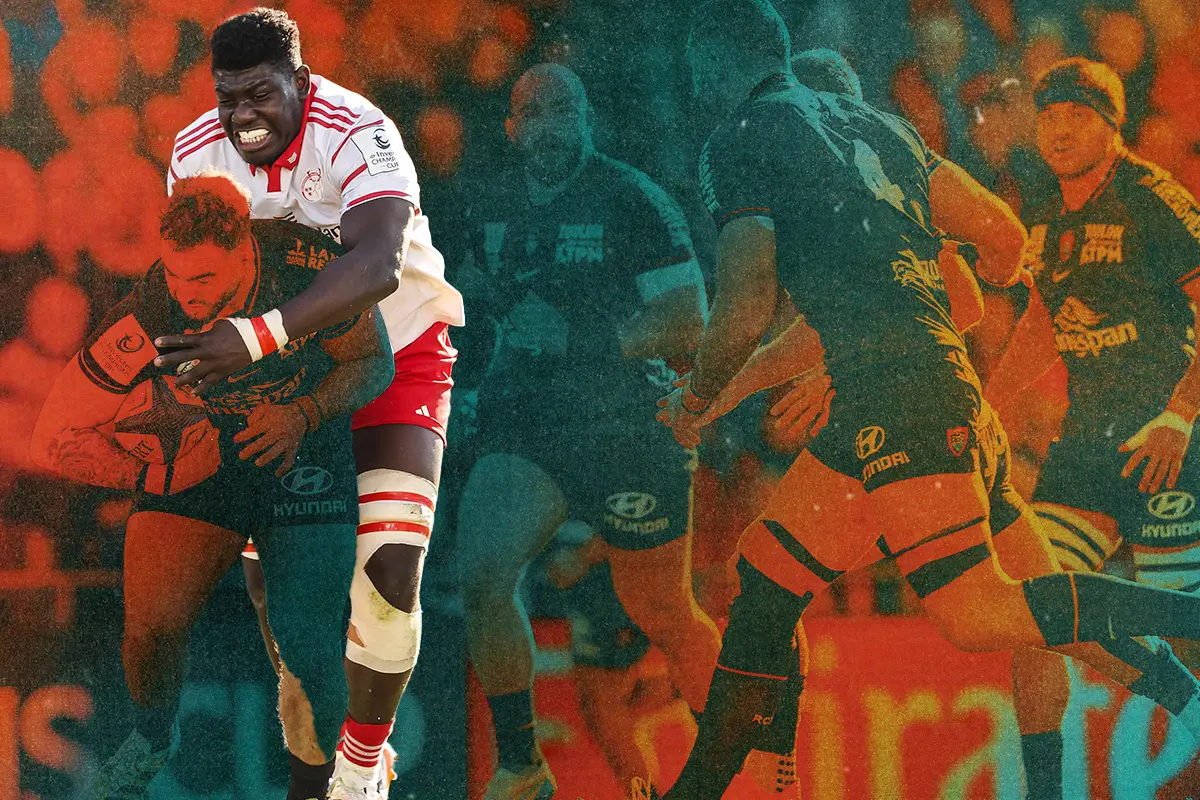
When he’s on the field, we look bigger, more physical and play with more gravity. Defensively, he’s an incredibly dominant stopper who turns regular tacklers into choke hold ups with freakish ease, can jackal like someone stuffed two Tadhg Beirnes into an overcoat, and when he gets on the ball, he’s harder to stop than climate change.
In the maul, he’s a heavy, dominant presence on both sides of the shove but especially on the defensive side at the moment and he was a core part of our scrummaging in the first half when Toulon were at their freshest — he’s learning to scrummage high, and that means he’s pulling together some of the more difficult tighthead lock roles.
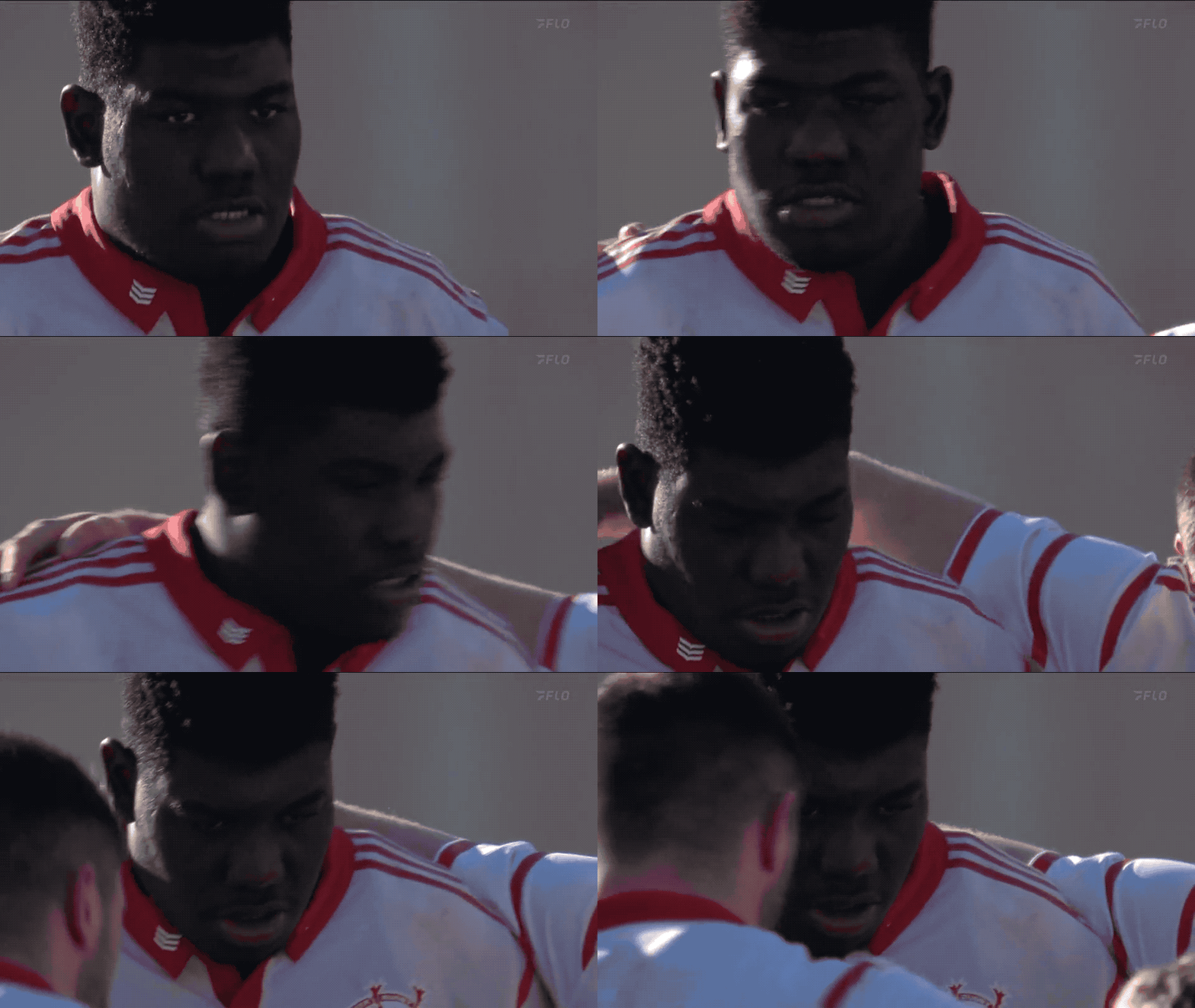
He’s a superstar in the making. ★★★★★
