


My guilty pleasure is real-time or turn-based strategy games like Civilisation (1, 2 or 3 exclusively), Sid Meier’s Alpha Centauri, Command & Conquer or, most recently, Stellaris. They scratch that itch that I seem to have to keep several hundred plates spinning simultaneously as if running this website isn’t stressful enough. I’m a sucker for punishment, basically.
One of the key things in these games is resources; they are ultimately what you fight over to control so you can expand your empire and conquer. If you get a good start in these games, you’ll be near a tonne of natural resources that you can easily convert into the Good Stuff that you need to tear through the map like a dodgy Abrakebabra.
If Munster were an empire in these games – and I can’t say that I haven’t done a run-through on Stellaris with a Grand Munster Hegemony – our biggest natural resource would be backrows. You can’t kick over a rock down here without finding a few backrows running around lifting weights, imagining themselves walking out on the field with Stone Cold Steve Austin’s music playing and spending a little too long getting their hair and stubble sorted, again with that Stone Cold Steve Austin music playing.
One of the things you regularly hear when you do this job is that Munster – or whatever team you care to mention – should be turning more of their natural back-row resources into other positions of need.
I call it Positional Alchemy.
Need more props who can carry the ball? Just turn a back row into a prop. Easy work. Next? Oh, you need a ball-carrying midfielder? Just take one of those backrows in the academy and slap #12 on his back. Off to the races. Is one of your backrows stalling a little bit two years into the academy? Have you considered making him a hooker now? Man, rugby is easy.
If only it was.
The first issue with this positional alchemy is that you’ve got to convince the player that (a) moving is good for their career, (b) that if they move they’ll be given time to perfect it, time you don’t have if they’re already in a professional setup and (c) that they’ll actually enjoy playing there.
For a lot of players, moving into the front row is scary enough and moving into the backline feels like going back to rugby school. In practice, it’s rare enough to see a back row transition into the backline successfully. Jonah Lomu is an obvious exception to the rule there but, in general, it’s more likely to see it go the other way. Levani Botia, who started at #12 and on the wing and transitioned into the back row late in his career is probably the best contemporary example. It didn’t matter what number he was wearing – he was always a heavy wing forward regardless of whether he was wearing #12, #11 or #7. André Esterhuizen was told by Jake White that he needed to move into the back row from midfield as a younger player;
At nearly 6ft 5ins and 115KG, Esterhuizen was already a midfield juggernaut. Andre the Giant, as he would soon be christened. Yet even in South Africa, where brawn reigns, even under White, famed for the brutality of his rugby, it was not merely enough to be a broadsword in the Sharks backline.
White didn’t rate him as a footballer. His handling wasn’t crisp enough; his understanding of space too poor. The options were stark: join the back-row, or leave the franchise.
“Moving to flanker was Jake White’s great idea… yeah, obviously I’m not a massive fan,” Esterhuizen tells RugbyPass. “He actually gave me my first shot against Saracens here in London. But as we went on, he called me in and said he didn’t think I would make it as a back, I must try playing flanker or he didn’t see a future for me at the Sharks.
It’s a good thing for Esterhuizen that Jake White was sacked a few weeks later and he got to stay in midfield. Maybe he would have been a great flanker but we know that he’s a great midfielder.
In general, it’s far more likely to see backrows moving into the front row, and this is often a tempting option for coaches when they come across a young talent they feel is just a little too short to make it in their system as a back row. There are many examples of players who started playing the game as small forwards in the back row turning into very good hookers; Malcolm Marx (a small forward in SA terms), Augustin Creevy, Jamie George, Theo Dan, and Stuart McInally are just a few examples from last 10 years but there are just as many instances that a player has been offered a move up only to reject it.
Heyneke Meyer famously told CJ Stander that he needed to become a hooker if he wanted a big role at the Bulls going forward, an act which pushed CJ into a top-class career in Munster and Ireland. Alfie Barbeary started his career as a very highly-rated hooker but he pushed to move full-time to the back row because that’s where he most enjoyed his rugby.

Munster have tried repeatedly to move back rows into the front row, going back several years. Shane Buckley, a former John McCarthy Academy Player of the Year winner was tried out as a hooker in 2015/16 after a series of injuries stalled his progress as a big ball-carrying #8. It didn’t take. John Hodnett was encouraged to play hooker in his late teens because the feeling was that he was too short to make it as a back row in the game as it was in the late 2010s. Brian Gleeson was encouraged to become a tighthead prop in school and almost quit the game over it. Ronan O’Sullivan – who recently won an AIL title with Cork Con at #7 – was heavily encouraged to switch to hooker in his last year of school with CBC and even came off the bench a few times for Young Munster at #16 when he moved to Limerick a year later. Again, it didn’t stick.
When you try to move the wrong back row to hooker, you actually ruin two players; the flanker that was and the dogshit hooker that is.
Like a lot of things in this game, it’s way easier said than done.
Even with the risks and the 50/50 success rate, you can see why it’s such a tempting move to make. If you can take a heavy-wing or strike-wing forward and stack another 5/10kg on them as required because they’ll rarely have to do the full 80 minutes, you get most of their best qualities around the field while ALSO having a full back row. But that only works if the set piece holds up. In my experience, you can hide a sub-par scrummaging hooker with a good scrummaging loosehead alongside them for the most part but there’s absolutely no hiding place at the lineout.
When young backrows are faced with the switch to hooker, the scrum is what makes them think about quitting but the lineout is what makes them quit.
For me, the lineout is the great filter when it comes to making the switch.
So when you see a young back-row forward deciding to make that switch to hooker willingly and to do it early enough in their career to actually make success a real possibility, you sit up and take notice.
That’s why I’ve sat up and taken notice of Max Clein.
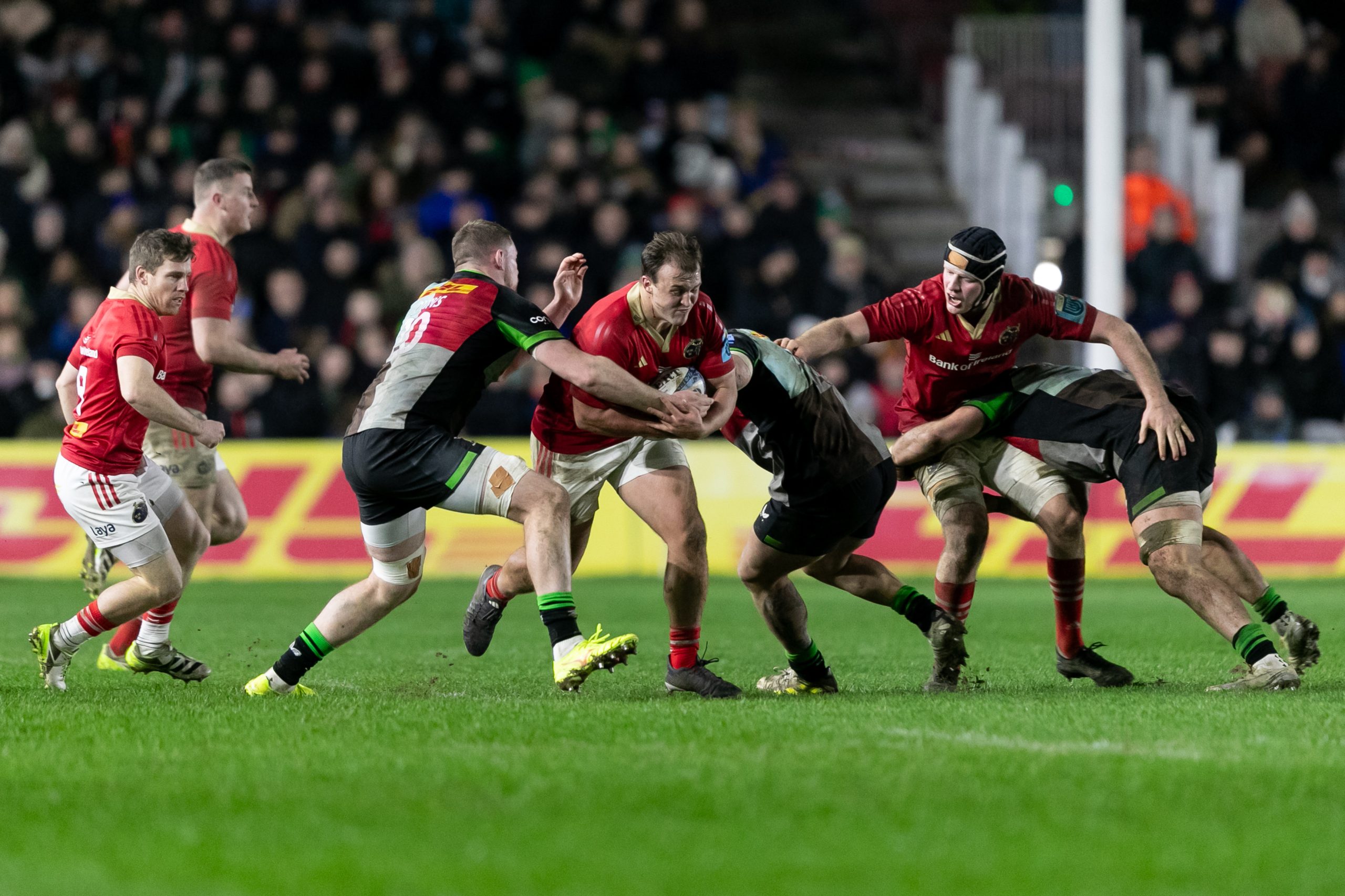
Now, to be fair, I was aware of Max Clein since he played a big role in Cresent Comp winning the Munster Senior Cup alongside Ruadhan Quinn and Conall Henchy. Clein played at #6 for Crescent in that team in a supporting role to Ruadhan Quinn. That shouldn’t be seen as a slight, Quinn was probably the most physically dominant forward I’ve seen at school level and the fact he went straight into the Munster academy after school reflects that. Clein was a big guy on that team too, but everything in that Crescent pack got swallowed up by Quinn’s 6’3″ powerhouse game.
After school, Clein was given a route to the pro game by making the switch to hooker or loosehead prop. At 6’0″ and around 95/100kg at the time, he was one of many small forward-build players in the Munster depth chart and already behind Hodnett, Kendellen, Daly and Quinn himself.
But if he made the switch to the front row, there was a much clearer run to the Munster academy but he’d have to go about it the hard way; by going from being an all-action standout schools back row to a front row learning on the job in Division 1A of the AIL with Garryowen.
He had one or two games as a loosehead prop before settling properly into hooker. As you might expect, there were bumps in the road. I edit game highlights for the AIL and watching Garryowen that season was hard work as they got slapped up one week to the next. They didn’t have a forwards coach either, at the time, so there was very little opportunity for Clein to shine. His throwing was very hit-and-miss but his work around the field was really physical. When I was scrubbing through the games I’d keep seeing Garryowen #2 popping up with decent moments even when everything else around them was tough going. He managed to make the Ireland u20 squad for the u20 World Championship in the summer, making three appearances. At that stage, he was pretty much already in the academy and even though Garryowen had an equally tough start to their first few games in 1B during 2023/24 but Clein, again, stood out.
So I wasn’t shocked when he was added to the Munster Academy in October along with Ronan Foxe. The first thing I noticed is that he looked like a hooker now in his second season out of school.
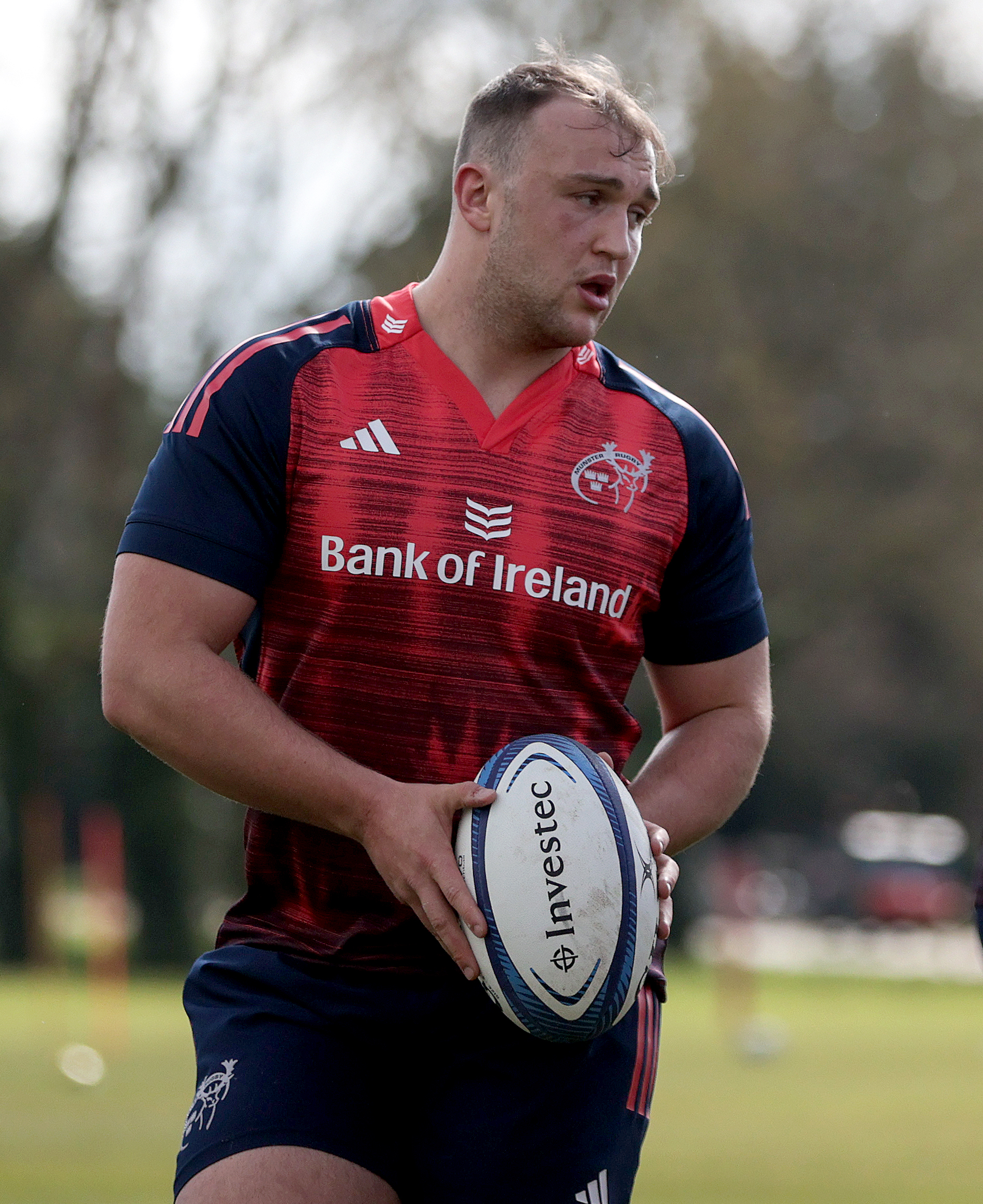
His neck had thickened up significantly and he looked very comfortable at 108kg, with scope for maybe another few KG to go on there over the next few years. A Ronan Kelleher like physique looks quite achievable for him.
Clein’s lineout throwing had improved significantly too. Like a lot of recent hooker converts, Clein’s got a bit of a floaty throw. That isn’t necessarily a bad thing because he’s mostly pretty accurate with it. It does leave you a little exposed to overthrowing and throwing crooked, but it’s also the easiest way to get shape onto the ball.
You’ll notice here that Clein doesn’t really have a whole lot of snap through his lower body when he’s throwing. Niall Scannell is excellent at this; he gets a big wide base and then flexes momentum from his feet, through his lower back and then into the throw itself. Clein’s throw is more focused on the upper body but, again, this is his second year as a specialist hooker and it takes time in the preseason to start adding bits and pieces to your game like that.
This is the one area of his game where there are a few question marks at the elite level. Even during good performances for Garryowen, there are usually two or three floaters that get picked off per game. As we know, that isn’t all down to the hooker, but for me, he needs to add a little more speed and flat trajectory throws to his arsenal to crack serious minutes next season.
At the tail of the maul he’s got good instincts, he’s tough and has a really powerful step off the base with a strong, low centre of gravity.
He’s got good instincts here, and that will stand for him as long as he can continue to get off the line with his throwing.
I’m least worried about Clein’s scrummaging. He’s taken to it like he’s been scrummaging his whole life. He’s part of a really good loosehead/hooker combo at Garryowen – George Hadden is another great scrummaging prospect for Munster – and they’ve been super effective in the last half of the season.
He’s got great grips, leads the scrum really well and you very rarely see him popping up – the usual sign of an uncomfortable scrummager. Most importantly, he’s got the aggressive mindset that you need to thrive as a professional.
The last clip here really excites me because he is sowing it into Stephen Smyth, a 6’2″, 110kg hooker who’s lined up to be a big deal for Leinster in the next few years. Clein gets under him, drives right over the top, and he’s letting him know all about it. He’s got good feet and can adjust his shape well under pressure without cracking his bind, which is a great sign in a recent hooker convert. I’ve seen him consistently put his opposition hooker under pressure in 1B this season too which, again, is a great sign.
Right now I’d say that his set piece work, if it continues at the current trajectory, should not hold him back. I look at Scott Buckley this season going through an absolute nightmare over December and January when his lineout badly let him down during a genuine injury crisis. It completely overshadowed what were generally quite good performances from him in the loose and this is always the balancing act for hookers; what you do on the line dictates the game, for you and the team. That pressure can be a tonne-weight around your neck and prevent you from showing what you can do during phase play.
Clein is a good, nuggety defender with an active poach threat. It’s a real solid area of his game but the best part of his game is his work with the ball in hand. This is a shit ball for him to truck up – slow and right into the teeth of Old Wesley’s heavy inside defence – but he gets to the gainline and presents long and quickly.
His best quality is that he’s a genuinely explosive athlete at 108kg with a real burst of pace and power. If that sticks around as he adds on another 4/5kg, he’ll be a threat from anywhere.
Clein is comfortable carrying anywhere across the field – off #9, as part of an outside pod off #10 or as an edge forward. He’s got enough pace and power to a real weapon in the tramlines, which a player of his profile – Power Hooker – has to be if they want to scale up through the levels.
He’s got a ferociously agile step off his right foot which he uses to real effect from close range. He’s very comfortable carrying the ball low, so that makes him a nightmare to tackle inside 5m if he gets any kind of separation.
All this is genuinely impressive work and if Clein can continue developing physically while keeping his lineout throwing on the upward curve it’s been on, I think he’ll be in with a shot of making early season appearances next season for Munster and from there, he’ll have every opportunity to stake a longer term claim.
Up Next – The Young Bucks :: Danny Sheahan
Note: It’s been pointed out to me that Max played hooker at junior cup level for Crescent before missing the next three years due to admin errors, COVID and then Conall Henchy being ahead of him at the time. During that time, he played back row instead. That doesn’t change much for me given the differences between being a hooker in third year of secondary school and Division 1A of the AIL.
