



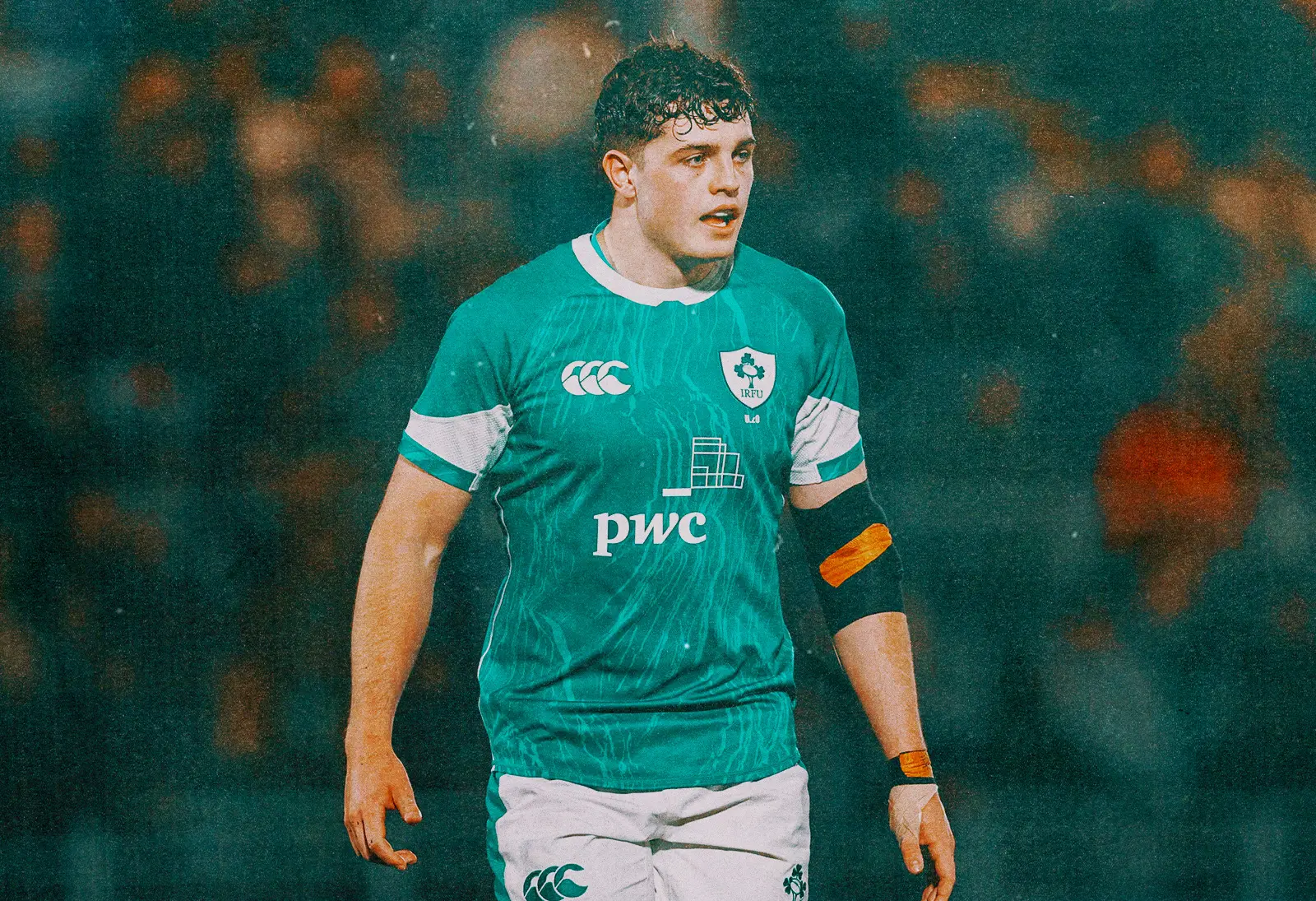
In my previous article on Michael Foy, I was pretty positive about his prospects in the short and longer term.
The reports about him from the Munster set-up are very, very good – beyond the normal placeholder stuff you hear about young lads – and, even then, I heard early in his 20s run at the camps that he was probably the best player in the squad. The 20s have been badly bitten by the injury bug this season and have struggled badly for results, but the reports I heard were right – Foy is the best player in that squad, and it’s not even all that close.
All the qualities that were visible in the Munster Senior Cup final last season seem to have scaled up to 20s level and, while the step up to URC level is steeper again, it shows the work ethic and role suitability Foy has in spades for the modern back-five.
He’s currently listed at 6’5″ and 107kg, which would track him to land as a half-lock build player in the modern game. As we get into the mid-20s and beyond, pack roles diverging and finding new specialisations. This is a natural product of teams, coaches and players evolving under the stimulating pressures of the game and the laws it’s played under.
I suppose, what I mean by this is whether there’s a functional difference between a “half-lock” as I’ve described on these pages and one of the other builds of “proper” second rows? For me, the modern pack has evolved beyond what we typically would describe as our “front five”. If we just look at the scrum, then loosehead, hooker, tighthead, left lock and right lock will always be #1 to #5 but, from a functional perspective, that isn’t what I’m talking about. The scrum is a different technical beast with its own specific physical requirements.
I think every elite pack in the modern game has to order itself under phase play first, lineout a close second and the scrum a distant third because it’s the one most distorted by factors you can’t control, i.e. the referee. Munster were pumped in the scrum against Edinburgh, for example, but how much of that came down to the referee’s interpretation? After all, it is they who decide what forward motion equals a penalty or not. The areas of the game you can fully control – your attacking and defensive lineout, your attacking and defensive maul and your roles on phase play are all way, way more important.
So I think your actual front five in the modern game is closer to an amalgamated offensive and defensive line in the NFL. Your loosehead prop, for example, might be a very good technical scrummager but also not a big ball carrier or impact defender in phase play. That’s OK – they don’t need to be. The guy who wears #4 doesn’t have to play like Eben Etzebeth – maybe they’re an edge forward with real value in the wider areas of the pitch. Again, this is fine. But you need a core of five or even six players to be able to impact in the areas close to the previous ruck on both sides of the ball, where the defence is the thickest and the ball carrying is the most intense. This is where we can start to describe “tight” forwards. Munster, for example, use Gavin Coombes as a tight forward even though he wears #8. Leinster do not use Doris in the same manner, despite him also wearing #8.
When we start to look at the pack like this, we can project Foy’s future usage.
At the moment, I see him as a lineout and defence dominant half-lock. What does this mean? It means he’s a guy who will primarily play in the middle and edge spaces in attack, the central and middle spaces in defence, scrummage in the back row, while taking a primary role on both sides of the throw at the lineout.
Foy’s work in the lineout, on both sides of the ball, is his most noticeable trait as he’s scaled up to 20s.
His lineout work was a real point of difference at schools level but, also, that’s a level where you can often be the biggest dog in the yard. That can breed bad habits in some players but not Foy – he’s got a really crisp progression from set to jump and has super sharp jump fundamentals on top of a long wingspan that makes him really effective on both sides of the throw. He’s quick over the ground, quick into the air and he’s an easy lift who gets real elevation.
It’s a super strength of his that will make him eminently selectable by any coach he works with because he plainly understands where his strengths lie.
On the defensive side of the throw, he’s got the same kind of pester ability that Peter O’Mahony does at the front of the lineout, while being a slightly longer Tadhg Beirne on the offensive side. These two player comparisons don’t end there.
Against France, in particular, Foy showed off how good he was on the defensive maul, showing real toughness, agility and power. Look how aggressive he is on these;
He’s constantly getting that big wingspan of his into those “joints” of the maul, and he’s got that same nasty little “drop swipe” that Beirne has when he fires an arm down and through the ball right as the opposition maul is about to form and the handover of the ball to the “rip” happens. This is all part of his lineout IQ, which is a massive part of his game. He just gets where he’s supposed to be and when the most dangerous time for him to act will be.
On the defensive side of the ball against France, he showed off a lot of what makes him such an exciting prospect.
The first two clips in this montage show off his athleticism pretty clearly. He started the first example as the last edge defender off a set piece launch so, as the #6, would work from the touchline in. He gets trapped on the edge of the defensive line with all the backs on the other side of the field. That’s normally bad news for a 6’5″ flanker.
Is he going to get caught for pace? No way. That track down is as good as you’ll see. The second example shows that speed and change of direction too. It’s easy to get staggered and stood up on a bouncing ball like this, but he rarely sits down on his heels and almost always stays active on his feet.
Another thing; look at how he snaps down into place on this poach attempt that isn’t rewarded by the referee but shows a lot of that technique, speed and aggression. Who does this remind you of?
Yeah. Tadhg Beirne. Foy is very much his own player, but he’s got so many traits that overlap with Tadhg Beirne and Peter O’Mahony. Sure, it’s an easy comparison to make now that he’s been training with them this year and, in all likelihood, influenced by them for longer. Tell me that this isn’t a Beirne-esque break from deep?
Foy’s got the pace, the power and the lineout ability to be someone you could plug in for URC minutes next season because I don’t think you’d need to hand hold him through the game. His ruck work is sharp, aggressive and meaningful, i.e. when he lands a shot on you, you feel it.
But one of the best things about his game is how outwardly aggressive is and how comfortable he is getting into it with the opposition.
This stuff is important, and it’s what a leader in the group will always do. They won’t stand for any of their teammates getting shoved around, they won’t stand for themselves getting shoved around and they’ll get into it with absolutely anyone to help their team win. They do it, even though it means they’re a bigger target for opposition players and fans, but they take that on because they have the mettle to do it.
In that second clip – look at how he gets into it with the biggest player in the French back, puts himself in front of him to make himself the focus. No, you deal with me. Ireland have been looking for leaders – real leaders – and Michael Foy is all that and then some.
