


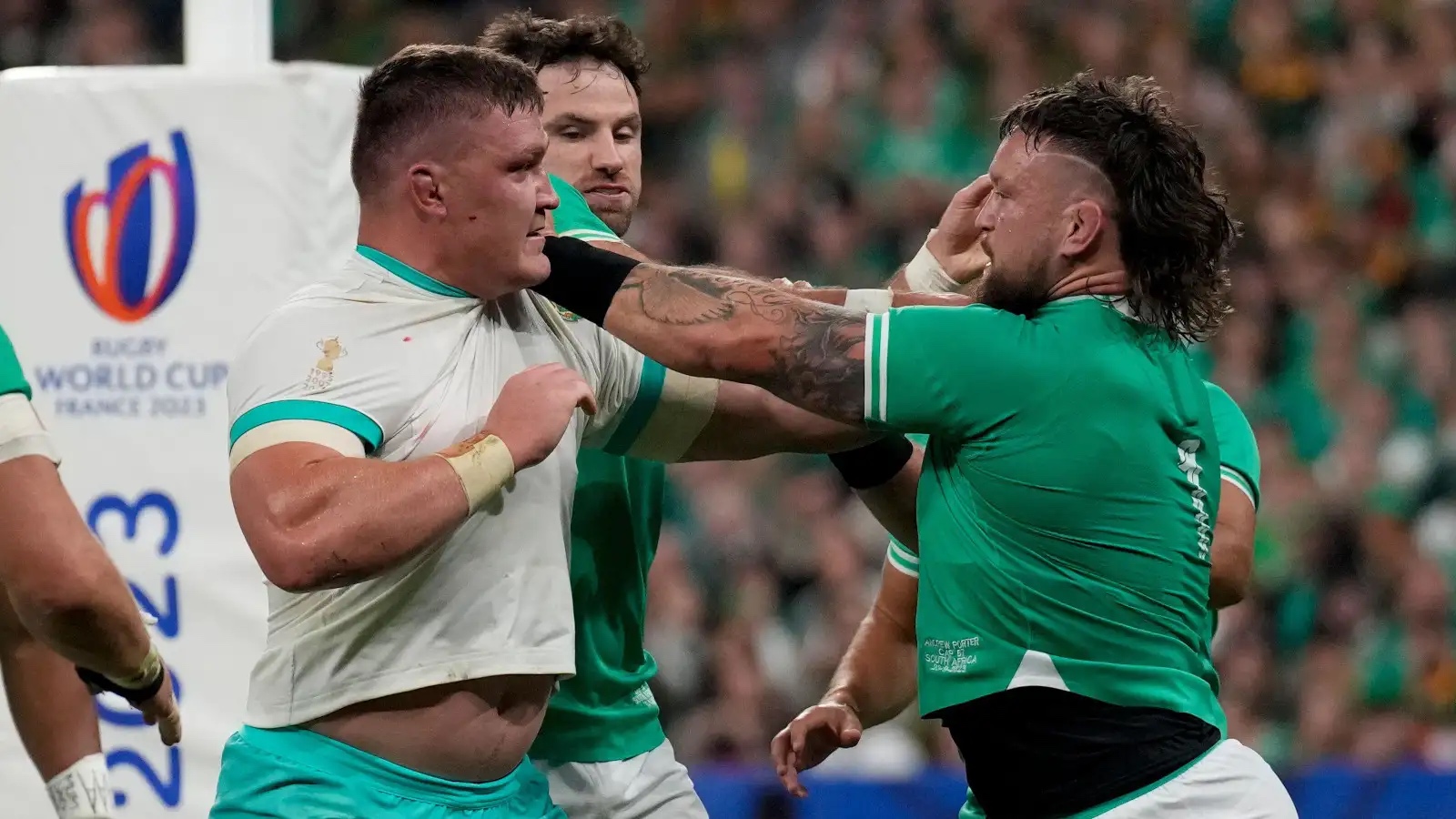
Every few years from the late 90s on until even a few years ago, there’d be a game bandied about as “the best rugby match of all time”, or words to that effect.
It was reserved for the highest-level games played out between the consensus best teams in the world at the time. I’m talking New Zealand vs Australia 2000, New Zealand vs South Africa 2003 – that kind of thing. Ireland were never in the frame for those game. Sure, we had dramatic games against New Zealand in the early 2010s – you know the one I’m talking about – but that was a plucky underdog scrapping it out with a giant and falling short. Dramatic, yes. Enthralling, yes. Heart-breaking, hell yeah, but we were a minor distraction for the likes of the All Blacks and the Springboks at the time.
We never took them on as peers.
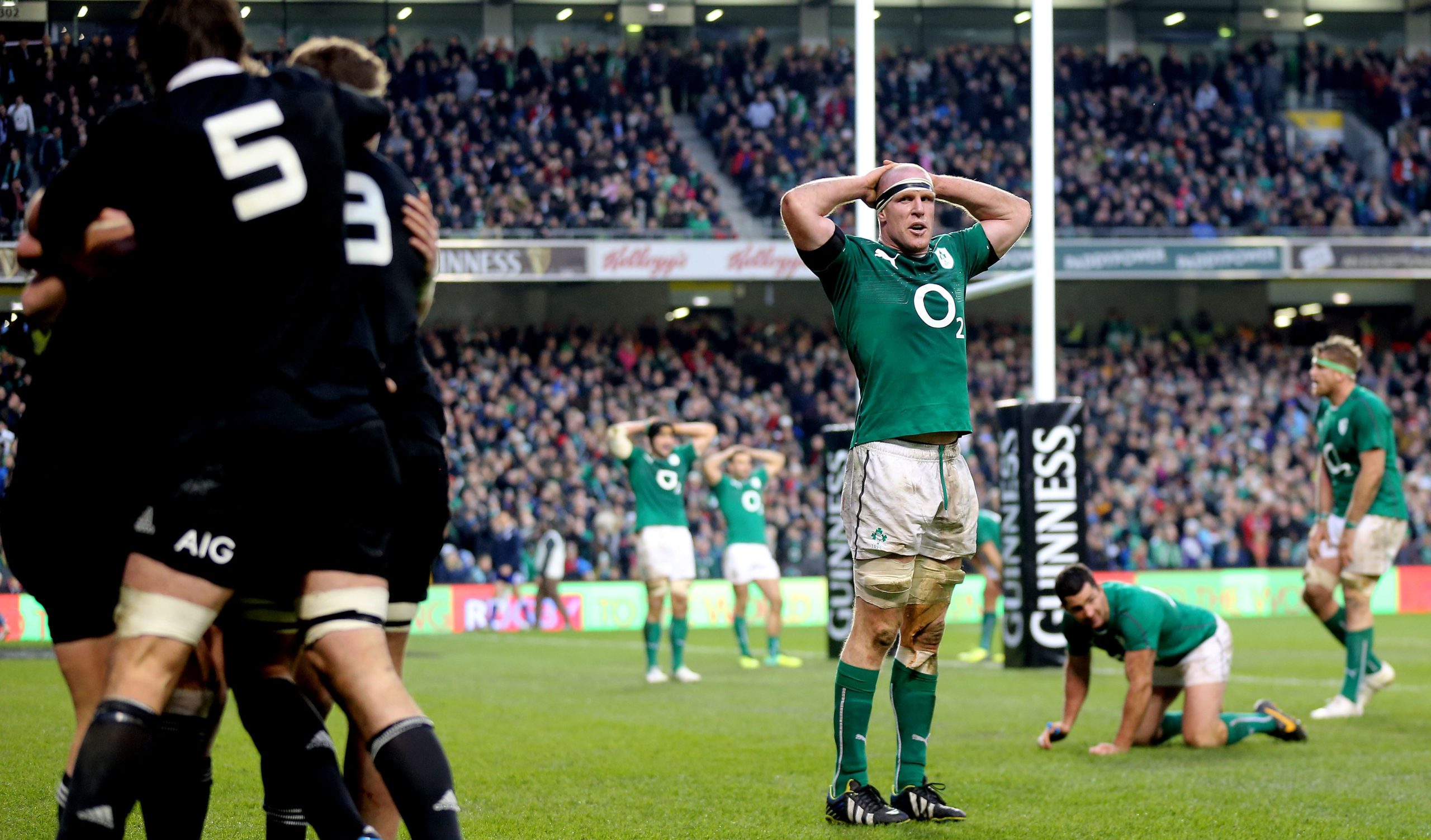
That has changed as the 2010s rolled into the early 2020s and reached its zenith on Saturday night when Ireland beat the reigning World Champions in a packed Stade de France in a Pool B decider with the entire game watching on.
Sure, this game had a big error count on both sides – Ireland’s lineout, South Africa’s goal-kicking – but everything else was played out in the most ferocious, intense, physical encounter I’ve seen in years. Ireland teams from years gone by would find an excuse to lose this game. The Ireland of 2023 found a way to win and, in doing so, told the entire sport that we are for real.
Does that mean we’ll win the World Cup?
No.
It means that, for the first time, we’re competing for it like a team that expects to win it. And for a guy who watched Ireland in the 90s, that’s a constant source of astonishment whenever I take the time to sit back and think about it.
This is a new world. Back in the ’90s, we’d lose to teams like Namibia, Romania, Italy and Argentina (they were rubbish in the ’90s too) and it wasn’t seen as a massive shock because as bad as these teams were, we were worse. Those were the “let’s hope Keith Wood can pull something out of the pan for us” days.
Flash forward 30 years and we’re playing in and winning the highest-level games in the sport.
When that whistle went on Saturday night I couldn’t help but think how far we’d come but also how far we have left to go. That said, it’s all for nothing if we don’t lift the Webb Ellis trophy.
A big win in the pools before going out in the quarters is too 2011 and 2015, for my liking. We have grander aims.
Those are the standards we should be privileged to have for ourselves. We were a joke for long enough.
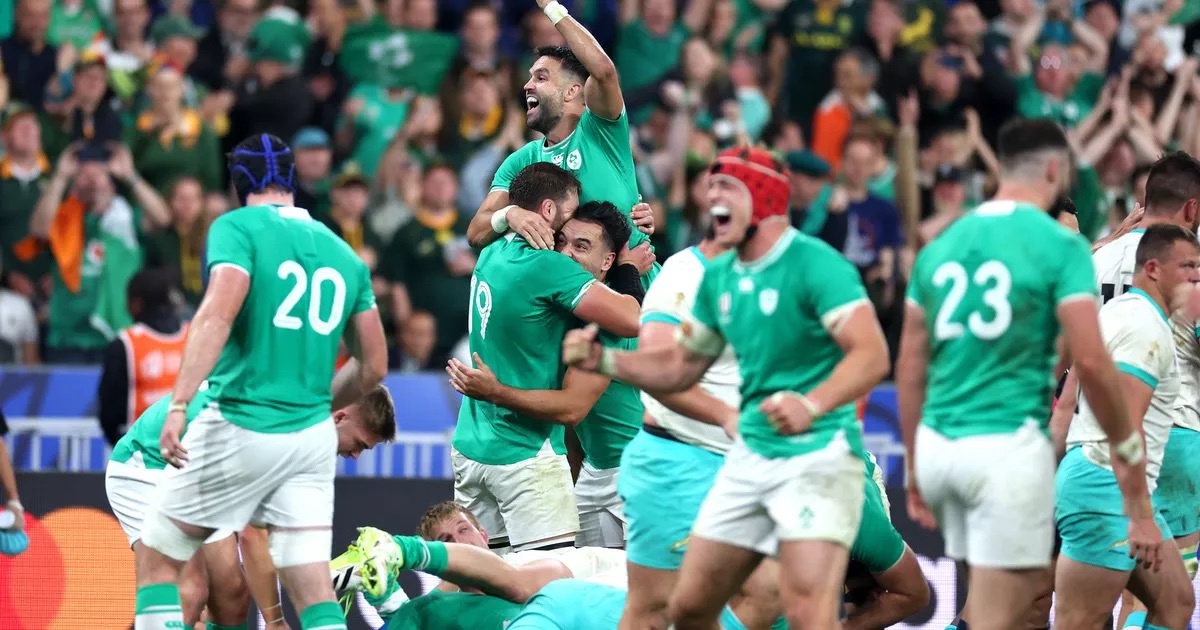
This Irish side is amongst the most experienced test side to take the field at a World Cup.
Ireland have four current centurions in the squad (three featured against South Africa) with ten of the match-day squad firmly in that 50 cap bracket. Experience isn’t everything, sure, but this is a team full of winners. Grand Slams, Six Nations, Lions tours, Heineken Cups, series wins in New Zealand, and URC trophies; this Irish team knows how to dog out wins on high-pressure occasions.
So when the lineout completely evaporated inside the first half an hour, did it break this team? I think it would have badly rattled most sides. Not this Ireland side. They kept playing, kept showing up for each other and eventually managed to turn the game around despite a lineout completion percentage usually associated with losing big games.
As usual, it was defined by a few players making big plays when it counted the most. This was a huge turning point in the game, for me. South Africa rumbling at the posts barely 5m out with Eben Etzebeth latched onto Pieter Steph Du Toit.
Henshaw and Lowe slow them just enough to allow Peter O’Mahony to bury Du Toit in the tackle, dislodge the ball and force a clean turnover on our own tryline.
South Africa would earn a 5m scrum from this and the intent was obvious; batter penalties out of the Irish scrum. Porter and Kelleher held out against savage pressure from Etzebeth and Malherbe, Furlong held Kitshoff and the Boks held it there for ten seconds – that Irish scrum didn’t budge.
Aki made a crucial tackle on Kriel, but the South African centre was inaccurate with his pop off the floor to Kolisi and that allowed Ireland to turn a certain 10-0 deficit into a manageable 3-0.
Sometimes Xs and Os don’t cover it. Sometimes it comes down to desire, fighting for your team and gutting out a big moment until it turns your way.
This Irish team has a seam of players just like that running through it. Beirne, O’Mahony, Lowe, Aki, Porter, Furlong – these lads won’t go missing when the heat goes up.
***
A few weeks ago, I wrote a piece on the €5 tier about Ireland’s problems at the lineout in the aftermath of some concerning performances against England, Samoa and Romania (in context) in the warmups.
The 67% return Ireland had in this game was as bad as the Romanian game from a raw percentage perspective it didn’t matter in the end. Why? Because the raw volume of lineout possession we had meant a lower percentage had a relatively lower effect on our systems. South Africa even went to a higher Kick Per Pass ratio than Ireland – a sure sign of an on-ball focus team – but they still needed to get the ball off the field at a higher volume than we did.
The Ball In Play time was well below 30 minutes, which is an aberration in Ireland’s recent past. This is the ball in play count from this year’s Six Nations.
- Ireland vs Wales 2023 – 38 minutes ball in play
- Ireland vs France 2023 – 46 minutes ball in play
- Ireland vs Italy 2023 – 34 minutes ball in play
- Ireland vs Scotland 2023 – 37 minutes ball in play
- Ireland vs England 2023 – 39 minutes ball in play
From a Ball In Play perspective, the nearest equivalent I can find to this game was actually when the Boks played France last November. That game had a Ball In Play time of 29 minutes. Even Ireland’s game against the Springboks last November – 33 minutes BIP – was well below our Six Nations average of 38 minutes.
What does mean in practicality?
Every second of time you spend in possession, you’re burning energy, more so than when you’re out of possession. Every team is conditioned to play a certain amount of rugby when they play optimally. At its core, this is what the different playstyles encompassing Primary On Ball, Primary Counter Transition and Primary Off Ball Kick Pressure describe – your comfort in dealing with different lengths of Ball In Play.
Counter Transition teams have to be conditioned to play the highest amount of ball in play – in part because a core part of the game is playing on that transition between defence and attack. On-Ball teams are close behind and sometimes have to be conditioned to go higher, depending on the particular flavour of On-Ball rugby they play. Off Ball Kick Pressure teams usually play the lowest amount of ball in play with a big focus on expending their energy in short, intense bursts at the set piece, kick chase and on blitz defence.
Off Ball Kick Pressure teams are usually constructed to be bigger and more powerful than Counter Transition teams who, by design, play “lighter”. An On-Ball team will be a mix between the two, but leans towards heavier pack builds with a big dichotomy in size across that same pack – you’ll see a lot of 110/125+KG players but they’ll be dichotomised by lighter small forward builds in two starting pack spots and on the bench. These forwards help you retain the possession you want to play off ruck for ruck.
South Africa have been looking to transition from an Off Ball Kick Pressure team – arguably THE team in that style – into a Heavy On Ball team in the last two years of this World Cup cycle. Basically, this means they are looking to kick less on average per game (a high Pass-per-kick metric) and play more phases of possession on average per game. If you track the Springboks Pass-per-kick metric you see a team who are playing more phases and kicking less frequently per possession. In this game, for example, they kicked once every seven passes. Ireland kicked once every six.
Part of the heavy investment in Manie Libbock in the last year – he was fast-tracked into the squad in November 2022 – was to facilitate this transition in style, in part due to Handré Pollard not playing for the Springboks since the Rugby Championship held in August 2022.
In practicality, this means the Springboks need creators who can create their own offence, as well as play with enough variety across five-plus phases to keep defences from settling. When we look at their squad through this lens, Libbock is a more varied and effective attacker, purely because of the pace and agility he can play with in settled phase play but also in transition.
What does this have to do with the lineout? Well, the Springboks have been left with one choice – to become an On Ball side capable of beating Ireland, they have to be comfortable playing their game north of 38 minutes ball in play. Munster never lost a game last season when the ball in play time was above 38 minutes because that was the sweet spot where our game hurt the opposition. The problem is the Springboks are not yet at the level where their cardio can service the new style they’re moving to for the full 80 minutes, they are playing too heavy in their back five to retain the ball over wide spaces to start, and they don’t have a balanced backline to compensate. They are still reliant on getting the ball off the field to recover after bursts of activity.
Here’s an example of how South Africa’s new style is causing them to overstretch their lines in an attempt to set up On Ball rugby ruck positions.
On both occasions, Kolisi was expected to cover too much ground as the lone forward off the set piece. Look at how slow Kitshoff, Etzebeth, Mostert, Du Toit, Malherbe and Mbonambi are moving off that scrum set piece – that’s an example of a forward unit expected to cover too much ground. You can’t show that picture to this Irish team because they’ll chew you up at the defensive breakdown. For all the hype around South Africa’s defence, Ireland’s is every bit as good, if not a little more effective.
But it doesn’t end there – I don’t think that their backline fully understands the concepts of the game they want to play.
In this clip, South Africa has already transitioned to their double small-forward build by bringing Van Staden and Smith on for Kolisi and Wiese.
At this stage, Ireland have finally managed to get some settled possession so we’ve started to kick the ball into the mid and long-range to engage the Springboks in transition phase play. We’re down on the scoreboard here but this is the game we’re comfortable playing.
If the Springboks’ possession game was where it needed to be, they’d use this transition starter play to go into settled multi-phase possession and start to punish Ireland. Instead, Willemse kicks the ball away when he has an outside winger to hit with TWO small forwards in the vicinity to secure possession.
That is off-scheme for the game they were playing in the phases before. It is thinking from 2021. The game the Springboks are playing should ask “why should I kick this” instead of “why didn’t I kick this”. Ireland are too good for this, especially with the lineout shored up in the absence of sustained South African counter-pressure.
It gets the ball off the field, it gives them recovery time, but it also does the same for Ireland. We’d win a penalty right after the lineout and, a few phases later, we’d win a scrum penalty in kickable range to retake a lead we’d never give up.
Here’s another example of the same thing; South Africa goes through a long sequence of phases only for Willemse to blow the open pass to Du Toit.
But look through that clip and what do you notice? The Boks are running the same post-transition 3-2-1 pod structure that Munster uses. They have Kleyn and Snyman in the two-pod spot, with a very deep structure behind them.
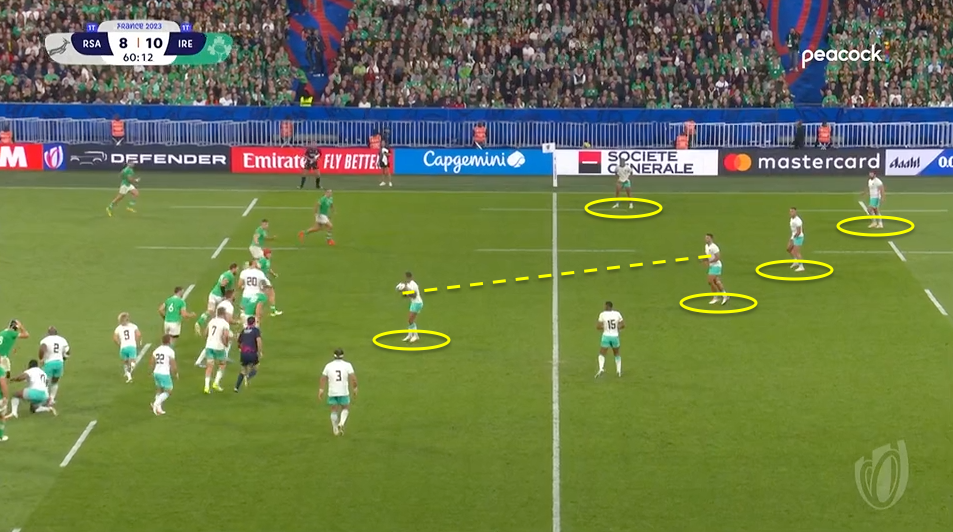
Now watch the same shape on the following phases.
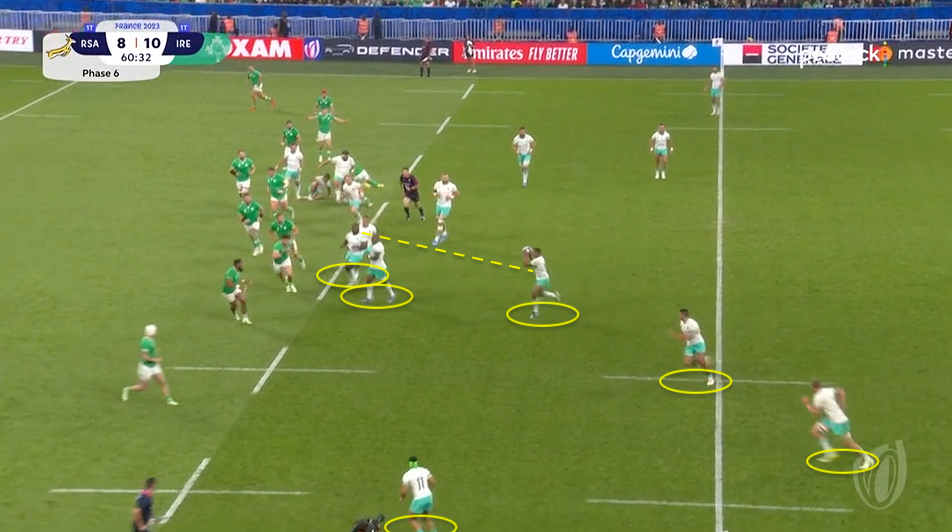
South Africa don’t use a 3-3 shape across the field. As a result, the backline shape has to use more depth than is optimal. Willemse almost has too much time to make a decision and Aki is free to engage with their structure without a third forward screening him.
A team that does not have that clarity in attack will struggle to beat this Irish team who, after four watchbacks, I firmly believe were a good 10 points better than this Springbok side. They should not have been in range to win this game in the last three minutes. Sure, the question of South Africa’s missed kicks – 11 points if you want to count the six points they missed from the halfway line – is a factor, as is the last maul which should have been a penalty, a yellow card and arguably a penalty try to South Africa, but Ireland left as many clear try scoring opportunities behind them. At our yearly point average per 22 entry, we left at least 11 points out there ourselves as well as wildly underscoring our Offensive Ruck Work metrics, but more on that later in the week.
If we play South Africa again, they’ll be better but this Irish team has levels and levels to go based on what we saw here.
As a child of the 80s and 90s, that’s probably the most exciting thing of all.
| Names | Rating |
|---|---|
| Andrew Porter | ★★★★★ |
| Ronan Kelleher | ★★★★ |
| Tadhg Furlong | ★★★★ |
| Tadhg Beirne | ★★★★ |
| James Ryan | ★★ |
| Peter O'Mahony | ★★★★★ |
| Josh Van Der Flier | ★★★★★ |
| Caelan Doris | ★★★★★ |
| Jamison Gibson Park | ★★★ |
| Johnny Sexton | ★★★★ |
| James Lowe | ★★★★★ |
| Bundee Aki | ★★★★★ |
| Garry Ringrose | ★★★★ |
| Mack Hansen | ★★★ |
| Hugo Keenan | ★★★★ |
| Dan Sheehan | ★★★ |
| Dave Kilcoyne | ★★★ |
| Finlay Bealham | ★★★ |
| Iain Henderson | ★★★ |
| Ryan Baird | ★★ |
| Conor Murray | ★★★★ |
| Jack Crowley | ★★★ |
| Robbie Henshaw | ★★★ |
