



Munster aren’t in a good place right now. No, not Cape Town — that’s a nice place. I mean, in general.
The last few months have been painful. Since we’ve returned from the test window break in November, we’ve played 12 games, lost 8. It’s our worst run since 2015/16 and, given how bad that season was, that’s a bad echo to hear back in the hallway.
Then, much like now, we were bedevilled by catch-22s and, for the most part, just not playing well enough for one reason or another.
Then, as now, I don’t think we had a clear picture of what we wanted to do moment to moment on the field — we lacked clarity then, and now. Just like 2015/16, we lack the foundational pieces to lean into one style or the other reliably.
So we floundered, as we’re floundering now.
By far the biggest liability this season has been our scrum.
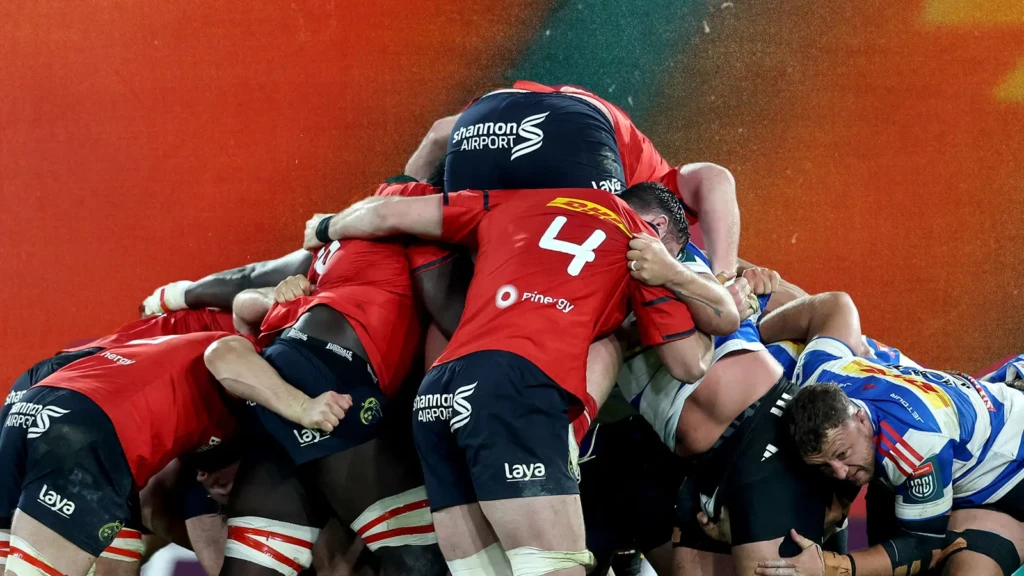
There’s no way around it.
Most of our problems start and end there. From an eyeball perspective, you know what this looks like. I’ve picked out some highlights from the loss to the Stormers and to the Sharks, but you could pick out bad moments from most of our games this season.
It’s not good watching and, as you’ll notice, almost all of the scrums we’ve dominantly lost have come through the tighthead side more often than not.
When we zoom out to look at the URC as a whole, the picture gets… significantly worse.
The headline number is the offences conceded: 44 scrum offences define our season at the scrum. Only the Dragons have conceded more (51), and the Dragons are a significantly weaker side overall. Every other team in the URC sits between 25 and 37. We are in a category of our own among teams with playoff ambitions.
We’re getting almost nothing back: 12 scrum penalties won is a poor return for a team conceding that volume of scrum offences. The Ospreys have conceded fewer offences (36) and won 22 penalties. Leinster have conceded more than the Ospreys (37), but they’ve won 28 so far. We, on the other hand, are haemorrhaging at one end of the scrum transaction and receiving very little at the other.
Our own ball is a genuine weakness, not just mediocre: 86.2% own scrum retention sounds passable in isolation, but in the URC context, it’s the third worst in the division, ahead of only Ospreys and Ulster. When you overlay that with the scrum offence count, it shows that we’re not just losing the battle cleanly — we’re being penalised repeatedly in the process of losing it.
The steal rate confirms the full picture: A 2.6% opposition steal rate means we’re offering almost zero threat when the opposition has the put-in. Ulster share a similarly low steal rate but concede far fewer offences, while protecting their own ball much more reliably. We have no comparable mitigation.
The quadrant tells the story simply: Every other team in the scrum liability quadrant has something working in their favour — Ulster’s clean discipline, Ospreys’ penalty return relative to size. Our bubble is the largest in that corner by a significant margin. We are the only side in the URC who are simultaneously struggling on our own ball, struggling to steal, conceding heavily, and winning very little back in return.
You can be a team with a penalty-winning scrum that aggressively chases penalties on your ball and other teams’ ball, and in doing so, cough up a few penalties. You can be a team that doesn’t really chase penalties, but doesn’t really give them away either.
Where you don’t want to be is where we are; fundamentally spooked on our own put-in, while being targeted repeatedly by the opposition on their put-in.
From a raw volume perspective, it’s even worse.
When we look at absolute losses rather than percentages, we’ve lost 10 scrums this season — second worst in the entire division, with only the bottom-placed Ospreys losing more at 12. Every team we’d consider direct rivals — Leinster, Glasgow, Ulster, Stormers, Sharks — have all lost 7 or 8. That gap might sound small, but combined with our 44 offences conceded, it paints a picture of a scrum that isn’t just losing, it’s losing messily and being punished for it repeatedly.
Our 86% win rate looks passable until you apply that context. A team can lose 10 scrums and still function if they’re competing hard and winning penalties back in the process. We’re conceding the losses and getting almost nothing in return, which is the worst of both worlds.
The Leinster comparison is a useful benchmark. They’re sitting at 8 scrums lost with 28 penalties won — with just two fewer losses than us, but fewer offences conceded, and more than twice our penalty return from the scrum. That differential in scrum penalties alone could account for a significant points gap over a full season.
At the other end of the table, the Ospreys comparison is the one that should concern us most. When you line up offences conceded, win rate and losses together, we’re sitting in a two-team bracket at the bottom of this ranking, and that’s if we forget that they have ten more scrum penalties won than we do.
That turns every knock-on, every spilt high-ball, every fumble into a loss of territory, or a loss of points, and sometimes they follow each other. It also has a dire effect on the mentality of the team because if every mistake means a scrum, and then, most likely, a penalty conceded, that flows into every decision downstream. Can we kick to contest freely if a knock-on means a penalty back the other way? Can we commit to high possession rugby knowing that every fumble, every marginal pass comes back to a scrum?
There’s no easy fix to this.
Getting Oli Jager playing again will be important, but our scrum is at a point now where referees expect us to get humped week to week, and teams, in turn, see this weakness as something they can target.
You can blitz a little harder, knowing that any fumble is a win. You can kick with more volume and freedom, for the same reason, on top of it being a winning play.
What will change it?
A change in scrum coaching, and signings at tighthead to augment a hopefully more available Jager next season. Sean Cronin has come in on short notice — promoted for the year from the academy pathways, incredibly early in his career — and has been mostly working with either two veteran tightheads in their mid-to-late 30s at the end of their careers, or risk going for very young tightheads who will, naturally, suffer in the scrum anyway for the most part, bar the odd freak.
With Ronan Foxe, in particular, there’s a good prop in there, both in the loose and from a scrummaging perspective, but whatever physicality he’d bring in open play is completely negated by the issues at the scrum.
The biggest fix is on the recruitment side. This season, we will be losing Ryan, Ala’alatoa and Salanoa, most likely, so you could argue that we need two tighthead signings, along with exposing Foxe a little more for next season, on top of a full-time coaching hire.
For the rest of the season, it’s about stemming the bleeding one way or another. Get Jager fit, get Loughman back into the side to help the loosehead side as much as possible — not that Milne has been poor, the problems are almost all on the tighthead side — but we need as much help in that unit as we can get.
