


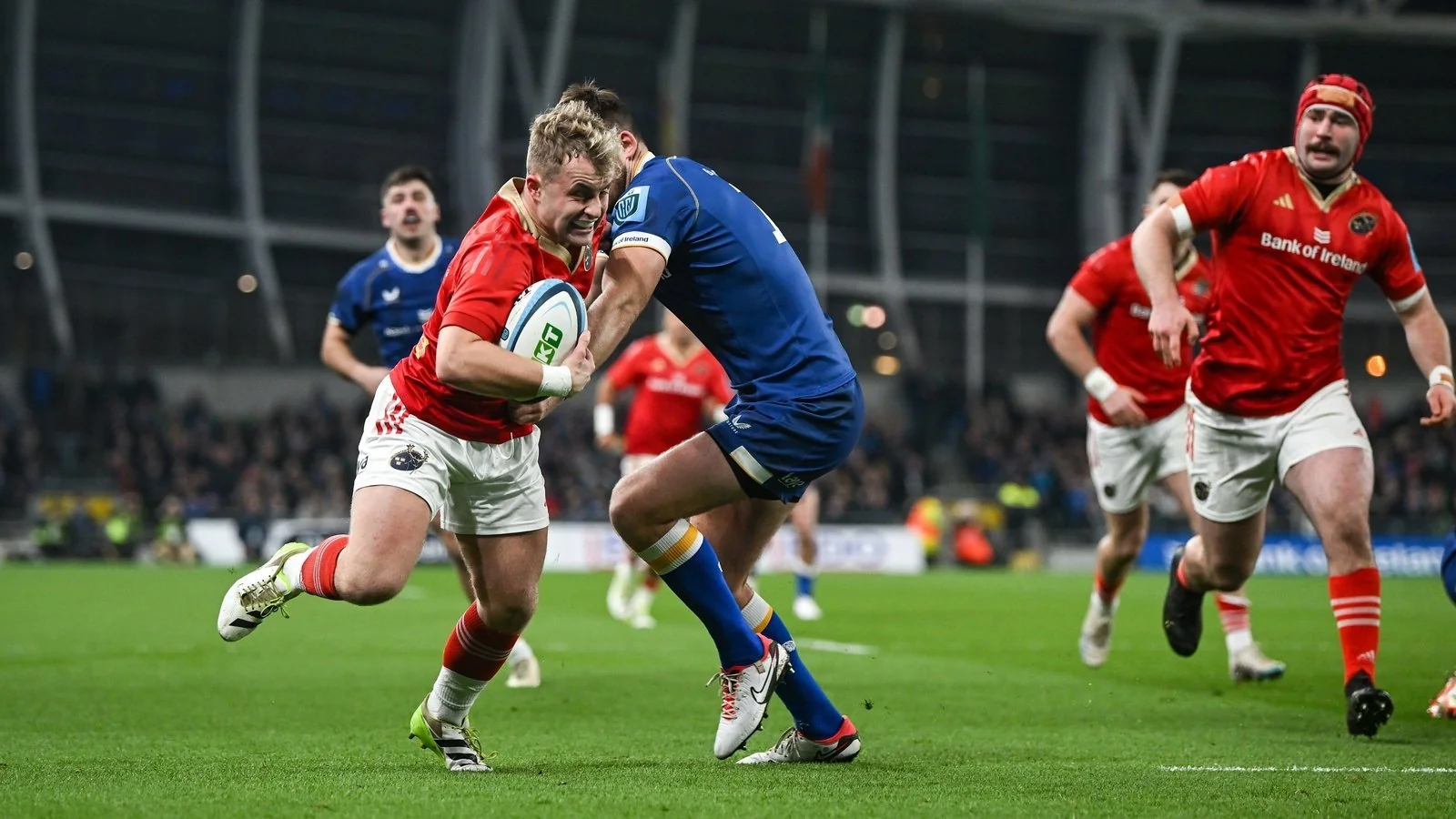
I have described Munster as an On-Ball team repeatedly on this platform. It is not a designation used anywhere else in rugby media so I want to expand on what I mean by it. It is, essentially, a team that chooses to hang onto the ball on multiple phases of possession beyond the usual 3/4 phase timer that, for example, counter-transition teams operate under. On-ball teams will, generally, kick shorter and more contestably when they do kick and, in a big-picture sense, kick the ball less frequently than counter-transition teams and absolutely kick way, way less than Off Ball teams.
We are in the bottom three in the league for both in-game kicking after six rounds of the URC and kicking metres.
The core principle of this way of playing is that when we have the ball, it is impossible for the opposition to score (unless we make a mistake) and, if we are accurate and physical enough we will break down teams in long blocks of phase play. We balance that with an efficient post-transition game but our game is based on taking opposition defences into long sequences where they don’t see the ball and have to depend a tonne of variety – off #9, off #10, tip on, cut backs, screen balls, layered handlers and that if we don’t score on one sequence of play, we bank the tiredness in the opposition legs and go again.

Absolutely vital to this way of playing is an efficient breakdown game. If we don’t have a clean supply of possession at the breakdown – not necessarily quick ball but obviously that helps – then it is impossible to build the pressure that we need to on the opposition.
My offensive ruck work metric measures this efficiency and when it comes to an On Ball team, the more rucks you have the better and the more ruck security you have, the better you play because it means you are on-scheme. In short, the more Dominant Actions (+3) and Guard Actions (+2) you have in a given game, the more likely it is that you are retaining the ball and building the phase pressure that our system is designed to build.
The more Ruck Attendances you have (a clear sign of a box kick more often than not) the more we can tell that you’re being forced into off-scheme kicking. The more Ineffective Ruck Entries you have, the more likely it is that your breakdown is getting heavily disrupted and, as a result, you are unable to build your phase play pressure effectively.
In fact, when we measure ineffective entries across our first six games, we see the Ulster game as the biggest outlier, by far, with our draw to Benetton also standing out.
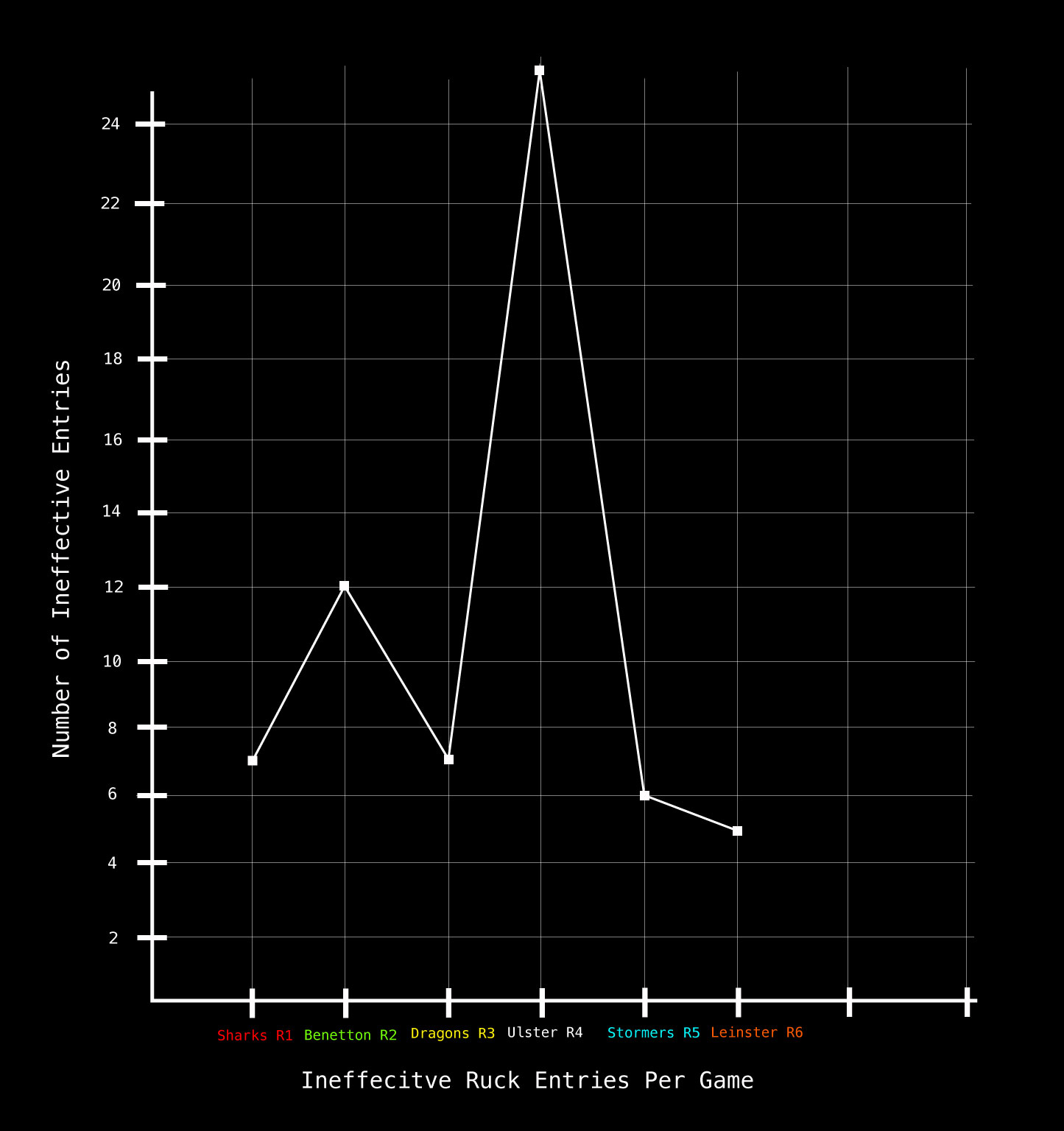
When you think back to those games, they “feel” like games where we didn’t play well, right? And you’d be right. Those two games were the ones where we forced off scheme the most so far this season and that’s in large part because of the disruption at the ruck.
Munster lost to Leinster at the weekend but in doing so we had the lowest number of Ineffective Entries so far this season. Is it a surprise that it also “feels” like we played really well in that game, despite the loss? That’s a large part of why that is.
Let’s have a look at the ORW from the Leinster game first and see what we find.
MUNSTER’S OFFENSIVE RUCK WORK SCORE VS LEINSTER
- A Dominant Clean is an action that decisively secures possession when the ball carrier takes contact. A Dominant Clean does not have to be the first arrival at the breakdown but it is rewarded in the context of effectiveness. We will assign this action 3 points.
- A Guard Action is where a player plays a role in helping to retain possession after we have “re-won” the ball on the floor. Sometimes this can happen on a carry/ruck point where there is no active contention by the opposition. Let’s assign this action 2 points.
- An Attendance can be anything from standing as a “kick shield” on a ruck to adding a bit of bulk to ward against a counter-ruck. I’m marking this down as being worth 1 point.
- An Ineffective Action is a blown cleanout, a lean, a breakdown penalty or an action that I couldn’t see any direct benefit for. This will be worth -2 points.
| Dominant Clean | Guard Action | Attendance | Ineffective | Ruck Work Score | |||||
|---|---|---|---|---|---|---|---|---|---|
| Loughman | 13 | 26 | |||||||
| Barron | 23 | 46 | |||||||
| Archer | 1 | 17 | 1 | 1 | 36 | ||||
| Kleyn | 3 | 18 | 1 | 46 | |||||
| Beirne | 22 | 4 | 48 | ||||||
| Ahern | 4 | 8 | 1 | 1 | 27 | ||||
| Hodnett | 2 | 5 | 1 | 14 | |||||
| Coombes | 3 | 25 | 59 | ||||||
| Casey | 0 | ||||||||
| Crowley | 6 | 12 | |||||||
| Daly | 11 | 22 | |||||||
| Scannell | 1 | 10 | 1 | 24 | |||||
| Frisch | 1 | 19 | 41 | ||||||
| Nash | 1 | 2 | |||||||
| Zebo | 2 | 4 | |||||||
| Buckley | 0 | ||||||||
| Kilcoyne | 13 | 2 | 28 | ||||||
| Ryan | 14 | 28 | |||||||
| Gleeson | 7 | 1 | 12 | ||||||
| Kendellen | 1 | 8 | 19 | ||||||
| Murray | 1 | 2 | |||||||
| Butler | 1 | 1 | 0 | ||||||
| McCarthy | 6 | 12 |
First of all – we find massive numbers. Antoine Frisch, Tadhg Beirne, Diarmuid Barron and Jean Kleyn all had 40+ ORW games which is always a great sign. Gavin Coombes scored 59, which is close to that 60 point super elite threshold. Think Andrew Porter and Josh Van Der Flier against France in the 2023 Six Nations. That is the level that Coombes played to here. He was everywhere. When you consider he was also our top carrier and tackler, it’ll give you an idea of how good his performance was here. I rated him at two stars initially because of one poor penalty concession and two dropped balls but when I watched the game back ruck by ruck, Coombes was helping us stay on-scheme over and over and over again.
Kleyn’s return to the team saw him pick up right where he left off with a bruisingly physical performance at the breakdown and Beirne was right back to his usual levels. Antoine Frisch’s work around the breakdown has really improved and it’s a key part of our ball retention in this game. His score of 41 is really high and it’s significantly more than his average on the season so far.
Frisch has averaged an ORW score of 32 points per game in his five appearances so far this season. In those other four performances, Shane Daly was his full-back and averaged 15 ORW points per game, with his average dragged down by a performance against Ulster where he played 70 minutes due a yellow card and scored 0 points due to four ineffective entries cancelling out his four guard actions. It was that type of game.
With Zebo at fullback – a low ORW player – Frisch’s ORW output naturally increased. Daly’s ORW went back to 22 – which is the mean of his performances so far this season – but he would have been hitting rucks in a different zone to Frisch. It’s interesting how this change in position played out for both players.
When we look at ORW averages across the season so far, one man stands out; Gavin Coombes.
I must have heard a dozen times this season how he’s not been great but if you look at his average ORW per game… it’s 42.5 points per game, which is absolutely insane. It tracks with Coombes’ conversion from a power forward role build to a half-lock/power forward. He’s more of a set-up carrier now – operating in the tight spaces – with a big focus on tracking between our two middle pods with tips on, tight carries and a mountain of breakdown work. Against Leinster, he was our top tackler, our top carrier and produced a herculean 59 ORW points. He’s our most important player at the moment because he allows us to select real firepower alongside him at 6 and 7.
The Big Finish
After the Sharks game in round one, I wanted to get a more detailed look at how our Collective Offensive Ruck Work tracked across a game. Initially, I collected the Collective Offensive Ruck Work – everyone’s ORW scores added up – per quarter to give an idea of how our ruck work peaked and troughed across a block of time in a game. The Sharks game actually convinced me that collecting it in 20-minute blocks was actually a blunt instrument because it didn’t give me enough detail. So, for the last few weeks, I’ve been breaking each game into eight 10-minute blocks.
I found almost immediately that it gave me predictable metrics that tracked all the way across the games, regardless of the opposition and, even better, it started to show me that Munster targets individual blocks to manage our way through games.
To understand why, we must accept a simple truth – attacking is more physically draining than defending. This is a core tenet of off-ball and Counter-Transition teams’ conditioning. If you can defend with intensity for 3/4 phases, the opposition will run out of ideas, kick the ball back to you and you can then either kick the ball further downfield if you’re an Off Ball team or enter into post-transition phase play if you play Counter-Transition.
If you’re an On Ball team, however, the idea is that you don’t run out of ideas or willing carriers to regularly take teams beyond that 3/4 phase mark and deep into 6/7/8+ phases.
You have to be conditioned to play this way and you almost certainly can’t play high-intensity on-ball rugby for a full 80 minutes. It’s impossible.
So Munster manages certain blocks and goes into defensive states at varying points across EVERY game they play.
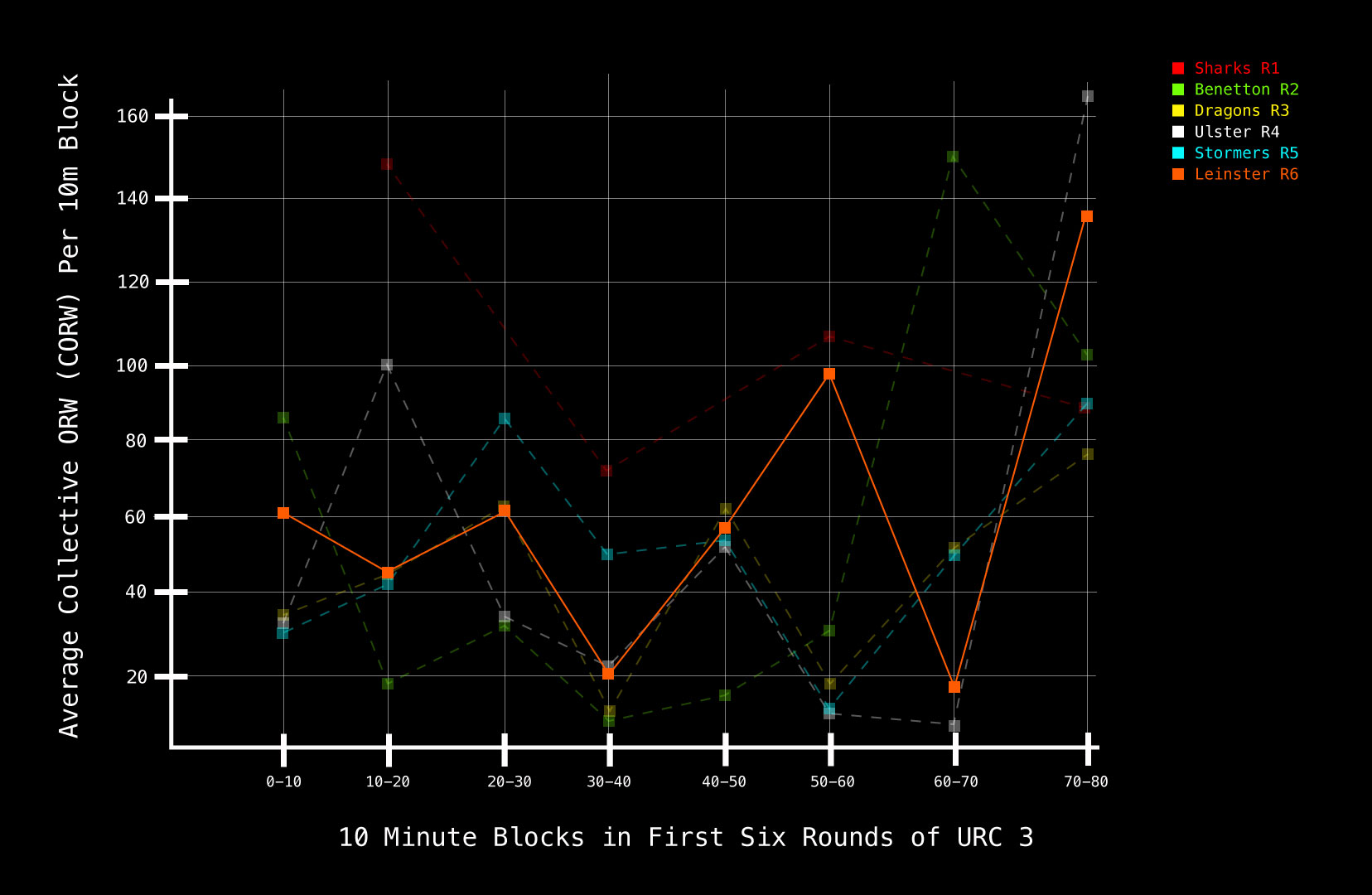
Here’s our mapped CORW score in 10-minute blocks across the season so far with the Leinster game highlighted.
What do you notice immediately?
We typically start slowly in a game from an ORW perspective and grow in intensity between 10 and 20 minutes, we can go either way between 20-30 minutes but we almost always dip into a defensive state right before halftime.
We start the second half with a big push, taper off between 50 and 60 minutes and then, in almost every game, rack up massive CORW numbers in the last 20 minutes, with the last 10 minutes being the biggest zone for CORW output in the opening six games of the season.
Remember the big finish against Benetton and Ulster? That’s what I’m talking about. Our output against Leinster showcases how close we were to turning that game back around with sustained possession and effective ruck work in the last 20 minutes that could and should have won us the game.
What does this show us? This Munster are conditioned to peak in games right when the opposition starts to drop off in intensity. Given that five of our opening six games were against, at the very least, incredibly physical opponents in the Stormers and Sharks case and high-performing sides currently in the top six of the league in Benetton, this is a very encouraging sign. Why? Because it shows we can manage games to a point where we can finish incredibly strongly so, even though we’re currently underperforming our ORW in those last two 10-minute blocks, the minute we convert that pressure we will win close, high-intensity games. Of that I’m sure.
