


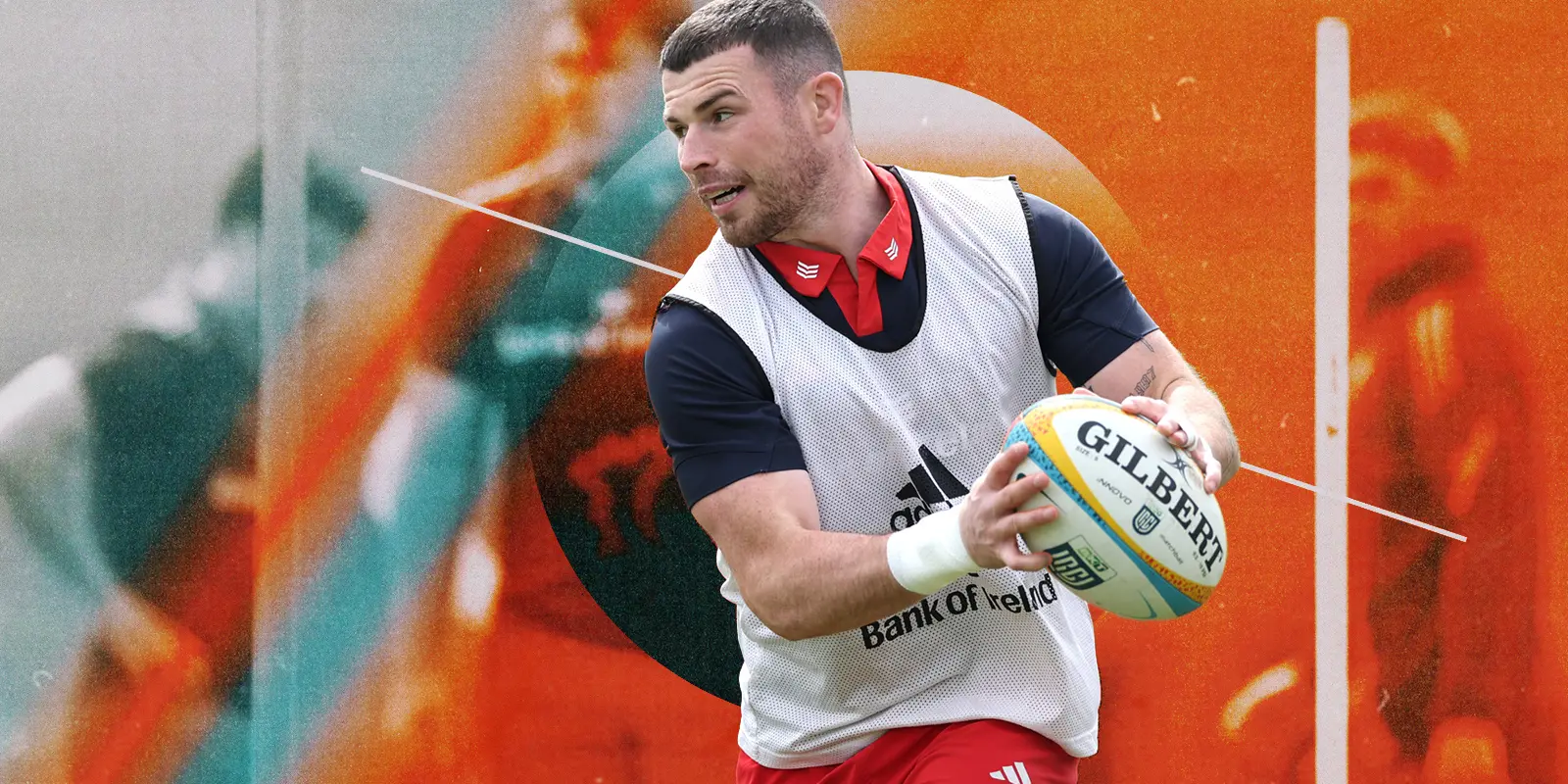
Last week’s win over Benetton only becomes truly meaningful if it can be followed up with a win here against Ulster.
At this stage of the season, it’s about numbers.
How many players do you have available for the run-in as it crunches to a conclusion? This is where your seasonal rotation and S&C come into play. Have you been burning too many of your top guys to do your business? No rugby player is ever at 100%, but you need to watch out when too many of your best players are starting to redline towards 50%. Half fit, half injured. We’ve seen ourselves how too much streamlining in selection over the five or six weeks post-Six Nations can bite you when it hurts the most.
In a more practical sense, it comes down to the number of points you have on the log.
For Munster, our magic number is 53. I project that the 8th-place team in this year’s URC will finish on 52 points. If we can get to 53 points from our current standing of 46, I think we’ll be guaranteed a top-eight finish and very likely somewhere between 4th and 6th.

Here’s my logic. Leinster, Glasgow and Stormers will all finish in the top three. I have Glasgow, Leinster and Stormers, in that order, but a lot depends on how Leinster manage their game against Benetton this weekend, and how Stormers vs Glasgow shakes out.
After that, it gets complex. The Bulls are almost certain to gorge themselves on Scarlets/Zebre/Benetton and clear 58, so they’re safe, and very likely to finish fourth or fifth, depending on the Lions’ northern tour. That leaves the Lions, Munster, Cardiff, Ulster and Connacht fighting for the last four spots, all with broadly similar ceilings and some brutal head-to-heads to be shaken out.
Because so many of these fixtures are between the contenders themselves, points get redistributed rather than accumulated, and that pulls the 8th-place line down. The Bulls-style “bank points against weak opposition” route isn’t available to anyone else in this pack.
That brings us to Ulster, specifically this week and also in the context of the run-in for the playoffs and the Champions Cup.
The top six URC sides are guaranteed Champions Cup spots for next season. The three remaining berths go first to any cup winners not already qualified — the Champions Cup winner, then the Challenge Cup winner — and only then do the 7th and 8th-place teams fill out what’s left, unless one of those teams goes on to win the URC title.
So if Ulster win the Challenge Cup from outside the top eight, they claim one of those two spots and 8th place gets bumped into the Challenge Cup instead.
That doesn’t affect URC playoff qualification — the top eight still go to the quarter-finals regardless — but it does push the effective cut-line for Champions Cup up to 7th. And this isn’t some remote hypothetical. Ulster are on 47 with a punishing run-in (Munster in Thomond Park this weekend, Stormers at home, Glasgow at home), and they’ll almost certainly rotate heavily for this weekend’s game with Exeter looming six days later. A 9th-place finish is well within their range. The same principle applies to Dragons, hosting the other Challenge Cup semi-final and sitting miles off the URC top eight themselves. Deeply unlikely, but still possible, in the realm of things that could, possibly, happen.
For us, that makes 7th a much more valuable finish than 8th. It’s not just a seeding difference anymore — it’s potentially Champions Cup rugby vs Challenge Cup rugby next year. Which is another reason Saturday is of vital importance. Win this one with a bonus point, and we’re probably looking at 5th or 6th minimum. Drop it, and we’re in a proper scrap where the stakes have quietly doubled.
That matters to Ulster, too, because they have two difficult routes, and picking one route exclusively means jeopardising the other. Practically speaking, they should probably pick the Exeter game to rotate, if they are going to rotate. They won’t, but if Champions Cup rugby next year is the primary aim, that’s what you’d do because they have half a hand on that anyway. They are six points away from what I project to be the cut mark.
But sport isn’t practical. A home semi-final against Exeter, with a chance to contest and win a European trophy, is why you are doing this at all. It is worth managing your resources for. A win against Exeter — at home, too, which doubles the emotional “want” — means you’re one win away from a first trophy since 2006 and a Champions Cup spot regardless of what happens in the remaining games. Of course, if they beat Exeter, that would also require managing your squad before the Challenge Cup final, which happens the week after they play Glasgow in Round 18.
Richie Murphy could, of course, take the injuries he already has, exclude those players for this weekend, and load up guys like Henderson, McCloskey, Agustus, Stockdale, Izuchukwu and Kok for this weekend, and if they pick up a one or two-week knock — all have featured pretty heavily in the last four weeks — so be it. It would make beating Exeter far more difficult and increase the pressure on the games against Stormers and Glasgow to finish, both of whom will be shooting it our for a top two finish, but he might choose to do that. I’m writing this segment on Wednesday morning, so we’ll see on Friday morning what direction Ulster go in.
For Munster, it’s simple. Beat whatever team Ulster send down on Saturday night, let them deal with whatever comes after.
Munster Rugby: 15. Shane Daly; 14. Calvin Nash, 13. Tom Farrell, 12. Alex Nankivell, 11. Andrew Smith; 10. Jack Crowley, 9. Craig Casey; 1. Jeremy Loughman, 2. Diarmuid Barron, 3. Oli Jager; 4. Jean Kleyn, 5. Tadhg Beirne (c); 6. Tom Ahern, 7. John Hodnett, 8. Gavin Coombes.
Replacements: 16. Lee Barron, 17. Michael Milne, 18. Michael Ala’alatoa, 19. Edwin Edogbo, 20. Brian Gleeson, 21. Ben O’Donovan, 22. Dan Kelly, 23. Alex Kendellen.
Ulster Rugby: 15. Michael Lowry (c); 14. Aitzol King, 13. Ethan McIlroy, 12. Ben Carson, 11. Ben Moxham; 10. Jake Flannery, 9. Conor McKee; 1. Eric O’Sullivan, 2. James McCormick, 3. Bryan O’Connor; 4. Harry Sheridan, 5. Charlie Irvine; 6. James McKillop, 7. Tom Brigg, 8. Lorcan McClaughlin
Replacements: 16. John Andrew, 17. Callum Reid, 18. Tom McAllister, 19. Joe Hopes, 20. Marcus Rea, 21. David Shanahan, 22. James Humphreys, 23. Jonny Scott
At their best this season, Ulster have been an unanswerable question for whoever they’ve played.
In a way, they’re the perfect expression of a head coach — Richie Murphy — getting the coaching clarity he needs to perfectly express his vision, combined with some excellent signings, who have all, to a man, delivered for him in spades, and top players like Jacob Stockdale, Stuart McCloskey, Nathan Doak, Robert Baloucone, Tom O’Toole, Iain Henderson and Cormac Izuchukwu thriving in that system.
That has raised everyone’s level to something that, for most of the season, has seen them radically outperform last season in most cases.
How much of that was down to a relatively softer, lower-key December/January block without high-level competition? I’m not sure you can fully disentangle one from the other, but ultimately, it doesn’t matter — results have been better, so perception is better.
Net 22m Efficiency
What this data tells me is that Ulster are finishing the season worse than they started it, and the trend line running through that diagram is the proof. After match one, the fitted line sits at +1.29 points per 22-metre entry; by match twenty, it’s at −0.19. That’s a swing of nearly one-and-a-half points of net efficiency across the year, or roughly a try-and-a-conversion of per-entry quality evaporating over twenty games. It’s not a collapse — there’s no cliff-edge moment where everything falls apart for Murphy’s team — but it is a steady, directional decline in efficiency, and the straightness of the line is what makes it particularly interesting. A team that was genuinely bouncing back would pull the regression slope flat or tilt it upward in the second half; Ulster’s hasn’t, as of yet.
What the trend smooths over, and what the rolling red line makes visible, is that this isn’t one problem but two overlapping ones. The autumn block was built on a ruthless attack — 5.6 points per entry against the Sharks, 4.3 against Racing 92, 3.1-4.2 for most of the early URC rounds — and during this period, they were the most efficient team in Europe by some distance.
Better than UBB. Better than Toulouse. Better than Leinster and Glasgow by an order of magnitude.
When you pair that with a defence that only really leaked against the Lions, you have a very clear picture of how Ulster generated all the positivity that they did. It was deserved.
Then, somewhere around the festive fixtures, the attack stopped converting: Munster in Belfast, Connacht away, Scarlets and Cardiff all produced per-entry numbers below 2.5, which in efficiency terms means Ulster were reaching the 22 and coming away with less than they had earlier in the season. The Munster game might look like a mistake here — they slapped us up 28-3 — but from an efficiency perspective, they generated 13 entries, and only scored an average of 1.6 points per entry against a rotated side playing their worst game of the season. Yes, including the Sharks. And Exeter.
At the same time, the defence, which had been the quiet hero of the early season, started coughing up four-plus points per entry in specific games — Scarlets away, Connacht at home — and because those defensive lapses happened in tight losses rather than blowouts, they hurt the rolling average disproportionately.
The Challenge Cup knockouts (matches 17-19) are where the story gets interesting and where the trend line does its most useful work. Looking only at the red rolling line, you’d say Ulster found their form again: the line climbs back to +1.4, the attack is converting at 3.5-4.0 per entry, they’re winning knockout rugby against Zebre, Ospreys and La Rochelle. But the dashed trend line doesn’t move. It can’t — it’s fitted to all twenty games so far and that late revival, welcome as it is for Richie Murphy after a tricky spell around the Six Nations window, is counterweighted by the three months of mediocrity that preceded it. The Leinster loss at Ravenhill in the last game before this one confirms what the trend had been suggesting all along: when Ulster met the best team on the list, the defensive efficiency gap reopened (3.7 conceded per entry), and the attacking spike couldn’t rescue them.
It also should be said that the mini-revival happened against Zebre, an Ospreys team that arguably should have beaten them if not for a controversially ruled out late try, and a La Rochelle team so full of “who’s that guy” players it was like watching a local soap opera in France when you’re on holiday and don’t speak a word of French.
So the trend line’s real message is about sustainability rather than peaks. Ulster are capable of very good rugby — the Racing and Sharks games prove that, and the cup run proves they can do it under pressure — but across a full season, the per-entry numbers have been drifting the wrong way. The Leinster defeat suggests the ceiling against top-tier opposition hasn’t really moved. The form is there in flashes, but for me, the foundation is the problem.
Ulster’s big adjustment this season has been to move solidly into a primarily “on-ball” style.
This is a core part of Richie Murphy’s style, and something that the addition of Mark Sexton properly unlocked when Ulster were, and are, at their best.
At their best, they are probably most efficient in scoring post-turnover. This is empowered by a combination of good lineout contesting, the box kicking of Nathan Doak (and contesting of Kok, Stockdale and Baloucoune) and then a solid commitment to very expansive wide bore attacking phase play that looks to crunch you on the edges and then play back against the grain against a scrambled and stretched defence.
With Ulster, though, I think the best teams have been “hacking” their exit posture as the season has gone on.
Fundamentally, Ulster exit through the boot, long, as much as any team in the URC, so if you have a proactive kicking strategy that pins them inside their 22, or just outside it, they tend to exit long through the boot to touch more often than other sides.
From Ulster’s perspective, this is a start play of its own — kick to touch, throw one or two pods into the air with Izuchukwu as the primary contester — and then use that to force scrappy possession that you can then leverage into either a transition opportunity, or kick downfield through Doak or Murphy to exert territorial control.
But if you can retain a pretty solid lineout and kick most everything back to them from any ball in your half or even just outside their 10m line, you can almost force them into a doom loop where they end up pitched in their own half for long periods.
They aren’t really a jackal-based team — although, like everyone else, they’ll have a cut off something obvious — so they try to fill the field and shut you down when you go into a series of possession. They force turnovers through tackle pressure and defenders in the line.
Around their 10m line, you’ll see one backfield defender and one secondary defender guarding the short side and trying to cover the back pin.
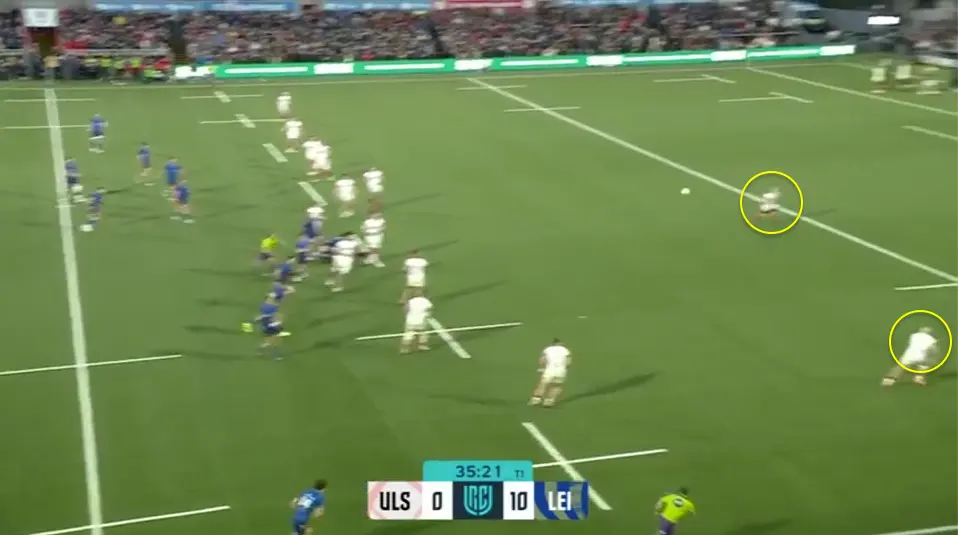
That leaves space in behind and on the opposite side, but you can only engage it by two or three phases of tight possession, where Ulster will pack into the tackle and fill the primary line with 13 or sometimes 14 defenders.
To get to that point, you need to make sure you consistently put Ulster into a position where their exit strategy tells them to kick to exit.
What that can lead to — if you have a solid lineout and, ideally, a pressure scrum — you can lever Ulster away from where they want to pressure you and have been successful, namely going into multi-phase sets post-turnover, by forcing them into a constant stream of exits, set piece, and then more pressure within their own 22.
If Munster can do this on Saturday, we’ll have a great chance of forcing Ulster away from where they’re good, into an area that has cost them consistently in the last few months.
And a win can spring from there.
