


You can’t read anything this week in the Six Nations without seeing references to “The Italian Job”, a film initially released in 1969 which is <checks Wikipedia> 54 years ago. The relatively recent remake you could also be referencing is 20 years old this year. It’s also rubbish, which is irrelevant to the reference but I think it’s worth saying anyway.
Why do we keep doing it? I’ve done it, and it annoys the hell out of me.
It’s a bit like the rugby commentariat of 1968 making eyebrow-humping references to 1915’s The Italian in an alternate universe where Italy are added to the Five Nations in 1960. Just wait a year, friends, the perfect reference to an away day in Italy is coming.
My point is, it’s time to get a new reference when it comes to playing Italy. What about The Talented Mr Ripley? It inspired me to go to Italy and includes a guy killing someone with an oar on a boat and assuming his identity – what’s not to like?
So who will Ireland kill with an oar on a boat this week? Will it be Italy?
Let’s see.
Typically, the Italy game has been the week of the Six Nations where you rotate around your squad, build a few minutes into wider squad players or prospects, pick up your bonus point and make sure to throw half a dozen tries in your basket for points difference issues you might run into later in the tournament.
Playing Italy home or away over the last 10 years was almost always a guaranteed win. In fact, the last time we lost to Italy was ten years ago – an ultra-grim 22-15 loss that saw Declan Kidney lose his job as Ireland’s head coach less than a month later.
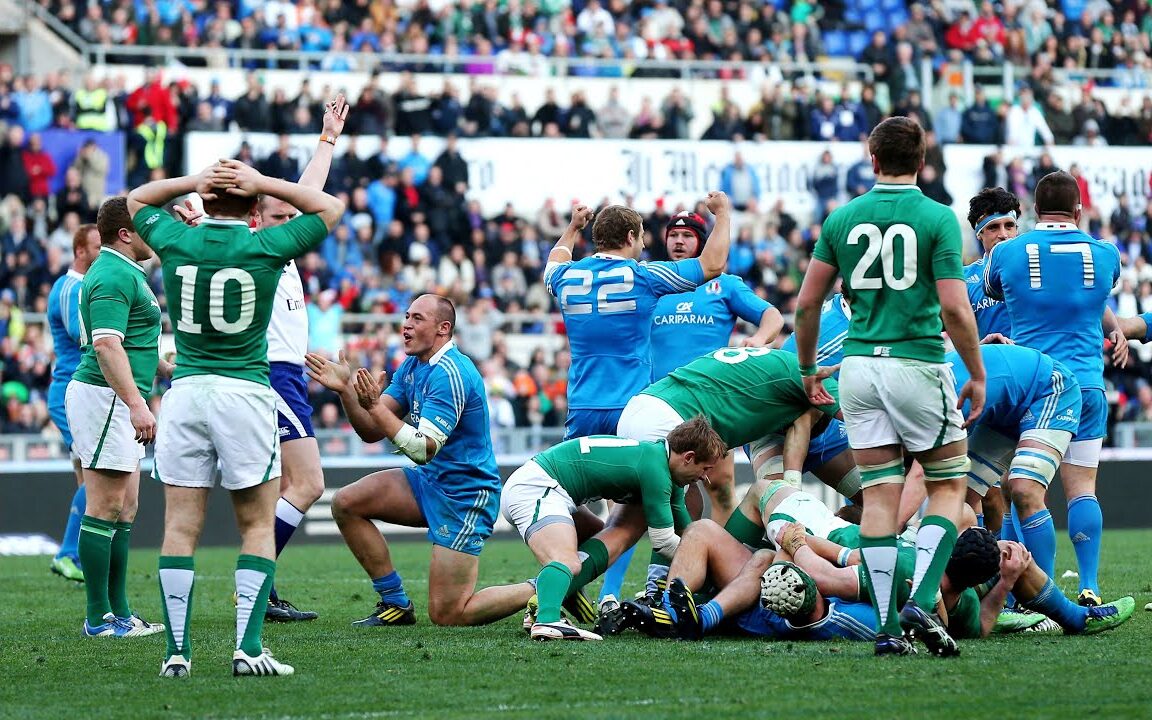
Joe Schmidt came in to replace him and the rest is history. Personally – and keep in mind that I am a sickeningly biased Munster keyboard muncher, after all – my own theory on Declan Kidney is that he had two eras as Irish head coach. The first was shaping the team that should have won a Grand Slam in the three years prior into a team that did, almost immediately.
The next four years of his tenure were spent giving debuts and initial starting opportunities to a number of players who would go on to be good internationals at the very least or foundational and, in Sexton’s case, generational talents for years to come. Cian Healy, Johnny Sexton, Sean O’Brien, Keith Earls, Donnacha Ryan, Sean Cronin, Mike Ross, Rhys Ruddock, Devin Toner, Conor Murray, Peter O’Mahony, Dave Kilcoyne, Simon Zebo and Iain Henderson all got their first cap or initial set of caps under Kidney. Bringing through players like that while the core of the team who dominated most of the 2000s does not come without taking a few L-shaped lumps along the way, and Kidney’s Ireland certainly did that.
Sexton, in particular, benefited quite a bit from the exposure Kidney initially gave him and then, crucially, stuck by him even though his goal-kicking was more than a little iffy at the time and he still hadn’t quite pulled it together consistently at test level. When Kidney started, Sexton was all potential. When Kidney finished, he had successfully replaced O’Gara as Ireland’s starting #10 with a player of a similar calibre, something that was seen as an impossibility for most of the 2000s.
But that loss to Italy was grim and it signalled that Kidney’s time was up. Ireland were less than the sum of their parts and Italy exposed that, plain as day. He finished up with a creditable 52% win record at Ireland and the first Grand Slam in decades with a tonne of young talent blooded.
Ireland would win the Six Nations the next year under Schmidt with the players Kidney capped early enough in his tenure chief among the top performers.
It seems like a different world now, but today has roots in that distant past. Today, Ireland is the #1 ranked team in the world. After that defeat to Italy ten years ago, Ireland fell to ninth from seventh.
 That seems unthinkable today – failure always does when you’re at the top of the wheel – but, as I take on the appearance of a gnarled, wizened old fisherman who’s seen way too many guys with massive oar wounds on their heads dumped over the side of rowing boats, let me tell you that the worst can always happen right when you think you’ve got it all figured out.
Will Ireland lose this game ten years on? No, no… I mean, probably not. It’s incredibly unlikely. Italy are improving and have improved in a way that isn’t just a relative uptick by small increments. They have made far more easily visible Big Steps in the last two years under Kieran Crowley that make them a particularly greasy banana skin as of late, as France almost found out on the opening round of the tournament this year. Put simply, it would be the shock of the decade if Ireland were to slip on it this weekend.
Italia: 15. Ange Capuozzo, 14. Edoardo Padovani, 13. Juan Ignacio Brex, 12. Tommaso Menoncello, 11. Pierre Bruno, 10. Paolo Garbisi, 9. Stephen Varney; 1. Danilo Fischetti, 2. Giacomo Nicotera, 3. Simone Ferrari, 4. Niccolo Cannone, 6. Sebastian Negri, 7. Michele Lamaro (c), 8. Lorenzo Cannone
Replacements: 16. Luca Bigi, 17. Federico Zani, 18. Marco Riccioni, 19. Edoardo Iachizzi, 20. Giovanni Pettinelli, 21. Alessandro Fusco, 22. Luca Morisi, 23. Tommaso Allan
One of the big myths of the last two or three seasons is the depth that Ireland have. Ireland do not have depth in the way France, the Springboks or maybe even the All Blacks or Australia do. Depth, to me, is when you have around three or four guys per position who could – realistically – step up the chart to maintain your current game plan and squad aims without too much in the way of disruption.
Think about the Ireland squad for even a few minutes and it’s clear that this only applies to, perhaps, the midfield or hooker. Every other slot on the team is vulnerable to real uncertainty with two or more injuries in associated units.
What does Ireland’s back five look like if all of Caelan Doris, Tadhg Beirne and Josh Van Der Flier were injured, for example? What does it look like in a serious game with actual consequences for the week after on the line? Since 2020, Farrell has started eight players in the three back-row role slots in the Six Nations.
They are Caelan Doris, Peter O’Mahony, Josh Van Der Flier, Jack Conan, Tadhg Beirne (used as a second row almost exclusively since 2021), Rhys Ruddock (currently out of the squad), CJ Stander (retired) and Will Connors (currently out of the squad). At fullback, Ireland last started a non-Italian Six Nations game without Hugo Keenan in 2020. Who starts there if he picks up a calf injury that keeps him out of two World Cup pool games? I couldn’t tell you. Whoever it is, they’d be coming in with very few minutes of any consequence. The last guy who started an Ireland game with 15 on his back was Ulster’s Michael Lowry, who isn’t currently in the squad.
At #10, the most important position on the field, we are as reliant on Sexton today as we were ten eight four two years ago with Joey Carbery, the player with the most consistent amount of backup minutes over the last few years out of favour. This weekend Ross Byrne will take the reigns to try and stake his claim with a start, the first time anyone other than Carbery (out of favour) and Burns (out of the squad) has done so since before the last World Cup.
This is not meaningful depth.
If James Ryan and Iain Henderson miss two games in a row at the World Cup we’d be left with Beirne, who’s World Class sure, but who else? Ryan Baird? Who is our tighthead lock replacement in that scenario? The talented but green as baby goat shit Joe McCarthy? Kieran Treadwell, the guy who wasn’t initially called up to the squad but only got in once Beirne got injured? We don’t know. Farrell has a plan, of that I’m sure, but we’re not seeing it in minutes earned during the Six Nations. Minutes played against Japan, Fiji, New Zealand XV or the Māori All Blacks in the summer and November, for me, are not consistent enough to build players into what is Ireland’s greatest strength – club levels of offensive and defensive cohesion.
Last year, Eddie Jones laid it out pretty clearly before the England v Ireland Six Nations game.
“They are literally, and I say it without any hesitation, the most cohesive side in the world.
The bulk of their team trains together for the bulk of the year, they’re very well coordinated in their attack, they’re very structured, they’ve very sequenced set-plays and they’re tough around the breakdown. So, they pose a great challenge for us.”
You might not like Eddie Jones, but he’s right. Ireland can play with a level of offensive complexity that isn’t normally possible at test level when it comes to the elite end of the game.
So “depth” for Ireland is only useful if you can seamlessly integrate that depth into Ireland’s System, which runs on the Leinster template of Stuart Lancaster and Leo Cullen from around 2020 to the present day. It is demanding, it is complex and it has very specific roles that make it work.
Caelan Doris is Ireland’s most important back-five forward because he can seamlessly play two roles in Ireland’s primary game. Andrew Porter, Dan Sheehan and Ronan Kelleher are the next most important players in this system because they provide the heavy support work that underpins everything and explosive edge ball carrying as Ireland move through the 3-2-X system that we’ve made our own over the last three years.
That system is fuelled by a high kick volume counter-transition game, which I’ve gone over before countless times but essentially works by attacking the opposition’s options on kick return, hyper-focusing on the phases after they kick back to you (Ireland have the most counter-attack tries in the Six Nations to date) and essentially controlling all outcomes after you kick long.
That is then counter-balanced by the midfield – high breakdown involvements expected from both – with high defensive intelligence and aggression to attack teams who try to on-ball Ireland after we kick back to them. This is what Italy will do this Saturday so, in that regard, Ringrose is a massive miss in that his defensive aggression and speed is vital to Ireland’s management of the game.
The biggest challenge facing Ireland here is how this rotated side handles the demands of running The System.
If Ireland are the most cohesive side in the world and cohesion in the system is the most valued property, changing up the components that define that cohesion has risk.
When Ireland have voluntarily mass rotated players into the System previously – think July 2021’s narrow win over Japan, Ireland XVs loss to the Māori All Blacks in July 2022, Ireland A’s loss to the New Zealand XV in November and a scrappy win over Fiji last November that was really scrappy and only fully defined by a Fijian red card and a subsequent yellow card in the second half, you get an idea of how changing from the winning script can be risky.
This is why I feel Farrell has been so reluctant to change from the winning formula in games he must win to succeed. But every game you choose to stick with your first template of Ireland 1 – we all know the team that is – that is one extra game where you aren’t accelerating players to the on-field application of the System. Farrell’s System heavily prioritises training performance in camp over performance outside the camp.
This is why guys like Scott Penny can be called up with no internal dissonance over his 10 Cat A match minutes in five seasons stat. He is embedded in the Leinster system, which is mostly the Irish system, so he is an ideal training addition for the week when you’re running a few new combinations.
That is not a risk for the Irish coaches.
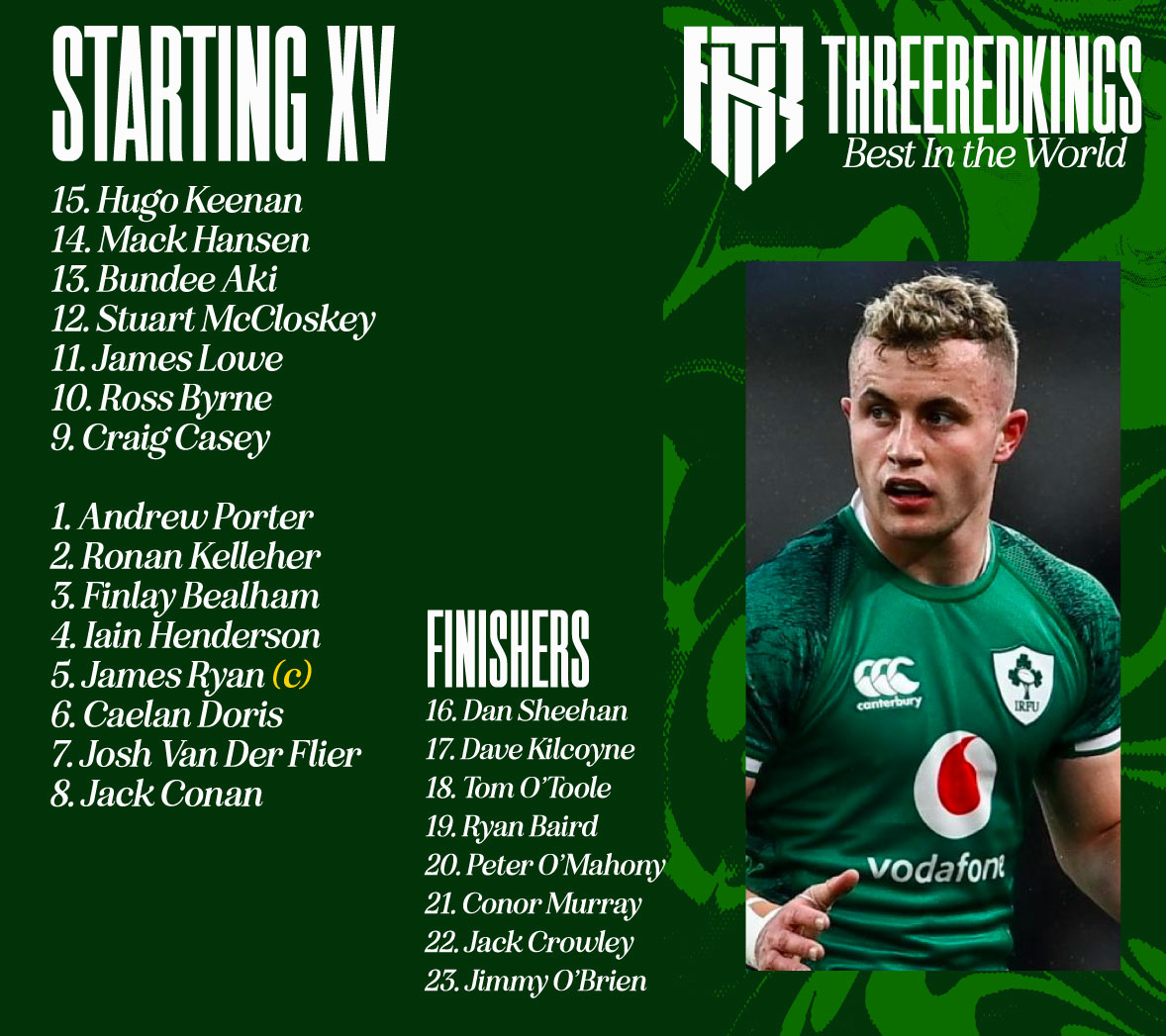
Of the changes to the squad here, all but two are injury forced.
Sexton is hurt, so Byrne starts in a role that he’s endlessly familiar with at Leinster level. Henshaw and Ringrose are both injured, so McCloskey and Aki have to step in. Henshaw was hurt pre-tournament but McCloskey’s performances were on-system, so he’s been retained however this kind of move away from both Henshaw AND Ringrose is not ideal with the System. This is a risk point for Ireland because Aki doesn’t give the same defensive coverage on transition so Italy can get access through this point.
The back three as we’ve come to know them in the last season or so remain unchanged.
One voluntary change is at halfback, where Casey steps in for a start. This is seen as a risk but isn’t, really, because Casey is the most accurate passer in this year’s Six Nations (100% accuracy on 68 passes) and easily plays at a tempo that Ireland runs on.
The other is in the back row where Farrell has chosen to start Conan and move O’Mahony to the bench. This is a typical Farrell rotation. Usually, he likes to start with O’Mahony for his lineout and breakdown output only to switch to Conan’s more rounded, heavy wing forward roleset for the final 20 minutes. He’s reversed that order here because it’s the one game where you can probably do that with relatively little risk and if the Irish lineout is underperforming – as it has done so far in the Six Nations running at a sub-elite 88.5% – you want O’Mahony on the bench to stabilise it if the worst comes to worst.
Ultimately, this is a game between two teams with very similar tactical approaches. Both Ireland and Italy have the highest volume of passes and play off some of the quickest ruck ball in the tournament. What’s the main difference? We’re a high-volume kicking team and Italy isn’t. Most of their passes come in the post-transition phases where they use Capuozzo (one of the best transition runners anywhere) and a uniformly mobile and athletic 11-12-13-14 to stretch teams on transition.
The biggest problem for Italy is that they haven’t been converting these opportunities with either direct tries or 22 Entries. When they get into the 22 they are really efficient (third overall for points per 22 entry) but they aren’t doing it enough. They have the lowest 22 entries of any side in the Six Nations this year so far and concede the most entries on the other end.
If they can up the volume of their 22 entries and keep that efficiency of scoring, they’ll start beating teams far more consistently. They will feel here that Ireland’s counter-transition game syncs up well with them, especially with Ireland’s issues in midfield and a feeling that our wingers are not lockdown defensive specialists in post-transition phase play. Too often this season, Italy have fallen victim to making a linebreak and then kicking on the ball for further territorial advantage. They’ve generated as many linebreaks as Ireland have but Ireland have scored SIX tries directly from these breaks. Italy have only scored two and have mostly lost possession – if they sort that out against Ireland… they can cause problems.
Ultimately, I think Italy’s defence will be their downfall here. They’ve conceded six tries off the lineout so don’t be surprised to see Ireland have more of a maul and first-phase focus than we’ve seen in the last two games to exploit this weakness. The big focus, for me, is how Italy react to Ireland’s long kicking game or if we’ll scale it back to a more contestable short game to avoid giving Italy’s outside backs and Garbisi too much exposure to our transition defence.
