



After the deeply stressful Race To The Eight in the last few weeks, the inherent pressure of knock-out rugby doesn’t feel quite as suffocating, even at altitude.
Since the loss to Exeter in the Challenge Cup Round of 16, Munster have been in survival mode week after week after week since the middle of April. It doesn’t feel like just over a month of rugby, but that’s what pressure does — it stretches and manipulates your perception of time. A month can feel like a season, and a season can feel like a month. At altitude, a game can feel like a year.
But we know this. Nothing about Loftus Versfeld is a surprise to anyone at Munster at this point. “Altitude. 1350m. It Matters”, the sign says. More suitable to a cockpit than a stadium, isn’t it? It’s part of the furniture, and the Bulls want you to know that you are very high up indeed, relatively speaking.
The challenge is always the same. Hard ground. Thin air. Big scrum. Massive human beings. Incredible pace on the edges. It’s predictably imposing.
Is it any more imposing than playing a game at home against the Lions with 12 first team players out injured and the financial future of the club on the line? Sure, the Bulls are big men, but are they any bigger than the fear that, if you lose a regular season game, you could be costing the jobs of people you meet walking through the stadium or at the HPC?
No. They are not.
Our injury issues haven’t really changed at all in the last two weeks. We’ve got Alex Nankivell back, and Fineen Wycherley on the bench, and they’ll be badly needed. But this isn’t about who isn’t available, it’s about who is. Two weeks ago, we went to war with the Lions with the rent due, essentially. Win, and live. Lose, and die.
On Saturday, the stakes are less existential. Sure, we’re cut to the bone with a mass injury crisis, but it’s not about who isn’t there, it’s about who is. We’re going to be heavily up against it, so let’s see if we can’t go to war one more time. Maybe, with a bit of luck, we can make the Bulls fear a little existenstial fear of their own.
Munster: 15. Mike Haley; 14. Andrew Smith, 13. Alex Nankivell, 12. Seán O’Brien, 11. Shane Daly; 10. JJ Hanrahan, 9. Craig Casey (c); 1. Jeremy Loughman, 2. Niall Scannell, 3. Michael Ala’alatoa; 4. Tom Ahern, 5. Evan O’Connell; 6. Jack O’Donoghue, 7. John Hodnett, 8. Brian Gleeson.
Replacements: 16. Diarmuid Barron, 17. Josh Wycherley, 18. Conor Bartley, 19. Fineen Wycherley, 20. Gavin Coombes, 21. Ben O’Donovan, 22. Dan Kelly, 23. Alex Kendellen.
Vodacom Bulls: 15. Willie le Roux; 14 Kurt-Lee Arendse, 13. Canan Moodie, 12. Harold Vorster, 11. Stravino Jacobs; 10. Handré Pollard, 9. Embrose Papier; 1. Gerhard Steenekamp, 2. Johan Grobbelaar, 3. Wilco Louw; 4. Ruan Vermaak, 5. Ruan Nortjé; 6. Marcell Coetzee (c), 7. Elrigh Louw, 8. Cameron Hanekom
Replacements: 16. Marco van Staden, 17. Jan-Hendrik Wessels, 18. Francois Klopper, 19. Cobus Wiese, 20. Jeandre Rudolph, 21. Paul de Wet, 22. Stedman Gans, 23. Sergeal Petersen.
In the last four rounds of the URC, the Bulls have picked four handy wins but it should be noted that all of those games have been against teams that had functionally nothing to play for.
That doesn’t mean the Bulls can’t put 40 points on us this weekend, of course, but I think they will be aware that they have not been fighting for their lives during the run in. The fixtures fell well for them — two away games against bottom ranked Welsh teams, two home games against Italian teams looking forward their holidays — and they earned a home quarter-final having been outside the top eight for a good portion of the season.
Of those four games, their most difficult was against the Scarlets — they almost lost it — and I thought it would be really interesting to see why that was.
At a basic level, the Bulls are a straight line team. They offload a lot, yes, but it’s off the back of straight, hard carrying off #9 to force compressions, with a lot of action off their lineout and scrum plays to take advantage of the speed and agility they have on the wings.
What they don’t like — and have no real ability to compensate for — is missing the first tackle on transition, and getting caught off balance on the second or third phase on transiton. Defensively, they play a drift to avoid giving up dog legs that their front five can’t cover behind. The key part of this is their size. It’s a massive part of their game when it’s going well, but they have to mitigate for it too.
If you go back to our game against them a few weeks ago, a lot of our linebreaks/tries came from this ability to unbalance them.
They want to smash you in the narrow spaces and drive you backwards, but you can, with the right accuracy, pull them apart post-transition.
Watch Wilco Louw and Cameron Hanekom on this phase;
The Bulls recover, but look at how a scrappy post-transition phase that didn’t exactly follow the flow the Bulls expected ended up in a critical linebreak.
On their own exits upfield, look how much spacing they give up behind the transition line because their pack can’t cover the space behind their backline press when the ball moves off the straight line of the kick.
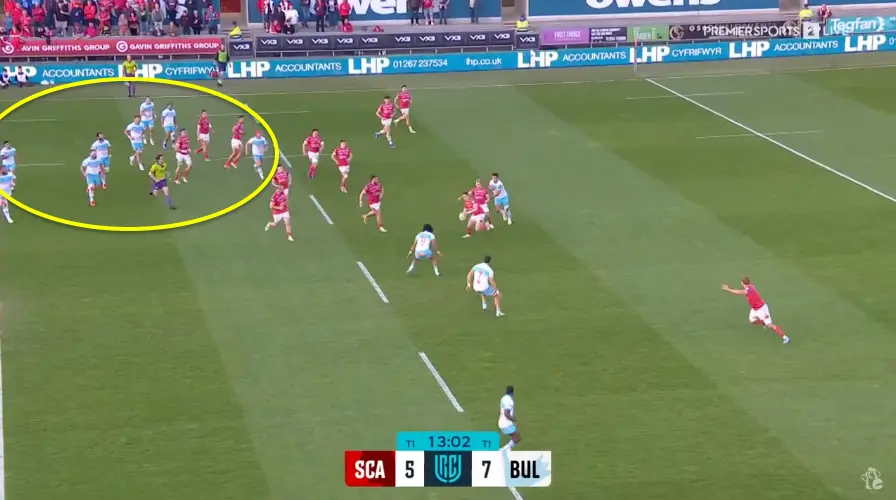
This is the core of their mitigation for size — they drift in the backline to buy time for the forward pack to cover across.
Off the set piece, they use Pollard — their slowest outside back — as a blitz to ensure he doesn’t get caught against the grain on the drift.
That leads directly to a yellow card for the Bulls to stop the linebreak.
Something to watch, something to manipulate.
The Bulls biggest weapon to bail them out of difficult situations is the scrum, and they have an incredibly formidable unit here, on both sides of the ball. They are rock solid on their own ball, and have been creeping up their penalties won as the season has progressed.
If they find themselves in bother at any point, their scrum gets them marching up the field. We’ll have to counter that with a very aggressive lineout strategy, firstly, and be incredibly quick and accurate with our own put in. If the ball gets stuck in our second row, they’re going to get up on both sides and we’ll concede penalties without question.
Our kicking game has to counter-balance that, too. We’ll have to kick in the mid-range for territory while also making sure we can compete in the air against Arendse, Jacobs, Moodie and Le Roux, but we will be well aware of the potential scrummaging mismatch.
They can get pinged for turning the corner on the loosehead side behind Steenekamp, in particular, but that depends on the referee.
If we can make the scrum a non-factor — the biggest battle — will be the biggest foothold we can get in the early game. Then it comes back to whether we can execute against their blitz.
