


Welcome to the mosh pit. We’ve got fun and games.
The URC mosh-pit is that sweaty, punishing spot in the league table between third and tenth where 10 points – two bonus point wins, essentially – separate eight teams who are all either two good rounds or two bad rounds from being in full-blown red alert mode when it comes to European qualification and the URC playoffs.
Here’s a quick example of how sweaty it is at the moment. Imagine the league finished tomorrow.
Cardiff, currently in 10th, would qualify for the European Cup ahead of Edinburgh, in 8th, who would miss out because Cardiff are top of the Welsh shield. Edinburgh would finish in the playoffs but out of the Champions Cup for next season unless they made the final. So, if you’re in the moshpit, you have to hope that Cardiff make it into the top 8 as long as you’ve already played them – so they can’t beat you – to make sure that the bottom half of the playoff/Champions Cup cut-line doesn’t go one slot higher.

And that’s before you realise that the super-stacked Cell C Sharks are currently 9th but they’ve got two games in hand on the rest of the mosh pit which, if they can manage to win both of those, means that they are in a false position with between 8-10 points yet to be allocated. So, if you have an interest in the mosh pit – and you do – you need to be watching Edinburgh vs the Sharks on Saturday evening with real interest because it all matters at this point in the season.
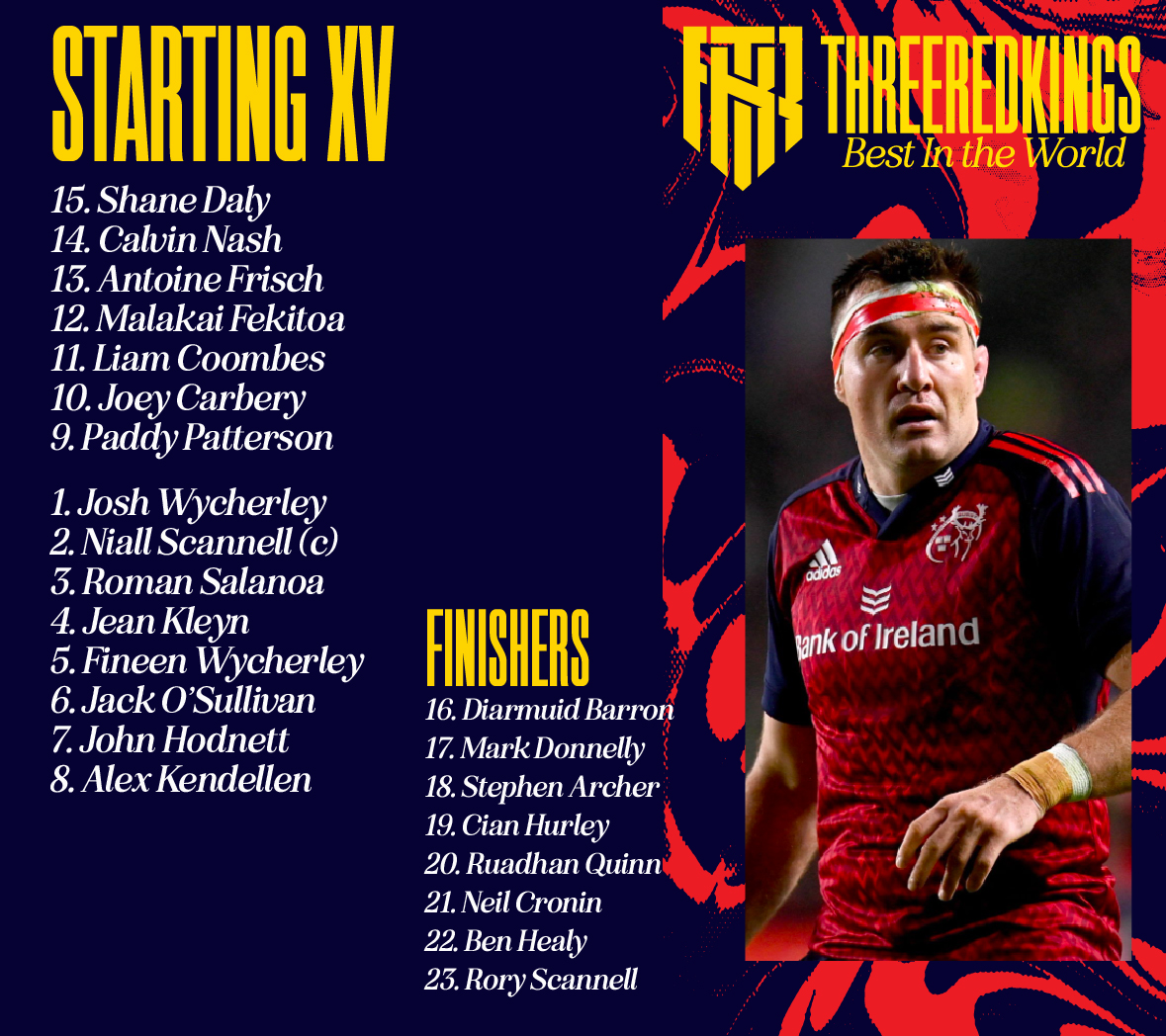
As for Munster, we are at the tail end of a fairly rough 10-week run of games that started against Connacht in late November, saw us travel to Northampton, Toulouse, Edinburgh and Belfast, and finishes this weekend away to Benetton in Treviso with the Six Nations break looming.
Munster won’t play again until the 17th of February which makes for a clean two-week break between match weeks. It’s badly needed. When I say that it’s a tough run of games, I mean that we have done the usual trick over the last block of games where we’ve been burned down to the ground with injuries in one particular position.

Ahead of this block, we brought in John Ryan because we’d lost both Keynan Knox and Stephen Archer to mid-level injuries, meaning we only had Roman Salanoa fit before signing Ryan as a short-term medical joker.
In the second row, we lost Thomas Ahern, Edwin Edogbo, Paddy Kelly and Fineen Wycherley to a string of injuries to go with the already-injured RG Snyman. We brought in Kiran McDonald who, over the last few weeks, was also injured. That meant we had to lean heavily on Kleyn and Beirne over the course of this mid-season block, who have played 873 and 858 minutes respectively. Our second-row injury crisis is such that Tadhg Beirne has already played more Munster minutes this season than he has since his debut campaign here and it’s not even February.
Power is expensive, as we know, and Munster’s mid-block of the season has been managed with two senior fit and available second rows available for most of it.
So that we currently find ourselves running with 6 wins out of 9 so far – two losses to Toulouse and one to Leinster – is pretty good going when you consider the first block of 7 games this season saw us win two. That wasn’t good enough and, for where this team want to go, 6 out of 9 isn’t good enough either but we’re seeing the building blocks of what is possible.
Facts are facts, though. We’re still sixth and we’ve got direct competitor business to deal with this weekend. If we can beat Benetton – ideally with a bonus point – and Glasgow stumble on the road against the Dragons we’ll be in fifth for the first few weeks of the Six Nations with three home games on the bounce to come against teams heavily drained by test callups.
It’s a tantalising prospect.
Benetton Rugby: 15. Rhyno Smith, 14. Ignacio Mendy, 13. Marco Zanon, 12. Filippo Drago, 11. Mattia Bellini; 10. Jacob Umaga, 9, Dewaldt Duvenage; 8. Henry Time-Stowers, 7. Alessandro Izekor, 6. Giovanni Pettinelli, 5. Riccardo Favretto, 4. Marco Lazzaroni, 3. Tiziano Pasquali, 2. Siua Maile, 1. Nahuel Tetaz
Replacements: 16. Bautista Bernasconi, 17. Thomas Gallo, 18. Filippo Alongi, 19. Nicola Piantella, 20. Carl Wegner, 21. Braam Steyn, 22. Manfredi Albanese, 23. Marcus Watson
Benetton have the highest test call-up percentage in the URC for the Six Nations. The 23 players Benetton lost to the Italian camp this week are three more than Leinster, eight more than Glasgow and nine more than the Ospreys. Does that mean the side we’re playing will be any less dangerous? Yes. But that doesn’t mean that they aren’t capable of hurting us in this game or causing what would, on paper, be something of an upset when you look at both sides.
One look at Benetton’s selection for this tells you where they think they win this game – they have a 6/2 split and two of their back five replacements are locks. The other replacement is Braam Steyn who, sure, might have dropped out of Italian contention but he’s still a powerful, direct power forward build back row who can make things difficult for us on both sides of the ball if we’re chasing the game.
Benetton’s usual framework is based on hard counter-transition with a high tackle volume, a big focus on breakdown pressure on the first few phases post-transition and it’s all fuelled by a high-volume, long-distance kicking game.
Duvenage and Albernoz are some of the highest-volume kickers in the league and they’ll use that to start counter-transition sequences where they really impact in the tackle and go hard at the breakdown in the wider channels.
Munster are really pushing on with our own kick transition game as of late so there will be opportunities for us to hurt them but we’ll need to be super sharp on our post-transition rucks. We’ve essentially picked a three small-forward back row to take advantage of this – we’ve upped our mobility in transition to maximise our numbers on those high-speed, flow breakdowns – so this will be a key battleground if Benetton stay on scheme.
They put a lot of focus on staying active on the short side to pressure jackal turnovers and errors on post-transition phase play, but that opens up an opportunity for us if we can keep the pace high.
Looking at their pack build and bench, they seem highly structured towards lineout contesting and heavy defence, which makes a lot of sense based on where we’ve fallen down this season. If we can avoid their lineout contesting and stay north of 95% completion at the breakdown there will be a world of scores for us in this game as Benetton try to play their A-game with their second layer.
