



No bones about it, this has to be a bonus point win.
We know, the squad know it, and Dragons probably know it, too.
The last two weekends in Europe have been two different flavours of disappointment, but that’s in the past now. No more changeable than something from ten years ago, or twenty. You’ve got to have a short memory in this game, so forget about Toulon and try to forget about Castres. There’s business to be done in Virgin Media Park on Friday night.

That is a skill in and of itself. Munster need a reaction this week, a good performance, a win, but you can’t overtly tie that to the loss to Castres either. Do that, or too much of it, and you’re still tied to that experience. You look past a Dragons side who have improved tenfold from last season, on multiple fronts, although they’re still something of a washout away from home. You could argue that, while we’re not quite a washout at home, we’ve been less than imposing there over the last few seasons.
This game can turn into a dogfight if we show up too focused on what we can’t change. In a way, that’s why it’s so refreshing to see the squad with so many younger players. The focus immediately turns away from last Saturday and into the energy needed this Friday.
Munster Rugby: 15. Mike Haley; 14. Thaakir Abrahams, 13. Dan Kelly, 12. Alex Nankivell, 11. Shane Daly; 10. JJ Hanrahan, 9. Ethan Coughlan; 1. Jeremy Loughman, 2. Diarmuid Barron (c), 3. Michael Ala’alatoa; 4. Jean Kleyn, 5. Fineen Wycherley; 6. Seán Edogbo, 7. Ruadhán Quinn, 8. Brian Gleeson.
Replacements: 16. Lee Barron, 17. Josh Wycherley, 18. Oli Jager, 19. Evan O’Connell, 20. Gavin Coombes, 21. Paddy Patterson, 22. Tony Butler, 23. Diarmuid Kilgallen.
Dragons RFC: 15. Angus O’Brien; 14. David Richards, 13. Fine Inisi, 12. Aneurin Owen, 11. Rio Dyer; 10. Tinus de Beer, 9. Che Hope; 1. Rodrigo Martinez, 2. Brodie Coghlan, 3. Robert Hunt; 4. Levi Douglas, 5. Ben Carter; 6. Harri Keddie, 7. Harry Beddall, 8. Aaron Wainwright
Replacements: 16. Oli Burrows, 17. Jordan Morris, 18. Cebo Dlamini, 19. Seb Davies, 20. Shane Lewis-Hughes, 21. Rhodri Williams, 22. Harri Ackerman, 23. Cai Evans
Dragons Cheat Sheet
What they are: A platform-and-strike side. Tight-field attack, heavy set-piece dependence, and they want points from repeat entries rather than long, flowing phase play.
How they score: Set piece is the engine. Their try profile is overwhelmingly set-piece led, with a big chunk coming straight off 1st phase. If they’re getting lineouts inside our 40 and launching mauls, they’re in their comfort zone.
How they play: Narrow and pragmatic. They keep a lot of ball <10 metres, don’t spend huge time in 5+ phase sequences, and end a high share of possessions with a kick — but they rarely contest in the air, so there are chances for us to win the exchange and counter if our receipt and connection are good.
What the data says: They can be efficient off limited entries, but when forced into long-field rugby, they can go blunt (Glasgow game). Starve them of entries and make them play from deep.
Defensive profile: High tackle completion, but not a big “gainline denial” or dominant-collision team. They’ll make tackles — so we need tempo + post-contact to bend them, not hopeful one-outs.
Munster keys:
- Discipline + exits: don’t feed their lineout/maul game.
- Maul defence: disrupt the set-up early, don’t wait for momentum.
- Territory + backfield: force them to play from deep, and punish their low contestable-kick rate.
- Attack with purpose: win collisions, quick ruck, then width—don’t get hypnotised by their tackle %.
The Dragons have, obviously, improved a lot from where they have been in the last few seasons. That’s mainly so obvious because of their position in the URC table — 13th, after multiple seasons finishing 15th or 16th — but their performances have been wildly improved. For a side that went a full calendar year without winning at home, they’ve managed two draws and four wins across the URC and Challenge Cup, and were a mad refereeing decision from maybe, possibly sealing another draw against Leinster, of all teams. Their 48-21 win over Connacht almost defied belief at times, but it reflected how much they’ve improved in a crystal clear, undeniable manner.
One thing is clear; they aren’t the rollover jobbers of seasons gone by, in Wales at least, but I wanted to see if I could track their improvement on my usual metrics.
Definitions I’m using
- Net Efficiency (NE): Dragons’ Points per Entry − Opponent Points per Entry
- +NE = Dragons are more efficient per 22 entry
- −NE = Opponent is more efficient per 22 entry
- LBR (Linebreaks per Ruck): Linebreaks ÷ Rucks
- I’ll also show per-100 rucks and the intuitive reciprocal: “one linebreak every X rucks.”
Season totals and baseline profile
Net Efficiency across the set
- Dragons weighted PPE: 2.73 (95 entries)
- Opponents weighted PPE: 3.00 (122 entries)
- Season Net Efficiency (weighted): −0.27 PPE
That’s the clearest “season” signal: they’ve been slightly less efficient per entry than opponents overall. This is good because, coming into the season, you would have expected that efficiency rating to be massively negative, as opposed to being a marginal one.
They are showing to be a team that hangs in the fight a lot more consistently than in previous seasons.
Two important context flags that matter for our game:
- Entry deficit is a bigger issue than efficiency. Across these games, they’re −27 entries overall (95 for, 122 against), i.e. about −2.1 entries per match. Even when they’re decent per entry, they often concede more entries.
- Their NE splits hard by game:
- In positive NE games (6): Dragons average 3.32 PPE vs opponents 2.03 (they’re usually very efficient when they’re efficient).
- In negative NE games (7): Dragons average 2.20 PPE vs opponents 3.68 (they’re not “slightly worse”; they tend to get hit hard on efficiency when it turns).
LBR across the set
- Total rucks: 1,095
- Total linebreaks: 55
- Season LBR: 0.0502
- Per-100 rucks: 5.02
- Reciprocal: one linebreak every ~19.9 rucks
Key interpretive point: their linebreak rate and their entry efficiency are basically unrelated in this sample (the relationship is effectively zero). That fits their broader profile: they can score efficiently off platform (set piece/short-field) without needing lots of linebreak creation.
Match-by-match Net Efficiency and LBR
The minute you plot the Dragons’ Net Efficency rating on a rolling scale, you can begin to track their improvement after a difficult first five games. They have been trending upwards since that point, and the results haven’t told the whole truth about what they’ve been doing week to week.
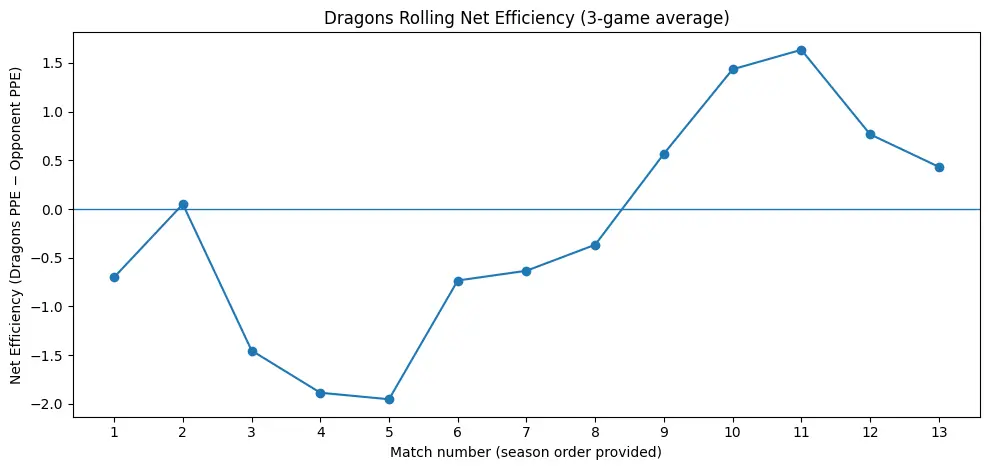
This is an incredible turnaround from where they have been over the last few seasons, and is worthy of serious praise.
What this says in plain terms
Their “good version” is brutally efficient per entry
When Dragons are positive on NE, it’s not marginal. They post 3.3+ PPE regularly (Connacht, Scarlets, Lyon), which is exactly the profile of a team that can cash in quickly when the platform is right (short fields, clean set piece, repeat pressure).
Their “bad version” can collapse on finishing (not just chance creation)
Glasgow is the clearest example: 6 entries, 0.0 PPE. That’s a finishing failure. It also aligns with what we’ve seen from their broader profile: if you force them into long-field, low-platform rugby, their scoring can stall.
LBR is volatile and often game-state dependent
- Their two biggest LBR spikes are Connacht (12.82/100) and Benetton (13.16/100). Those are the kinds of games where linebreak totals can inflate because the match becomes looser, there are more transition looks, or one team is chasing/defending broken shape.
- At the other end, Leinster (1.19/100) and Lyon (1.04/100) show they can have very few linebreaks and still be in games (or even win on NE) because their scoring profile doesn’t require sustained linebreak creation.
The key relationship isn’t NE ↔ LBR; it’s NE ↔ platform quality
Across their seasonal sample, the linebreak rate doesn’t predict their entry efficiency. What predicts it is whether they’re getting their preferred looks: set piece, early-phase, and short-field access. Deny them those, and their ability to score evaporates.

The core problem: Dragons don’t need “flow” to hurt you
Everything in their seasonal data points the same way:
- They are narrow (only 20.6% of their play goes wider than 1st receiver; 59.6% of their movement is <10m). This is, essentially, a set-up attack designed to buy penalties and compress defences for kick action, which they do on almost all of their phases outside of the opposition 10m, and many inside it.
- They are platform-led scorers (try origins: 75% set piece, 41.7% 1st-phase).
- They are not a counter-attack team (0% of tries from kick returns; very low from turnovers).
- They end possessions with a kick a lot (43.9%), but rarely contest in the air (6.9%).
So the shutdown brief is less “stop their linebreak game” and more “stop their platforms”. If we keep them out of our 40 and deny lineouts/scrums in our half, we remove the bulk of their try supply. They will kick almost everything they get off a turnover outside of the 22, so we’ll have to be accurate when we’re pressing them, because almost everything we spill or kick loosely will be coming back down the field at our backfield, with Rio Dyer, Inisi and Owen haring after it. That scramble is a key part of their game outside of penalty access.
Your mistake gets turned into negative territory at the first action.
Discipline and exits are the match
Because Dragons score via set piece + first phase, the biggest gift you can hand them is: penalties that turn into lineouts inside our half, multiple penalty ladders in particular.
What we need to do
- Treat every midfield penalty as a potential maul try conceded. Don’t feed them.
- Prioritise exit accuracy over exit ambition. Their 22 exit success is high (86.9%), so they’re comfortable starting sequences; we want them exiting under pressure, from deep, after long carries — not getting handed entries via whistles.
- On our exits, back ourselves to win the next contest: Dragons kick a lot but don’t contest much, which should let us win territory if our chase and backfield are connected.
Live trigger: if Dragons have two lineouts inside our 22 in the opening quarter, we’re playing their game. Fix immediately: tighter discipline, simpler exits, less “play-from-own-22” ambition.
Maul defence must be proactive, not heroic
The set-piece data plus try-origins is explicit: they can score through the maul and then strike immediately off 1st phase.
What we need to do
- Contest the throw: their own lineout is 85.1%, and they have modest returns on opposition throws (12.7%) to justify a proper contest plan. Deny them a platform with strong contesting early.
- Disrupt the set-up: win the space before the drive forms.
- Win the first stop: a maul doesn’t need to be a try threat to be a “platform”; it only needs to force a penalty, a defensive splinter, or a short-side mismatch for a 1st-phase shot.
Live trigger: if their maul is consistently getting front-foot and forcing us to overfold, expect the next play to be a rehearsed short-side or seam shot off 9/10.
First-phase defence: force them to play beyond 1st receiver early
They’re built to win quickly off structure, not to improvise across the field. The movement stats say they want to stay tight and strike early.
What we need to do
- On scrum/lineout defence, keep our inside shoulders and seams locked. Dragons’ favourite profit zone is the space just inside the first defender where help arrives late.
- Don’t get pulled into “compress and hope”. Compressing without line integrity is how you concede clean 1st-phase breaks.
- Make them earn width. If we can force them to go past 1st receiver repeatedly, we move them away from the profile that produces — 75% set-piece tries.
Live trigger: if they’re repeatedly beating us on the inside seam rather than the edge, that’s alignment and communication, not “we need more width in defence.”
Win the restart battle
The set-piece data gives us a major warning: Dragons are notably stronger on 50m restarts than we are (they’re meaningfully ahead on “own won %”). For a platform team, restart regains are effectively free entries.
What we need to do
- When we score: put real work into the kick placement and chase shape — don’t hand them an uncontested receipt plus a clean exit.
- Don’t turn a restart into a chaotic sequence that ends with us conceding a penalty and defending a maul in our half.
Live trigger: if they win a restart early, tighten the next two restarts immediately — no “same again” complacency.
Our attacking plan should be tempo + post-contact, not pretty rugby
Their defence profile is telling:
- High tackle completion (90.6%)
- But low gainline denial (26.8%) and modest dominance
- High “missed tackles leading to try/break” consequence rate (32.2%)
This is a defence that will make tackles but can be moved if you keep ruck speed and carry shape clean. That’s where we can put them under stress — with on-ball action.
What we need to do
- Attack with post-contact and fast ruck, not lateral shape for its own sake.
- Keep carries demonstrably “connected” (latch/support) so we don’t give them cheap slowing ball — even if they’re not a high-volume jackal side, any stop-start attack brings them back into their comfort zone.
- Once we have ruck speed, then use width with intent. Their own attack is narrow; teams that play narrow often rely on folding and system to defend edges. Tempo is what breaks that.
Key point: We don’t need 10 linebreaks to beat the Dragons. We need to force them into long defensive sets and make them defend multiple clean possessions without being bailed out by our errors or penalties.
Kicking strategy: use our contest edge, but don’t give them cheap field position
They end possessions with a kick at a high rate (43.9%) but contest very little (6.9%). That’s a structural weakness we can lean on.
What we need to do
- Kick in ways that let us compete or pin — make them either play from deep (where they’re less comfortable) or concede territory.
- Avoid loose “relief” kicks that hand them a lineout around halfway. That’s still a platform, and their profile says they’ll take it.
Live trigger: if Dragons are repeatedly starting possessions around midfield off our kicks/penalties, we’ve manufactured the exact platform they want without them having to earn it.
The big warning: they can be efficient without breaking you apart
Dragons can post strong points-per-entry without piling up linebreaks. So “we’re not conceding breaks” is not enough reassurance.
What we need to measure in-game
- Entries conceded: keep them under 6–7 if possible.
- Penalty profile: especially penalties that give them lineouts in our half.
- Set piece concessions: scrum/lineout outcomes, plus “maul penalties conceded”.
Closer Each Day, Home vs Away
One interesting note from their data is their performances in Wales and their performances outside Wales. You see it first in the results and in their average points scored and conceded.
- Inside Wales: scored 24.6, conceded 18.8
- Away outside Wales: scored 14.8, conceded 51.5
In Wales
- Dragons weighted PPE: 2.99
- Opp weighted PPE: 2.29
- Net Efficiency: +0.70
- Entries: 67 for / 73 against (slight deficit, but they finish better)
Outside Wales (4 games)
- Dragons weighted PPE: 2.11
- Opp weighted PPE: 4.04
- Net Efficiency: −1.94
- Entries: 28 for / 49 against (they concede far more entries, and opponents convert them ruthlessly)
Munster takeaway: make it an entries + territory night. Outside Wales, the Dragons’ big weakness is bleeding 22 entries; don’t feed them set-piece platforms in our half, and force them to defend long-field.
If we want to shut the Dragons down, we don’t start with phase play defence because they won’t show us too much of that — we start with platform denial. Their profile screams set piece and first-phase: a narrow attack, high kick-to-end possessions, and tries heavily skewed to lineout/scrum launches.
The job for Munster is to keep the game in the right areas: ruthless discipline, clean exits, and a restart plan that doesn’t hand them free entries. When they do get lineouts in our half, maul defence has to be proactive — disrupt the set, contest the throw, and force them past 1st receiver. We’ll need Nankivell and Kelly to stay really sharp on their strike plays that will target Patterson and Hanrahan on the inside. Lots of coverage scramble required.
Then, when we have the ball, we don’t need a highlight reel; we need tempo. They tackle well but don’t deny the gainline consistently, and when they miss, it tends to be costly. If we keep ruck speed, carry connected, and build pressure without giving them cheap platforms, we drag them away from the only game they really want to play, and the one game that has powered their positive start to the season.
What we’ve been doing for the last few weeks — to mixed results — is exactly what we need to do here if we’re to land the tries and points difference we need to bank to get the season up and running again.
