



It’s always good to get Glasgow out of the way early, but the problem is that you have to play them early. It’s like when you have an important meeting at 8 am. Sure, you have the rest of the day free, but you still have to be up and at ’em at 8 am. In bed early. Thinking about it on the pillow. In the car for half 6 in the morning. Too much Red Bull before you go in.
How far along are we after a preseason of change, if not verging on radical change?
We’ll find out soon enough, I suppose.
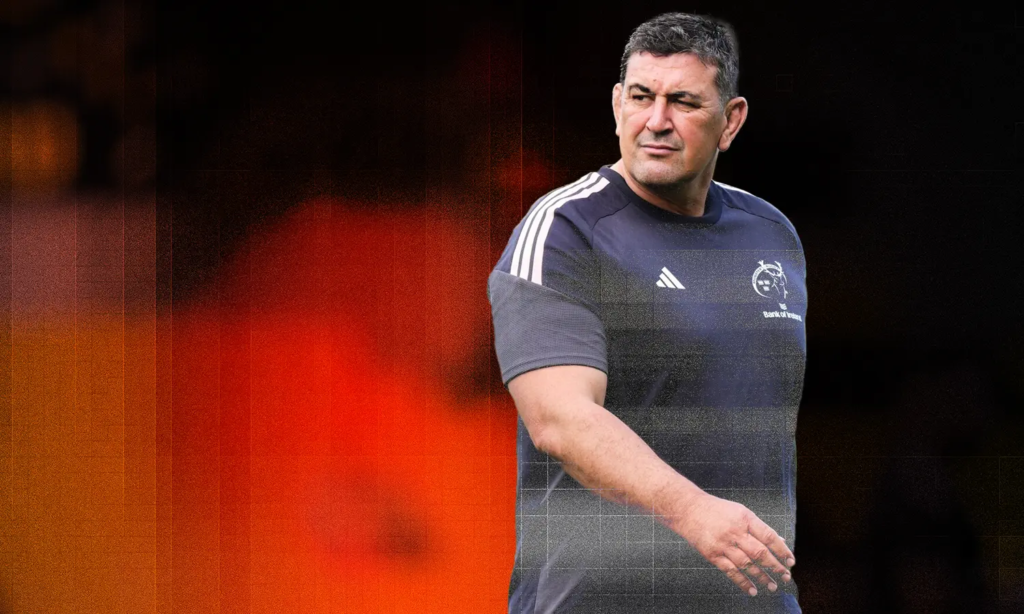
Glasgow are something of an inverse to Munster Rugby in the last few seasons. Where we have had near-constant coaching flux and seasons of uncertainty as we try to work out what we are, what we should be and who should be doing it, Glasgow have thrived under the coaching of Franco Smith, who has successfully moulded the Warriors in his image since he arrived ahead of 2022/23.
Year one should have been a write-off. Smith got the job so late that he took over just before Glasgow’s pre-season fixtures were due to be played, and still they won 13 of their 18 URC regular season matches, up from just 10 the season before. They went unbeaten at Scotstoun, took the prestigious Scottish/Italian Shield*, made their first European final (Toulon gave them a 43-19 hiding at the Aviva, mind), and Smith was named Coach of the Season. Their only home defeat all year? 14-5 to Munster in the quarter-final. Small mercies.
* lol
Year two, they won the URC. Through Thomond first — 17-10 against a Munster side on a 10-match winning streak, a night I’d rather not relive — and then in Pretoria, coming back from 13-0 down just before half-time to beat the Bulls 21-16.
Year three was the comedown, if you can call it that: fourth in the URC, and Leinster ending them in both the URC semi-final and the Champions Cup quarter-final.
Last season was arguably the best of the lot, trophy or no trophy. First in the regular season at 13-5 with 65 points, a perfect Champions Cup pool and a knockout win. Then two gut-punches: a three-point quarter-final loss to Toulon in Europe, and a 22-21 semi-final defeat to the Bulls after leading 21-3 at halftime.
So that’s the floor under Smith. A semi-final, every year, bar his first, and constantly punching above their weight in Europe. The question is whether it holds with Huw Jones, Adam Hastings, Jack Dempsey, Johnny Matthews and our regular torturer, Sione Vailanu, all gone — and whether we’re the ones sat in the car rubbing our eyes at 9 am wondering how it all went so badly.
We don’t know how Munster are going to go here; that’s the truth of it. If last season’s lines continue into this one, we’ll lose, even if Glasgow will be without some of their Scottish internationals. Our big question is whether we’ve managed to cut those strings successfully in the preseason.
- 15Mike Haley
- 14Diarmuid Kilgallen
- 13Alex Nankivell
- 12Seán O’Brien
- 11Ben O’Connor
- 10JJ Hanrahan
- 9Ben O’Donovan
- 1Michael Milne
- 2Diarmuid BarronC
- 3Kieran Brookes
- 4Evan O’Connell
- 5Fineen Wycherley
- 6Jack O’Donoghue
- 7Alex Kendellen
- 8Gavin Coombes
- 16Marnus van der Merwe
- 17Josh Wycherley
- 18Michael Ala’alatoa
- 19Brian Gleeson
- 20John Hodnett
- 21Jake O’Riordan
- 22Charlie O’Shea
- 23Dan Kelly
Munster: Mike Haley; Diarmuid Kilgallen, Alex Nankivell, Seán O’Brien, Ben O’Connor; JJ Hanrahan, Ben O’Donovan; Michael Milne, Diarmuid Barron (capt), Kieran Brookes; Evan O’Connell, Fineen Wycherley; Jack O’Donoghue, Alex Kendellen, Gavin Coombes.
Replacements: Marnus van der Merwe, Josh Wycherley, Michael Ala’alatoa, Brian Gleeson, John Hodnett, Jake O’Riordan, Charlie O’Shea, Dan Kelly.
- 15Josh McKay
- 14Kyle Rowe
- 13Ollie Smith
- 12Stafford McDowallC
- 11Jamie Dobie
- 10Dan Lancaster
- 9George Horne
- 1Patrick Schickerling
- 2Gregor Hiddleston
- 3Murphy Walker
- 4Gregor Brown
- 5Max Williamson
- 6Ally Miller
- 7Rory Darge
- 8Matt Fagerson
- 16Seb Stephen
- 17Nathan McBeth
- 18Sam Talakai
- 19Scott Cummings
- 20Angus Fraser
- 21Macenzzie Duncan
- 22Callum Reidy
- 23Bayley Kuenzle
Glasgow Warriors: Josh McKay; Kyle Rowe, Ollie Smith, Stafford McDowall (capt), Jamie Dobie; Dan Lancaster, George Horne; Patrick Schickerling, Gregor Hiddleston, Murphy Walker; Gregor Brown, Max Williamson; Ally Miller, Rory Darge, Matt Fagerson.
Replacements: Seb Stephen, Nathan McBeth, Sam Talakai, Scott Cummings, Angus Fraser, Macenzzie Duncan, Callum Reidy, Bayley Kuenzle.
On Strings
I went through last season’s per-match numbers for all sixteen URC sides, and the headline is broadly what you’d expect from the eye test. Glasgow carried the ball 156.2 times a game, on average, more than anyone in the league. We carried it 119.9 times. That’s 36 more carries a match, or roughly the gap between Glasgow and Zebre Parma.
Everything else follows from that. Glasgow led the league in possession (57%), territory (57%) and 22-entry differential (+3.4). We were at 50%, 49% and -0.7 on the same metrics. They passed 191 times a game to our 148, beat 28.1 defenders to our 19.8, and won 23.9 dominant contacts to our 15.6. In most of those columns they’re first and we’re somewhere between seventh and twelfth.
When I ran the numbers on a per-carry basis, they evened out quite a bit, but I’m not going to show you that data because it’s incredibly misleading. Glasgow’s system is built around ball retention and maul dominance. They carry the ball more than pretty much anyone, hit more rucks than anyone, and probe for opposition errors on the edges more often than any other team in Europe. So when you average it out on a per-carry basis, you get a false reading on your carrying game relative to theirs. They will carry, lose ground, but keep playing until you make a mistake on one of their frustratingly effective edge plays, in which case they’ll either get a linebreak or double down on your mistake with more carrying until you infringe.
In which case, they’ll kick it down the line, get their maul going and, on last season’s evidence, score.
On a per-game basis, their model forces +52.6 tackle differential on the opposition, which in non-geekinese means they hold the ball way more than their opponents, in almost every single game they play.
I don’t mean this as a backhanded compliment, but I’ll say it anyway; the best thing about Glasgow’s offensive system is how often it forces penalties out of the opposition and, in some ways, the most effective thing about it is how often it gets their maul going inside the opponents’ 22. What kills you against Glasgow? Not rolling away at the breakdown and offside. We have to cut those out, for the most part.
They hardly ever kick a penalty at goal when they win a penalty. Last season they attempted two kicks at goal from penalties — total, across the whole season — so the aim is to always get the ball down the line, get their maul or a strike play going, and then start the cycle all over again. And Glasgow’s ruck is not as clean as their possession numbers suggest. They conceded 3.0 ruck penalties a game, the most in the league, and lost 4.3 rucks, the third-most. That makes sense for a side hitting 108 rucks a match, since more volume means more exposure, but that’s part of their system that they live with. It’s a real weakness, and it lines up exactly with the one thing we did better than nearly everyone last season, but we’ll need to be accurate, because they roll the dice with their possession to make the referee make a decision. If it goes their way, that’s their plan working; if not, they’ll back themselves to defend it.
Defensively, Glasgow barely contest the breakdown. They won 5.6 turnovers a game, thirteenth in the league, and contested only 20.7 breakdowns. We won 7.2 turnovers, joint top with the Scarlets. We had 1.3 jackal turnovers, joint top with Connacht, and contested 29.9 breakdowns, a number only the Dragons beat. They fill the field and try to choke up any contact they get. As a result, they don’t really concede a whole ton of defensive penalties. They are most likely to concede a not-rolling-away penalty, which comes with the choke focus in defence as standard, but they are very good at managing their own offside line which, combined with a balanced defensive press — middle of the road for PPDA (passes per defensive action), which is essentially how many passes they allow before a defender threatens a ball carrier — means they try to contain, rather than blitz you.
Just 25% of Glasgow’s tackles went in below the waist, the lowest share in the league by a distance, against our 36%. They hold you up and choke you rather than chopping you down, and it works: their 82% tackle success is second in the league, and they miss, on average, just 18.9 tackles a game. The catch is that an upper-body system relies on winning the contact. A side that carries low and hard, and gets the ball to the ground quickly, is exactly what it doesn’t want to face. The trouble is that our dominant-contact numbers say we haven’t been that side, although we hope to be this season.
The Scrum
How the scrum interacts with our kicking game, and theirs, will tell us a lot about where this game will be played. Glasgow don’t kick very often, but when they do, it’s almost always a box-kick starter play from on or behind their 10m line. When they box kick, they tend to kick longer so their transition defence can pin you into their defensive system, or go straight to touch.
How will we kick? Either through bad exits or design, we kept the ball infield a lot after our exits in preseason, so I’m not sure if that’s a work-on, or a plan to bump the ball-in-play time. Either way, if that’s the plan here, we’re exposing ourselves to Glasgow’s transition game, which is as sharp as it comes in Europe, even allowing for them missing a few guys for this one.
It makes sense; if they’re going to be a high possession side on their own ball, the natural counter to that would be to force them into transition so you can hijack them off their structure and into one where they’re not so good. It would be the main weakness of their system — if they had that weakness in their bag, which they don’t.
Smith, being a great coach, understands that bargain, so has spent the time making sure that Glasgow are incredibly dangerous in transition. They make you defend, and then, if you try to kick to disrupt them, they’ll hurt you there too.
For us, I think a possible hijack of that system relies on how confident we are with our new scrum. If we kick contestably, we’ll likely see more scrums on both sides of the ball. Last season, Glasgow had a pretty clean scrum, but not a dominant one by any means. On their own put-in, they were solid, and no more, which is actually pretty much what most teams can hope to achieve.
They won about the same number of scrum penalties as we did per 80, and had a broadly similar success rate, but their big point of difference was that they didn’t concede penalties at a damaging rate.
We did.
If our scrum has improved to the point where we can trade with Glasgow like-for-like, it might be a decent place to start as part of a kicking game that looks to pin them around their own 10m line. Of course, the risk here is that we don’t get the disruption we want and we start conceding the kind of offside penalties we did against Leicester in preseason.

If our scrum from La Rochelle and Leicester can translate to here, a game with 10+ scrums could be exactly what we need to slow Glasgow’s roll and put them in a position where we can hurt them. In that semi-final loss to the Bulls in Edinburgh, it was their scrum that cost them. We don’t have a scrum like the Bulls — very few teams do — but is that an area where we could stress them? If it is, that’s a way to turn the tide of their usual game.
So what does it mean on Saturday?
Glasgow should have more of the ball, unless we can do that first. Our balance of kicking vs retention has yet to be determined under the new system we’re using and, just spitballing it myself, I see a deeper attacking set-up as being conducive to kicking less often, at least when it comes to how and when you trade possession for territory.
If Glasgow don’t really attack the breakdown all that much, and look to fill the field without blitzing that high or aggressively, that to me suggests a deeper, more fluid structure should look to keep the ball for long(er) stretches.
That will stress our pass quality and line running, especially in game one of the season, but I think it’s better than the alternative. Of course, if our scrum has moved to where we think it is, we should see more box kick contestables than last season — we were the second lowest team for box kicks last season — but only after 3/4 phases beyond what people might consider wise.
The question is what we do when we don’t have it, and that means the breakdown, where the numbers say we could have a genuine edge with the right approach. Last season, we carried an awful lot but coughed up so many turnovers that we had to defend as much as anyone. Burning the candle at both ends.
Every ruck penalty we win is territory Glasgow don’t get, and every turnover is a carry they lose from their usual 156~. If there’s a weakness in Glasgow’s game, especially this early in the season, it’ll be in their defensive set-up, which is set up to contain and frustrate, more than it is to destroy you with line speed. That, to me, means more ball in hand and living with the mistakes that will come with that, as long as it doesn’t turn into 10+ turnovers.
If we arrive half-asleep, Glasgow will just keep the ball. Arrive sharp and compete at every ruck, and we can make life difficult for them, as long as we’re competing for almost everything on our terms.
