


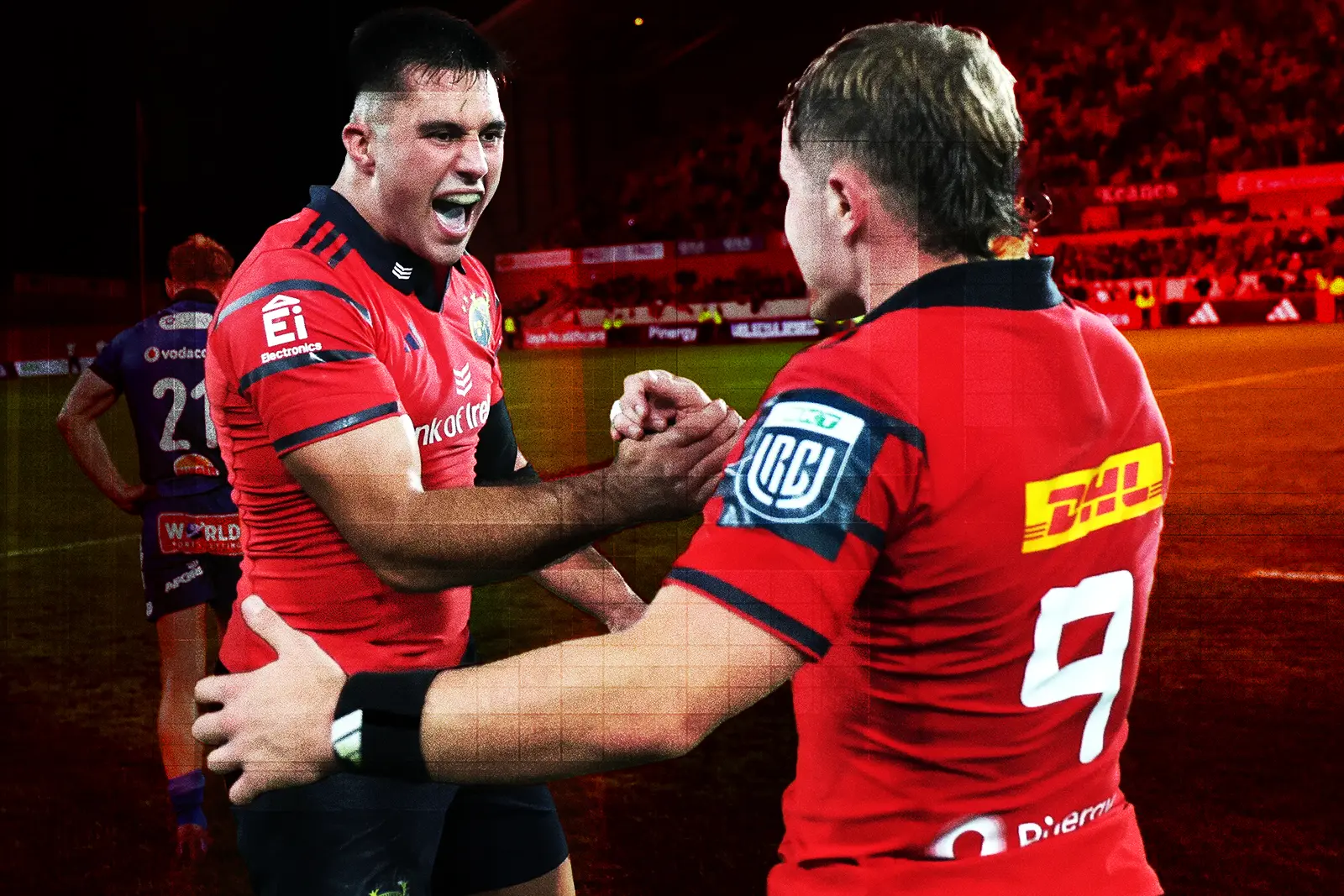
Belfast is a tough place to go.
Literally, for Munster, it’s a four-hour bus trip up and down, for an eight-hour round trip, but metaphorically, too. Sure, you might point out that they lost three of their last five home games last season, drew one, and last beat a URC team in the Affidea Stadium in January of this year, with that streak continuing into a loss against Edinburgh in Round 1 this season.
Still, I really want to emphasise that none of that matters this weekend. When Ulster get their game rolling in Ravenhill — what even is an Affidea, anyway? — they are incredibly difficult to beat.
If you ask me, there are quite a few similarities between Ulster and Munster at the moment. Sure, they might have more internationals occupying Andy Farrell’s headspace for now — Baloucoune and McCloskey, primarily, although Bryn Ward and Izuchukwu are In The Camp — and that, in turn, has meant their vibes have stayed relatively high in the Media Space that often defines perception, despite missing out on the Champions Cup for a second year running. Ulster, like Munster, are in that difficult step between teams where they have a lot of young lads stepping up into a vision they have bought into, but with the challenges that come from not quite being where they’d like to be.
The last time we rocked up to Belfast, we were dismissed in a lopsided defeat that showed everything that was wrong with us last season. Too many penalties, an attacking system that was clearly not working, and everyone within that system showing the worst version of themselves. Sure, we’d rotated out some top guys, and Ulster did the opposite — we had Toulon away a week later, and that matters as much as you want it to — but it was a bad night out, and a sign of some of the other bad nights out that were yet to come as the season progressed.
For some meaningless background here, I watched that game in an American-themed restaurant in CentreParcs, on a jittering phone screen, with my overstimulated daughter kicking up a fuss, me kicking up a fuss along with it, and having just paid €22 for nachos. The pain those same nachos caused an hour or so later didn’t last as long as the pain I experienced watching that game back four times.
So we need a better performance this weekend; that’s plain as day, but getting that better performance is the tough part.
- 15Ben O’Connor
- 14Shane Daly
- 13Alex Nankivell
- 12Dan Kelly
- 11Seán O’Brien
- 10JJ Hanrahan
- 9Craig Casey
- 1Jeremy Loughman
- 2Marnus van der Merwe
- 3Kieran Brookes
- 4Evan O’Connell
- 5Tadhg BeirneC
- 6Jack O’Donoghue
- 7Alex Kendellen
- 8Gavin Coombes
- 16Diarmuid Barron
- 17Josh Wycherley
- 18Jack Aungier
- 19Tom Ahern
- 20Brian Gleeson
- 21Ben O’Donovan
- 22Charlie O’Shea
- 23John Hodnett
Munster: Ben O’Connor; Shane Daly, Alex Nankivell, Dan Kelly, Seán O’Brien; JJ Hanrahan, Craig Casey; Jeremy Loughman, Marnus van der Merwe, Kieran Brookes; Evan O’Connell, Tadhg Beirne (capt); Jack O’Donoghue, Alex Kendellen, Gavin Coombes.
Replacements: Diarmuid Barron, Josh Wycherley, Jack Aungier, Tom Ahern, Brian Gleeson, Ben O’Donovan, Charlie O’Shea, John Hodnett.
- 15Ethan McIlroy
- 14Robert Baloucoune
- 13Jamie Benson
- 12Stuart McCloskey
- 11Jacob Stockdale
- 10Jack Murphy
- 9Nathan Doak
- 1Eric O’Sullivan
- 2Tom StewartC
- 3Keynan Knox
- 4Ben Donnell
- 5Eli Snyman
- 6Cormac Izuchukwu
- 7Nick Timoney
- 8Juarno Augustus
- 16Henry Walker
- 17Tom O’Toole
- 18Tom McAllister
- 19James McNabney
- 20David McCann
- 21Matthew Devine
- 22Jake Flannery
- 23Chay Mullins
Ulster: Ethan McIlroy; Robert Baloucoune, Jamie Benson, Stuart McCloskey, Jacob Stockdale; Jack Murphy, Nathan Doak; Eric O’Sullivan, Tom Stewart (capt), Keynan Knox; Ben Donnell, Eli Snyman; Cormac Izuchukwu, Nick Timoney, Juarno Augustus.
Replacements: Henry Walker, Tom O’Toole, Tom McAllister, James McNabney, David McCann, Matthew Devine, Jake Flannery, Chay Mullins.
Last season, Ulster were really good, right up until the steam ran out of them near the end of the campaign.
I went through every URC side’s numbers from last season on a per-80 basis, covering carrying, passing, defence, the breakdown, kicking and set piece. Short version? Ulster were, and still are, a carrying team, and a properly good one.
They were fourth in the league for carries (125.8), fourth for metres carried (407), fourth for post-contact metres (122) and third for dominant contacts (22.4). Only Glasgow beat more defenders than their 25.6. They crossed the gainline 54.8 times a game, fourth again. The three sides ahead of them were Leinster, Glasgow and Connacht — not bad company to be keeping, going on how last season went.
That’s a pack and a midfield that spent the season falling forward. And when they fell forward, they kept the ball. Ruck retention was 96%; they won 84.6 rucks outright per 80, and they lost only 3.3. When McCloskey, in particular, and the forwards get going, the recycle comes quick and clean. In Belfast, that can make the pitch seem really small.
They run a fairly classic Irish standard 3-2-X for the most part, with key carrying assets in all of those slots; Agustus is a bull of a runner off #9 or #10, so is Timoney, McCloskey is a dangerous offloader and carrier in the middle and wider spaces, and Stockdale/Baloucoune almost always get an edge in the tramlines.
When they get that edge, they come back across the field in waves and, when you step offside or get trapped under a carry, it’s a penalty, a kick down the line and the same thing again.
The ball stays in hand
Watching Ulster last season, you won’t be too surprised to see how little they kicked. Their 20.7 kicks from hand per 80 was the lowest in the league, 16th of 16. They were 14th for kick metres (544). They also had the fewest lineouts in the competition (12.5 a game), which is partly a response to that use of possession. They didn’t kick it much, so the opposition didn’t kick the ball out as much, so a lot of that lineout count can be brought back to penalties.
What they did instead was play ball. They were fourth for passes (153), fourth for offloads (8.2) and third for try assists (2.8), behind only Leinster and the Lions. Ulster look to go through you and, often, around you with the ball in hand.
When they did kick to score, it worked. They topped the league for tries from kicks at 0.4 per 80, despite being 14th for attacking kicks. One honest caveat: even across a full season, 0.4 a game is a try every two and a half games. That’s a handful of tries in total, so a couple of good bounces could account for most of it. Still, it points to a side that picks its moments rather than kicking for the sake of it. When you look at their wingers, you see it pretty clearly — they look to stress you with the ball in hand, wait for a compression and then kick to the edges to Baloucoune and Stockdale.
Then there’s the red zone. Ulster made 10.7 entries into the opposition 22 per 80 (joint-sixth with the Bulls) and scored 2.46 points per entry (fourth). Multiply that out, and it’s roughly 26 points a game from visits to the 22, which is right alongside Glasgow and only a few behind Leinster. They didn’t get there more often than most, but when they got there, they finished. You could see that efficiency last week against Glasgow with a scoring average of 3.3 points per entry.
Where the cracks are
So, are they unbeatable at home? No. And the defensive numbers are where it starts.
Ulster’s tackle success was 81%, third in the league, which looks great on the surface, but their dominant tackles came in at 4.2 per 80, which was dead last. Dragons, Zebre and everyone else won more collisions in defence than Ulster did. They completed tackles; they just didn’t win them. Their tackling was 65% upper-body, too. Taken together, that reads like a side that catches and holds the ball carrier rather than driving him backwards to slow the recycle and look for a scrum turnover. In a lot of ways, they’re so like Glasgow that it’s no surprise they played out a 33-33 draw last week.
What does that mean on the pitch? Carry with intent into that defence, and you should get go-forward. The tackle gets made, but on the defender’s back foot, and the next ruck comes quicker than they’d like if you win the position.
Their defence was more about attendance than threat, in part because they try to fill the field. They won 6.4 turnovers per 80 (seventh), but only 0.8 of those came from the jackal, which is in the bottom half of the league. They contested 26.1 breakdowns, comfortably behind the Dragons, Ospreys and Zebre. Their own ruck ball is safe, but it’s safe because the carries are dominant. Stop the carrier, and it’s a different conversation.
The air was another soft spot. Ulster won 29% of their aerial contests, tenth in the league. They box-kicked 9.2 times per 80, mid-table, and were 14th for attacking catches (0.7), so they rarely won back their own kicks. When Ulster kick, they give the ball away more often than not, which is why they tend to hang onto the ball more than most.
Set piece: nothing to write home about
Ulster’s scrum was a genuine weakness. They were 14th for scrum success (87%), won the fewest scrum penalties in the league (0.6) and conceded 2.7 per 80. It wasn’t as bad as ours last season, but it was close. That’s not a scrum you build a game plan around. If anything, it’s one you build a game plan against. Their on-ball game comes with that risk baked in — any inaccuracies or tackle turnovers can often turn into penalty ladders for the opposition. We’ll be hoping to do just that.
The lineout wasn’t much better. They were tenth at 86%, lost 1.7 per 80, and were second-worst for not-straights (0.5, behind only the Dragons). Their maul was tidy, 89% success and third in the league, but it gained only 11 metres a game and produced 0.1 tries. It’s a platform outside the 5m line, rather than a weapon in and of itself.
That fits everything else. Ulster don’t need set piece to win games. They need clean ball from it, and then they back their rotation of carriers. Disrupt that first phase — either in the set piece itself, or by stopping McCloskey on the crash, or the compression his line forces, and you’ve got a good chance of frustrating Ulster.
Discipline
Ulster conceded 10.3 penalties per 80 last season, the fourth-most in the league. Of those, 7.1 came in defence, which is about what you’d expect from a side making plenty of tackles without winning the collision. Scrum penalties made up another 2.7 per game of that 10.3. They weren’t especially guilty of anything at the breakdown (0.8 not rolling away, mid-table), and yellow cards were middling at 0.7.
So the penalties came from being on the back foot: in the scrum and in defensive sets where the carrier had already won the contact. They’ll go after the breakdown more here, because we’ve shown a weakness on our own ball there so far, but there’s a risk in that too. If they do well here, expect Timoney to be chief amongst the guys profiting. It’s a key work on for us after the first two rounds.
So what’s the picture?
Ulster last season were a side with a clear identity. They carried hard, kept the ball, kicked as little as anyone in the league, and were clinical once they reached the 22. When that’s working at home, they’re as difficult to play against as anyone in the competition.
But the weaknesses are just as clear. They didn’t win collisions in defence, they lost the aerial contest more often than not, and the scrum and lineout were bottom-half. All of that tends to show up as penalties.
The numbers say they can be beaten in Belfast; we just need to make those numbers count.
Ulster’s big weakness, as it stands, is their on-ball game’s inherent conflict with their issues in the scrum.
We know all about this weakness, because it was our weakness last season. We didn’t play as many phases as Ulster last season, but we weren’t far behind them.
Ulster’s biggest weakness right now isn’t the scrum on its own, though. It’s the way their scrum and their ball-in-hand game work against each other.
Think about what their approach actually produces. A side that kicks less than anyone in the league is going to put the ball on the floor. Not through carelessness, just through volume. More carries and more passes mean more knock-ons and forward passes. When possession changes hands that way, it comes back through a scrum.
And the scrum is where Ulster got found out. They conceded a net of minus 2.1 scrum penalties a game, the third-worst in the URC. More than a quarter of all the penalties Ulster conceded came from the scrum.
So the game that makes them dangerous also keeps sending them back to the one place they can’t hold their own. Every handling error in the opposition half isn’t just lost possession. It’s a decent chance of a penalty, and with it a kick to the corner or three points against. The work of a dozen phases gets undone in one engagement.
This was our problem last season. Our scrum was every bit as shaky: 88% success (13th), 3.2 scrum penalties conceded per 80 (second-worst, behind only the Dragons) and just 0.9 won. That’s a net of minus 2.3, the only team worse being the Dragons. Nearly a third of our penalties came from the scrum.
This season, our scrum seems to have improved — radically, you might say — but this game is a big test of that improvement.
Against the Bulls and Glasgow, we knew we’d be under pressure, but this is the first game this season — including preseason — where we’d be expected to make improvements show decisively. On both sides of the ball, Ulster struggled to keep their position. It started on their loosehead side, and then radiated through their tighthead.
If anything, Glasgow could grumble that they didn’t get enough of a reward for their dominance.
If their own put-in is scrappy, they narrow McCloskey up to generate the position that the scrum didn’t, which is relatively easier to defend and make the next phase scrappier again. On your put-in, a scrum going forward naturally tugs McCloskey in further to cover a break from the #8, which should give us the option to attack Benson defending at #13 from the start for the first time in his career.
This is where Brookes vs O’Sullivan, and then Aungier vs O’Toole — with Loughman on Knox — is a key area for us to chase after. It’s no shock that we’ve also loaded Van Der Merwe at hooker from the start, either. He’s one of the best scrummaging hookers in the league, going up against Stewart, who does many things really well but struggles decisively under scrum pressure.
If our defensive approach pressures Ulster’s handle without handing them easy 22 access, our improved scrum could — should — be a difference maker.
