

You can’t talk about injuries.
The minute you do, a plethora of doses, waste men and cod artists arrive to declare “well, everyone has injuries, you just have to get on with it” as if it means anything beyond “stop trying to contextualise a loss – we’re trying to hammer you here”.
So you have to beat them to it. You have to wear the codology as a form of armour.
Next Man Up. Next Cab Off The Rank.
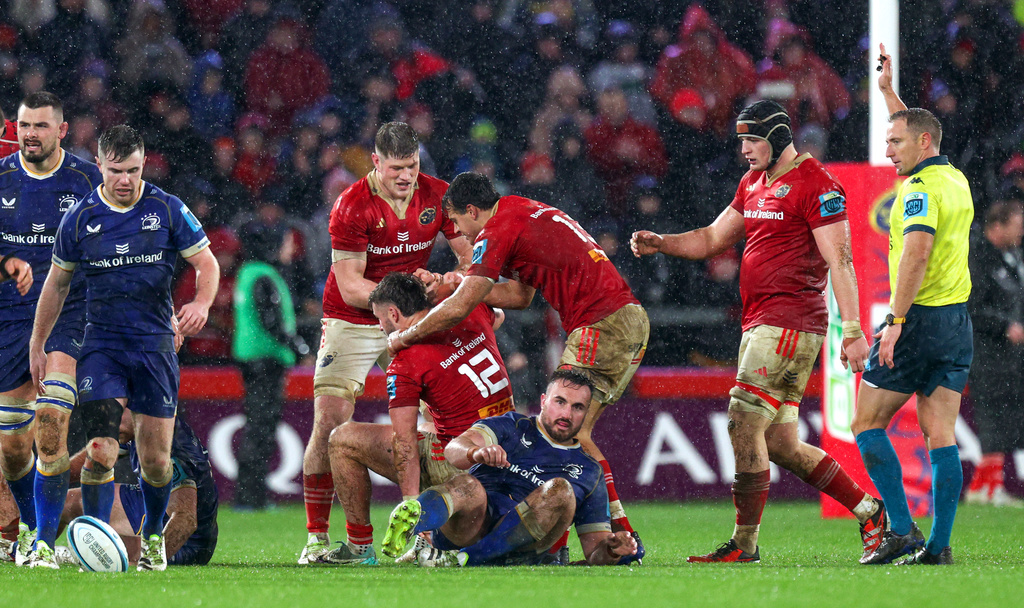
But the facts are what they are. Munster are missing ten players who realistically could have played a role in this game due to injury. We’re missing a further two players who absolutely would have started but won’t due to IRFU minute management.
Dave Kilcoyne, Roman Salanoa, Diarmuid Barron, Niall Scannell, RG Snyman, Jean Kleyn, Edwin Edogbo, Peter O’Mahony, Craig Casey, Jack Crowley, Alex Nankivell and Mike Haley. I haven’t included Keith Earls or Andrew Conway in that.
To pretend that this missing list – which has grown in the last two weeks – doesn’t have an impact on everything from the intensity and quality of your training to results on-field is Black Knight ’tis but a scratch childishness. Munster are expected to win no matter what – and I think winning this game is certainly possible – but it’s impossible to disentangle the bad results from the last few weeks from the crippling injury list Munster have had to endure.
This is where “depth” comes into play but there is depth and then there’s effective depth.
I’ll start this by saying that every single elite team can handle five or six injuries spread throughout the lines of the team and expect to continue more or less as normal. Your system can survive that kind of attrition because, generally, you’ll have effective depth to handle these injuries. You could lose your starting loosehead, a starting lock, a starting back-row, one of your core half-backs and your centrepiece midfielder and still be pretty competitive against other elite sides. You’d be a reduced force, sure, but you’d still expect to be able to bring something close to your prime game.
As with every team, there are generally four guys you really can’t lose, especially as a group. For Leinster, that’s Andrew Porter, Dan Sheehan, Ronan Kelleher and Garry Ringrose. For Toulouse, it’s Antoine Dupont, Peato Mauvaka, Julien Marchand and Romain Ntamack. For La Rochelle, it’s Gregory Aldritt, Will Skelton, Uini Atonio and Jonathan Danty.
Lose one of those, it hurts. Lose two, trouble. Lose three, big trouble. Lose four, pain.
For Munster as of right now, our Big Four are Jean Kleyn, Peter O’Mahony, Gavin Coombes and RG Snyman. We have other big, big players for us – Beirne, Hodnett, Ahern, Jager, Casey, Crowley, Frisch, etc – but Kleyn, O’Mahony, Coombes and Snyman’s skills and physical profile look after core elements of our offensive and defensive system.
This is the Winning Formula I spoke about before Exeter in a more digestable format.
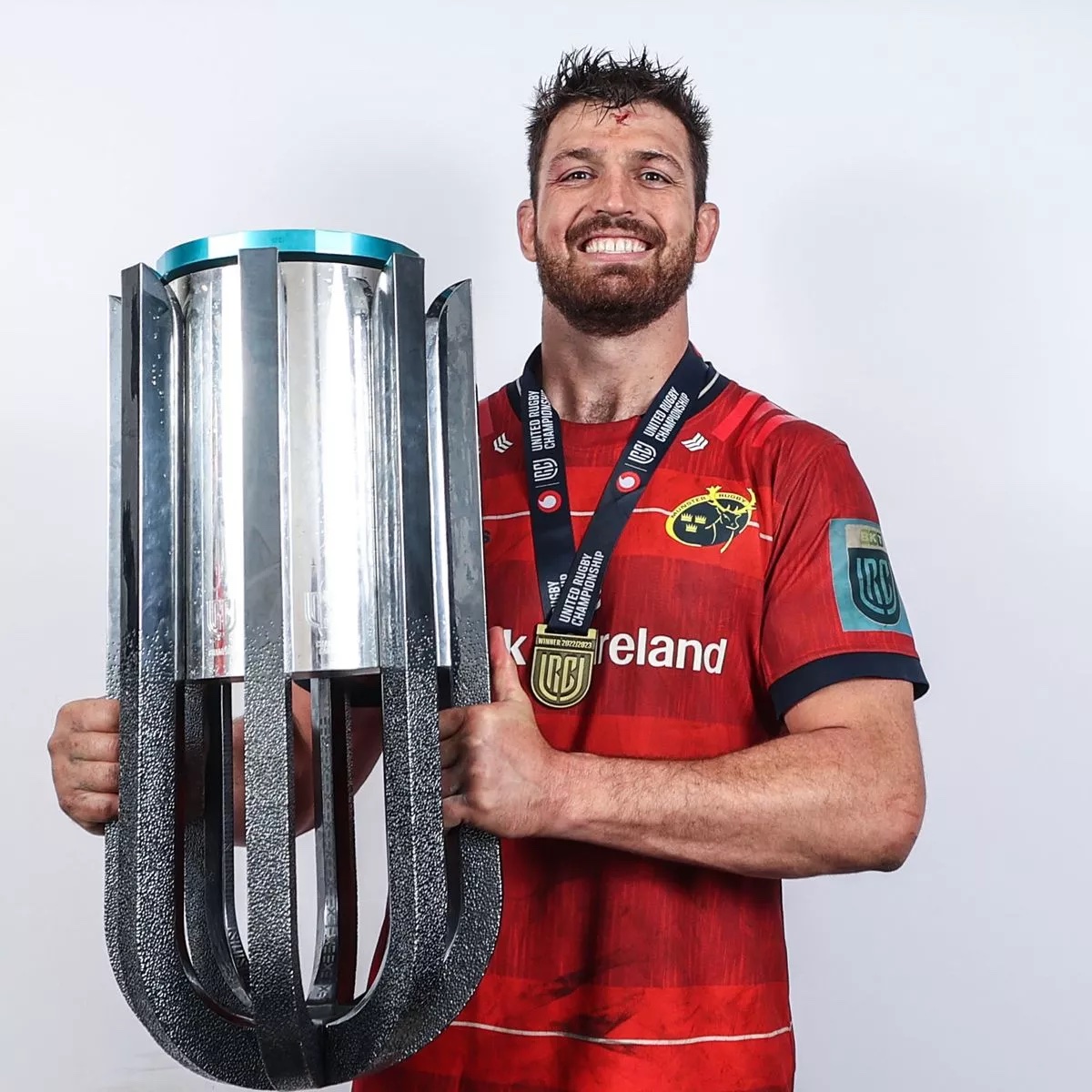
At the moment, we’re down three of our four primary game plan movers and you can see the stress it’s causing on what we know is our primary game. The biggest miss, by far, is Snyman and Kleyn as a starting pair or a 50/30 split. Without our super-heavyweight locks, our front row gets exposed to more off-scheme action, and the locks we use to replace them endure a greater risk of injury in the same way that if you sprain your right ankle on the first day of a three-day hike and you can’t stop, you’ll end up hurting your left ankle by the end of day two.
Why was Coombes moved up to the second row in the last few weeks? Because he gives us a facsimile of what Kleyn and Snyman – and Edogbo – do for this attacking system, which is to anchor it in the middle of the field.
Forget about the scrum for a second. Forget about the way you traditionally see players listed on a rugby formation graphic. Forget about “balance”.
The only important thing for Munster, and any team, is how the system they have implemented runs. The system is your phase defence, your phase offensive, your scrum, your lineout, your set piece attack and your offensive and defensive transition. No team will be truly elite in all of these areas of the game so you hang your hat on a few of them and build to be the best you can be in those areas while shoring up the rest so they don’t become a weakness.
The players – your best 23 – are the epitome of this. The best teams in the world have a system that fits their best 23 like a glove and they win with that system. Teams that have talent but a system that doesn’t fit them can never win anything.
What does that mean for this New Year’s Day InterPro?
It means we’re going to see if we can get a win in a Cat A game for the first time this season while we’re still without most of the players that our framework runs on at its best.
Munster: 15. Simon Zebo; 14. Calvin Nash, 13. Antoine Frisch, 12. Rory Scannell, 11. Shane Daly; 10. Tony Butler, 9. Conor Murray; 1. Jeremy Loughman, 2. Eoghan Clarke, 3. Oli Jager; 4. Fineen Wycherley, 5. Tadhg Beirne (c); 6. Tom Ahern, 7. John Hodnett, 8. Gavin Coombes.
Replacements: 16. Scott Buckley, 17. Josh Wycherley, 18. John Ryan, 19. Jack O’Donoghue, 20. Alex Kendellen, 21. Paddy Patterson, 22. Seán O’Brien, 23. Shay McCarthy
Connacht: 15. Mack Hansen; 14, Byron Ralston, 13. Cathal Forde, 12. Bundee Aki, 11. Shayne Bolton; 10. JJ Hanrahan, 9. Caolin Blade (c); 1. Peter Dooley, 2. Dave Heffernan, 3. Finlay Bealham; 4. Darragh Murray, 5. Joe Joyce; 6. Cian Prendergast, 7. Shamus Hurley-Langton, 8. Jarrad Butler
Replacements: 16. Dylan Tierney-Martin, 17. Denis Buckley, 18. Jack Aungier, 19. Niall Murray, 20. Oisín Dowling, 21. Michael McDonald, 22. Jack Carty, 23. Conor Oliver
I’ve been asked a lot in the last month why Munster became so reliant on Edwin Edogbo – a 21-year-old player who is yet to progress to a senior contract.
I said in reply, over and over again, because he fits what we want from a player in that role. He wins collisions off #9, he dominates the offensive breakdown, he makes big stops in defence and at the maul and he’s a great scrummager so it doesn’t matter how old he is, he hits all the markers we want from players in that spot.
By the same token, I’ve been asked why, during an injury crisis in the second row, is Thomas Ahern is wearing #6 on his back as opposed to #4 or #5. My answer to that is that numbers on jerseys don’t matter.
What we’ve learned in the last few weeks is proof positive of what Munster’s system values. Ahern has been one of my most highly-rated players in the last few weeks because he’s essentially become a cross between RG Snyman and Peter O’Mahony.
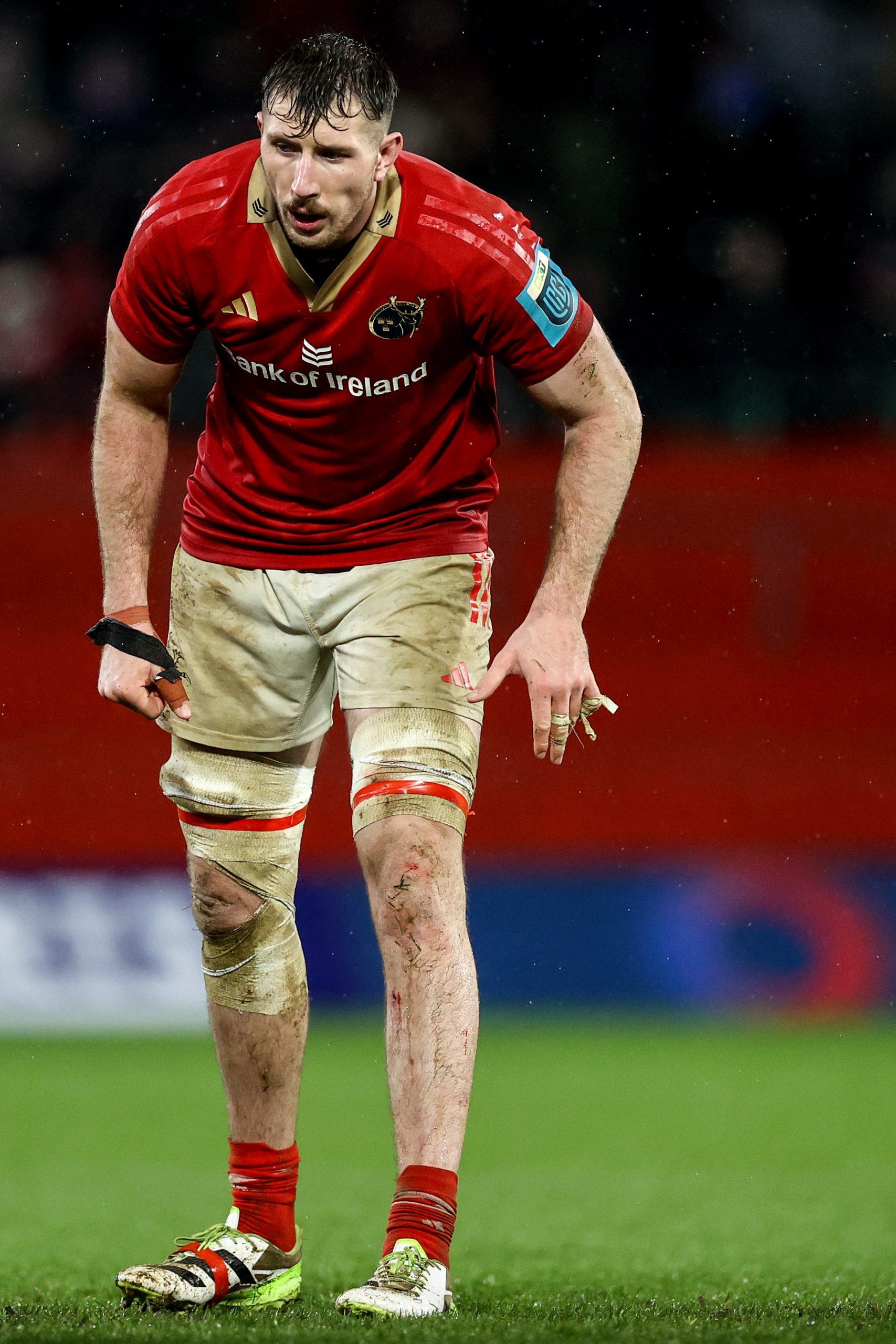
What are Ahern’s weaknesses? Not the best scrummaging lock – in large part due to his length – and he’s also shown a tendency to get banged up when exposed to too many tight collisions in the middle of the field in consecutive games. When Munster need three heavy locks (ideally these are Snyman, Kleyn and Coombes as a half-lock power forward) to break up the opposition’s defence on multiple phases of possession, Ahern doesn’t quite fit. Sure, he can do the job but is it the best use of his skills?
To follow up on that, I’ll ask what Munster typically requires from the #6 jersey.
They need;
- a primary lineout target on our ball
- a heavy disrupter on the opposition’s ball
- a heavy defensive maul presence
- an explosive edge forward with great hands and the speed to pair with our wingers
- a big offensive breakdown output
- a disciplined defender who can slow down ruck ball on the edge of the play and cycle infield when the opposition enters the 22.
Ahern’s skillset is almost a perfect match for this job.
He’s a great lineout target and a very good counter-jumper with his wingspan alone. His edge running at 6’9″ and 118kg is some of the best you’ll see anywhere in the game. Nobody at his height and weight is moving as fast or as nimbly as Thomas Ahern. Imagine Brodie Retallick as a winger? That’s the kind of unicorn air that Ahern is breathing right now.
His offensive breakdown, maul presence and defensive work need work but the upside we’ve seen on the basics of the O’Mahony role are enough to keep him there long-term.
We’ve missed O’Mahony’s leadership and his ability to freshen up our back row over the last few weeks off the bench but his loss hasn’t been felt as profoundly because of what Ahern has brought.
These two players showcase what we want from our system and because we play to that system so rigidly – this is a good thing – we produce a few notable stats. Teams with distinct styles will show up in odd places in the data. Under Van Graan, for example, we were generally middle-of-the-road for everything because we didn’t have a style to speak of.
This season, as with last season, we kick way less often than the average team in the URC and we kick way shorter than average. What does this mean? It means we play more phases and carry more ball than almost anyone. Why? Because we are an on-ball team.
Here’s another weird stat for you.
Munster have the best defence in the URC so far.
We’ve conceded the fewest points overall and the fewest tries but when you look at the URC stat page, we’re in the bottom four in the league for “tackles made” and we’re 10th in the URC for tackle completion at 80%. What does this mean?
Well, because we’re an on-ball team who carry more than almost everyone and we kick way less than almost everyone else, it means we don’t have to defend with the same frequency that other teams do. When you couple that with having the third most turnovers in the league – on one of the lowest tackle counts – you can see why we’ve conceded so few points and tries.
Connacht, on the other hand, are third in the league for tackles made and 7th in the league for kick volume. They’re fourth in the league for kicking distance which tells us a few things;
- They are slowly moving to the higher end of counter-transition rugby
- They are kicking less often than last season but still kicking as far as they did last season
- They are conceding too many offensive turnovers
Over the last few games, we’ve seen a few different looks from Connacht. For most of the season in the URC, they’ve played solidly in the counter-transition range of one kick for every five passes and they’ve won most of the games where they’ve done that with one exception; the Leinster game that they 100% should have won.
Weirdly enough though, when they come up against sides they’re giving up a lot of size to – Bordeaux, Ulster, Saracens and the Bulls – they’ve played close enough to on-ball rugby to be notable.
Against Bordeaux, they played a ratio of 1:25.3 which is, obviously, mad (and related to them chasing the game at home) but they also did the same, albeit not to the same extreme, against Ulster, Saracens and the Bulls.
What will they do here? I think they’ll start the game off in counter-transition mode and look to get their heavy combo-flanker, small forward build back row into our offensive structures. Fundamentally, they don’t rate our ability to retain the ball against them – they’ve selected a 6/2 split to exaggerate this – so they will feel comfortable putting referee Chris Busby under pressure to reward their defensive breakdown work with momentum-earning penalties.
The key for Munster is retaining the ball when they kick to us and moving them across the pitch. They will commit numbers to the breakdown so if we can retain and roll across their defence, there will be space for Butler to attack.
We’ll need to see a better return in the air on our box kicks from Nash and Daly too but if we can punish Connacht for kicking to us, we can overload them offensively. They’ll back themselves to steal our lineout ball – they’re the best in the league for steals and we’re in the bottom half for completion ourselves – but we’ll be comfortable going after their lineout too to the point that it might balance itself out. Connacht have the second-worst lineout completion rate in the league so we can 100% attack them there if we choose to give them that platform.
It’ll be difficult but we can win this one as long our breakdown functions and our lineout stays above 85% completion.
