


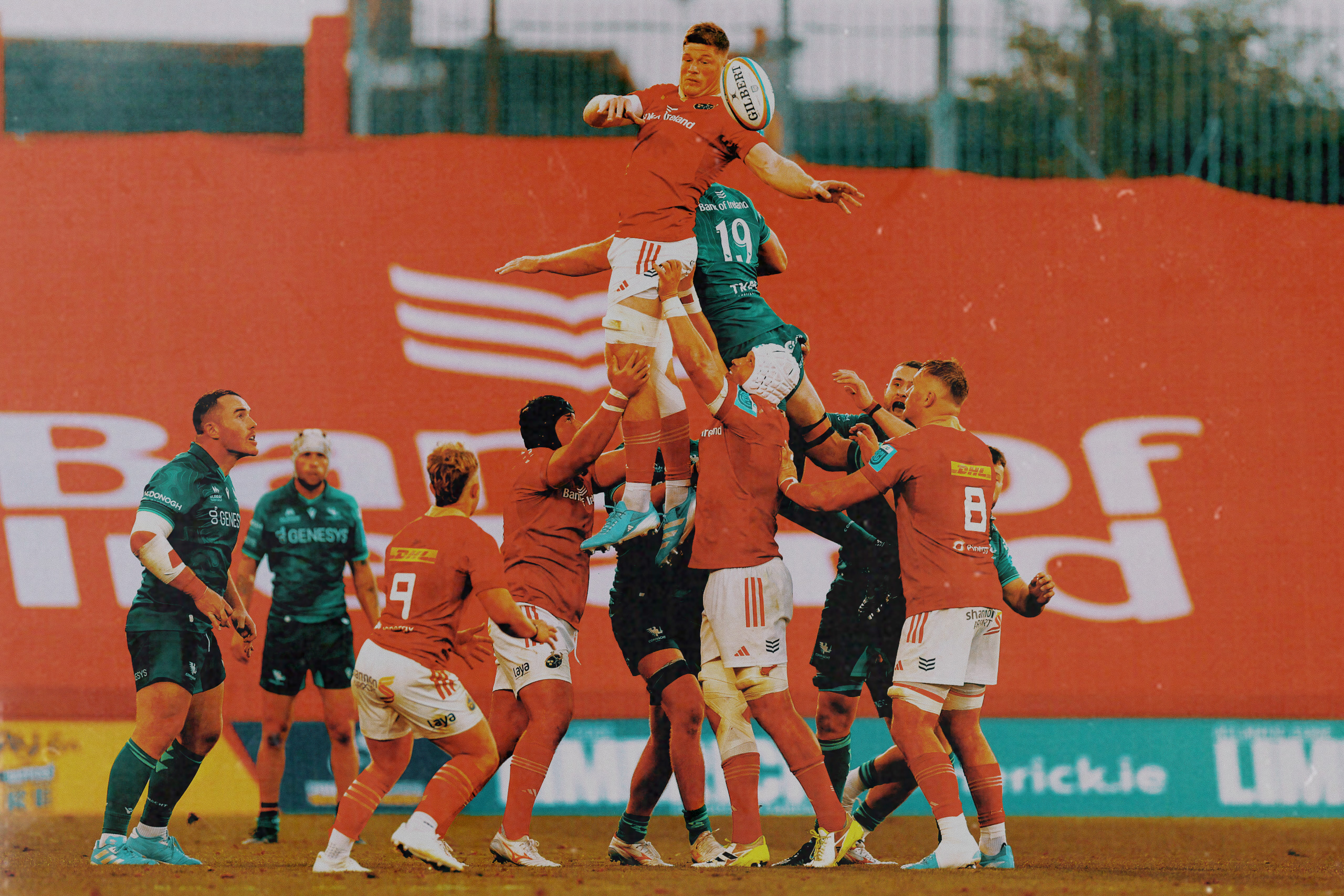
One interpro down, seven to go.
That’s how you have to think about it. Every URC season so far has seen Munster’s shield performances against the other Irish provinces heap pressure on the rest of our regular season games. We won two out of six interpros last season but still managed to finish top of the league because they were the only games we lost; Leinster (x2), Ulster (a) and Connacht (a).
We have another three interpros this calendar year and how we navigate them will go a long way to defining our 2025 run-in. I wrote last week that whoever came out of that opening day Interpro in Thomond Park with a win would have the “perfect start”. While the performance itself was imperfect, you can’t argue with the five points accrued. At this stage of the season, everyone is working out bugs in the machine so if you can do that while winning the better off you’ll be.
We’ve seen the alternative.

That brings us to Zebre Parma and a tricky enough away fixture, albeit a fixture we should be winning with some degree of comfort.
Zebre Parma are a tough side to read because, for a while last season, they seemed to be doing relatively well, even while losing almost every game they played. After Round 11 – right after playing Munster – they found themselves in 13th place with 14 points due to how many losing bonus points they’d picked up to that point. They were losing games, yes, but they were almost always making the loss quite close or scoring four tries come what may.
It would be a high water mark for them. In the next seven games, they’d pick up one single losing bonus point – away to the Dragons – but lose every other game with nothing. In the last five rounds of the season, they conceded an average of 40 points a game and finished the season rock bottom of the league with just 15 match points.
That points total didn’t reflect how decent they were in the first half of the season and nothing sums that up like eight bonus points accrued between October and March, with just one earned between March and the end of May. There’s a reason for that, though.
Zebre are at their best against teams who show up with a tonne of new combinations or debuting players. If you’re still firming up your defensive systems after the preseason or are waiting for internationals to come back after their various summer breaks, Zebre Parma can sting you. We have to be wary. Zebre’s best results last season came in the first five games of the season where they almost beat Ulster and the Ospreys before beating the Sharks and drawing with Cardiff. There was a hefty home loss to the Bulls sandwiched between those results, but they also scored 29 points that day.
Once they hit the post-Six Nations window and most teams they face are full-strength, they lose and lose heavily.
This means one thing; Munster picking up five points against a team that, realistically, our rivals for the top four will also pick five points up against throughout the season.
Munster: 15. Mike Haley; 14. Calvin Nash, 13. Shane Daly, 12. Tom Farrell, 11. Thaakir Abrahams; 10. Tony Butler, 9. Craig Casey; 1. Josh Wycherley, 2. Diarmuid Barron (c), 3. Oli Jager; 4. Jean Kleyn, 5. Fineen Wycherley; 6. Ruadhán Quinn, 7. John Hodnett, 8. Gavin Coombes.
Replacements: 16. Niall Scannell, 17. Jeremy Loughman, 18. John Ryan, 19. Jack Daly, 20. Jack O’Donoghue, 21. Conor Murray, 22. Bryan Fitzgerald, 23. Shay McCarthy.
Zebre Parma: 15. Geronimo Prisciantelli; 14. Jacopo Trulla, 13. Giulio Bertaccini, 12. Luca Morisi, 11. Simone Gesi; 10. Giovanni Montamauri, 9. Allesandro Fusco; 1. Danilo Fischetti (c), 2. Tommasso Di Bartolomeo, 3. Matteo Nocera; 4. Matteo Canali, 5. Leonard Krumov; 6. Davide Ruggeri, 7. Samuele Locatelli, 8. Giovanni Licata
Replacements: 16. Giampetro Ribaldi, 17. Luca Rizzoli, 18. Juan Pitanari, 19. Andrea Zambonin, 20. Giacomo Ferrari, 21. Patricio Baronio Guana, 22. Scott Gregory, 23. Giacomo De Re
Structurally, you should expect Zebre Parma to run a 3-3-X shape during phase play and directly off their post-transition phases. Last season, they played a brand of rugby that I thought was perfectly suited to their resources, at least for the first half of the season. Everything they did with the ball was designed to minimize turnovers in the middle of the field but also set the table to get their ridiculously quick back three onto the ball in space as often as possible using as few hands as possible to do so.
No team played more tight phases – #9 hitting a close running centre pod off the ruck – and only the Bulls played more blindside phases. They are broadly the same this season. This is a standard enough Zebre sequence in possession.
This might look pretty standard – and it is – but Zebre’s narrow width on these carries is designed to maximise their ball retention until they can unlock the wide channels, which they will try to do with long passes or crossfield kicks when on the front foot.
The Bulls – who played broadly the same way with the ball in hand last season – used that narrow pattern for a different reason, which was to overwhelm your B/C defenders with some of the biggest human beings you’ve ever seen. But teams know you can’t over-commit on those Bulls defenders given their threats elsewhere, so teams mostly give them gainline to attack the breakdown.
Zebre don’t have the Bulls’ size and power so, as a result, teams are really comfortable throwing three defenders at these narrow patterns to batter the ball carrier. Only Leinster drew more 3+ tacklers last season, as a result. Zebre had the second-lowest dominant carry percentage in the league. Benetton had the lowest but were able to offset that by being one of the most accurate offloading teams in the league. They were #1 in the URC for the percentage of offloads that led directly to a try or a linebreak. Zebre were middle of the road on this metric and were in the bottom three for offload success rate, while being in the bottom two for offloads thrown.
This is where the Italian national team comes into play because Zebre and Benetton are playing broadly the same style to try and build cohesion for test level. Zebre differ from Benetton in that they very rarely play beyond the first receiver and it’s even rarer again for them to play beyond the second receiver. They were in the bottom two of the URC for both those metrics, alongside… the Bulls who, again, play a very similar style.
When Zebre get to width, it most often looks like this. Narrow phases, screen pass, long pass to edge runner.
They give up a penalty here for too many body rolls but they’re equally prone to breakdown attacks in positions like this. So much of what they do is based on running those narrow lines, though. The winger hits the line here after a short series of narrow phases to attack that seam on the edge.
Their #8 is the release option on the 5m tramline with the onus on the winger to give the offload. They’ve also worked in some direct winger carries off #9 as a variant to mix up the defensive structure of the opposition.
All that being said, defending them is relatively straightforward. Pack the middle of the field, stuff their carries with two-man tackles, make the breakdown a mess with the third man, slow the #9’s progression, and wait for the kick reset. You’ve got to be mindful of the dart to the blindside that they almost always work into post-transition phases but stuffing them is relatively straightforward.
You can see the two-man shots Cardiff lay on here and how effectively it sends Zebre back to the kick.
On average, Zebre only played 2.6 phases per attack last season on average, which means that if you can keep the ball in their half of the field via your own kicking game, they will almost always kick the ball back to you after two phases of defence. If you can stay patient with Zebre, make your tackles and fill the field they will usually make errors when they try to offload or go to the screen. That’s when you can hurt them.
By far the best way to score tries against Zebre Parma is to launch off the lineout and scrum in and around the 10m line. They concede a ridiculous number of linebreaks directly on the first and second phase post-set piece. If we can get any kind of reliable platform at the lineout, we have the weaponry to hurt them in the #10 channel and on the sweep attacking their #13 channel. Look for us to kill them off central scrums in their half of the field too.
Get into their 22 and they’ll concede tries almost on every entry.
