


The semi-final stage of any tournament is a strange place to be. In one way, it’s already an achievement of sorts but not one you can ever talk about meaningfully. To be in the final four of a 16-team, trans-equatorial league is the sign of a good season, regardless of anything else, but you dare not lose. Losing consigns you to the memory hole of the season, rendering almost everything to that point meaningless. We know this well at Munster. In 2017/18, 2018/19 and 2019/20, Munster lost three semi-finals away to Leinster, before losing a hastily arranged final during the pandemic in 2020/21.
I’m not sure when losing in rugby turned into an opportunity to “take our learnings” but the only thing worth taking from losing a semi-final is that you’d better win the next one. If you can’t, the only learning to take is that something fundamental has to change and until that change is made, you’ll continue to lose.
Last year, something fundamental did change when we reached the semi-final stage for the first time in two seasons and beat Leinster in the Aviva Stadium. We went on to win the URC title.
This year, retaining that title and going back to back is within our grasp. We can see it. Feel it, almost. Last year, we learned that winning titles is addictive. This weekend, we will see how badly we’re craving that opportunity again. How far will you go?
Standing across the way from us? Glasgow. A team that hates us as much as we hate them. This is how things should be. There’s no friendly fire here; this is bone-on-bone, kill-or-be-killed, winner stays on knockout rugby. They will be talking about revenge all week long because we beat them in Scotstoun last year in the quarter-finals.
They say that before you go looking for revenge, dig two graves. In years gone by, when teams came looking for revenge at Thomond Park they only needed the one.
It’s time to reopen the House of Pain on the Cratloe Road once again.
Munster: 15. Mike Haley; 14. Shane Daly, 13. Antoine Frisch, 12. Alex Nankivell, 11. Simon Zebo; 10. Jack Crowley, 9. Craig Casey; 1. Jeremy Loughman, 2. Niall Scannell, 3. Stephen Archer; 4. Fineen Wycherley, 5. Tadhg Beirne (c); 6. Peter O’Mahony, 7. John Hodnett, 8. Jack O’Donoghue.
Replacements: 16. Diarmuid Barron, 17. John Ryan, 18. Oli Jager, 19. RG Snyman, 20. Gavin Coombes, 21. Conor Murray, 22. Seán O’Brien, 23. Alex Kendellen.
Glasgow: 15. Josh McKay; 14. Sebastian Cancelliere, 13. Huw Jones, 12. Sione Tuipulotu, 11. Kyle Steyn (c); 10. Tom Jordan, 9. George Horne; 1. Jamie Bhatti, 2. Johnny Matthews, 3. Zander Fagerson; 4. Scott Cummings, 5. Richie Gray; 6. Matt Fagerson, 7. Rory Darge, 8. Jack Dempsey
Replacements: 16. George Turner, 17. Oli Kebble, 18. Murphy Walker, 19. Max Williamson, 20. Euan Ferrie, 21. Henco Venter, 22. Jamie Dobie, 23. Ross Thompson
Glasgow are a very good side on a good run of form.
Their only losses this season have come away in South Africa, away to Exeter, away to Edinburgh, away to Harlequins, away to Connacht and away to Ulster. One win in South Africa probably sees them finish top of the URC, even allowing for the free ten points they get playing Zebre twice. Along the way, they have racked up some seriously impressive metrics.
They’re first in the league for clean breaks and defenders beaten, third in the league for offloads, second in the league for turnovers won, second in the league for lineout steals, first for lineouts won, first for maul tries scored; they are an imposing side who are very rarely blown out of it in games.
From a game-state perspective, Glasgow plays counter-transition rugby against every side in the league that isn’t an Irish province or South African in South Africa.
I wrote this back in December and it’s still true now;
Against every non-Irish team, Glasgow have kicked the ball in a purely counter-transition range. They averaged around one kick every 4.9 passes against Benetton, Ospreys and Stormers.
Against the Irish provinces they’ve played so far, however, they’ve averaged one kick for every 16.4 passes. So does Glasgow play on-ball rugby? Yes – against Irish provinces exclusively.
Part of this is down to their behaviour in-game against Irish teams. Glasgow does not kick for three points off penalties so when they enter long periods of on-ball rugby against Irish sides between the 10m lines, they are almost exclusively looking for advancement penalties.
Almost everything about what Glasgow does during phase play – on both sides of the ball – is fine-tuned to generate penalties that they can kick downfield almost exclusively so they can earn further penalties off their maul, which they will then look to turn into tries.
Against Munster back in December, they followed this script to the letter. They had a pass-to-kick ratio of 10.1 – right in the on-ball range – and scored four tries directly off the maul with a fifth scored indirectly. To be honest, they looked like scoring every time they set up for a lineout.
What do you notice about Glasgow’s maul in these two clips;
Two banks of three, drivers transiting behind the drop before landing, a strong carrier at the rip… wait, isn’t that what we do now?? Like, literally what we did last week against the Ospreys?
It is! We saw how effective their maul was and how simply they were able to build it – even from the front – and pretty much reverse-engineered it. From a defensive perspective, it is possible to swing up the outside of the maul given its compact length but that is not without further penalty risk. The best defence for Glasgow’s maul is to not give them the position in the first place.
Munster have gone with our off-ball pack build to start this game with a strong, super-heavyweight on-ball pack to come off the bench with a 6/2 split.
It would seem that we intend to off-ball Glasgow initially with strong maul and lineout defenders, mobile tacklers and dangerous turnover threats in the wider channels. Why have we done this?
When I watched Glasgow against the Emirates Lions this week, I noticed a few key principles that are worth paying attention to; first, Glasgow dominated possession in that game and played heavy on-ball rugby. Second, when the Lions kicked they kicked long and infield, backing their defence on transition and off Glasgow’s longer-range maul breaks.
They are staying well out of those rucks once Glasgow break and they aren’t blitzing too hard on their outside backline. Make the stop, stay out of the ruck, stay active in the line. Glasgow stack their backs really, really deep from the gainline – just like Smith’s old side the Cheetahs – and they use it to draw out blitzing defenders or give looping wingers like Steyn or Cancilliere space to make a kicking play on the run or spot a lagging defender.
The Lions defended this long transition defence sequence quite well with 14 men right up until the ball slots into the third layer to Cancilliere.
For me, the key is to avoid committing any numbers to the ruck in central spaces to avoid getting trapped in for cheap penalties and advance with moderate line speed. What killed the Lions here – even with 14 men – was that they had their heaviest, slowest player closing the door on the inside.
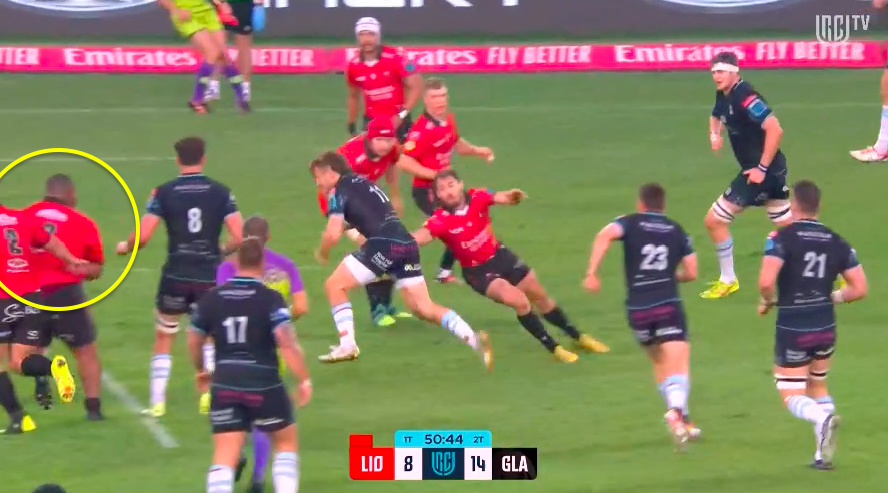
That can’t be us in the early and mid-game. This has to be Jack O’Donoghue or John Hodnett. Our defensive alignment and structure has to be spot on here. Glasgow go to these super deep layers to expose bad alignments and so many of their linebreaks come in these post-transition phases.
Because Glasgow kick the ball so infrequently, most teams expect that there are easy territory gains to be made against them. And they’re right – but they waste energy competing at trap rucks and getting drawn in by Glasgow’s deep-lying strike runners. Glasgow’s pass-per-carry rate is incredibly high because of these layers.
Teams kick to Glasgow, and Glasgow goes into their transition structure to go looking for those deep linebreaks or trap penalties at speed. If you can get them at a wide ruck, however, they can be counter-rucked a little easier than you’d think. Glasgow don’t really use edge forwards – they play a 1-3+1-3 shape in possession – so if you can get a stop in the 5m channel on Cancilliere, there are turnovers and disruption opportunities.
Ultimately, we want to exhaust Glasgow with their own post-transition phase play and on-ball tendencies before switching our game state with a four or five-man bench transition around 45/50 minutes. Glasgow were very reluctant to use their bench against the Stormers last week because I think Smith doesn’t rate what he has there. As such, if we can draw out Glasgow with a tonne of their own phase play, and keep the score tight for the first half before going very heavy right as their front five will start to tire, I think we can take them apart in the third and fourth quarter.
This is where I’d also change our kicking style to short and contestable to really up the pressure on their pack and force them into early changes. With shorter kicking, we can also target their scrum where they’ll be seriously reluctant to take off Zander Fagerson.
This is where our on-ball core of Snyman, Coombes, Jager and Ryan will add serious punch, with Kendellen adding the ruck security and nastiness we’ll need to keep their defensive turnover game quiet.
