


I’m reluctant to use “bonus territory” or “free shot” in playoff rugby.
It’s where we’re supposed to be, doing what we’re supposed to do. It would be easy to look at the oppressive, all-consuming, jobs-on-the-line pressure of securing European Cup rugby for next season, and the earning potential that comes with it and think that whatever happens in these next few weeks happens. It’s been a tough, gruelling and mentally attritional season. Remember when Graham Rowntree left? That doesn’t feel like this season because it was seven months ago.
Time moves on. The world moves on. I still remember where I was when I found out Rowntree was out – sitting on the floor in my living room, trying to put together a flat-pack coffee table at half 9. It felt like the whole world, or at least my particular part of the rugby world, ground to a halt. The next day, when the news broke officially, I was cutting a scary mouth into a pumpkin in the Currachase Garden Centre.
My phone turned into a molten brick with all the notifications, texts and calls I was getting, but the world moves on. It seemed like two days later, it was that thing that happened three weeks ago. Rugby is so week-to-week-to-week these days that you never have time to dwell on anything for too long, and so it goes. Rowntree’s departure was the only news, then it was old news, and Munster’s season rolled on.
But, in a way, we were defined by that departure for the rest of the season, in one way or another. You can’t just untangle a head coach’s influence after two full seasons mid-season with one short, sharp excision. Rugby clubs are like cruise ships in that once you’ve set off to sea, stopping and turning back the way you came is far easier said than done. There’s no putting the toothpaste back in the tube. In this game, more so than any other, you are defined by what you have done. Your game today is the product of hundreds of decisions over the previous two seasons.
We’ve been trying to untangle things since October, all while the cruise ship inexorably travelled towards here, the end of the season.
As a result, we barely scraped into the playoffs, and Europe, with it. Not only that, but we’ve spent five weeks going mostly back-to-back trying to save our season, with multiple high-stakes home games mixed with jittery road games. You could see the squad and coaching staff feeling every single bar of that pressure.
It reminded me of when an NCT inspector failed my car because the baby seat wasn’t installed correctly, but would pass me if I could fix it properly, right there and right then. It didn’t matter that my daughter was never in that car. It mattered that the seat should have been secured, but it wasn’t. What do you mean the seat isn’t in properly? It should be! Installing that seat with him watching me, something that I was expected to do and, in reality, should have already done, was one of the most high-pressure moments of my life, and it was a fraction of what this Munster squad felt running around onto a rugby pitch. It’s negative pressure, where you’re more focused on the downsides of losing rather than what happens if you win.
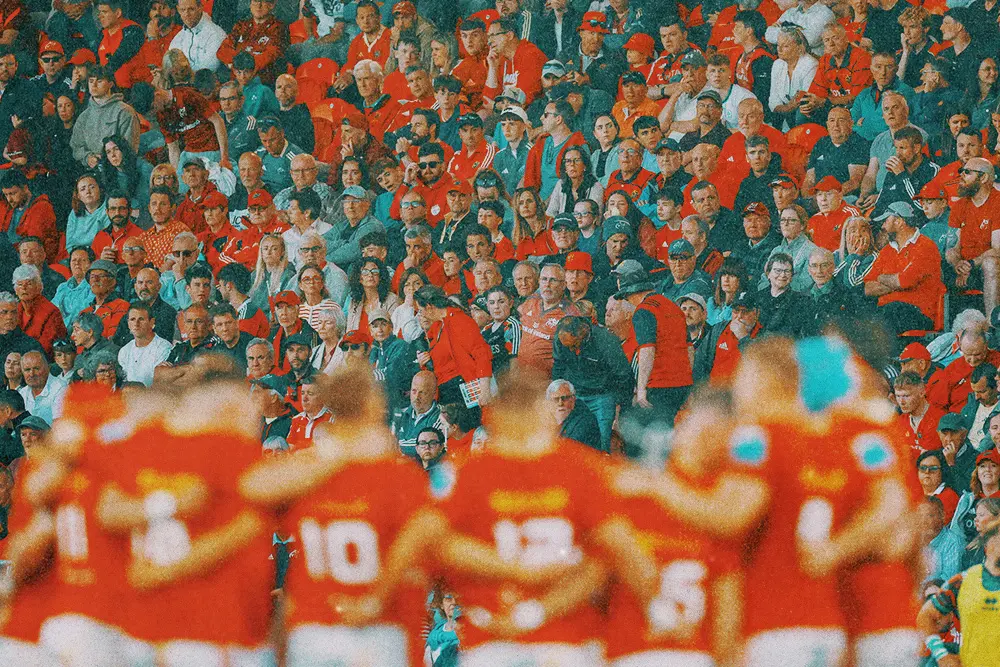
We felt the somewhat withering eyes of the Munster public on us as we tried to, metaphorically, fit the baby seat at the NCT. It followed the last few years, where it seems we’ve struggled to generate momentum at home, especially when the pressure is on. In a way, that made the two wins in the last two rounds all the more cathartic and, without trying to be too much of a gimp, a little healing.
Those two wins mean the negative pressure is gone, and we can instead focus on the positive pressure of the playoffs. Lose, and reset. Win… and who knows?
Munster: 15. Thaakir Abrahams; 14. Calvin Nash, 13. Tom Farrell, 12. Alex Nankivell, 11. Diarmuid Kilgallen; 10. Jack Crowley, 9. Craig Casey; 1. Michael Milne, 2. Niall Scannell, 3. Stephen Archer; 4. Jean Kleyn, 5. Tadhg Beirne (c); 6. Peter O’Mahony, 7. John Hodnett, 8. Gavin Coombes.
Replacements: 16. Diarmuid Barron, 17. Josh Wycherley, 18. John Ryan, 19. Tom Ahern, 20. Alex Kendellen, 21. Conor Murray, 22. Rory Scannell, 23. Mike Haley
HollywoodBets Sharks: 15. Aphelele Fassi, 14. Ethan Hooker, 13. Luhkanyo Am, 12. Andre Esterhuizen, 11. Makazole Mapimpi; 10. Jordan Hendrikse, 9. Jaden Hendrikse; 1. Ox Nche, 2. Bongi Mbonambi, 3. Vincent Koch; 4. Eben Etzebeth (c), 5. Jason Jenkins; 6. James Venter, 7. Vincent Tshituka, 8. Siya Kolisi (v/c)
Replacements: 16. Fez Mbatha, 17. Ntuthuko Mchunu, 18. Hanro Jacobs, 19. Emile van Heerden, 20. Phepsi Buthelezi, 21. Bradley Davids, 22. Francois Venter, 23. Yaw Penxe
The Sharks are an odd team.
On paper, the only team that’s any way close to their star power is Leinster. Look through their squad and you’ll see double World Cup winners everywhere, plus a few guys who “only” have one. Etzebeth. Mbonambi. Nche. Koch. Kolisi. Fassi. Esterhuizen. Mapimpi. Am. Sure, it gets a little thin underneath that level, but when it comes to Big Names, the Sharks are about as close to the Springboks as you can get at club level.
Straight away, at a headline level, that’s a deeply spooky team to play in Durban. Like I said, on paper.
But the Sharks this season have been… puzzling. Part of the reason why I went on a Rowntree Detour in the preamble for this article was down to realising that our loss in Durban earlier this season was his last game as Munster coach. That grim loss – and it was grim, I’ve rewatched it – showcased the absolute worst of our rugby this season.
In no particular order;
-
- A bad, flat start where we looked like we were running through wet concrete and ended up conceding a try inside the first minute.
- The least athletic and impactful front row that any URC, Gallagher Premiership, or Top 14 club could start together as a unit, with two inexperienced academy props on the bench.*
- Our slowest possible outside backline build.
- Gavin Coombes was fit but dropped from the squad.
* I’ll qualify this by stating that John Ryan, Niall Scannell and Stephen Archer are all good players as individuals who could all contribute something as a part of a blended unit, but I think it’s fair to say that starting them together in 2025 was a reflection of how burned down to the ground with injuries we were at the time.
Our lineout and scrum were actually fine in this game, but that made our phase play on either side of the ball look all the worse. We looked lightweight but somehow, also incredibly slow. We looked mentally fried coming onto the field and played with a kind of burned-out resignation for every second of the game when it was in the balance.
That notoriously dangerous mixture of forced overplaying, sloppy execution and tactical naivety you’ll be familiar with from our worst games this season, and over the previous two, was also present, and we’ll need to avoid all three of those things if we want to win here.
I think there is a clear path to beating the Sharks in this game, and it’s been clear in all the games they’ve either lost at home or almost lost. The games I paid very close attention to were their narrow win over the Scarlets in Round 18, their Round 17 win over the Ospreys as a control, their late, 35-34 win over Zebre in Round 13 and their loss to Leinster in Round 14.
In every single one of these games, their opponents played a narrow, low Pass Per Carry game in attack, and a low Kick to Pass ratio throughout. Why?
The Sharks play a form of blitz defence that is almost identical to the Springboks side of 2018-2023, with mostly the same components. Watch Etzebeth, in particular, here and how Scarlets are deliberately kicking to avoid that two-part blitz, led by the big #4.
You can see that pressure coming a mile away, and you should 100% expect it on every phase outside your 10m line. The Scarlets found a lot of success popping the ball over the top of the blitz, and we will too if we disguise it well enough.
Loop Kilgallen off his wing to have a crack off this.
You’ll also get an occasional linebreak opportunity with a pump fake when that veteran Sharks front row are the inside fold on Etzebeth’s blitzing line.
O’Brien does really well to cut back against the grain against Mbonambi and Koch, and Crowley can go after that same opportunity.
If we swap over to the Leinster game fully, you can see how both parts of their blitz look in more detail, albeit without Etzebeth leading their line from the C position.
But the interesting thing here is how Leinster got to that position in the first place. I’ve included the set-up phase here, which has Gunne finding the outside pod runner rather than the centre pod to give the runner a chance to get outside the C pressure.
When they get that ball back, they hit a high mid-range contestable off #10 to the same-way back pin.
They force a spill and a free play out of Penxe, but you’re more likely than not to force a spill from the Sharks’ back three in the air.
Going long and non-contestable against the Sharks back three is a bad idea because Hooker, Fassi and Mapimpi are incredibly dangerous runners with any kind of grass in front of them. Flood them with high mid-range contestables where you can swallow them up immediately on defensive transition.
This is where you can get to the Sharks. The quality of the transition game play when they don’t make an initial line break is incredibly average. They are top five in the URC for converting linebreaks into tries, mostly on transition, but they also concede more turnovers than any other side in the league.
That brings the scrum into the game but I’ll talk about that more on the podcast.
We are the best side in the world – you read that right – when it comes to denying opposition 22 Entries. Our average of just 6.8 entries allowed per game is better than Leinster, the Bulls, Benetton, the Hurricanes, the Chiefs and Stade Toulousain.
The Sharks have below average conversion rate from their 22 Entries in the URC and have found themselves getting stymied on their offensive maul builds this season at an alarming rate. Why is this important? Because if we can hold to our averages on both sides of the ball this season, I think we’ll win if we can avoid going more than a converted try behind inside the first 20 minutes.
The Sharks are good. Big. Powerful. Dangerous on transition. But if we can lever the pressure of the occasion onto their phase play, there are opportunities here all day for us.
