


One way or the other, someone’s going to be at red alert with alarms ringing, buttons flashing and black smoke billowing on Saturday evening. Around five o’clock on Saturday evening, someone’s going to be looking towards next week’s European knockouts to jump start their season, the equivalent of trying to cure a migraine by taking four solpadeine – even if it works, the problems that come after might not be worth the relief.
Someone’s going to be staring at the walls of McHale Park in Castlebar, wondering what next season might hold with a sense of trepidation. Someone will wonder where they go from here.
That’s what it’s come to.
This is a vital inter-pro with both sides fresh out of wiggle room and that neither can afford to lose. Last week, I said that any side who puts together back-to-back wins, or back-to-back losses in the last leg of the regular season will either do their business, or have their business done for them.
For Munster, a third loss on the spin could critically damage our Champions Cup prospects for next season, never mind going on a URC play-off run. For Connacht, a second loss in a row could essentially guarantee a sub-top eight finish on Saturday night and put their Champions’ Cup hopes entirely on winning the Challenge Cup.
Something’s got to give.
In the last three seasons, the average points tally to make the top eight has been 49 points, but on two separate occasions, the cut has been exactly 50 points.
This season, I think the points cut will fall around 51 points. Get that or above it, and you’ll make the top eight. Get below it, and you better start learning Tbilisi, buddy.
So, for Munster, that means getting 17 points from the next five games, starting at the weekend. Now we’re lucky, in one way, that we have three home games in this run and a chance to deal directly with the surrounding teams in the URC mosh-pit – ideally helping our cause while hurting theirs, pulling the points cut back as we do it – but we’ve got to actually win games to do that.
Four points here, four against the Bulls, four against Cardiff and then nine points from our last two games will do the job nicely. Win all our remaining games? A novel concept. I hope the coaches are reading this. That would leave us on 57 points, which has been enough for 5th in the league in two of the last three seasons.
Win our next five games just to ensure that we finish 5th?
That’s where we are. The URC takes no prisoners these days. Even earning twelve match points from here would only be enough to qualify in 8th place once in the last three seasons. Last season it meant an 11th place finish.
The novelty of Castlebar pales in comparison with the crushing demand for numbers this weekend. We need match points on the board, and that’s that.
Munster Rugby: 15. Ben O’Connor; 14. Calvin Nash, 13. Tom Farrell, 12. Alex Nankivell, 11. Seán O’Brien; 10. Jack Crowley, 9. Craig Casey; 1. Jeremy Loughman, 2. Diarmuid Barron, 3. Oli Jager; 4. Fineen Wycherley, 5. Tadhg Beirne (c); 6. Tom Ahern, 7. John Hodnett, 8. Gavin Coombes
Replacements: 16. Niall Scannell, 17. Josh Wycherley, 18. Stephen Archer, 19. Jean Kleyn, 20. Ruadhán Quinn, 21. Conor Murray, 22. Rory Scannell, 23. Alex Kendellen.
Connacht Rugby: 15. Mack Hansen; 14. Chay Mullins, 13. Hugh Gavin, 12. Bundee Aki, 11. Finn Treacy; 10. Josh Ioane, 9. Caolin Blade; 1. Jordan Duggan, 2. Dave Heffernan, 3. Finlay Bealham, 4. Joe Joyce, 5. Darragh Murray, 6. Cian Prendergast (c), 7. Shamus Hurley-Langton, 8. Sean Jansen
Replacements:16. Dylan Tierney-Martin, 17. Denis Buckley, 18. Jack Aungier, 19. Josh Murphy, 20. Paul Boyle, 21. Matthew Devine, 22. JJ Hanrahan, 23. Santiago Cordero.
Connacht have been about as inconsistent as we have this season, but for broadly different reasons.
Munster’s inconsistency is largely to do with the coaching box and the physio room – too few guys in the former, too many in the latter.
Connacht’s season has been defined by a rookie coaching unit getting their feet under the table, some of whom who are in their first ever gigs of that nature at this level, and a style of play that appears to be all duck or no dinner in nature.
That’s what happens when you commit to on-ball rugby, as Connacht have whole heartedly. No team kicks less often or shorter than than they do on average across the season. That’s often meant that they have come out on the wrong side of free scoring shootouts, often by fairly slim margins.
In fact, in this season’s URC, nine of their 13 games have been decided by eight points or fewer and they four games that finished higher than eight points in the difference all happened in a weird middle block of the season that has defined their season so far.
With a South African tour to come, they might well run out of road especially after last weekend’s mental marathon against the Ospreys, which highlighted all the good and all the bad of Connacht’s season so far.
Offensively, they were outstanding for most of the game and showcased their deep lying attack patterns throughout. If you’re going to be an on-ball side without overwhelming power in your pack – and Connacht certainly don’t – then the only option is to play with deep lying strike runners in a layered attacking framework.
Here’s a good example of what that looks like for Connacht;
It’s a pretty simple principle in one way; there’s no way to grind down and run over an opposition forward line, so the best way to play through teams is by using their defensive press against them by stacking four layers of attacking runners with an option at each stop.
Connacht often use Ioane as a strike runner on the ruck layer, use tip-ons in the screen layer, but the best work is done in the option layer that is almost at a diagonal line from the ruck origin point. This is where Connacht will have Hansen, Forde, Aki or Gavin in key positions to either use the looped attackers outside them, or attack a dogleg in front of them.
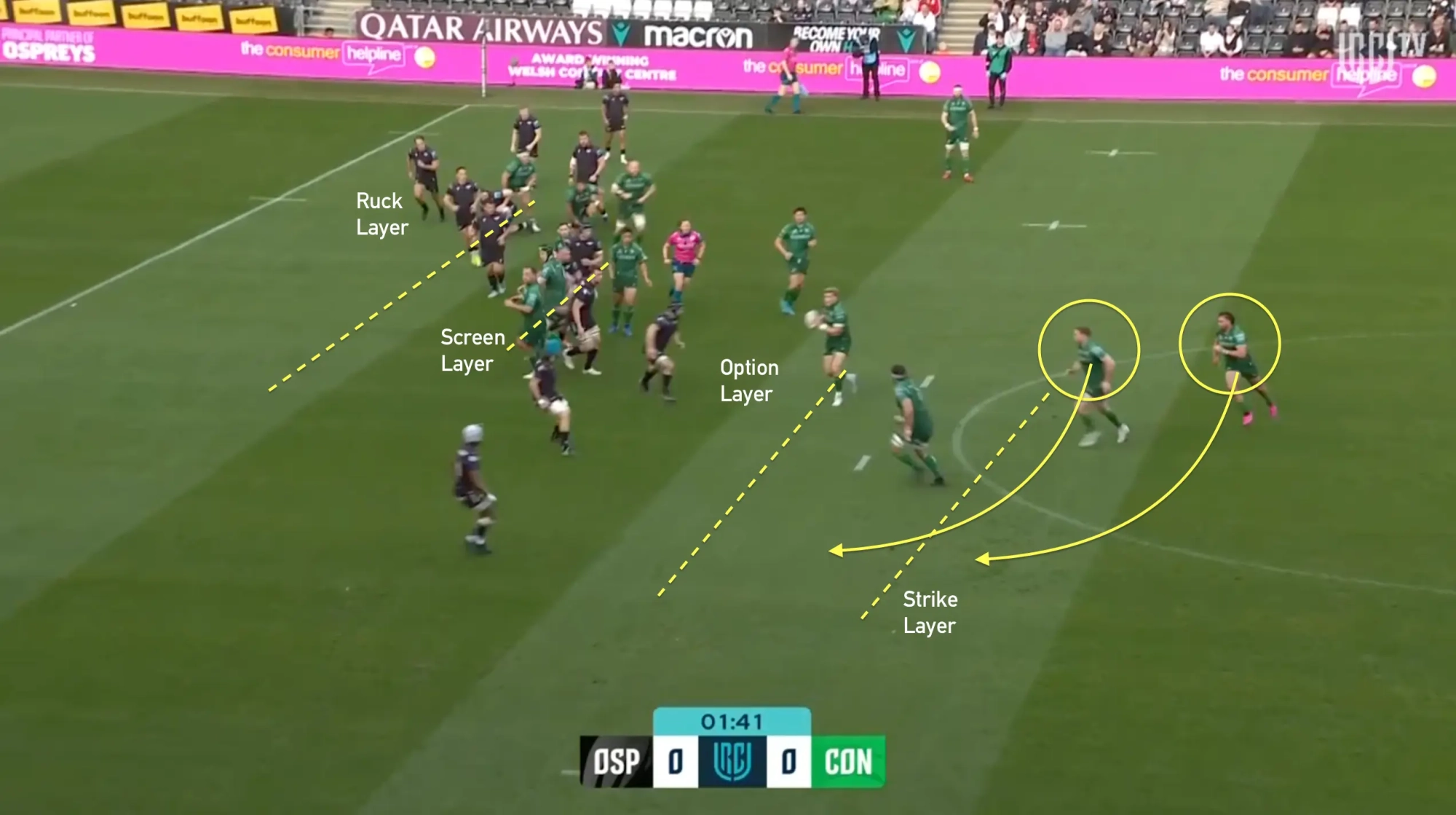
When you look at their attacking structure in any game, this depth is a constant feature and when defended wrong (because there is a right and a wrong way to do it) they will find angles and runners constantly in that 3/4 space.
When they attack from deep, they will often have a cut around their own 10m line where defences are more likely to press them directly. They kick from these spaces less often than most of the teams we’ve faced this season and we have to be ready to defend them correctly.
The trick on this is looking out for Murphy as the late arriving runner on their screen layer behind what looks like an initial two pod. Tipuric sees the threat developing late but that, in turn, creates the deep overload once Murphy gets the offload away to Ioane.
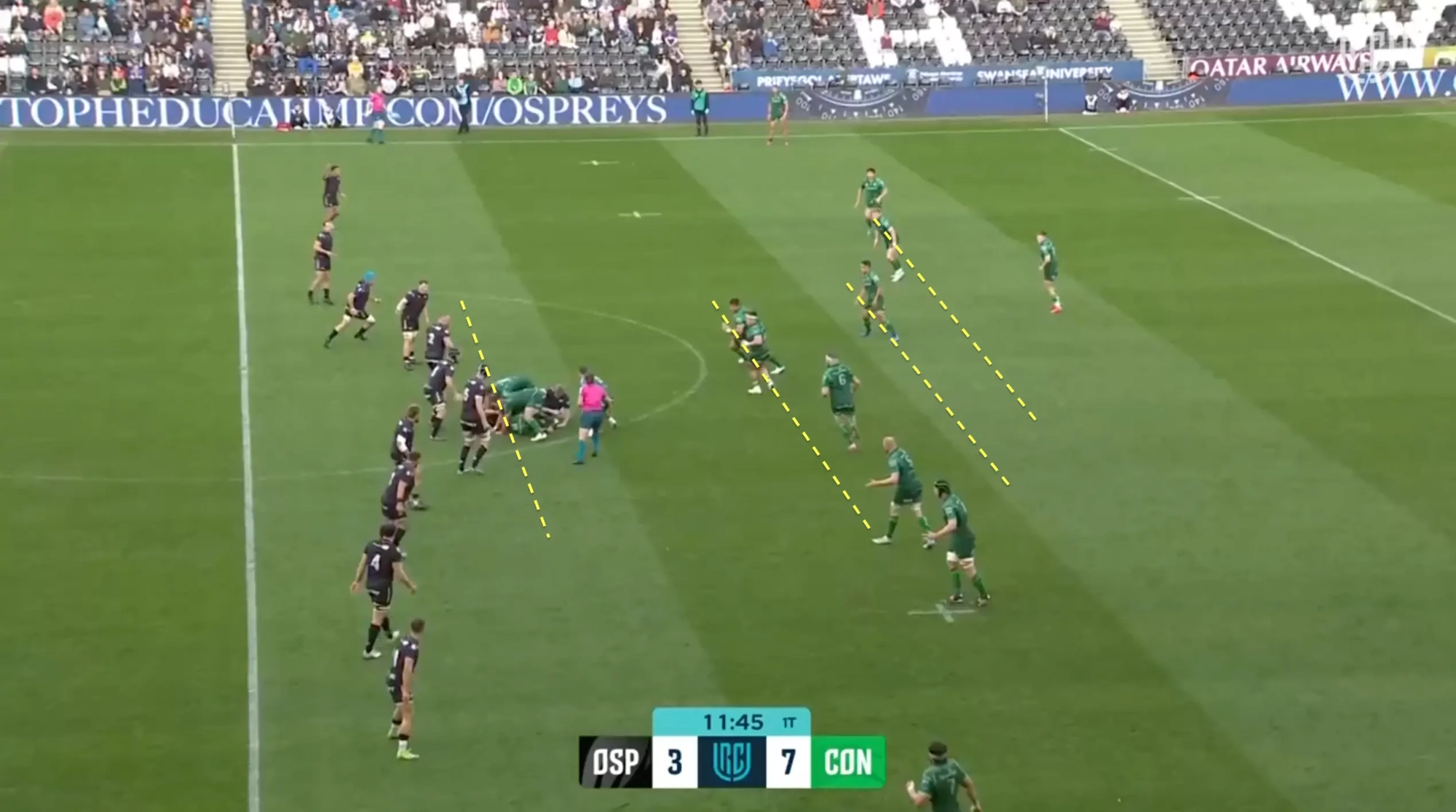
A few phases later, you can actually see Hugh Gavin waving attackers to get deeper on his line as Connacht come back across the pitch on a transition strike.
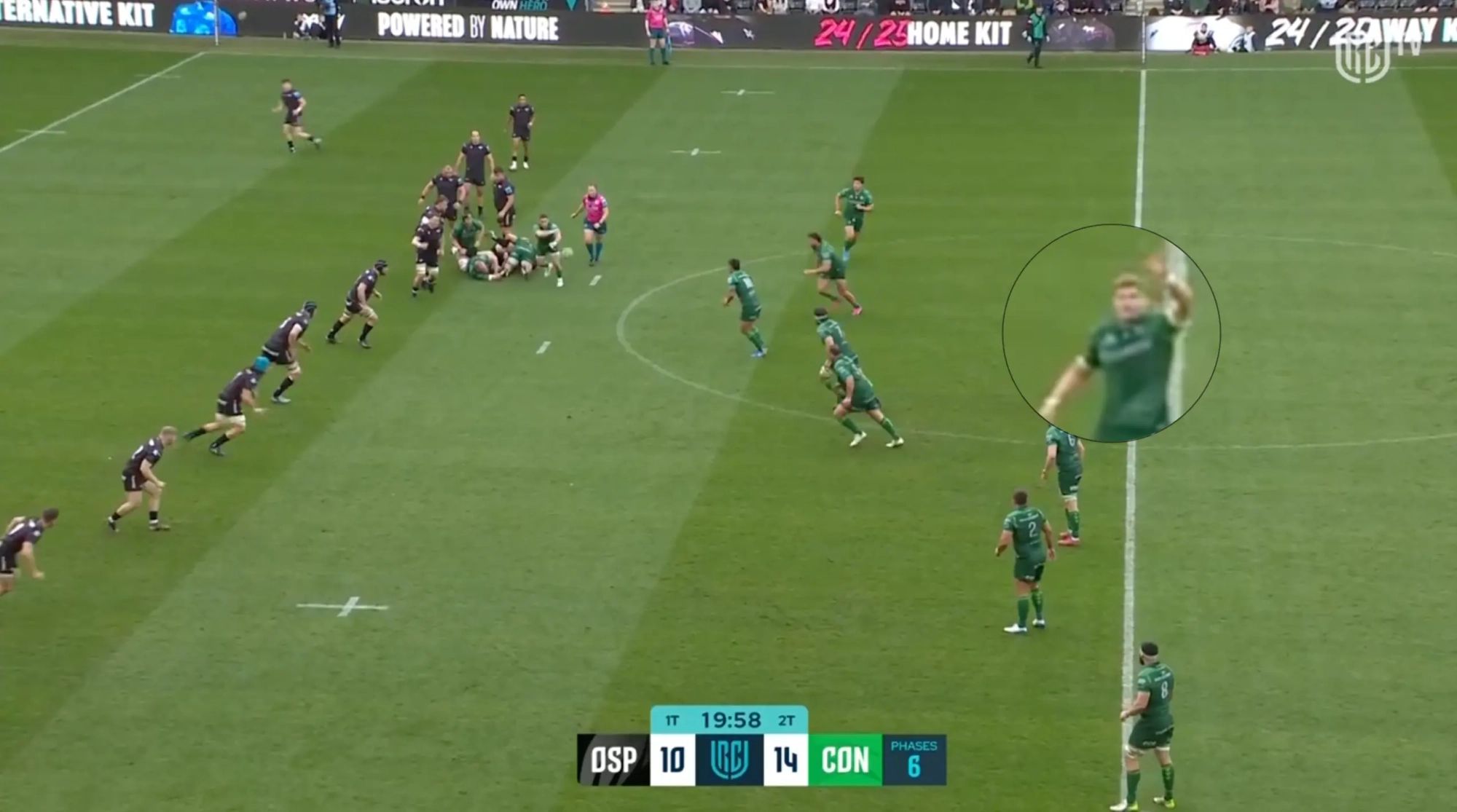
That depth is vital to making the attacking scheme – which is almost identical to the Irish u20s that Mark Sexton coached – work in targeting edge defenders with enough layers to force bad decisions or indecision.
When you see Ioane in the screen on his own, you’ve got to watch for his carry and off load to the forward pod in the Option Layer.
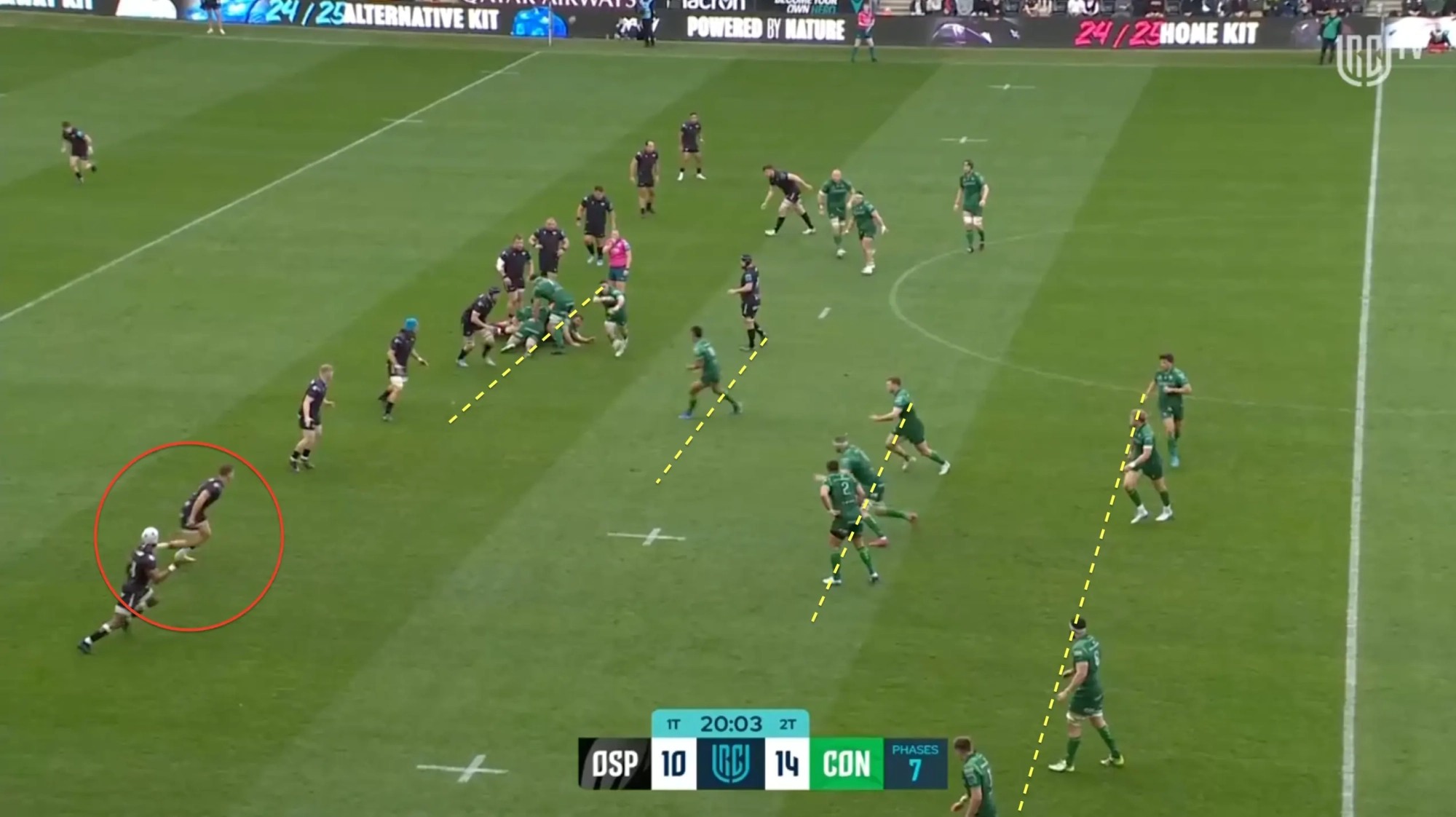
This play gets pulled back for a forward pass on the previous phase, but the intent and structure was clear, as was the target they were trying to isolate.
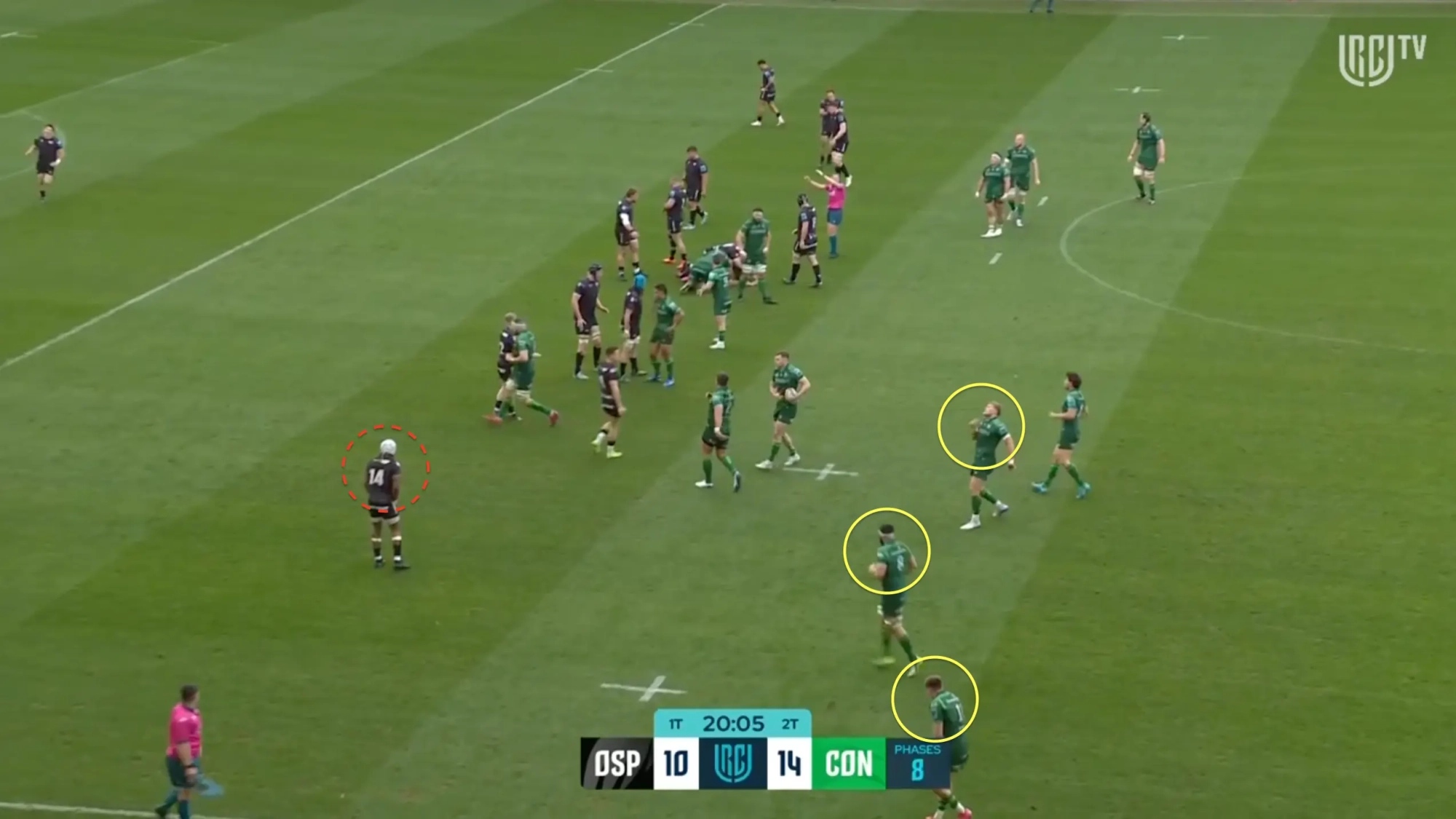
For Munster, the key to hurting this structure is at the ruck layer through aggressive counter-rucking in the middle to draw Connacht’s forwards out of their layers, and with targeted poaching on the edge space after they reset to thin out their layers and force them to play shallow.
If we can do that, you get a similar look to last week when we contained Glasgow for longer periods – everything going back and out – but with a breakdown focus that, if applied with discipline, could pull Connacht into a contest where we are better suited to engage with them.
