


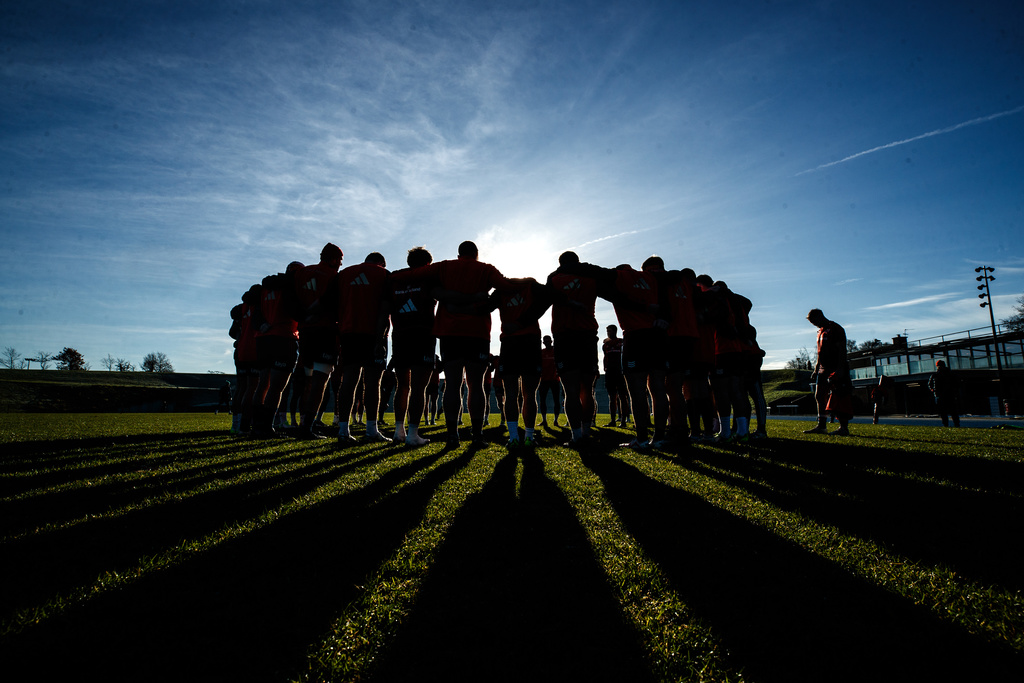
The European Cup will always hold a special place in Munster, no matter how badly they massacre my boy with dodgy format changes, name changes (it’s the Investec European Champions Cup now, by the way) and a feeling that we’re drifting further and further from God’s Light (the peak mid-2000 years) with every iteration change.
I am old, though, so I know that’s at least part of why I yearn for the simplicity, such as it was, of my early twenties and the then Heineken Cup. Six pool games, a back-to-back series in December, and then a big finish in January. Jumpers for goalposts, drinking water out of the hose, no phones, everyone living in the moment and I had hair.
Oh, and Munster were one of the top three teams in the tournament for the guts of eight seasons and won twice (really should have won another two tbh) so that probably has something to do with it too. That Munster story – the Quest for the Holy Grail – sold the Heineken Cup in the early years of the tournament in a way that can’t be properly measured. We wanted the Heineken Cup badly and couldn’t get it, no matter how close we came. Because we wanted it so badly and the grief – that’s what it was – that we felt at each loss along the way was so profound that it sold the idea that this thing was worth winning to the casual TV audience.
Munster and the European Cup/Heineken Cup/European Champions Cup/Heineken Champions Cup/Investec Champions Cup are intertwined in a way that goes beyond what you see on the field. Munster are the romantic heart of this tournament, even now, fifteen years on from the last time we won it.
It doesn’t make sense, but you know it’s true.

We are no longer a top-three side in the tournament and haven’t been for a decade. We’ve come close in a few knockout games in the last five years, sure, but we haven’t been serious contenders for over a decade. Yet, here we are, ready to get hurt again. For the first time since 2012, we enter this European campaign as domestic champions and with the 30-stone gorilla of a decade of failure off our back. How free will we feel in this tournament because of that? Can we play with the confidence of a team that’s won something? Can we bring the attacking flavour that won us the URC to this tournament, finally? Can we bridge the power gap that has so often flummoxed us when the pressure comes on?
Are we anywhere close to crashing the Leinster/La Rochelle/Toulouse troika party that has dominated this tournament for the last three seasons?
These are the questions that I’ve peppered myself with this week and I’m no closer to answering them. Are we a better side than last season? Yeah. Will that be enough to get us some home knock-out games? We hope so. If we get a home R16 and Quarter-Final, can we go on a run and win this entire thing?
…
…
Yeah. I think we can. With the right run of fitness and a few home draws… who knows?
But like I said, it’s Munster, it’s Europe and I’m ready to get hurt again.
Munster: 15. Calvin Nash; 14. Shay McCarthy, 13. Alex Nankivell, 12. Rory Scannell, 11. Seán O’Brien; 10. Jack Crowley, 9. Conor Murray; 1. Jeremy Loughman, 2. Scott Buckley, 3. John Ryan; 4. Fineen Wycherley, 5. Tadhg Beirne (C); 6. Tom Ahern, 7. John Hodnett, 8. Gavin Coombes.
Replacements: 16. Eoghan Clarke, 17. Josh Wycherley, 18. Stephen Archer, 19. Jack O’Donoghue, 20. Alex Kendellen, 21. Craig Casey, 22. Tony Butler, 23. Ben O’Connor.
Bayonne: 15. Cheikh Tiberghien; 14. Bastien Pourailly, 13. Peyo Muscarditz, 12. Riko Buliruarua, 11. Rémy Baget; 10. Thomas Dolhagaray, 9. Maxime Machenaud; 1. Matis Perchaud, 2. Facundo Bosch, 3. Tevita Tatafu, 4. Denis Marchois, 5. Kote Mikautadze, 6. Pierre Huguet, 7. Baptiste Heguy, 8. Rodrigo Bruni
Replacements: 16. Thomas Acquier, 17. Swan Cormenier, 18. Junior Tagi, 19. Arthur Iturria, 20. Rémi Bourdeau, 21. Gela Aprasidze, 22. Arnaud Erbinartegaray, 23. Tom Spring
Bayonne are something of an unknown quantity from a European perspective.
This is their first time at this level and their first time playing an Irish province other than Connacht in a competitive game since 2014.
This is their first ever time competing in the Champions Cup and it came off the back of an impressive run to the top eight of the TOP14 last season. How seriously are they going to take this campaign? Well, I would suggest that their most important game in the next two weeks comes when they play Perpignan in the TOP14 that’s already something of a relegation 8/10 pointer.
But that doesn’t mean that they can’t be a sticky, difficult opposition who’s more than capable of upsetting the apple cart here if we turn up sloppy.
What do we know about Bayonne? Well, I would describe them as a Heavy Low-End Counter-Transition team. What does this jibberish mean?
Well, they kick the ball in a low counter-transition range – around one kick for every 4.5 passes in their last few games – and, when they do play the ball, they have a Pass Per Carry ratio of under 1.0 which means they are most likely to hit off #9 directly when they hit settled phase play with very little screen passing or tip on action in their pods. You will mostly likely see Bayonne playing off #10 and using screen passes in the phases directly after a lineout or scrum launch.
They are pretty balanced in their kicking off #9 and #10 but I feel they might lean a little more on Machenaud in this one, as opposed to the relatively inexperienced Thomas Dolhagaray. Their kicking is almost always under the midrange and contestable. Their wingers are decent in the air but no more than that, from what I’ve seen against La Rochelle, Lyon and Montpellier this season. They will stick their tackles when they go contestable off #10 but they do leave gaps on their chase lines that a sneaky offload from McCarthy/O’Brien/Nash to a support runner could unlock on transition.
If we get into a heavy scrummaging contest with these lads, they have the size and heft to hurt us. They are playing an academy player at tighthead but don’t let that fool you – he’s 130kg+ and exactly the kind of tighthead we’ve struggled with. On our tighthead side, John Ryan is a bad match-up for Matis Perchaud, and we could well have an advantage there if we’re aggressive.
By far the biggest way to hurt Bayonne is on the first two or three phases of transition. They have a super heavyweight pack – four locks, essentially – on top of a heavyweight front row so the last thing they want to do is to defend for eight-plus phases across a lot of ground on settled phase play but they especially don’t want to defend space on transition.
Look at the lanes they give up on their own exit off #10 here.
This is a bad kick under pressure that drifts infield but that space is there even on good exits. Why? The players they have covering that central space are heavy, heavy athletes. There’s only so much ground they can cover. That spacing is just as accessible on their kicking off #9 too.
The biggest thing about this Bayonne side is that inconsistency with the boot. They will give us opportunities like this and, when they box kick in particular, they cluster under the line of the kick and struggle to fill the gaps out wide. If we can field these kicks, we know we can hurt them on these edge spaces.
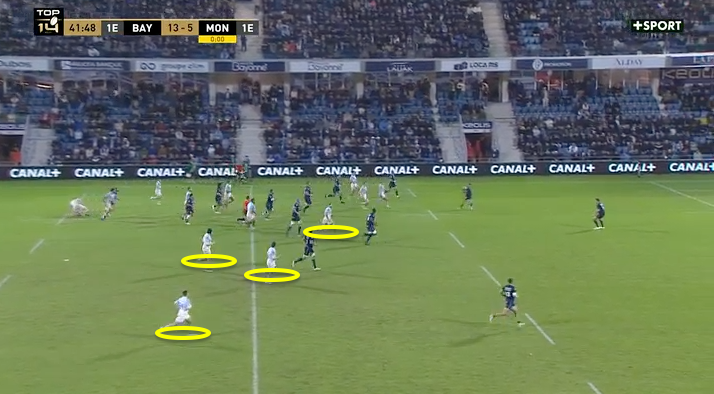
Even then, we don’t need to overcomplicate it – they will give us lanes to attack right up the middle of the field in line with the angle of their kick. If you target their front five, you will find gaps and lanes almost every time. This goal line drop out against Montpellier is an exaggerated illustration of a constant gap in their game.
They will kick to us, so we don’t have to overcomplicate the breakdown and risk giving them drivable mauls – if we do that, they’ll hurt us.
We need to make our tackles off #9, make them play and then wait for them to exit because if we can keep them between the 10m lines, we will have transition opportunities. Either way, if we can go on-ball with any kind of fluency, they will break at the seam between forwards and backs so look for Crowley to break right up the middle on one or two sequences if we can get a flow going.
All in all, it’s all there for us. They map quite a bit on Benetton though, so we know what can happen here if we’re off it at our offensive ruck.
Let’s get after it.
